


 SpaceX Option
💢💢💢
A US Treasury announcement added $1.2 trillion to the precious metals and crypto markets within three hours.
Bond yields, the dollar, gold, silver, and cryptocurrencies all saw sharp volatility today. Each of these moves can be traced back to a single press release.
Treasury doubles bond buyback size
The US government runs a program to repurchase its older bonds from dealers. Launched in May 2024, it addresses a specific issue.
When the government issues new 30-year bonds, they trade actively. But bonds issued before that, known as "non-benchmark bonds," are virtually illiquid.
They make up about 98% of all outstanding Treasuries. Dealers hold them but struggle to sell, demanding higher yields to take on new issuance.
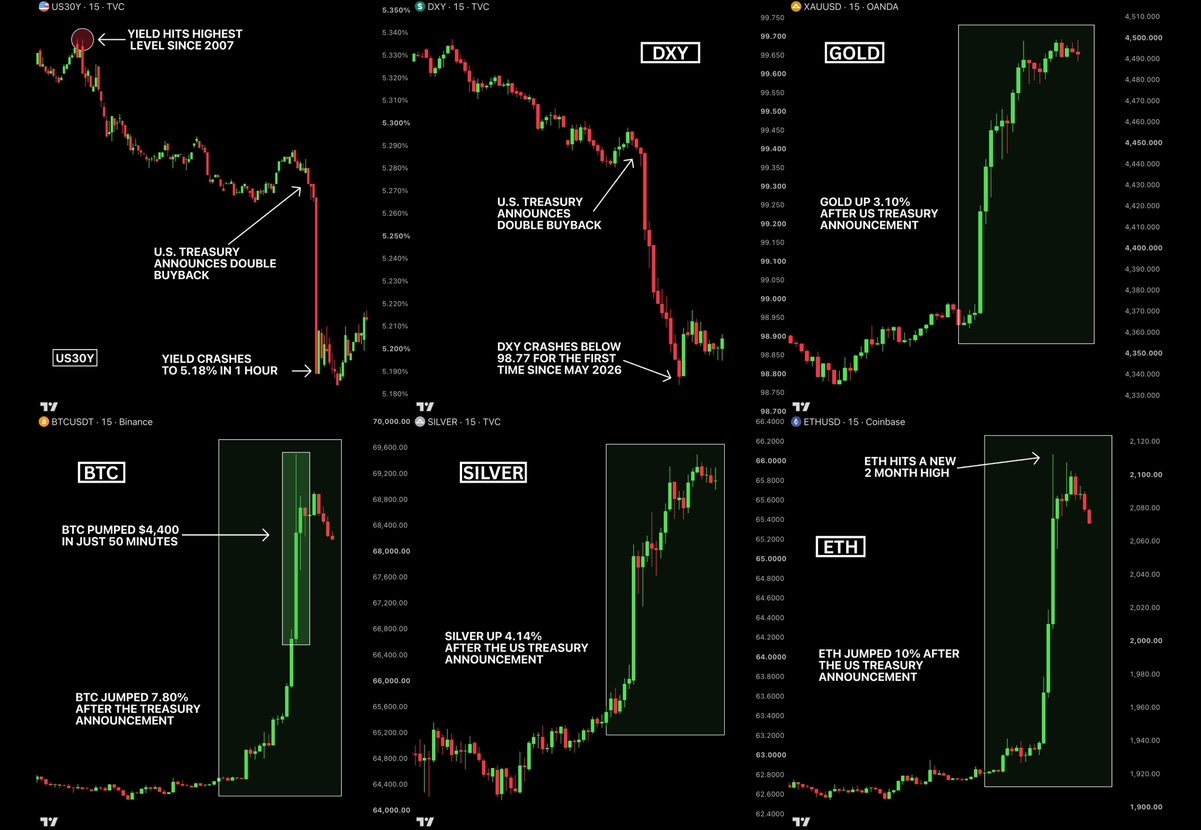
Today, the Treasury announced it would at least double the buyback size for the 10- to 30-year segment of the market, raising it from $2 billion per operation to at least $4 billion, running from September 9 through November 4.
Bond prices and yields move inversely. A buyer of this scale pushes prices up, thereby driving yields down.
The 30-year yield hit 5.337% yesterday, its highest level since 2007. Within an hour of the announcement, it plummeted to 5.18%.
The Treasury described this as routine support for market liquidity. But it stems from concerns over the pain of long-term yields reaching 5% or higher, with midterm elections just three months away, forcing their hand.
Why the US can't afford these yields?
In the past 12 months, US interest expenses alone reached $1.4 trillion. Borrowing costs have more than doubled since 2020.
On the current path, the bill will hit $1.7 trillion annually by November 2028, making interest the single largest item in the federal budget, surpassing Social Security.
To halt the rise in these costs, the US 5-year yield needs to fall to 3.25%.
This implies a 110-basis-point drop, which would merely freeze interest expenses at $1.4 trillion. It wouldn't reduce spending by a single cent.
The reason is refinancing.
The OECD projects governments worldwide will borrow a record $18 trillion in 2026, with 78% not for new spending but to replace existing debt. These older bonds carry rates from cheaper times, roughly 2 percentage points lower than today's yields.
Each rollover resets costs higher.
This is the cycle. The longer yields stay here, the more of the debt stock gets repriced upward, causing interest costs to climb faster.
And this happens simultaneously across every government
The Bloomberg Global Long Government Bond Index yield has surged to around 4.2%, its highest since July 2008. Long-term sovereign borrowing costs have returned to crisis-era levels, while government debt burdens are far heavier now.
German long yields hit a 15-year high. French yields hit an 18-year high. UK yields hit their highest since 1998. South Korea set an all-time high. Canada reached its highest since 2010.
Japan is the part no one accounts for
Japan's 10-year yield is approaching 3%, unseen since 1996. Its 2-year hit a 31-year high, and the 5-year set a record.
For three decades, Japanese yields hovered near zero, prompting pension funds, insurers, and banks to send massive capital overseas chasing returns.
These funds bought US and European government debt. Japan is now the largest foreign holder of US Treasuries, at ~$1.2 trillion, ahead of the UK's $897 billion and China's $693 billion.
Now, Japanese investors can earn a 3% return domestically without FX risk. The incentive to hold foreign bonds has vanished.
If this capital starts flowing back, the largest single foreign buyer could exit precisely when the US needs the most refinancing like never before.
This is why the BOJ's next move matters for yields in Washington and Berlin, not just Tokyo.
What happened the moment yields fell?
Gold, silver, and crypto pay no interest.
When govies paid 5.34% yields, holding them meant losing out on that yield. As yields dropped, that opportunity cost collapsed, and capital rotated directly back.
This shift began minutes after the announcement.
- Gold rose 3.10% to $4,500, adding $934 billion.
- Silver rose 4.14%, adding $136 billion.
- Bitcoin surged 7.80%, climbing $4,400 in just 50 minutes, adding $103 billion.
- Ethereum jumped 10% to a two-month high, adding $22 billion.
The DXY fell 0.71% below 98.77, a first since May.
Since all these assets are USD-denominated, a weaker dollar further props them up.
The buybacks won't start for three weeks, but the market has already priced in lower yields.
The copyright of this article belongs to the original author/organization.
The views expressed herein are solely those of the author and do not reflect the stance of the platform. The content is intended for investment reference purposes only and shall not be considered as investment advice. Please contact us if you have any questions or suggestions regarding the content services provided by the platform.
