


After "Smart Selection", Seres is in the red again: Is relying on Huawei no longer working?
After the second half of 2025, investors in $SERES(09927.HK) often fell into self-doubt. On one hand, the "Smart Selection" cooperation model between the company and Huawei still has a star effect, and the sales of several Aito models are still on the rise; on the other hand, since then, the stock price of $SERES(09927.HK) has entered a "downward channel," with the current stock price having fallen by more than 70% from its high point at that time.
While many were still immersed in the narrative of "the market wronged $SERES(09927.HK)," an official announcement was released: net profit loss for the first half of 2026 is expected to be 1.5-1.8 billion yuan (with a loss of 1.9-2.5 billion yuan in the second quarter).
Rumors spread across the market. Considering that total revenue in Q1 still saw a year-on-year growth of 34%, and non-GAAP net profit was as high as 100 million yuan (down 74% year-on-year), the market erupted in uproar after the loss forecast was issued.
What exactly happened to $SERES(09927.HK) after 2025? The core viewpoints of this article:
First, although the loss of $SERES(09927.HK) in Q2 2026 is indeed related to technological innovation, the issue of profit distribution under the "Smart Selection" model cannot be ignored;
Second, under the Smart Selection model, the Huawei system takes the lion's share of profits, and $SERES(09927.HK) needs to achieve sufficient profits through high-speed growth and accelerated premiumization;
Third, due to various factors in 2026, $SERES(09927.HK) encountered some setbacks in both sales and premiumization. The key focus next will be to make up for these shortcomings.
The Losses of $SERES(09927.HK): Focus on the "Smart Selection" Model
The Losses of $SERES(09927.HK): Focus on the "Smart Selection" Model
Regarding the losses, the official also provided explanations:
1) Rising prices of upstream raw materials, including but not limited to memory chips, metals, lithium carbonate, etc.;
2) Adjustments to the book value of limited existing assets due to product iteration and model replacement leading to obsolescence (simply put, asset losses caused by eliminating product lines).
All the above reasons have some validity, as these are pressures faced by the entire automotive industry. However, seeing the above explanation, we still raised new questions: Raw material price increases have persisted for a while, yet as of Q1 2026, $SERES(09927.HK) still maintained a gross margin of 26%, which is considered quite good in the industry. So why was there such a stark contrast in Q2?
We focused on the "Smart Selection" cooperation between $SERES(09927.HK) and Huawei. This cooperation began in 2021 and formed a clear division of labor model:
Huawei leads product planning, channel retail, and ecosystem operations, providing core technologies such as HarmonyOS cockpit, ADS advanced intelligent driving, and DriveONE electric drive platform;
$SERES(09927.HK) is responsible for whole vehicle development, production manufacturing, supply chain management, and quality control. The two parties form a complementary synergy of "technology + channel" and "manufacturing + capacity," belonging to a business cooperation relationship of joint design and joint marketing.
In December 2021, with the official launch of the Aito brand, the first model M5 went on sale simultaneously, but it did not reverse the operating efficiency of $SERES(09927.HK) in the short term; its gross margin level was even lower than before cooperating with Huawei.
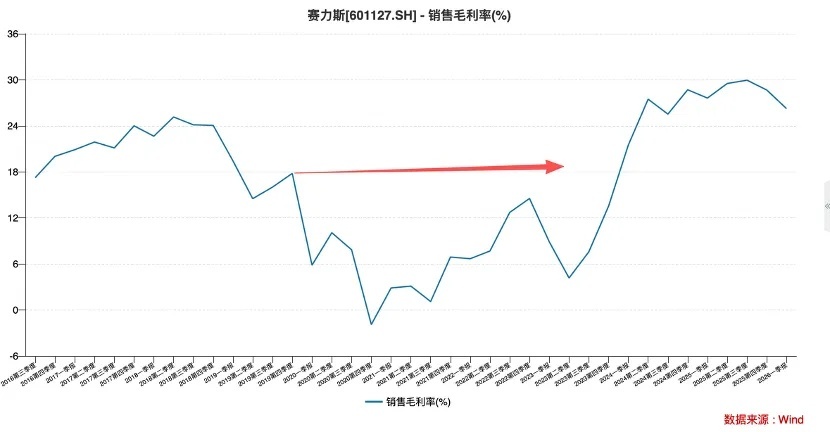
Regarding this reason, mainstream analysis attributes it to "insufficient sales of the M5." Indeed, as the first "Smart Selection" cooperative model vehicle, its initial sales were not stunning. Without economies of scale, discussing profitability for automakers is inevitably luxurious.
After careful research, we believe the focus should still be on the "Smart Selection" model itself. As mentioned earlier, this model involves Huawei providing "functions" and sales channels, while $SERES(09927.HK) is responsible for production and supply chain control. So how do the two parties actually split the profits?
According to information provided by some institutions, the cooperation between the two parties is mainly divided into:
1) $SERES(09927.HK) purchases core components and hardware from the Huawei system. This expenditure is directly counted as part of $SERES(09927.HK)'s operating costs, reflecting Huawei's role as a core tier-one supplier.
On a per-vehicle basis, hardware procurement costs account for the largest proportion of fees flowing to the Huawei system. According to mainstream market analysis calculations, in the first half of 2024, the per-vehicle value of just the hardware procurement portion was approximately 50,000 yuan; entering 2025, with the increasing proportion of high-end models and upgrades in intelligent configurations, this figure rose further. If hardware procurement and subsequent service fees are combined, based on sales volume in the first half of 2025, the per-vehicle cost flowing to the Huawei system (including hardware and services) reached a high range of 136,000 to 141,000 yuan, with hardware procurement remaining the absolute majority.
2) Technical Service Fees: Fixed rate expenditures based on the whole vehicle selling price;
According to industry research and financial calculations, the technical licensing fee rate charged by Huawei to $SERES(09927.HK) is approximately 2% of the total vehicle sales price. Based on the average transaction price of the Aito series in 2025 of 391,000 yuan, the per-vehicle technical licensing fee is about 7,820 yuan. Estimating based on the expected sales of 426,000 vehicles for the Aito series in 2025, the total annual technical licensing fee is approximately 3.33 billion yuan.
3) Channel and Sales Service Fees
Under the Smart Selection car model, $SERES(09927.HK) deeply utilizes Huawei's nationwide network of HarmonyOS Intelligent Driving stores and mobile phone flagship stores for product display, customer attraction, sales conversion, and brand marketing. In consideration, $SERES(09927.HK) needs to pay high channel service fees to Huawei.
Combining and calculating the expenses of the above three major sectors clearly outlines the full picture of costs flowing to the Huawei system within $SERES(09927.HK)'s comprehensive per-vehicle costs.
Based on the 2025 data model, the explicit fees paid by $SERES(09927.HK) per vehicle to Huawei totaled approximately 91,400 yuan, specifically composed of: hardware procurement fees of about 52,300 yuan, technical licensing fees of about 7,800 yuan, and channel service fees of about 31,300 yuan.
To more intuitively display the differences in cost structures among different models, the following table breaks down the proportion of Huawei fees based on different price ranges:
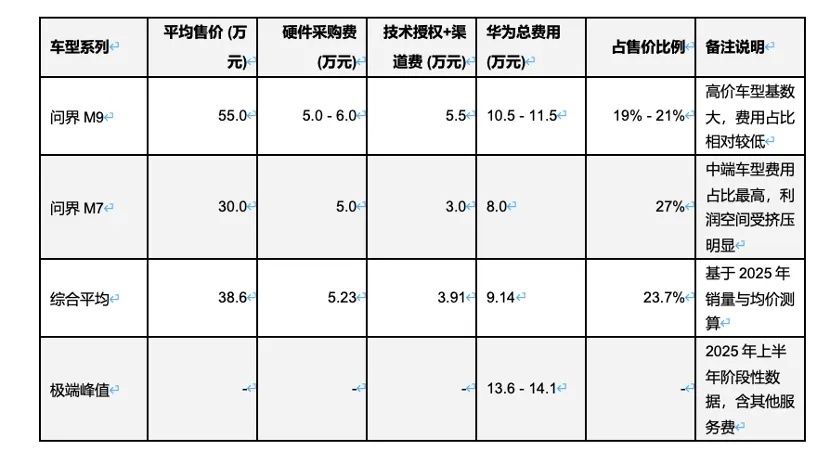
Riding the wind of the "Smart Selection" model, $SERES(09927.HK) quickly obtained the ticket to enter the intelligent driving automobile market, which is a cause for celebration. However, at the same time, it paid an expensive "ticket" cost to the entire Huawei system. Nevertheless, if the prospect of automobile sales is infinitely bright, both parties can obtain their own benefits, which is understandable.
However, this also reveals the prerequisite for the win-win model between the two parties: clear vehicle sales expectations. For example, in 2022, when the sales of the first M5 were not high, the technical service fees and channel fees paid by $SERES(09927.HK) to the Huawei system would be very large when amortized per unit. But with the surge in sales in 2024-2025, the cost per vehicle was diluted, allowing $SERES(09927.HK) to still obtain high premiums.
After 2026, the automobile market underwent dramatic changes, and $SERES(09927.HK) also encountered new challenges, bringing new pressure to the income statement.
Setbacks for $SERES(09927.HK) in the First Half of 2026
For $SERES(09927.HK), deep binding with the Huawei system was undoubtedly a strategic victory, completing a leap in brand and models. However, from the financial statements, for the cooperation between the two parties to achieve a win-win situation, two conditions must be met:
1) A leap in the growth rate of whole vehicle sales, allowing the company to obtain sufficient returns;
2) High-end models driving ASP (Average Selling Price), thereby diluting the fixed expenses of the cooperation between the two parties.
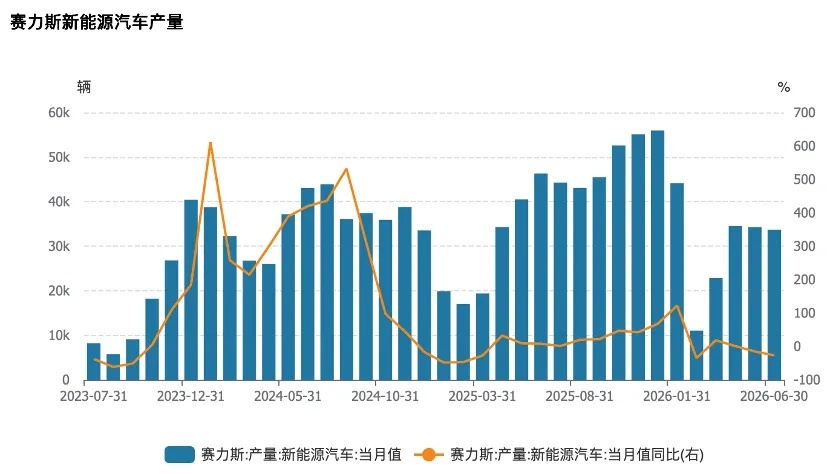
Let's first look at the total sales situation of $SERES(09927.HK). 2024 was its most brilliant moment for growth speed (at which time the stock price showed rapid upward movement). After entering 2025, although sales continued to hit new highs, the growth rate had already begun to decline. After 2026, the growth rate even dropped into negative territory at one point.
This is partly attributed to the general environment of new energy vehicles. Fierce competition among automakers in terms of price and product strength inevitably brings volatility in sales. On the other hand, as Huawei launched Zhijie with Chery, Xiangjie with BAIC, Zunjie with JAC, and Shangjie with SAIC under the "Smart Selection" model, $SERES(09927.HK) is no longer the only one in "Smart Selection," which will also divert some fans and users of the Huawei system.
Given the total volume, what changes have occurred in the high-end models of $SERES(09927.HK)?
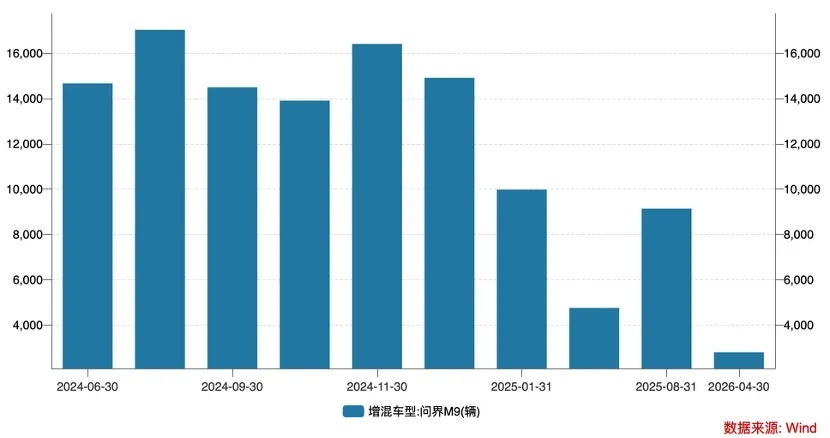
When major automakers in the industry are fighting over models around the 300,000 yuan mark, $SERES(09927.HK)'s M9, with a starting price of over 450,000 yuan, aimed to 冲击 the high-end car market and was once highly anticipated by the market. In 2024, monthly sales were mostly above 15,000 units, injecting new possibilities into the highly competitive automotive industry at that time.
But after entering 2025, affected by factors such as the launch of the Aito M8, sales began to decline, casting a shadow of uncertainty over the frenzied "premiumization process" of 2024.
Looking at commercial history, people often use "strategic diligence" to take shortcuts. $SERES(09927.HK) joining the Huawei system is equivalent to obtaining a super ticket to the intelligent driving automobile market, but this does not mean the company can rest easy and lie flat to enter a new cycle. We also hope that $SERES(09927.HK) can take this opportunity to make up for its shortcomings and stand firm in the new cycle with its own strength.
$SERES(09927.HK) $SERES(601127.SH)
The copyright of this article belongs to the original author/organization.
The views expressed herein are solely those of the author and do not reflect the stance of the platform. The content is intended for investment reference purposes only and shall not be considered as investment advice. Please contact us if you have any questions or suggestions regarding the content services provided by the platform.
