



半导体错杀还是价值毁灭?资金悄悄流向了.....
Chips are being sold, while Coke is being bought. Money hasn't left the market; it has just moved to a different place.
How bad have chips been these past two days?
The Philadelphia Semiconductor Index fell by 519.198 points, or 4.49%, closing at 6,586.11 on Tuesday. Including Monday's drop, the cumulative drawdown over the two trading days exceeded 6.5%. Since the June high, it has fallen nearly 25%.
The decline was even steeper for individual stocks: $Micron Tech(MU.US) plummeted as much as 12% intraday; $Sandisk(SNDK.US) dropped over 14%; $Corning(GLW.US) fell more than 12%; $NXP Semiconductors(NXPI.US) dropped over 4% after hours; $Taiwan Semiconductor(TSM.US) fell 1.70%; and $AMD(AMD.US) plunged 8%. The $Roundhill Memory ETF(DRAM.US) crashed 8.89% in a single day. Since its June 24 high, Goldman Sachs' US AI Semiconductor Index has seen a cumulative drawdown of 30%.
The problem isn't demand; it's price. These stocks rose too fast over the past year, with valuations already pricing in the most optimistic future earnings. With expectations raised to this level, merely "meeting expectations" itself feels like a disappointment.
Korean stocks fared even worse.
The KOSPI triggered circuit breakers for two consecutive trading days, with intraday declines widening to 12%, breaking below 5,600 points. It has fallen 35% cumulatively this month, representing a drawdown of over 40% from its historical high on June 19.
SK Hynix reported Q2 revenue of 79.32 trillion KRW, up 257% year-over-year; operating profit was 60.54 trillion KRW, surging 557% YoY, with a margin of 76.3%. Both figures hit record highs, yet they still missed market expectations, and the stock price continued to fall—"the more it earns, the lower it drops." The reason is that HBM accounts for too large a share of revenue. About half of these sales were locked in at long-term agreement prices in advance, preventing the company from fully capturing the upside from spot price increases.
However, management's tone this time was relatively optimistic: HBM4 shipments began in earnest in Q2, and the next-generation HBM4E is confirmed for mass production in 2027, accompanied by signed long-term supply agreements. Management stated there are "no signs of slowing AI investment," expecting shipment growth rates in the second half of the year to be faster than in the first half. Kim Yong-beom, Director of the Blue House Policy Office, indicated that the stock market stabilization fund would not be activated at this time, characterizing this downturn as a "market re-evaluation," and noted that expansion moves by Chinese memory chip companies also served as one of the external triggers.
Where did the money go?
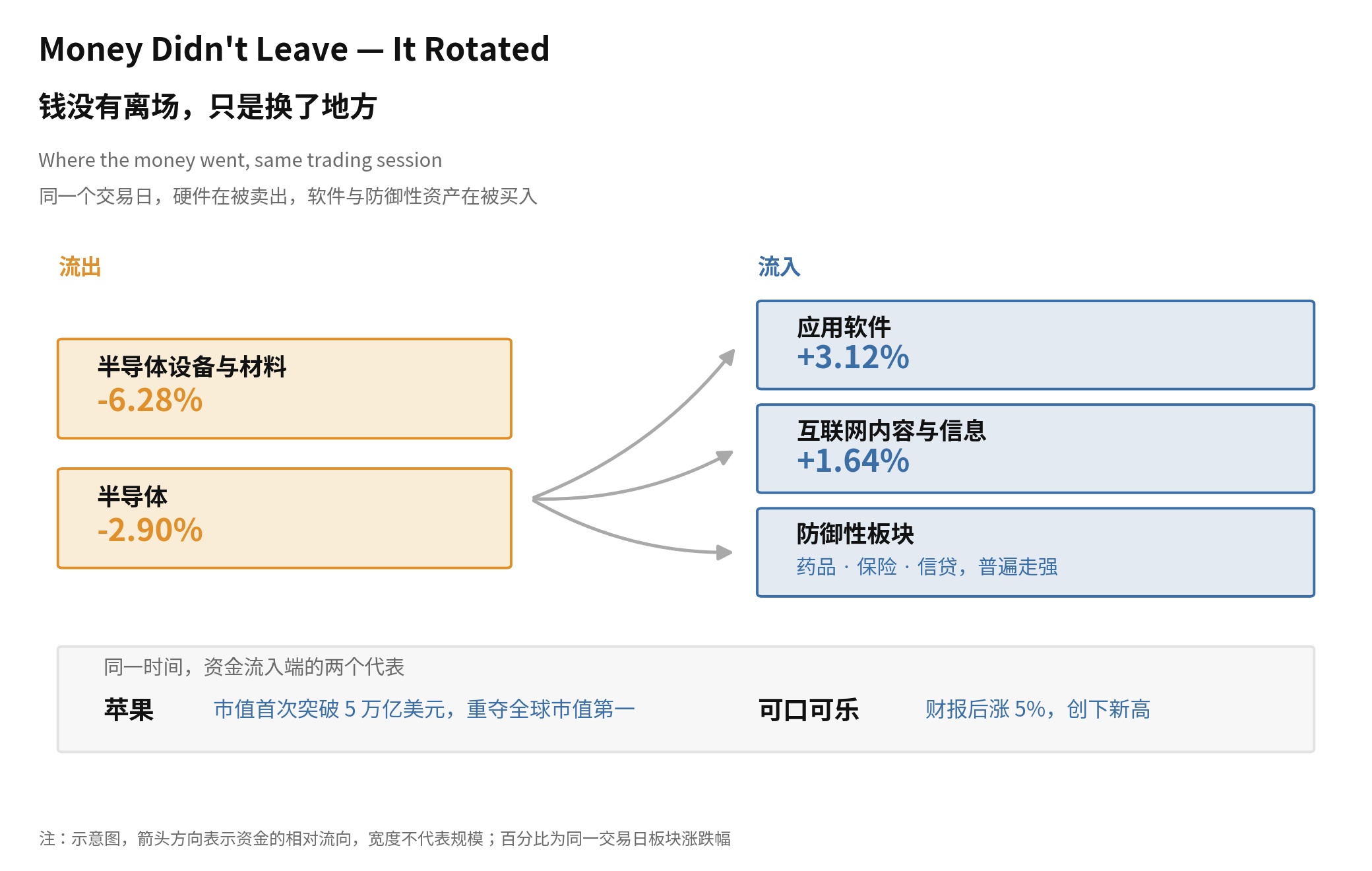
At the same time, $Apple(AAPL.US) saw its market capitalization surpass $5 trillion for the first time, reclaiming the top spot globally; $Coca Cola(KO.US) rose 5% after earnings to set a new high. On the day, the Dow Jones Industrial Average rose 1.03% against the trend, the S&P 500 gained 0.21%, while the Nasdaq fell 0.22%.
This wasn't entirely a panic-driven exodus.
Marija Veitmane, Head of Equity Research at State Street, noted that based on the earnings reports released so far, market demand remains extremely strong, "for us, this is a great opportunity to buy the dip."
On the same day, money was indeed concentrating in areas with higher certainty: the semiconductor equipment and materials sector fell 6.28%, and the broader semiconductor sector dropped 2.90%; meanwhile, the software applications sector rose 3.12%, software infrastructure gained 0.38%, and defensive sectors such as generic pharmaceutical manufacturers, diversified insurance, and credit generally strengthened.
While hardware valuations were being crushed, software assets and consumer/pharmaceutical assets with robust cash flows were being bought.
How does the market view what's next?
The cautious side
Both Barclays and State Street highlighted concerns regarding the sustainability of capital expenditures and the free cash flow status of large tech companies. State Street described it as "negative momentum is accumulating."
However, Vanda's portfolio data shows that the previously crowded trade of "long semiconductors, short Mag 7" has basically been unwound, suggesting that selling pressure may have largely been exhausted.
The optimistic side
Song Hyun-chung, President of SK Hynix Group, stated during the conference call that mid-to-long-term AI investment by leading cloud providers will continue. The company judges the probability of mid-to-long-term oversupply to be very low, having already signed five-year long-term supply agreements with about 10 core customers.
Nomura Securities' view is that this round resembles a shift from a "leverage bull" to a "buyback bull," rather than a trend reversal. South Korean companies' buyback scale is expected to reach 116 trillion KRW in 2026, with approximately 90% coming from the two semiconductor giants.
Have semiconductor valuations truly bottomed out this time, or is this another opportunity to buy the dip?
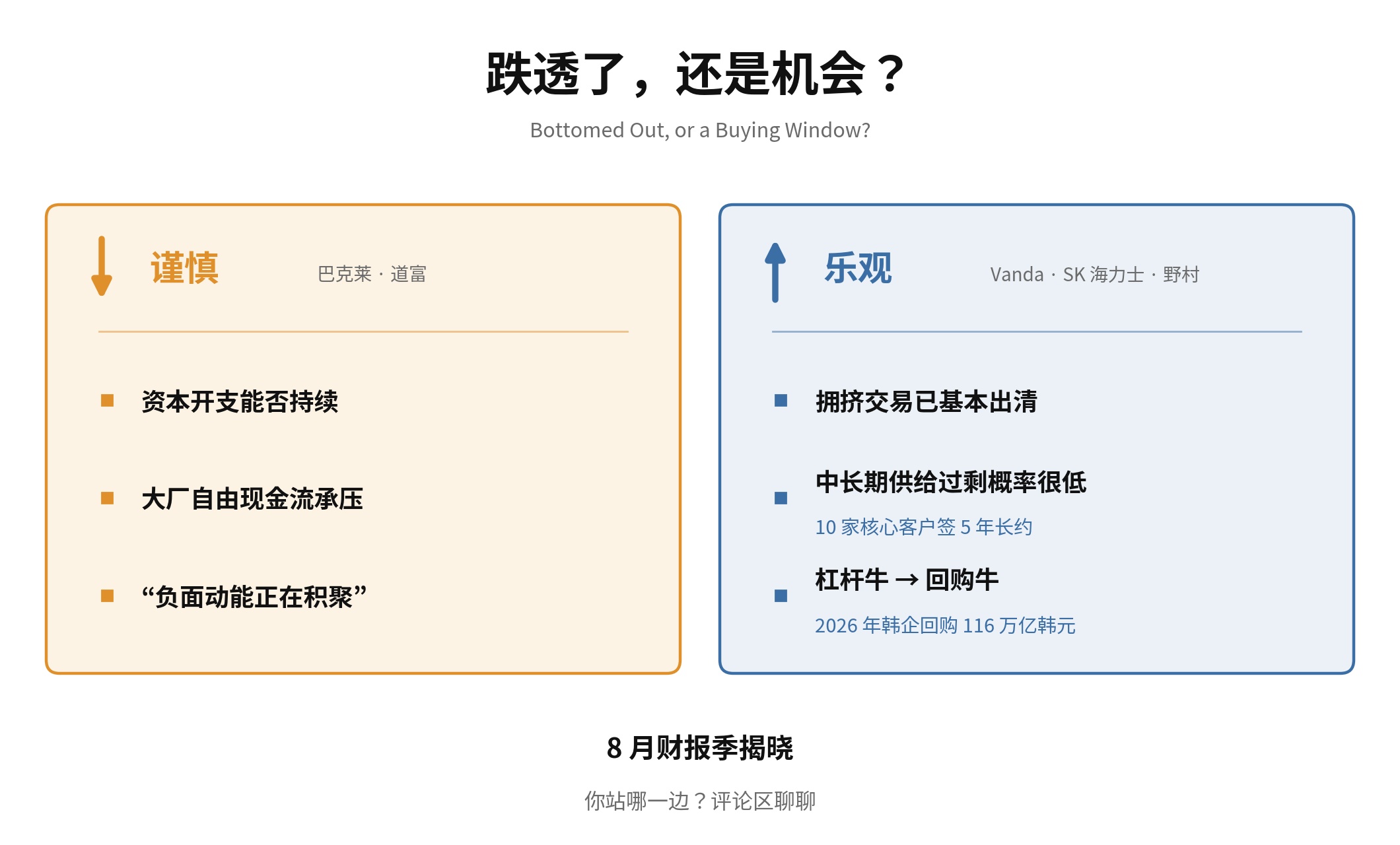
The August earnings season is about to kick off. Share your thoughts in the comments ⬇️—Can the semiconductor market return to form in August? Prizes for quality comments; feel free to speak up.
Related Tickers
Semiconductors & Storage
$Micron Tech(MU.US) $Sandisk(SNDK.US) $AMD(AMD.US) $Taiwan Semiconductor(TSM.US) $SK Hynix(SKHY.US) $Samsung Electronics (SSNGY.US)
The other end of capital inflow
$Apple(AAPL.US) — Market cap surpassed $5 trillion for the first time, reclaiming the global #1 spot
$Coca Cola(KO.US) — Rose 5% post-earnings to a new high, representing defensive consumer stocks
$Baiya(BIYA.US) $Grab(GRAB.US) $Onfolio(ONFO.US) $PSQ(PSQH.US) $Coca-Cola Bottling(COKE.US) $Boeing(BA.US)
Leverage & Hedging Tools
$VanEck Semiconductor ETF(SMH.US) — A basket covering major semiconductor companies globally
$Direxion Semicon Bull 3X(SOXL.US) — Tracks the daily 3x leveraged performance of the Philadelphia Semiconductor Index, with extreme volatility
$Roundhill Memory ETF(DRAM.US) — A thematic ETF focusing on the memory chip industry chain
$XL2CSOPHYNIX(07709.HK) — Tracks the 2x leveraged performance of SK Hynix and Samsung Electronics respectively
More content: Click [My] - [Opportunity Insights] to view curated opportunities.
The copyright of this article belongs to the original author/organization.
The views expressed herein are solely those of the author and do not reflect the stance of the platform. The content is intended for investment reference purposes only and shall not be considered as investment advice. Please contact us if you have any questions or suggestions regarding the content services provided by the platform.
