


 Likes Received
 Posts
PostsBefore Boston Scientific's earnings report, the largest Call bet is placed until December
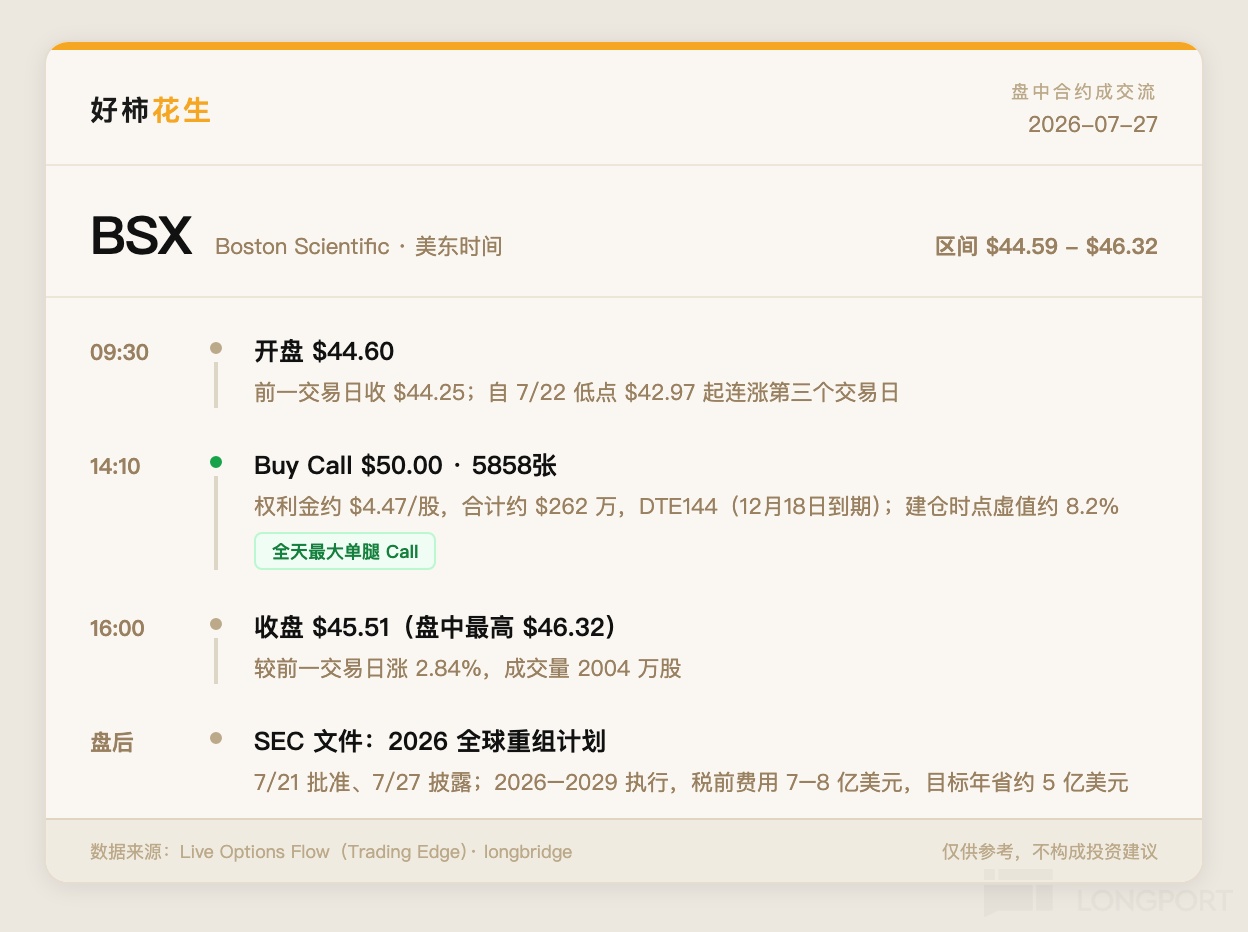
The single largest premium Buy Call of the day on 7.27 didn't land in tech stocks, nor in semiconductors—the buyer chose Boston Scientific. $2.62 million, single-leg, 5,858 contracts, strike price $50, expiration pushed all the way to December 18.
Let's first look at where this company stands right now. In mid-July, it just touched its 52-week low range. On July 14, when sellers downgraded it, the stock dropped about 5% in a single day. By July 22, it closed at the low point of this pullback, then rallied for three consecutive days, recovering a cumulative 5.9% by July 27. There are reasons for its cheap valuation: management slashed its full-year 2026 organic growth guidance to 6.5%–8%. WATCHMAN, electrophysiology, and urology lines were all weakening simultaneously, which was the direct cause of this downgrade. Market expectations for this quarter are also suppressed very low; revenue year-over-year growth is expected to drop from 22.8% in the same period last year to 5.9%.
There was a second event on the same day. After market close on July 27, the company filed an SEC document announcing a global restructuring plan running from 2026 to 2029—supply chain optimization, production line relocation, and functional reorganization. Pre-tax costs will be between $700 million and $800 million, with the goal of cutting approximately $500 million in pre-tax expenses annually. It will involve layoffs, and the savings will mainly be reinvested into growth projects. The document was approved on July 21 but only made public on July 27.
This $2.62 million Call was bought in the afternoon of July 27.
I think what's most noteworthy about this trade isn't the amount, but the expiration date.
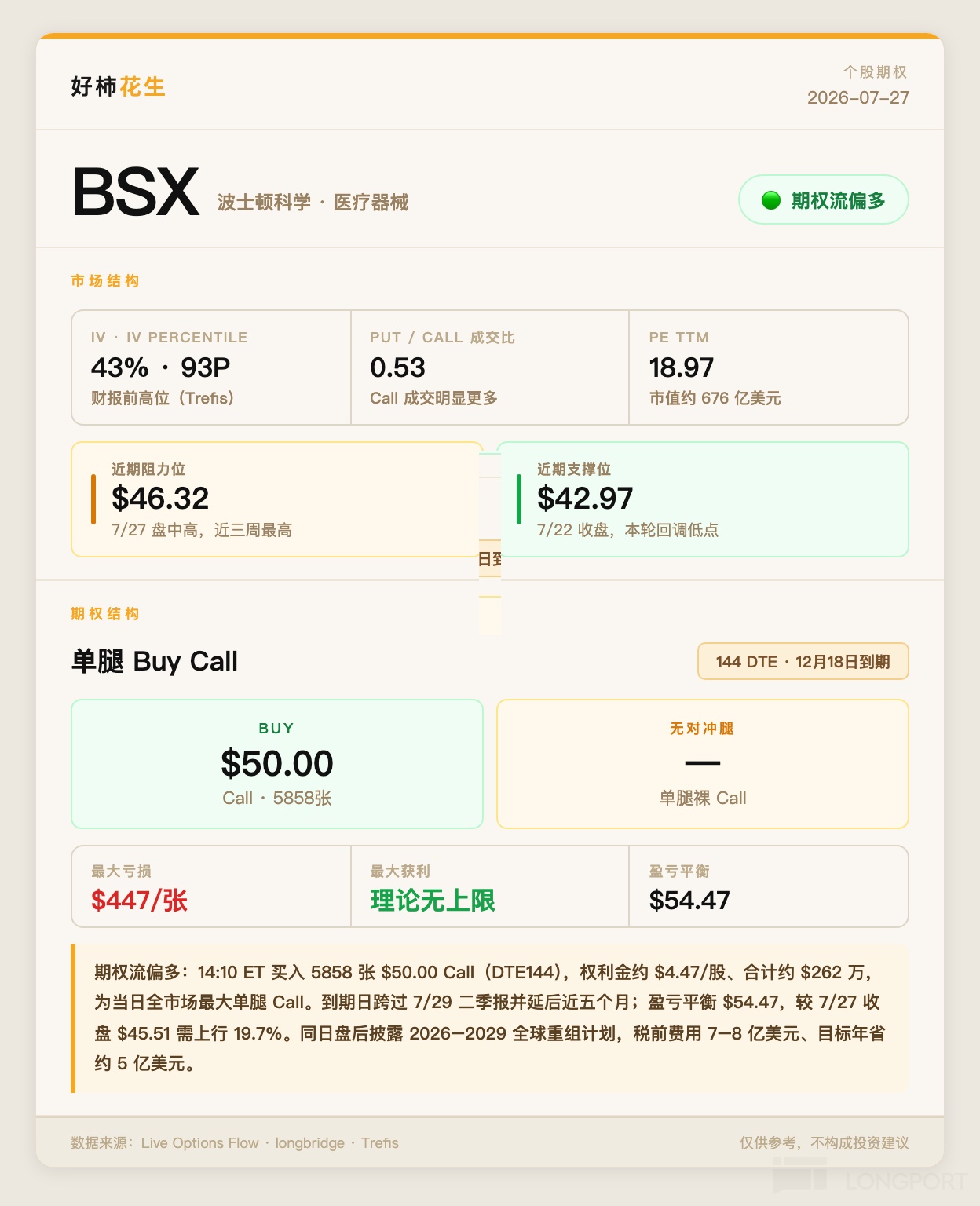
BSX's Q2 earnings report is scheduled before the market opens on July 29. Counting from the day of purchase, the results come out just one day later. If the goal was truly to bet on the earnings report, the cheapest approach would be to buy contracts expiring in early August and exit after the results are released. But they bought ones expiring on December 18, with 144 Days to Expiration (DTE), paying for five months' worth of time value upfront. This isn't renting an event; it's buying a cycle. The bet isn't on whether Wednesday morning's numbers look good, but whether this company will be worth $50 five months after the guidance cut and restructuring launch.
Reading it this way, the $50 strike price makes sense too. The underlying stock needs to rise about 10% just to reach the strike price. Adding the premium, the break-even point sits at $54.47, which is another 19.7% above the current price. A 20% gain over five months isn't unreasonable for a leading medical device company, provided that the $500 million in annualized cost savings actually materializes in next year's financial statements, rather than just leaving behind a one-time charge of $700–800 million.
The structure itself is clean: unit price is about $447 per contract, maximum loss is exactly this $447, upside is theoretically uncapped, and break-even is $54.47.
So, is this trade reliable? My view is that the direction is credible, but the price is not attractive.
You might say, "30 sell-side analysts give BSX a consensus 'Buy' rating, with 19 Strong Buys and zero Sells. The consensus target price is $72.25, nearly 59% higher than the current price. A $50 Call is practically free." I don't see it that way. A target price gap widened to 59% usually doesn't mean the stock is too cheap, but rather that sell-side models haven't yet incorporated the impact of the July guidance downgrade. The divergence range from a low of $55 to a high of $106 itself indicates that these updates are uneven. The more exaggerated the gap, the lower the reference value.
The real vulnerability lies in the cost. BSX's current options implied volatility (IV) is around 43%, sitting at the 93rd percentile of its own past year. This is typically the most expensive time before earnings. Once Wednesday's numbers are out, regardless of whether they beat or miss, IV crush will likely eat away a chunk of the premium first. This December Call has 144 days to withstand the pressure, so theoretically, it can hold. However, its entry cost was paid at the most expensive point of the year—for the same directional bet, entering after the earnings release would likely be cheaper. This is the unavoidable earnings gambling risk of this trade: although it doesn't rely on the earnings report for realization, it must endure the pricing revaluation on the day of the report.
The scenario where this logic fails is quite specific: if guidance is cut again on July 29, and the underlying stock breaks below the 52-week low range near $42.20 from July, the $50 strike price will basically become worthless, and five months won't save it. For the restructuring story to hold, revenue must stop falling. Conversely, if IV drops after the earnings report and the underlying stock stabilizes above the pullback low of $42.97, then the cost-effectiveness of the $50 Call truly emerges.
I've put it on my watchlist. What I'm watching isn't Wednesday's numbers, but whether anyone continues to add to this December contract after Wednesday. A single $2.62 million trade could just be some fund rebalancing. It's only when it happens for the second or third time that it signals someone is genuinely betting on the restructuring.
The copyright of this article belongs to the original author/organization.
The views expressed herein are solely those of the author and do not reflect the stance of the platform. The content is intended for investment reference purposes only and shall not be considered as investment advice. Please contact us if you have any questions or suggestions regarding the content services provided by the platform.
