


Haier New Energy's 5 billion RMB inter-institutional REITs application accepted; largest same-category filing under SZSE's new rules
On July 27, the Shenzhen Stock Exchange (SZSE) accepted a new energy institutional interbank REIT application with a volume of 5 billion yuan. This comes just three days after the official implementation of new regulations on real estate ABS by both the Shanghai and Shenzhen stock exchanges, making it the largest new energy infrastructure application accepted by the SZSE since the new rules took effect. The Taiping Asset - Guotai Haitong - Haier New Energy Infrastructure Carbon Neutral Green Holding Real Estate Asset-Backed Special Plan simultaneously incorporates rural revitalization attributes. The original equity holder is Qingdao Haier Green Energy Technology Co., Ltd. This marks the second move by Taiping Asset in the new energy institutional interbank REIT track this year, following its Hong Kong-based Smart Energy project.
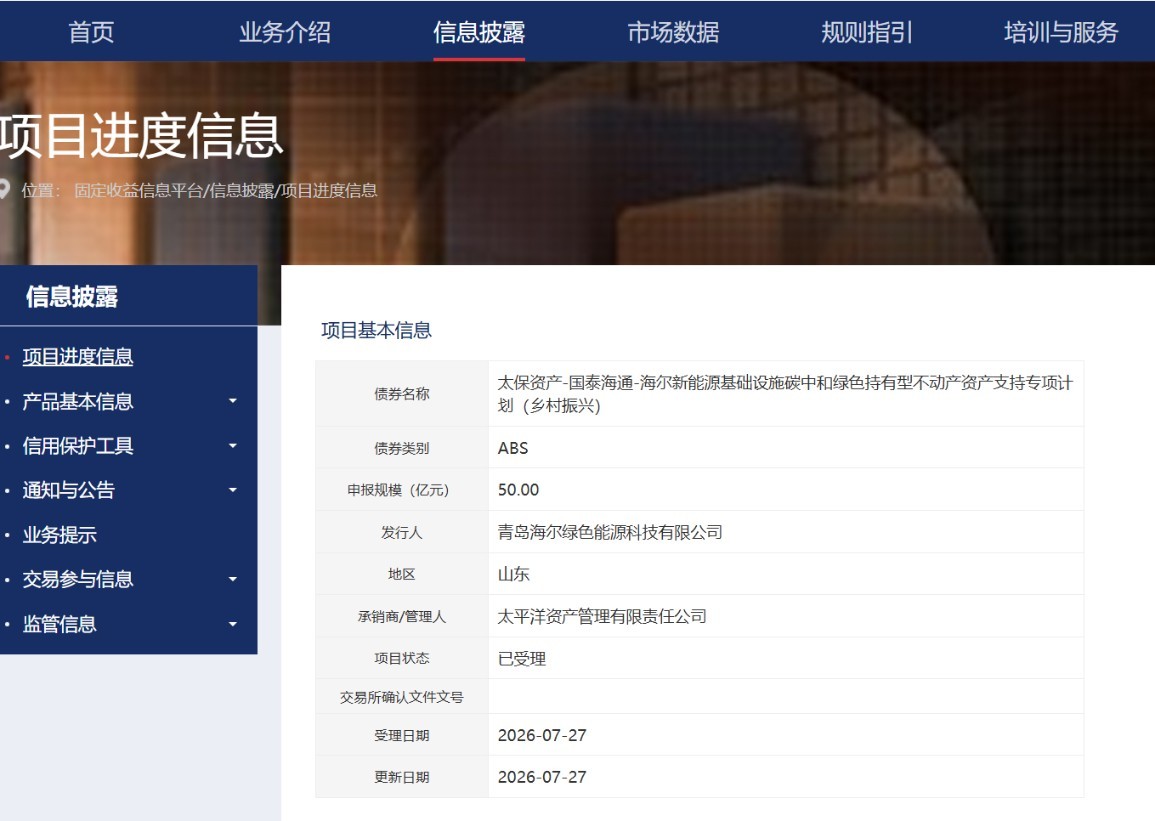
Currently, detailed underlying asset lists have not been disclosed. Based on industry conventions and Haier Green Energy's business structure, it is expected to primarily consist of distributed photovoltaic (PV) power stations and supporting energy storage assets, covering county-level clean energy projects to align with the rural revitalization positioning. As the core implementation vehicle for Haier Group's new energy sector, Haier Green Energy covers the entire operational chain of distributed PV, user-side energy storage, and virtual power plants, establishing a mature source-grid-load-storage integration system locally in Shandong. This large-scale asset securitization application during the regulatory window is both a practical choice for revitalizing existing new energy assets and a landmark event where the new energy track responds first to regulatory guidance after the exchange officially named holding-type real estate ABS as "Institutional Interbank REITs."
Prior to this, institutional interbank REITs were long in a state of "market leading, rules lagging." On July 24, the Shanghai and Shenzhen stock exchanges synchronously revised their ABS business guidelines, formally establishing the identity of institutional interbank REITs in official business rules for the first time. This sets unified access, asset restructuring, and state-owned asset transfer regulatory standards for real estate assets, filling gaps in equity attribute regulation and ending the previous situation where products evolved only through market nicknames and inconsistent review standards.
From early quasi-REITs with 主体 credit enhancement, to de-guaranteed holding-type real estate ABS, and now into the formal exchange rule system, the intermediate layer of the multi-level REITs market finally has a clear institutional foundation: it accepts new energy assets in the cultivation phase that do not yet meet public REIT access standards downwards, and provides more efficient securitization exit paths than block trades for mature projects upwards, further connecting the complete industrial chain from Pre-REITs incubation, mid-term holding cultivation, to public REIT ultimate listing.
For the new energy track, the value of the new rules goes beyond naming. On one hand, unified ownership review standards directly address historical review pain points such as scattered distributed PV assets and complex roof lease ownership. On the other hand, clearly allowing expansion without interval limits perfectly fits the new energy industry characteristic of "rolling development and batch injection," significantly reducing capital circulation costs. More importantly, after official confirmation of equity attributes, compliance barriers for long-term funds like insurance and wealth management are cleared, making long-cycle, predictable cash flow assets like new energy power stations a key direction for fund allocation.
Volume data confirms the inevitability of this intermediate channel's explosion. According to China International Capital Corporation (CICC), as of the end of June 2026, the total number of institutional interbank REITs issued across the market reached 59, with a total scale approaching the 100 billion yuan mark. In the first half of 2026, 24 new issues totaling 33 billion yuan were added, representing growth rates of 11 times and 24 times in quantity and scale compared to the same period in 2025. With subsequent issuances following, the total market issuance scale officially exceeded 102.4 billion yuan at the end of July, successfully crossing the 100 billion threshold. Underlying assets cover 15 types including highways, affordable housing, IDCs, commercial properties, and new energy infrastructure.
Securitization Paths Cover All Categories of Wind, Solar, and Storage
The certainty brought by the new rules has directly accelerated the expansion rhythm of new energy institutional interbank REITs in 2026. The entire track has long moved past the limitations of early single distributed PV pilots, gradually forming a mature model with diverse categories, diverse entities, and rolling expansion capabilities.
Distributed PV is the 细分 track that first commercialized its logic. At the end of 2025, Bicheng Energy launched the nation's first distributed clean energy institutional interbank REIT — Xingzheng Jishi - Bicheng Nengfa New Energy Holding Real Estate Asset-Backed Special Plan (Carbon Neutral), with security code 121620 and short name 25 Bicheng A1. It packaged commercial and industrial rooftop PV totaling 130MW scattered across multiple locations nationwide into standardized securities products, solving the industry pain point of difficult large-scale capitalization for small, scattered PV assets. Entering 2026, the project received another 500 million yuan expansion approval, becoming the first institutional interbank REIT in the PV field to achieve expansion operations. The cycle model of industry funds incubating new projects, injecting them into securities products when mature, and reinvesting proceeds into new power stations was validated.
Deep involvement of insurance asset managers further solidified the long-term funding base for PV assets. The Taiping Asset Hong Kong Smart Energy REIT, approved in February and officially listed in May this year, had an issuance scale of 305 million yuan. Its underlying 14 commercial and industrial PV power stations are distributed across five major manufacturing provinces: Jiangsu, Zhejiang, Guangdong, Shandong, and Hebei, aligning with industrial electricity load. The self-generation and self-use model significantly reduces the risk of power consumption, with annual CO2 reduction nearing 93,000 tons, providing insurance funds with green underlying assets matching long-duration liabilities.
Model innovation is also advancing synchronously. In April, the Shengang - China Unicom Combined New Energy Infrastructure Holding Real Estate Institutional Interbank REIT was approved by the Shanghai Stock Exchange (SSE). After completion of issuance in the same month, it was listed on May 28. This is the market's first new energy infrastructure institutional interbank REIT with a real estate investment fund as the original equity holder, with an issuance scale of 114 million yuan. The underlying assets are rooftop PV on industrial factories and commercial buildings in various parts of China,打通 ing the operational closed loop of "new energy real estate fund cultivation + institutional interbank REITs exit." Regarding reserve projects, on May 6, ICBC Prudential - Hangtai Digital Intelligence New Energy Infrastructure Holding Real Estate Institutional Interbank REIT submitted its application, proposing an issuance scale of 383 million yuan, and has entered the feedback stage. The original equity holder, Zhejiang Hangtai Digital Intelligence Energy, was jointly initiated by Hangshi Group and Chint Group, holding over 1GW of self-owned PV power station capacity. Even if some small and medium-sized fund-series PV REITs and local state-owned joint PV projects complete applications and issuances, they merely supplement the downward penetration of the track and cannot shake the mainstream pattern of cooperation between leading industrial parties and insurance capital.
Energy storage and wind power, two hard assets previously difficult to securitize, have successively achieved breakthroughs from zero to one,补齐 ing the asset shortcomings of new energy infrastructure. In June 2026, Canadian Solar's Independent Storage REIT was listed on the SSE. Its underlying asset is the 200MW/800MWh grid-side independent energy storage power station in Jiuquan, Gansu, marking the country's first independent storage category institutional interbank REIT, breaking the market's prior inherent belief that storage projects could not issue equity-type securitized products. The wind power sector continued the momentum of Envision Energy's first wind power REIT. Also in June, Envision's second wind power project worth 585 million yuan was accepted by the SSE, formally forming a continuous application trend for Northwest land-based wind power assets.
Energy central enterprises also entered in batches mid-year, directly raising the overall scale ceiling of the track. In June, Huaneng Group's two phases of new energy REITs were approved synchronously, with a total proposed issuance scale reaching 4.5 billion yuan. They batch-integrate cross-regional wind and PV power stations under their control, representing large state-owned energy groups formally listing institutional interbank REITs as a tool for routine revitalization of existing assets, initially forming a diversified participation pattern of private enterprise trials, insurance capital increases, and central enterprise entry.
Liquidity and Cash Flow Become Core Shortcomings
While rule naming opens up the growth ceiling, the inherent shortcomings of institutional interbank REITs and the operational volatility risks of new energy assets will not automatically dissipate with the implementation of new rules, determining that this product can never replace the positioning of public REITs.
Liquidity is a hard injury that cannot be avoided in the long term. Public REITs rely on intra-exchange bidding trading, possessing sufficient turnover space, whereas institutional interbank REITs are only open to qualified institutional investors, with transactions mainly conducted via agreement transfer, excluding individual investor participation, resulting in low asset liquidity efficiency. Currently, many institutions deploying related products are essentially betting on future premium space for conversion to public REITs. However, at this stage, the exchanges have not issued clear, actionable normalized rules for board conversion, and the pace of policy implementation remains uncertain.
Secondly, new energy asset cash flows inherently carry volatility risks. PV is constrained by sunlight duration and the stability of commercial tenant electricity usage; energy storage returns rely entirely on peak-valley electricity price spreads and grid dispatch policies; wind power is significantly affected by monsoons and curtailment policies. Even with pure equity architecture designs completing de-subject guarantee, final loss risks are still borne by product investors. Compared to traditional quasi-REITs with subject credit backing, this places higher demands on operators' asset management and operation/maintenance control capabilities.
More noteworthy are implicit risks at the compliance level. Distributed new energy assets generally face issues such as mismatch between roof lease terms and product terms, questionable land nature compliance, and fragmented grid-connection procedures. These are also the links most prone to feedback opinions in past reviews and are key verification directions emphasized in this new regulation. Although the new rules unify access standards, they do not lower compliance requirements. The clarity of underlying asset ownership remains the core prerequisite for determining whether a product can smoothly pass review and operate stably in the long term.
Viewed within a longer industrial cycle, Haier New Energy's 5 billion yuan large-scale application is merely a microcosm of the new energy industry using multi-level REITs to achieve separation of heavy and light assets. In the past, new energy enterprises relied on own funds for heavy asset land acquisition and power station construction, keeping debt ratios high. Now, by utilizing Pre-REITs cultivation, recouping funds through institutional interbank REITs, and exiting via public REIT listing when mature, enterprises are gradually divesting heavy asset holding businesses, shifting towards a light asset model earning development management fees and O&M service fees.
Completing rule building is only the first step. The long-term stability of underlying asset cash flows is the true yardstick determining how far this track can go.
The copyright of this article belongs to the original author/organization.
The views expressed herein are solely those of the author and do not reflect the stance of the platform. The content is intended for investment reference purposes only and shall not be considered as investment advice. Please contact us if you have any questions or suggestions regarding the content services provided by the platform.
