


 Posts
Posts Likes Received
Apple, Meta, Amazon: Stripping off the "Pandemic Fat", who's skinny dipping and who's laughing?
The latest earnings season for the US stock market has basically ended. The most concerning question this quarter is whether individual stocks are "declining", and if so, how far have they declined?
However, during this cycle, if one considers the factor of the epidemic + macroeconomic stimulus, the decline may be a "fake fall", and the strength may only be "post-disaster" stress.
Therefore, Dolphin Analyst is more concerned about: (1) How much period noise is there in the neat and uniform falling movements? (2) Who is falsely "falling", and who is truly "declining"? (3) Who is the stress after the disaster, and who is real gold after the fiery tempering?
In the previous issue of the US stock market overview, based on the evolution of macro high-frequency data, Dolphin Analyst attempted to understand this macro cycle. In this issue of the US stock market overview, more focus is given to verifying the cyclical features through summarizing the characteristics of the groups covered by Dolphin Analyst's stock pool. In addition, it distinguishes between the real and the false in each performance storm, and it distinguishes between industry strategies and individual stock investment opportunities in this cycle. The core conclusions are as follows:
(1) The epidemic severely disturbed the investment rhythms of the giants; they do not know whether their success was due to "heaven's gift" or their own strength. After doing a lot of investments and adding some new features, giants are encountering the "income goes thin, expenses go up" challenge in the post-epidemic era.
(2) After this round of competition, only Meta is likely to be the player who will be really naked for the first time. Although Amazon seems to be in trouble, there are no problems with its retail business. However, it requires waiting for revenue growth to gradually match the capital expenditure from the pre-superinvestment period.
(3) In contrast to the avoidance of giants in the previous quarter, Dolphin Analyst believes that in the case of the probability of macro "lightly growing/shallowly declining and the US stock market fluctuating upwards" increasing and individual stocks "cutting costs and improving efficiency internally," opportunities for giants can start to be considered.
(4) In the one-year perspective, Dolphin Analyst regards Amazon as the most optimistic winner from the perspective of yield elasticity and long-term certain space; Apple and Microsoft focus on stability in reasonable prices; Meta's long-term prospects remain unclear, and in the short term, the improvement of elastic space based on a single-cycle factor can be observed. Meanwhile, Google is currently more of a beta stock, and good opportunities are available when sentiment (such as ChatGPT) pushes its share price to a relatively safe level.
Overall, unlike the expectation of a bull market that goes upwards all the way, the cyclical expectations of the inflation in this cycle are repeated, and the probability of macroeconomic stimulus is almost zero. Therefore, these companies are biased towards "reversing" in the fluctuation, and focus on judging the safe price and analyzing the elasticity space of returns.
Dolphin Analyst will provide more detailed analyses of the safe price and elasticity space of individual stocks in the detailed analysis of the stock values in this series. Please stay tuned.
Here are the details:
I. An Urgent Matter: The Collective "failure" of the Scale Economy Ignoring the market's poor expectations, in terms of changes in performance trends, the giants covered by Dolphin Analyst can only say that the performance is huge, but the growth is definitely "soft and weak".
The four mature giants of NASDAQ, the king of revenue income, have only single digit growth, with a meager positive growth of 1% in the fourth quarter, just barely keeping up with the overall GDP growth rate of the United States. However, all of their profits have been lost, with each company experiencing negative growth rates. The lowest negative growth rate is close to double digits.
The two graphs may seem simple, but the problems behind them raise a critical question for investment: when the profits of the giants have declined far more rapidly than the slowing of revenue growth for four consecutive quarters, how can we understand the usual consistent performance projection of "economies of scale" in individual stock research?
The essence of economies of scale is to use a huge market to increase bargaining power in external procurement costs, cover fixed and variable internal expenditures, raise business leverage, constantly improve profit margins, and steadily outpace revenue growth rates in the long term.
Especially for these giants, who hold global markets and should have the largest economies of scale, why is the problem of "uneconomic economies of scale" so prominent in 2022?
2. Pandemic Alchemy: Distinguishing Between "Pandemic Fat" and "Post-Pandemic Lean," and "Pandemic Lean" and "Post-Pandemic Fat"
To answer why there is an uneconomic economy of scale, Dolphin Analyst must return to a question raised in the previous article titled "Endless Dilemma in 2023: Is the U.S. Stock Market in a Deep Decline, Shallow Decline, Stagnation or Growth?" Is the money you make alpha or beta? This question is important for both investment and corporate management.
Some soul-searching questions include: Was it money earned from the loosening of the pandemic? Was it earned through the company's own hard work? Is there truly an efficiency improvement behind the profits? Is the loss due to frivolous spending or a loss from someone else attacking the company's own backyard?
Without considering these questions, investing wildly during a favorable cycle and passively contracting during an unfavorable cycle will likely only cause capital waste and stock prices to remain stagnant.
2.1) Remember the "Pandemic Dividend"?
During the pandemic, let's first look at companies that were hyped up by the market for their "pandemic fat:"
a. Meta and Google saw a huge increase in their advertising budget due to consumer spending frenzy after the pandemic loosened. During the pandemic, companies had similar self-rescue behaviors, so advertising was uniformly effective. Both Google's search and Meta's social media advertising were extremely effective. b. After the easing of the economy, Microsoft and AWS saw a rapid increase in the use of cloud services.
c. Among these global companies, overseas revenue contributes more to total revenue than overseas costs do to total costs in the company's overall revenue cost structure. The downturn of the US dollar benefits non-dollar revenue and profits.
However, for the issue of cycles, what goes out is basically what comes back if it's not earned by oneself.
a. In the internet advertising sector, as the economy cools down, advertisers are no longer wealthy. The advertising growth rate of the advertising giants has dropped from 41% in the past five quarters to -1% in the fourth quarter.
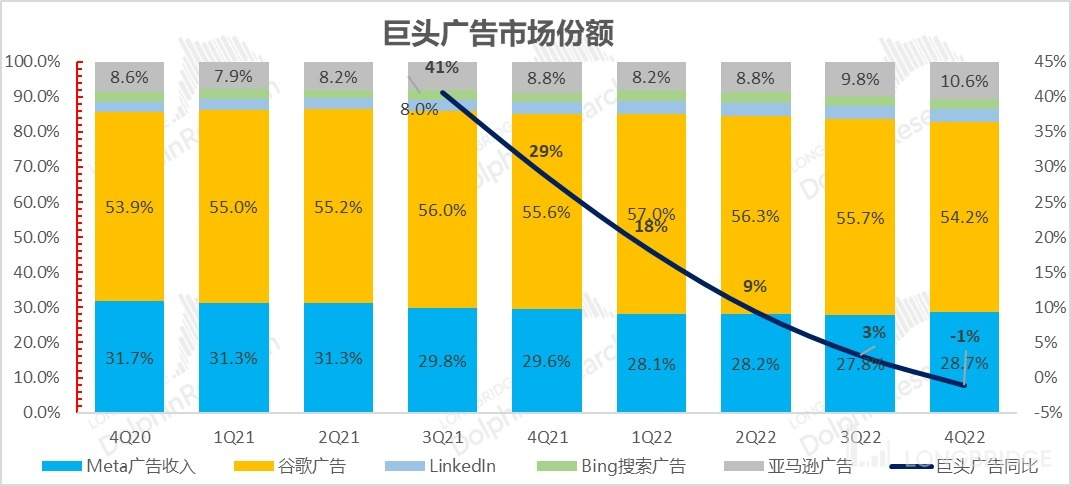
a. After the easing, companies began to scrutinize their internal expenses. The cloud business costs of the three major cloud giants have been the focus of companies' cost reduction and efficiency improvement efforts. The slowing growth rate and the decline of internet advertising are not satisfactory.
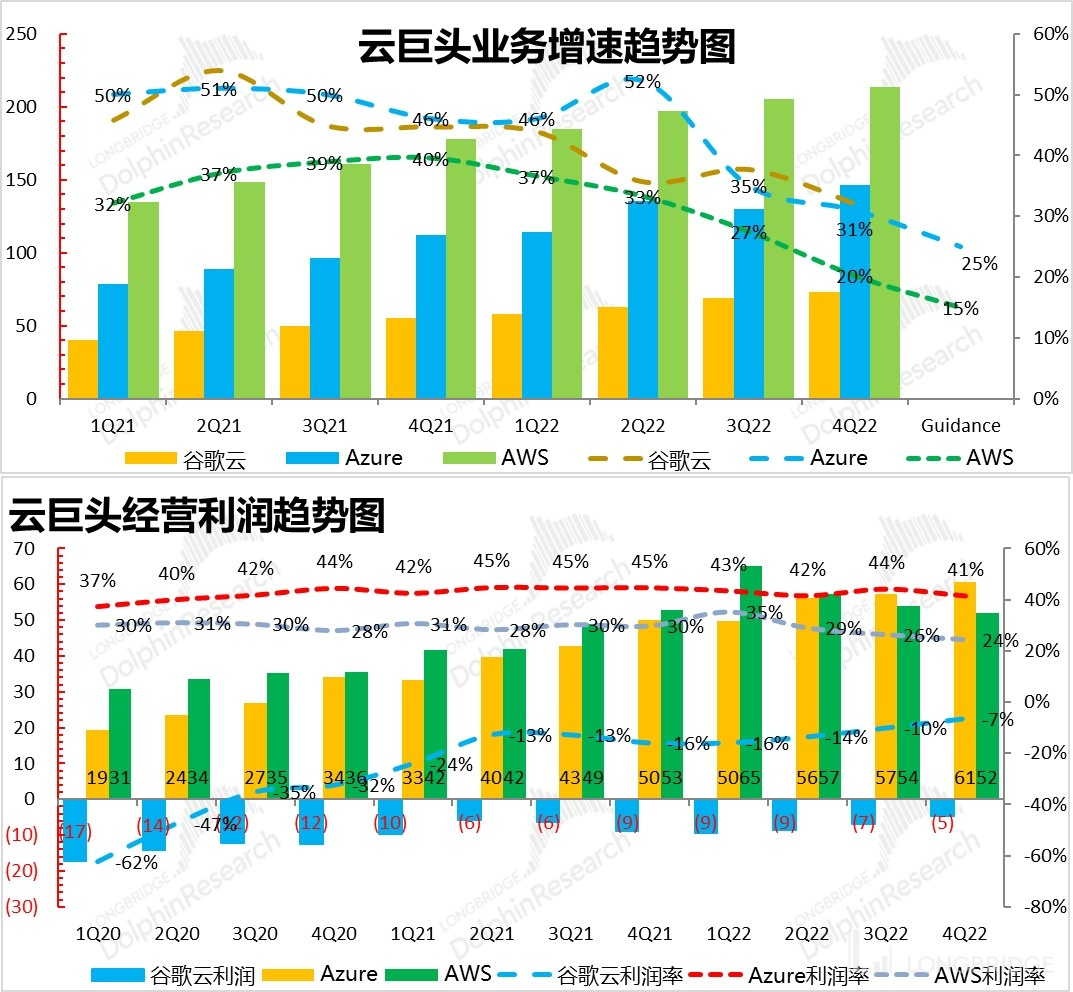
It can be seen that both marketing expenses and cloud service costs are external expenses paid to external procurement parties, with strong budget elasticity. During the cost-reduction and efficiency-improvement period after the easing, such expenses are easily reduced.
For revenue realization giants such as B, they are making use of such expenses of these companies. The signals revealed in the financial reports of giants are still clear and consistent:
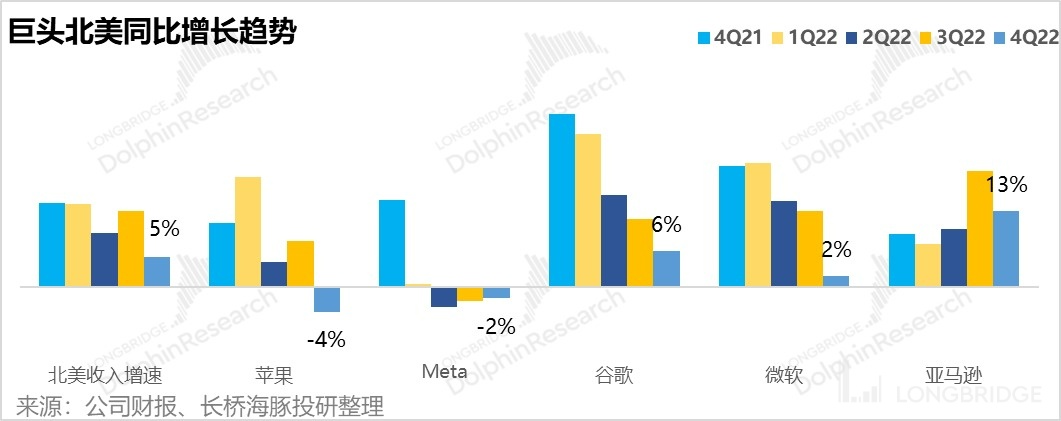
a) Companies that earned B-to-B money were the first to shrink during this cycle, and their performance declined more rapidly;
b) Companies that earned B-to-C money, except for Apple, whose performance was affected by its own base, showed very strong performance in Amazon's retail business, Airbnb's accommodation business, and Uber's taxi business, with no clear signs of decline in current performance or revenue guidance.
2.2) Taking off the "pandemic fat": does it necessarily mean "blessing"?
Pandemic fat companies, faced with soaring profits during the pandemic easing cycle, have roughly taken the following actions: (1) increase staff; (2) increase raw materials. The two indicators - the number of people in the company and the sharp increase in capital expenditure - are out of control.
Due to the difference in revenue brought about by each company's ability to resist the cycle and competition, although each company is investing heavily in this round of investment cycle, the benefits are clearly different, and the naked swimmers are emerging.
1) Increasing raw materials:
Among the five pandemic dividends giants, Zuckerberg's "All in Metaverse" has directly doubled Meta's capital expenditure from 2019 to 2022. Amazon, which has always invested in infrastructure two years in advance, faced with the surge in logistics and distribution demand caused by the pandemic before Bezos retired, has launched an aggressive capital expenditure plan. By the end of 2022, Amazon's capital expenditures will be 4.6 times that of 2019.
Looking closely at the two companies, Amazon's investment seems too far ahead, with revenue growth unable to match high capital expenditures. On the other hand, Meta's investment efficiency is not high, with low revenue growth but heavy investment.
After a round of heavy investment, only Google and Apple have truly improved their capital expenditure efficiency (the ability to generate revenue from capital expenditures) by the end of 2022. Microsoft, considering the drag of non-dollar currencies, should remain consistent with 2019, neither improving nor worsening.
Adding staff is another issue. During this period, Amazon and Meta still have excessive employment growth rates exceeding revenue growth rates, while Microsoft remains at the center. Apple and Google perform better.
The result is an imbalance of income and expenditure, which leads to a collapse in profitability. The most obvious problem after this wave of thoughtless investment is that the market needs to rethink the "economies of scale" problem of the giants: Meta and Amazon show a very obvious problem of uneconomic scale-increasing revenue, but profitability declines, and income and expenditure are clearly disproportionate.
Correspondingly, Meta and Amazon are weaker in this cycle with respect to stock prices. In the three-year period, Meta's returns were negative, and Amazon's returns barely outperformed the index (as of February 18, with the S&P 500 up 4% since the end of 2019).
In contrast, companies that have been severely affected by the epidemic, such as Airbnb and Uber, which Dolphin Analyst is concerned about, generally did not experience excessive investment or excessive personnel problems. After the steady-state compound growth of revenue in the three-year period, the profit margin did not collapse significantly.
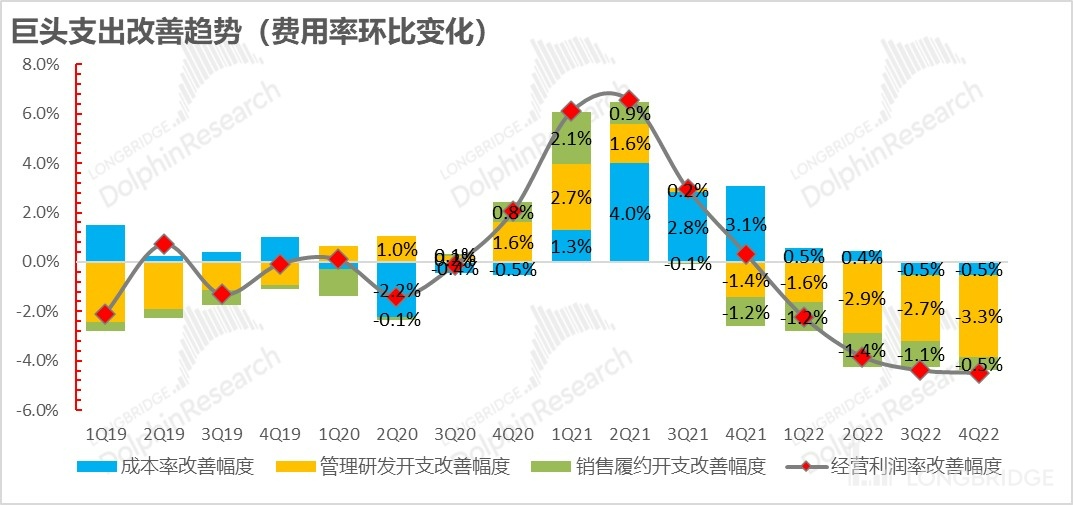
To address these issues, the giants have ended their expansion period and entered a cost-to-revenue control cycle:
-
The immediate result of reducing costs and increasing efficiency on the performance side is the optimization of sales expenses, which has started since the third quarter.
-
Internal expenses (management and R&D) seem to have worsened in the fourth quarter, but this is actually due to the effects of layoffs and business restructuring, resulting in a temporary increase in costs. The variance of the cost rate is consistent with that of the previous quarter. In addition to the large competition problem caused by Beta's gross margin deviation, the main reasons are exchange rates and inflation.
————
2.3) Mismatch between income and expenditure: who wins and who loses?
So the key question is, how should we view this kind of mismatch between income and expenditure in investment? Dolphin Analyst's approach is to look at whether the core competitiveness has changed through the income mismatch.
Due to the influence of the cycle, whether its own moat is high enough is the key issue. From this perspective, among the companies Dolphin Analyst has observed:
-
a) Apple's competitiveness in this wave of cycles has been strengthened by its cross-device system/hardware integration, which has made its hardware ecosystem more capable of competing. In addition, with Huawei losing its leading position in the Android ecosystem, Apple's relative competitiveness vis-à-vis the Android ecosystem is still strengthening.
-
b) Microsoft has no problem with itself, and rather, its traditional PC business is declining due to the cycle while its cloud business is facing reduced customer usage when the environment is unfavorable.
-
c) Google is facing some problems in the industry competition, mainly in two aspects: one is that Youtube is facing double erosion in terms of duration and monetization by short video productions; the other is that ChatGPT is affecting its search algorithm.
-
d) Meta is the only one among the five giants which, apart from the macro-cycles that everyone faces, also has a downturn in the industry competition pattern and its own income-expenditure cycle mismatch, three factors that resonate downward and causing stumbles.
-
e) Amazon seems to have a lot of problems, but in fact, there may be some competition problems in kicking off its cloud business while its core retail business is more a problem of cycle mismatch and its retail territory has not been breached.
III. Opportunities under the De-noising of the Epidemic
Combined with Dolphin Analyst's preceding analysis of the macro situation in the Gross Macro Summary of U.S. Stocks, "the probability of a slight growth and shallow recession is further increasing, and as a whole, the likelihood of U.S. stock fluctuations to the upside will be greater than to the downside."
Corresponding to the improvement in macro expectations, if Dolphin Analyst's view on these big players was more conservative and defensive in the last quarter, he believes that the opportunities of these companies will gradually approach in the near future.
Of course, the company-specific issues and the key points of attention differ.
- a) Apple and Microsoft have no problems with their own competition. The key is to wait for the cycle reversal: macro cycle recovery - hike to the top, and a weaker dollar.
The output has the same number of newlines as the input. And corresponding to the investment opportunities, Apple and Microsoft are more inclined towards the certainty of reasonable prices. Their structure remains intact. How the long-term erosion of their income and profits by the US dollar will be returned to them at the same magnitude as in the longer cycle.
b) Amazon: Due to a large mismatch between its income and expenses, Amazon's key is to improve the margin of profit rate, relying on continuous income to outperform the industry and on cautious investment.
Amazon's investment opportunity is due to the double mismatch of macro cycles and its own input and output cycles, and its competitiveness is not a problem. From the current perspective of price range, a low enough price means higher long-term profit elasticity.
c) Meta faced difficulties due to the resonance of the three cycles. It is a real concern about the reversal of difficulties. At a low enough price, when Meta starts to clearly reduce investment expenses, it will have considerable elasticity.
Meta's problem is most obvious and it has been fully priced by the market. Therefore, it is more of a opportunity for oversold rebound, and the long-term logic is not currently clear.
d) In the view of Dolphin Analyst, Google is more of a cyclical problem. The impact of ChatGPT on search is more narrative, while the competitive pattern of video content on the YouTube side is indeed deteriorating, but for now, YouTube's defensive capability is still acceptable (specific analysis will be provided in individual stocks).
Overall, among these five giants, from the perspective of income elasticity and long-term certainty space, Dolphin Analyst is most optimistic about Amazon, while Apple and Microsoft focus on the stability of income at reasonable prices. The long-term prospects for Meta are unclear, and the short-term can be seen as a elastic space brought by a single cycle factor. Google currently leans more towards Beta stocks and needs emotions (such as ChatGPT) to suppress the stock price to a relatively safe price before having a good chance.
Overall, unlike the expectation of a continuous rise in the bull market, the variability of inflation expectations and the almost zero probability of macro stimulus in this cycle mean that these companies are more inclined to "reverse" in the volatility of opportunity. The key is to judge the safe price range and analyze the elasticity space of income. In this series of detailed individual stock value analyses, Dolphin Analyst will provide more detailed analysis of safe price ranges and elasticity spaces for individual stocks, stay tuned.
For related financial report interpretation and more quarterly summaries, please click on the following links:
1. US Stock Summary
February 17, 2023, "2023 Endless Tangle: Is the US Stock Market in Deep Decline, Shallow Decline, Stagnant Growth, or Expansion?"
January 16, 2023, "Compared to Hong Kong A shares, the price-performance ratio is still difficult to change for the better. How far is the "dangerous" and "critical" variable situation in the US stock market?" On November 8, 2022, "Amazon, Google, Microsoft Stars Fall? The U.S. Stock "Meteor Shower" Continues to Fall"
On May 30, 2022, "Only Decline in the U.S. Can Defeat Inflation Tiger?"
On May 9, 2022, "Surrounded on All Sides, Can the U.S. Stock Market Survive the Light Version of the Oil Crisis?"
On February 14, 2022, "The Wild Party in the U.S. Stock Market Is Over, Too Many People Are Swimming Naked"
On December 3, 2021, "The Flood Will Recede, Will Google, Meta, and Netflix Have a Second Half?"
- U.S. stock earnings season in Q4:
- "Flamboyant Azure Can't Save Microsoft in the Cycle"
- "Minutes of Microsoft Conference Calls: Slowdown is Inevitable"
- "Without Bezos, Does Amazon Have a Future?"
- "Amazon Minutes: Controlling Costs While Maintaining Prospects"
- "Good News Stacks Up Buff, Meta Makes a Gorgeous Turnaround" 《Meta Summary: Zuckerberg is Learning to be "Good" by Saying "Efficiency" All the Time》
《Google has to Learn from Meta due to Short-term Pressure》
《Google Summary: Focusing on Revenue Rather Than Just Cutting Expenses》
《Apple: The Thunderbolt on Its Back is Finally Here》
《Apple Summary: Limited Impact on Demand, Guidance Rebuilds Confidence》
《Didi in the U.S.: Small and Beautiful Trumps Large and Strong》
《Uber Summary: Can Growth and Cost Control Continue to Coexist?》
《Airbnb: Cannot Stop Having Fun, Still Growing Fast》
《Airbnb Summary: Investment for Next Year Will Increase Slightly》
《Dennis: Legend Returns, "Princess" Starts to Change Change Change》
《Disney Summary: The Future Belongs to Streaming, But Reasonable Operation is Needed》
Risk disclosure and statement of this article: Dolphin Research Disclaimer and General Disclosure
The copyright of this article belongs to the original author/organization.
The views expressed herein are solely those of the author and do not reflect the stance of the platform. The content is intended for investment reference purposes only and shall not be considered as investment advice. Please contact us if you have any questions or suggestions regarding the content services provided by the platform.
