


 BRK.B Commentator
 BRK.B Gain Hunter
If 1 million is invested in the Nasdaq 100 Index Fund QQQ, with an additional 150,000 invested annually, how long will it take to reach 10 million?
Based on the long-term historical average of the Nasdaq 100 Index (combined with your expected 15% annualized return), starting with 1 million and investing 150,000 at the end of each year, it would take approximately 12.2 years to reach the asset goal of 10 million.
I. Compound Interest Projections Under Different Return Rates
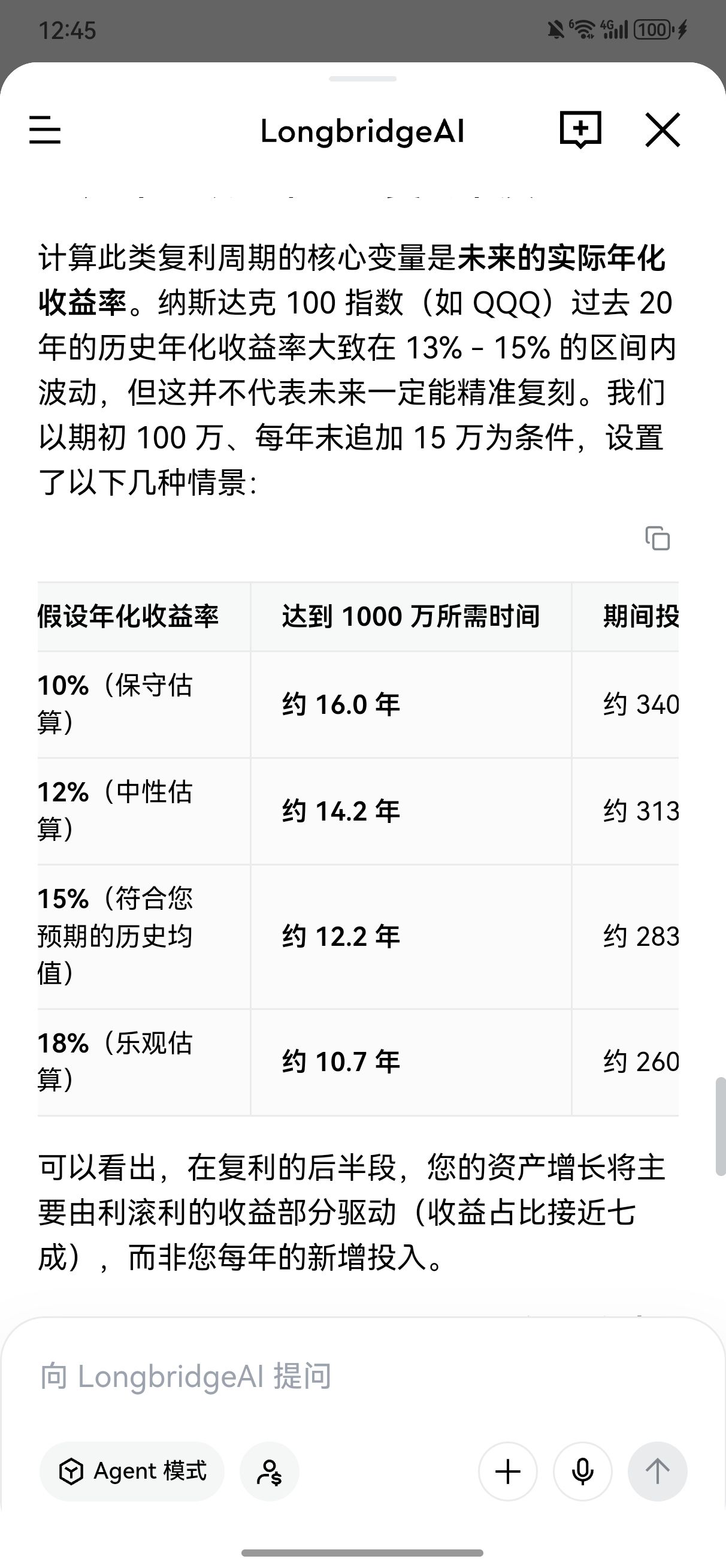
The core variable for calculating such compound interest cycles is the future actual annualized return rate. The historical annualized return of the Nasdaq 100 Index (e.g., QQQ) over the past 20 years has fluctuated roughly within the range of 13% - 15%, but this does not guarantee it can be precisely replicated in the future. Using an initial 1 million and an additional 150,000 at the end of each year as conditions, we have set up the following scenarios:
Assumed Annualized Return Time Required to Reach 10 Million Total Principal Invested During Period Principal % / Compound Interest %
10% (Conservative Estimate): Approx. 16.0 years Principal approx. 3.4 million 34% / 66%
12% (Neutral Estimate): Approx. 14.2 years Principal approx. 3.13 million 31% / 69%
15% (Historical Average in Line with Your Expectation): Approx. 12.2 years Principal approx. 2.83 million 28% / 72%
18% (Optimistic Estimate): Approx. 10.7 years Principal approx. 2.6 million 26% / 74%
It can be seen that in the latter half of the compound interest period, asset growth will be primarily driven by the interest-on-interest component (accounting for nearly 70% of gains), rather than the annual new investments.
II. Characteristics of Nasdaq 100 as a Long-Term DCA Core Holding
Combined with the previously mentioned investment logic of "focusing on industry leaders" and "pursuing long-term compound interest," the Nasdaq 100 Index has the following characteristics when executing this goal:
1. "Automatic Weeding Out the Weak and Keeping the Strong" at the Mechanism Level
The Nasdaq 100 is not static. Its composition rules cause the index to automatically remove underperforming companies and concentrate its weight on top giants with the strongest profitability and powerful "alpha" moats, such as $Apple(AAPL.US), $Microsoft(MSFT.US), and $NVIDIA(NVDA.US). Buying the Nasdaq 100 is essentially passively executing a strategy of "holding only the top industry leaders."
2. The Test of High Volatility During the Cycle
Although the number of years in the long-term projection seems clear (around 12 years), the high-growth nature of the Nasdaq also comes with high volatility. Over a DCA cycle lasting more than a decade, the market is highly likely to experience 2 to 3 macro systemic risks. For example, during the Fed's aggressive interest rate hikes in 2022, the Nasdaq's maximum drawdown exceeded 30%. The biggest challenge in achieving the compound interest results in the projection table after 12 years often lies in whether one can firmly continue the annual 150,000 DCA discipline without exiting midway when experiencing such a level of drawdown.
To be safe, DCA into index funds can avoid all in on a single company. How many tech companies will still be around 20 years from now?
$Berkshire Hathaway B(BRK.B.US)$Alphabet - C(GOOG.US)$Invesco QQQ Trust(QQQ.US)


The copyright of this article belongs to the original author/organization.
The views expressed herein are solely those of the author and do not reflect the stance of the platform. The content is intended for investment reference purposes only and shall not be considered as investment advice. Please contact us if you have any questions or suggestions regarding the content services provided by the platform.
