


PDD (Trans): New 10-Yr Starting Line; 'New Pinmu' to Reinvent PDD
Below is Dolphin Research's compiled Trans of $PDD(PDD.US) FY1Q26 (quarter ended Mar 31, 2026) earnings call. For our take on the print, cf. 'PDD: Aging and 'arrogant,' now disliked by all'.
I. Key takeaways
1) Shareholder returns: Management did not mention any dividend or buyback plans this quarter.
2) Guidance: No specific revenue/profit guidance for next quarter or FY was provided. Management reiterated that quarterly volatility is normal given seasonality and investment cadence, and that long-term, sustainable growth in intrinsic platform value takes precedence over short-term financials.
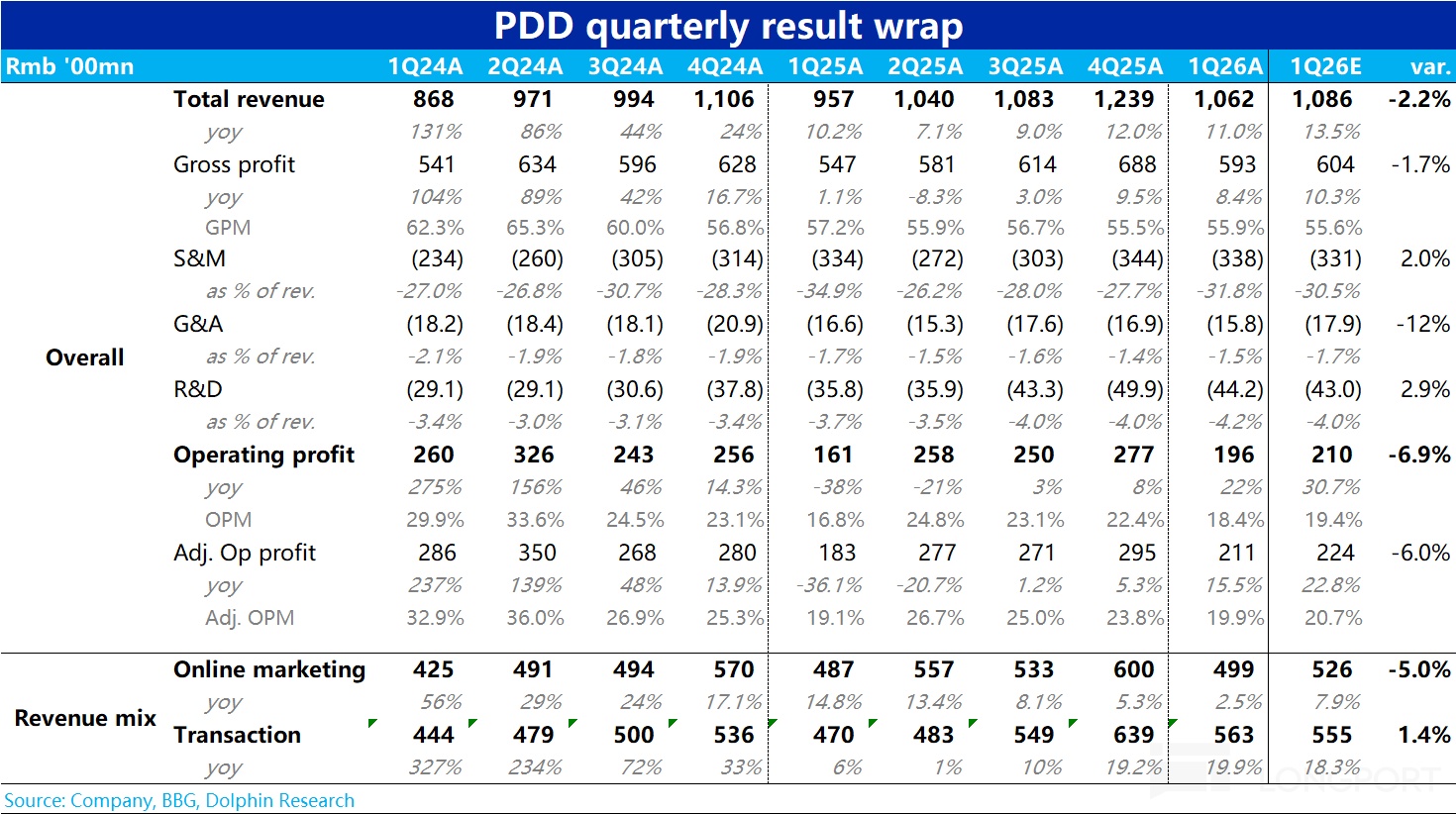
3) KPIs: Q1 revenue rose 11% YoY to RMB 106.2bn, driven mainly by transaction services. Non-GAAP OP was RMB 21.1bn with OPM of 20% (vs. 19% a year ago). As of Mar 31, 2026, cash, cash equivalents and short-term investments totaled RMB 436.1bn.
4) Capital deployment: In Mar, the company formed a dedicated subsidiary and officially launched its self-owned brand 'XinPinmu' initiative, with an initial cash injection of RMB 15.0bn and a planned RMB 100.0bn investment over the next few years.
II. Call details
2.1 Management remarks
1) Strategy and org changes
a) 2026 marks the start of PDD's second decade and a pivotal year for a comprehensive reset of organization and culture. The core theme is 'high-quality growth,' driving deep transformation across biz. teams, internal processes and org. management.
b) Safety, compliance and social responsibility are positioned as prerequisites for operations. Management stressed platform responsibility to create positive value for users, the industry and society, acknowledging past shortcomings and decisive actions to fix operations, rebuild internal controls and strengthen compliance awareness.
2) Self-owned brand initiative
a) At last year's AGM, management unveiled a 3-year plan to 'build another PDD,' shifting the strategic focus to supply chain investment. This quarter was the first full quarter under that strategy, and a dedicated subsidiary was established in Mar to launch the self-owned brand business.
b) Teams went deep into category clusters to aggregate quality supply chain resources and build the framework for self-owned brands. They are co-developing with manufacturers to design products for different global markets, while incubating new brands via deep partnerships with global IPs.
c) Business logic: Brand building spans product design, standards, manufacturing, QC, warehousing/fulfillment, legal/compliance, and CS, requiring sustained investment. Many SME factories excel at mass production and cost control but remain stuck in commoditized competition due to lacking brand capabilities; the platform-led model assumes more responsibility and risk, offering volume certainty so manufacturers can focus on R&D and process innovation.
3) RMB 100bn support plan and supply chain investment
a) The 'RMB 100bn support plan' remains in high gear, with upgrades across quality agri-produce, 'new-quality supply,' and logistics support in remote areas.
b) In agriculture, the 2026 agri-produce support program extends last year's product/merchant support to the full value chain, including planting guidance, logistics and deep processing. The first batch has launched across specialty regions, helping them move up the value chain.
c) In industry, 'new-quality supply' initiatives have rolled out in multiple mfg. clusters, shifting merchants from selling commoditized items to consumer-centric, R&D-led models. Some OEMs are rapidly upgrading into automated smart factories.
4) Rural logistics and remote-area support
a) Logistics support in remote areas is opening new growth for merchants. For example, for Zhongshan lighting, shipping a large ceiling lamp to remote regions used to cost RMB 40–50; with platform-funded freight, that can be cut to ~RMB 10, and many merchants now see >30% YoY order growth to western provinces.
b) The 'last-mile to villages' program is advancing at full speed and showing early results. In certain counties, using county transit hubs and village pickup points, direct-to-village coverage has exceeded 70% of local villages by Mar, with daily throughput near 10k parcels at hubs. This widens the free-shipping radius, creates local jobs and energizes county/rural economies.
5) Platform governance and compliance
a) Multiple rounds of measures have tightened platform oversight and compliance. In Q1, the platform launched 20+ food safety actions, including license checks, live-stream food ad content governance, and a dedicated food database.
b) It also enhanced live-stream compliance patrols, upgraded food safety reporting channels and strengthened automated menu monitoring, while cutting store violation handling times down to hours.
6) Global biz.
a) After nearly three years of growth, the global biz. has earned broad consumer support worldwide and continued to grow steadily this quarter. The addressable opportunity remains large.
b) The focus will return to e-comm fundamentals, i.e., supply chain capability, along two tracks. First, integrate/optimize the supply chain to clear end-to-end bottlenecks, expand selection and improve CX, while onboarding quality merchants and ecosystem partners. Second, deepen the self-owned brand model to reinforce 'high quality at fair prices' in consumers' minds and enhance compliance amid a more complex regulatory backdrop.
7) Agri research investment
a) The company continues to invest in agri R&D and recently held the finals of the Duoduo AgriTech Competition. The four finalist teams built intelligent grow facilities to explore crop solutions that maximize yield/quality while cutting costs/energy use.
b) Now in its sixth edition, the competition has evolved from an industry event into a 'testbed' for agri-tech innovation and an incubator for next-gen agri researchers.
2.2 Q&A
Q: PDD has long defined itself as an e-comm platform, yet last quarter it launched a self-owned brand initiative. What is the core rationale at this juncture, and should this be seen as a key pillar of overall strategy?
A: Since the start of the year, we have been driving a deep overhaul of organization and internal management around safety, compliance and social responsibility, aiming to create greater value for users, the industry and society. The formation of a dedicated subsidiary and the launch of the self-owned brand model in Q1 are a continuation of that direction. We increasingly see challenges in the supply chain. Many quality manufacturers, constrained by talent, information and scale, have not completed brand transformation and remain in commoditized competition.
As a platform, we have both the responsibility and the capability to invest further in the supply chain and provide solutions to industry pain points. The new subsidiary is meant to pool platform resources and take a deeper, more proactive role in product development and standards to advance a self-owned brand model. Under this model, the platform assumes more responsibility and risk so partners can focus on high-quality production. We view this as necessary to drive the platform and broader e-comm ecosystem into the next phase of high-quality growth.
Leveraging our scale, we will share returns with suppliers while taking on more risk to provide certainty for all ecosystem participants. We believe this certainty will materially improve overall supply chain efficiency and enable factories to reinvest in product development and R&D, forming a virtuous cycle. In a complex and changing market, the platform must shoulder more responsibility and deepen operations. We will stay focused and continue to reinvest in the supply chain to drive its next leg of high-quality development.
Q: Third-party data show solid user growth in PDD's global biz. What are the key priorities ahead? How do you view user growth, retention and service?
A: After nearly three years of growth, the global biz. has gained broad consumer support. As the business scales, we keep asking how to create more sustainable and differentiated value amid intense global competition, and the answer is to return to e-comm fundamentals: supply chain capability. We are advancing on two fronts around that core.
First, integrate and optimize the supply chain to clear end-to-end bottlenecks. This expands selection and improves CX, and we will actively onboard quality merchants and partners to embed the platform into each market's commercial ecosystem.
Second, deepen the self-owned brand model. In global markets, brands are key to reinforcing the 'high quality at fair prices' value proposition and to raising product quality standards, which helps strengthen platform compliance amid increasingly complex regulation. E-comm competition is fierce and switching costs are low, so many focus on marketing. But durable, sustainable advantage ultimately comes from the often-invisible supply chain capabilities. Supply chain investment is a long-term, systematic effort. Whatever the challenges, we will stick to fundamentals, drive deep transformation of teams, processes and org. management, and scale the global biz. through tangible supply chain improvements.
Q: How will the RMB 100.0bn three-year investment in self-owned brands be deployed? When will it show up financially, and how should we assess incremental growth potential?
A: Brand building spans product design, standards, manufacturing, QC, warehousing/fulfillment, legal/compliance and CS, each requiring patient, long-term investment. Many SMEs in industrial belts are adept at mass production and cost control but have not moved up the value chain due to lacking brand capabilities. Through the dedicated subsidiary, we leverage platform strengths in tech, scale and organization to build foundational capabilities suppliers need for brand building.
Under the self-owned brand model, we offer volume certainty so manufacturers can invest confidently in R&D and process innovation, materially reducing inherent costs and risks in innovation and branding. We believe the platform stepping in to internalize and absorb part of the manufacturers' uncertainty is the right strategic direction. By injecting certainty into the supply chain, we aim to create a win-win ecosystem: manufacturers escape commoditized competition and focus on quality upgrades, consumers enjoy quality products at fair prices, and the platform deepens its supply chain capabilities to 'build another PDD.'
Historically, from early agri supply chain upgrades to grocery group-buy, global biz. and the RMB 100bn support plan, the platform has consistently dug deeper into the supply chain through 'finding and solving problems.' To structurally address merchants' commoditization, we must take on more responsibility and drive deeper supply chain integration; this is an inevitable path in ecosystem evolution. As we embark on a new decade of high-quality growth this year, we will use this opportunity to reshape organization and management and focus on supply chain capability building. The self-owned brand initiative is the first strategic move after announcing our 'invest in the supply chain' strategy a few months ago, and with more actions to come, we believe we have a chance to build another PDD in three years.
Q: Overall retail consumption was steady in Q1 and online penetration keeps rising, yet PDD's online marketing growth slowed. Where will GMV and ad growth come from?
A: Online retail still offers substantial headroom and there is much we can do. But the industry has entered a crucial phase of high-quality development, and the only way to achieve sustainable, healthy growth is to take the necessary steps to empower the supply chain in depth. With that in mind, after launching the RMB 100bn plan last year, we rolled out a series of supply chain initiatives. Teams have gone deep into agri regions and industrial belts to unlock new growth by solving practical supply chain issues for the industry and the platform.
For example, we are upgrading village pickup points into multifunctional digital micro hubs. These act both as parcel pickup points and the first logistics nodes for local specialty agri-produce distribution, providing one-stop packaging and shipping support to help quality products reach broader markets, while boosting local income through direct jobs and produce sales. For remote-area logistics, by setting up transit hubs and covering transit costs, more remote consumers are now within the free-shipping radius. Logistics costs to certain remote areas have fallen by ~80%, smoothing operating cost disparities across regions, and many merchants save millions of RMB in annual freight. These are just a few cases. Looking ahead, we will continue to execute concrete supply chain projects to create more value for users, the industry and society.
Q: New formats like live-stream e-comm and on-demand retail keep emerging. How do you assess their impact, and do you plan to enter these areas?
A: E-comm has much lower entry barriers than traditional retail, so the industry evolves faster with fiercer competition, and we closely track new technologies. Regardless of platform or model, competition ultimately rests on underlying supply chain capabilities — assortment, sharp pricing and better service. That is why we set a clear group strategy late last year to refocus and reinvest in the supply chain.
Under this strategy, we are steadily advancing supply chain initiatives, especially self-owned brands. Dedicated teams are accelerating the aggregation of high-quality supply chain resources across key industrial belts, building the self-owned brand framework, and co-developing products with manufacturers for different global markets, while driving supply chain upgrades. This is a critical investment window for us. We will press ahead with self-owned brands, step up investment in foundational supply chain capabilities, and respond to evolving industry dynamics by continuously creating unique value for the supply chain ecosystem.
Q: S&M ratio ticked up in Q1 and margins were volatile. How should we think about margin trajectory and a reasonable steady-state level?
A: As we have consistently communicated, our goal is long-term, sustainable growth in intrinsic platform value. Some quarterly volatility is normal given seasonality and other factors. Ultimately, long-term value depends on the value we create for consumers and the broader ecosystem, which is why we are committed to supply chain investment. Whether self-owned brands, last-mile to villages, or the 'new-quality supply' initiatives, these are high-impact, long-duration projects that unlock industry growth, and we will invest with conviction. Therefore, rather than focusing on short-term financials, we prioritize ecosystem health and the accumulation of distinctive supply chain capabilities — the durable, idiosyncratic advantages that will set the trajectory of intrinsic value.
<End>
Risk disclosure and statements:Dolphin Research Disclaimer and General Disclosures
