


One article to understand GFS: Why did it rise 34% without doing 3nm?
In 2026, when everyone is chasing TSMC's 2nm and NVDA is pushing AI computing power to the limit, a foundry called GlobalFoundries (ticker GFS) has quietly risen 34% this month—it was still at $44 at the end of March and had already reached $59.62 by April 20. It doesn't work on the most advanced processes, so why is it rising?
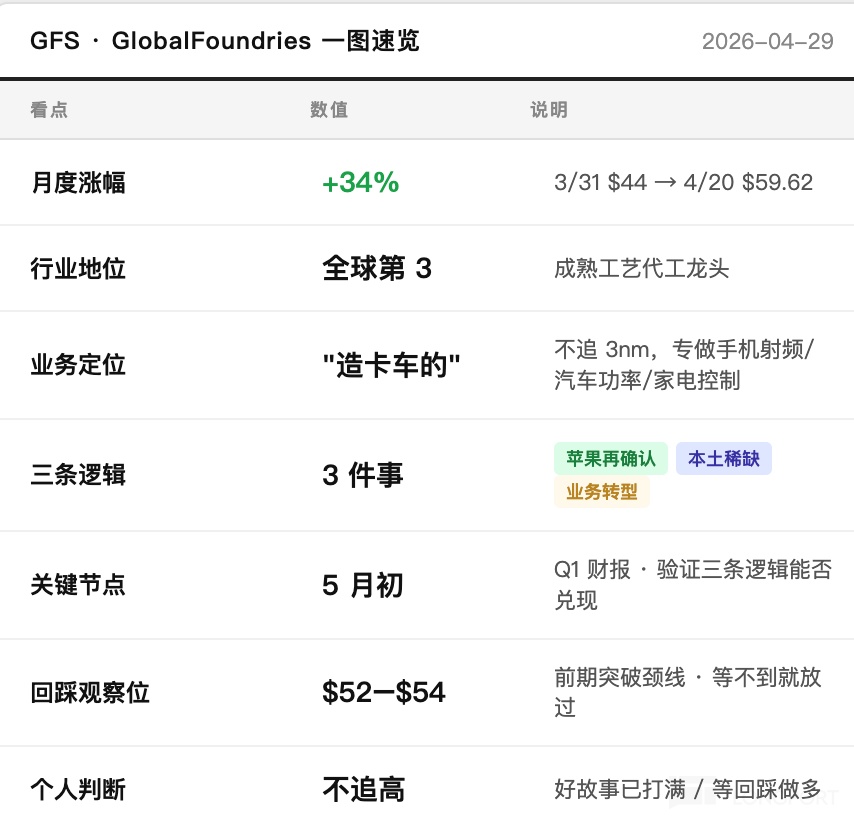
To answer this question, we first need to understand what kind of business $GlobalFoundries(GFS.US) is.
To use an analogy: If chip manufacturing is the automotive industry, TSMC builds Ferraris, Samsung builds Porsches, then GFS builds pickup trucks and heavy-duty trucks. It doesn't sound sexy, but think about it—there aren't that many Ferraris on city streets; what you see most are trucks, SUVs, and commercial vehicles. The chip world is the same: RF chips in phones, power chips in cars, control chips in appliances—these applications don't need the most advanced processes at all. Instead, they have high demands for being 'cheap, stable, and able to supply continuously for ten years.' GFS is the world's third-largest player in this 'truck' business.
Its client list validates this logic: Qualcomm, AMD, Broadcom, Sony, and recently, a very heavyweight addition—Apple.
This is why this stock has recently started to be re-evaluated by the market, with three things driving it simultaneously.
First thing: Reconfirmation of the Apple partnership. Around April 20, GFS announced it would help Apple with chip mass production at its New York fab. The market initially reacted with only a -2% move to this news, but don't be misled by the reaction—'Apple is already using GFS' for a mature-process foundry stock is like telling the market, 'Our capacity and yield can handle the volume of such a top-tier client,' which is a re-endorsement of the valuation anchor point.
Second thing: The 'US-based foundry' label has suddenly become scarce. Against the backdrop of US-China decoupling and restrictions on AI computing power exports, GFS's capacity is 100% in the US, Germany, and Singapore (with the US being the largest). This supply chain security premium was underestimated over the past few quarters and is now back on the table.
Third thing: GFS is also actively transforming itself, moving from simply selling foundry services to 'selling foundry + selling chip design modules.' This is an attempt to evolve from a 'contract manufacturer' into a 'semi-principal' company with a differentiated narrative. Once this transformation story is accepted, the valuation ceiling will be lifted.
But a dose of cold water is needed—
This stock has already priced in the good story. The $59 level has given a valuation premium to all three of the above logics, but actual realization hasn't arrived yet. How much revenue the Apple order will contribute, whether the transformation business can generate cash flow, and whether it can win that patent lawsuit with Tower—these questions will need to wait for next month's Q1 earnings report for answers. If the numbers can't support this valuation, a 15–20% pullback is normal.
I think GFS's story is good, but the price has already run ahead of the fundamentals. I won't chase it in the short term, but if it pulls back to the $52–$54 level (the previous breakout neckline), I'll take another look. My judgment is—this is a stock to 'go long on a pullback, not chase at highs,' a good sector is worth waiting for a good price.
The copyright of this article belongs to the original author/organization.
The views expressed herein are solely those of the author and do not reflect the stance of the platform. The content is intended for investment reference purposes only and shall not be considered as investment advice. Please contact us if you have any questions or suggestions regarding the content services provided by the platform.
