


Ipsos and Taikang jointly release the 2025 "Insurance Partner White Paper" - In-depth Insights Report on High-Performing Organizations
Recently, Ipsos (China) Consulting Co., Ltd. collaborated with Taikang Insurance Group to jointly release the "2025 Insurance Partner White Paper: In-depth Insight Report on High-Performing Organizations".
Following the consecutive releases of the "Insurance Partner White Paper" focusing on high-performing agents in 2022 and 2023, the two parties have once again collaborated, elevating the research perspective from "high-performing agents" to "high-performing organizations". This shift signifies that the future competitiveness of the life insurance industry no longer relies solely on individual high performers working in isolation, but rather on the ability to build professional, high-productivity, and sustainable high-performing organizations.
This white paper expands the perspective from individual high-performing agents to high-performing organizations centered around team leaders. Through the quantitative collection of 1,380 valid questionnaires and in-depth interviews with 58 high-performing team leaders, it has established a scientific assessment system for high-performing organizations, providing a practical guide for the high-quality development of the industry.
Industry's High-Quality Transformation at a Critical Stage
Currently, China's life insurance industry is in a critical period of high-quality transformation. Data shows that as of the third quarter of 2025, the number of individual insurance sales agents in life insurance companies has dropped to 2.59 million, a sharp decline of over 60% compared to the peak in 2019. However, while the workforce continues to shrink, industry premium income has been steadily growing. This fully confirms a fundamental shift in the growth logic—from scale expansion relying on "mass manpower tactics" to quality and efficiency-driven growth based on improving "per capita productivity".
Behind this profound transformation lies the dual drivers of national policy and market demand.
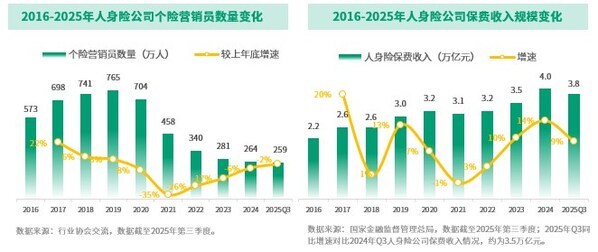
On one hand, a series of new regulatory measures, such as the "Insurance Sales Conduct Management Measures", have set higher requirements for the professionalism and vocational level of sales personnel. On the other hand, customer demand has also evolved from purchasing single products to comprehensive life-cycle solutions covering retirement, health, and wealth management. Against this backdrop, the limitations of individual high-performing agents are becoming increasingly apparent. Only by building efficient high-performing organizations can resources be integrated, collaborative operations be conducted, and the complex demands of the market be met.
High-Performing Organizations Exhibit High Education Levels and a High Proportion of High Performers
Through in-depth research on 1,229 high-performing team leaders in the insurance industry, the "White Paper" accurately depicts the core profile of high-performing organizations.
First, high-performing team leaders themselves represent high-caliber talent. Their average age is 40.5 years old, which is the prime "golden period" of their careers, combining rich practical experience with mature market understanding. A remarkable 96% of team leaders hold college degrees or higher, with bachelor's degrees being the main qualification. Nearly 70% of team leaders have seen continuous income growth in the past two years. Meanwhile, the career development confidence index shows that the confidence index of high-performing team leaders in the insurance industry is as high as 84.1%, demonstrating strong career development confidence and growth potential.
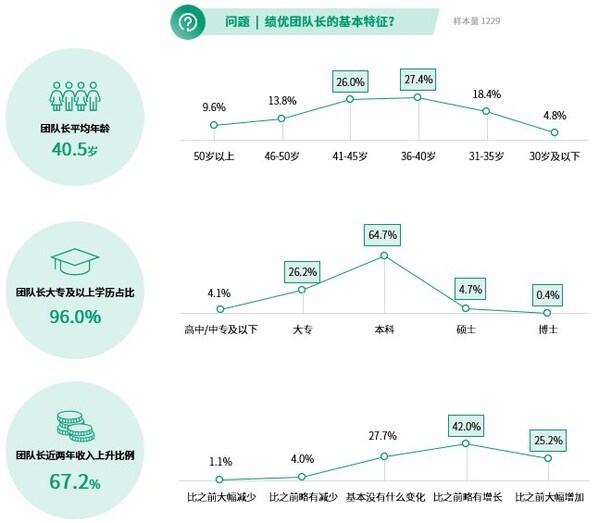
Second, high-performing organizations exhibit characteristics of being "elite and strong". The quality of organization members is extremely high. The average proportion of members with college degrees or higher exceeds 80%, and the average proportion of members meeting the company's internal high-performance standards reaches 45.6%, achieving a high-quality team ecosystem where "everyone can be a high performer".
Finally, the sources of high-performing team leaders present a diversified pattern. Over 60% (65.6%) are seasoned professionals deeply rooted in the insurance industry. Furthermore, over one-third (34.4%) of high-performing team leaders come from external industries such as finance and real estate. As integrated talents, they bring cross-industry perspectives, resources, and management methodologies into the insurance industry, injecting new vitality into organizations.
"New Life Insurance" Business Model: The Core "Engine" Attracting and Empowering High-Performing Organizations
Competitive products and the "New Life Insurance" business model, which synergizes "payment + service + investment", have become key to attracting high-performing team leaders to join and driving the success of high-performing organizations.
High-performing talents, whether from within the industry or transitioning from other fields, consider product competitiveness and the "New Life Insurance" business model as primary factors. Taking Taikang as an example, its "Happiness Appointment" product plan and "Taikang Community" retirement community provide differentiated tools for team leaders to serve high-quality clients. Additionally, team performance, customer marketing capabilities, and the deal-closing ability of organization members collectively contribute to the successful development of high-performing organizations.
Innovative High-Performing Organization Development Assessment Model Provides a Scientific Benchmark for Industry Development
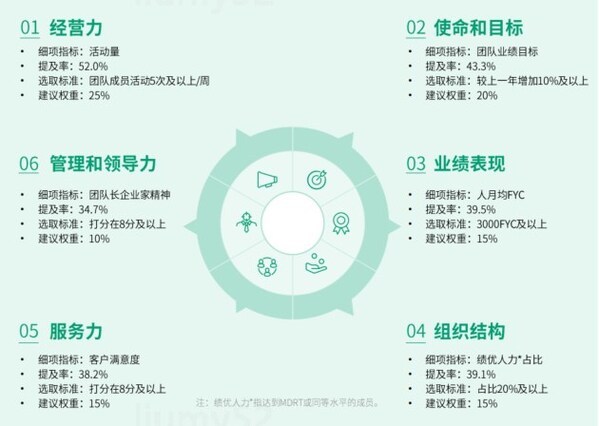
To scientifically evaluate and guide the development of high-performing organizations, the "White Paper" innovatively constructed a "High-Performing Organization Development Assessment Model" that combines theoretical depth and practical value. This model fully draws on advanced industry theoretical frameworks such as the McKinsey 7S Model, the Weisbord Six-Box Model, and the Ipsos High-Performance Team Model. Combined with in-depth interviews with high-performing team leaders and quantitative analysis of 1,380 valid questionnaires, it ultimately established a complete indicator system comprising 6 major aspects and 26 detailed items.
Based on data validation, the model further distilled six core indicators: activity volume, team performance goals, monthly per capita FYC, proportion of high-performing personnel, customer satisfaction, and team leader entrepreneurship. The release of this model provides the industry with a "golden benchmark" for measuring high-performing organizations. It not only helps insurance companies accurately identify, cultivate, and empower high-performing teams but also provides clear action guidelines for team leaders to self-diagnose and optimize management.
High-Performing Organizations Inject New Momentum into the High-Quality Development of the Life Insurance Industry
High-performing organizations form a virtuous cycle of "individual capability enhancement—organizational level improvement—enterprise stable operation—fostering individual growth" by aggregating high-caliber talent into high-efficiency teams. The "White Paper" and its accompanying assessment model jointly released by Ipsos and Taikang provide the entire industry with a replicable and implementable template and evaluation system for organizational development. The establishment of this system will help the insurance sales force comprehensively transition from extensive growth to refined, professional, and organized development, contributing solid insurance strength to building a path of high-quality financial development with Chinese characteristics.
The copyright of this article belongs to the original author/organization.
The views expressed herein are solely those of the author and do not reflect the stance of the platform. The content is intended for investment reference purposes only and shall not be considered as investment advice. Please contact us if you have any questions or suggestions regarding the content services provided by the platform.
