



Cangu's 2025 annual report, then look at the company's development logic again.
After Cango's 2025 financial report was released last week, the overall market reaction has been relatively calm. The market is now basically pricing the company entirely based on the logic of a mining company, further compounded by the weekly disclosure of mining progress, which essentially constitutes "real-time information disclosure." Expectations have been continuously digested, so a single earnings report doesn't cause significant volatility.
Let's go over the basic situation:
First, look at the revenue structure. 2025 revenue was $688 million, of which mining revenue was $676 million, with an annual output of 6,594.6 BTC. The company has essentially completed the transition of its business foundation, with mining becoming the absolute core structurally.
Profit volatility is relatively high, mainly due to the following structural factors:
First, the disposal of legacy assets in China, which the CEO summarized in the conference call as approximately $169 million. This item is not listed separately in the financial report and consists of disposal losses, taxes, and foreign currency translation, among other items.
Second, mining rig impairment, with approximately $338 million recognized for the full year, of which about $257 million was concentrated in Q2, mainly corresponding to the repricing of the 18EH equity payment transaction. This portion had already been digested by the market in Q2.
Third, changes in the fair value of BTC, resulting in a loss of approximately $96.5 million for the full year, primarily due to the impact of the coin price retreating from highs in Q4.
In addition, the company's full-year mining rig depreciation was approximately $116.6 million, included in costs, creating short-term pressure on profits.
Looking at the asset side, there are $663 million in BTC collateral receivables; mining rig net value is $248.7 million; long-term debt is $557.6 million. Leverage is still relatively high, but it's all debt from related companies, involving a financing spread issue. Current cash and cash equivalents stand at $41.2 million.
The overall impression of the financial report is that asset disposals during the company's transition period have made the income statement look rather poor, but it's not closely related to operations.
Let's talk about the AI business. The conference call actually contained quite a bit of substantive content about the AI business, with more information than the financial report itself.
1. Regarding EcoHash's Positioning
EcoHash targets more decentralized, low-latency-sensitive demands like AI inference and generative AI. It does not directly compete with traditional HPC data centers, which typically focus on large-scale, centralized training.
The logic is not hard to understand. The HPC training market is currently too heavy and concentrated, with major players having too strong an advantage. Inference computing power is more suitable to be approached with a modular, distributed method. The company's current strategy leverages the energy network and deployment experience accumulated from its original mining operations to build standardized, modular AI computing nodes.
2. AI Business Timeline
The most substantial progress currently is the deployment of the first batch of standardized AI computing nodes at the company-owned mining site in Georgia, USA.
Management remains relatively cautious, stating that the AI business is still in its early stages, validating the business model and unit economics. It has entered the deliverable stage and will contribute some revenue within the year, but no specific revenue guidance was provided.
Regarding specific project details, a modular container solution is currently being used. From start to operation, it's expected to take approximately 4-6 months, with an investment of $20 million per MW (including GPU).
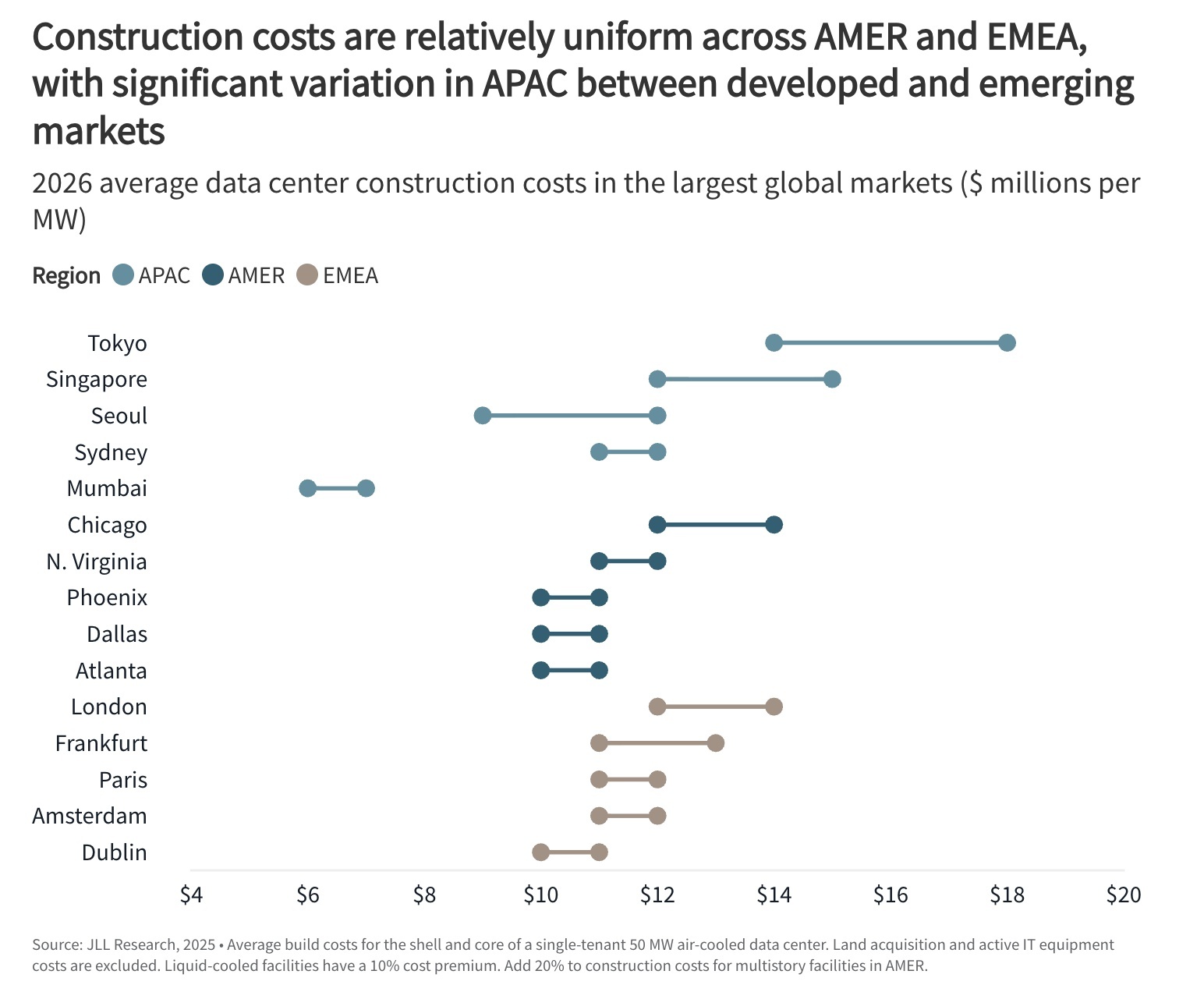
What level is Cango's CapEx at? Looking at industry benchmarks, the JLL 2026 Data Center Report shows global data center construction costs are about $11 million/MW (only civil and MEP). Fit-out costs (technical equipment including GPUs, etc.) depend mainly on the cards used, ranging widely from $7 million to $20 million/MW, with a maximum reaching $25 million/MW.
HPC pursues extremely high density and long-term operational efficiency, often resulting in higher capital expenditures. Cango's currently disclosed investment of approximately $20 million/MW falls within a reasonable range for small-scale pilot projects. The current stage is primarily focused on getting the Georgia pilot running smoothly while ensuring overall liquidity and balance sheet safety.
Another number to reference for this business's expectations: management mentioned that in the medium to long term, it can connect to a 1.2GW energy network. However, it's not suitable to have too high expectations now, as details about customers, gross margins, and subsequent capital expenditures are not yet clear.
Although the company's current investment in AI remains relatively restrained, with no large-scale capital expenditures in the short term, at least this business doesn't seem like a distant prospect anymore.
3. Company Valuation Logic
This mainly concerns how to value the company after the AI business is developed. Management's view is that mining remains the foundation, with AI as the incremental growth engine, positioning it as a computing platform capable of flexibly dispatching energy and computing power. They mentioned an interesting framework using the "revenue per megawatt" metric, which is the economic value per unit of electricity.
I've expressed similar logic before. Whether it's mining or AI computing power, whichever can contribute more revenue and profit, adjust dynamically. The company will definitely allocate resources to the direction with higher returns.
For the mining line, the core lies in whether costs can stabilize. The Q4 2025 cost per coin (excluding depreciation) was $84,552, and the all-in cost (including depreciation) was $106,251. With the global hash rate still rising, theoretically, only when the coin price returns to this level can the company's new capital potentially return to this area.
The company has no clear plans to invest significant capital in purchasing new mining rigs. Simultaneously, it is systematically phasing out old, high-energy-consumption mining rigs and gradually migrating some of its hash rate to regions with lower electricity prices. In the short term, the total hash rate scale of 50EH/s may decline. The overall fleet efficiency should improve, and the cost per coin should also decrease.
For the AI line, we'll see which reporting period this year can provide specific operational numbers. With the current 1-2MW pilot and a 4-6 month deployment cycle, clear indicators like customers, order quantities, and MW utilization rates need to be filled in.
Two institutions tracking small-cap stocks, H.C. Wainwright and Greenridge Global, have given a target price of $3, for reference. This likely considers the company's net assets of $390 million plus some premium for mining and AI.
As of Friday, the stock price was $0.42, and the current net asset per share is $1.1. It's worth keeping an eye on.$Cango(CANG.US) $Strategy(MSTR.US)
The copyright of this article belongs to the original author/organization.
The views expressed herein are solely those of the author and do not reflect the stance of the platform. The content is intended for investment reference purposes only and shall not be considered as investment advice. Please contact us if you have any questions or suggestions regarding the content services provided by the platform.
