


Deshi-B (2526.HK) is in the IPO process, raising 832 million, oversubscribed over 35 times, model licensing fees have grown significantly, valuation space has opened up.
Deshi-B (2526.HK), a company with a medical imaging foundation model, started its IPO subscription on March 20, with the subscription period from March 20, 2026, to March 25, 2026. It is expected to list on the Hong Kong Stock Exchange on March 30, 2026.
The company plans a global offering of 7.9992 million shares (no over-allotment option, no volume adjustment right), representing 9.00% of the issued share capital. The indicative price range is HKD 95.60 to HKD 112.50. The public offering portion has only about 16,000 board lots available for subscription, which is relatively small. If there are many subscribers, it's highly likely there won't be enough to go around. The minimum subscription fee per board lot is approximately HKD 5,681.73.
Based on the mid-point of the price range at HKD 104.05, the total funds raised would be approximately HKD 832 million. This offering uses Allocation Mechanism B, with a fixed 10% for the public offering and no mandatory clawback. The international placing portion can subscribe to about HKD 749 million. According to market sources, the international placing was oversubscribed by more than 2 times on the first day. The post-issue total market capitalization is estimated to be around HKD 9.248 billion, with the H-share market cap also at HKD 9.248 billion (near the threshold for inclusion in Stock Connect).
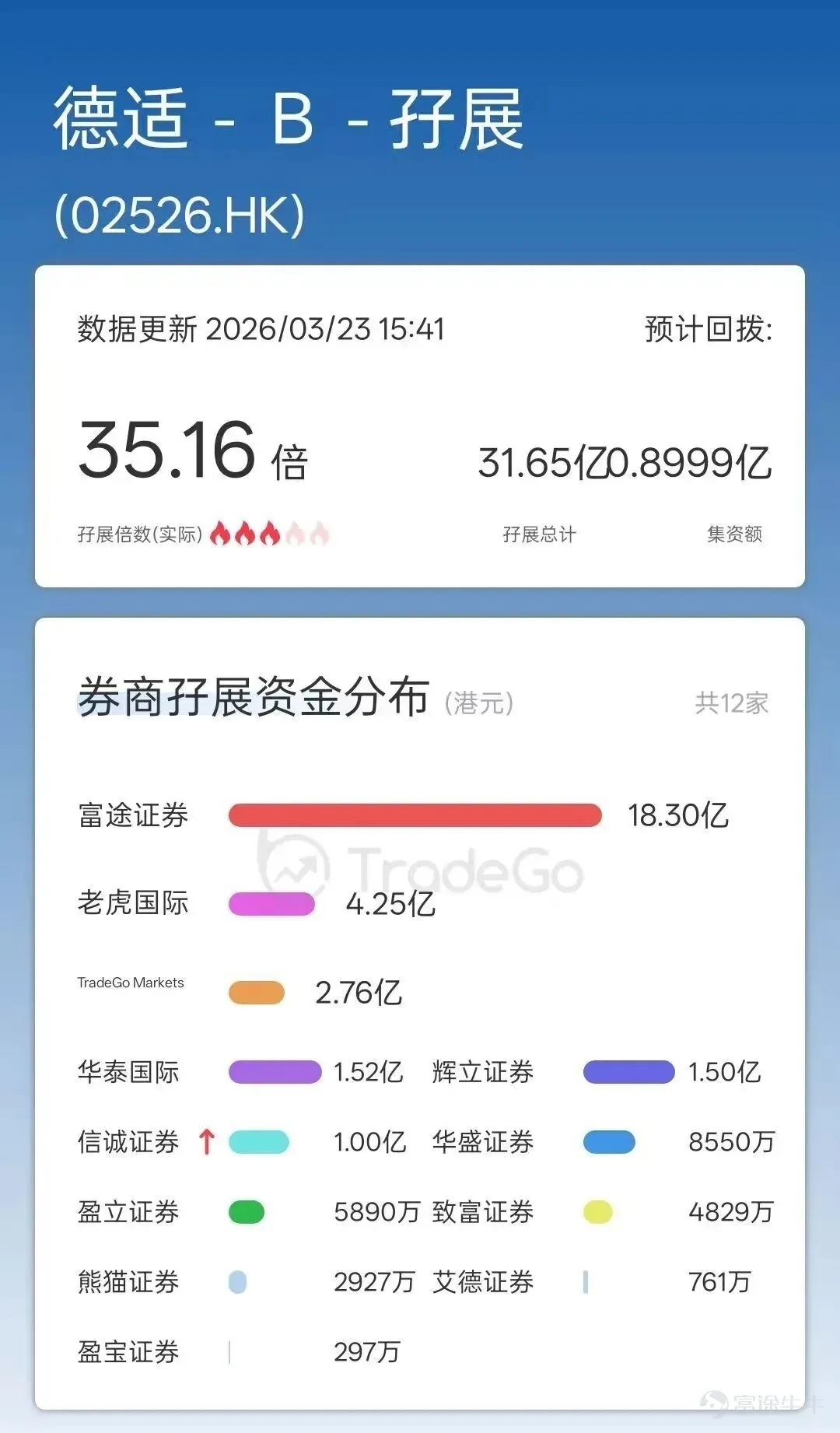
According to TradeGo's IPO margin financing data, as of 3:00 PM on March 23, the total margin financing subscription for Deshi-B reached about HKD 3.165 billion, with a margin financing subscription multiple of approximately 35.16 times. Among them, Futu Securities, Tiger Brokers, and TradeGo Markets provided HKD 1.83 billion, HKD 425 million, and HKD 276 million in margin financing, respectively.
On the business front, for the first nine months of 2025, the company's business structure was primarily divided into: 1) Medical imaging software and medical devices, 2) Technology licensing, 3) Analysis and consulting services, and 4) Others. Their revenue contributions were 43.6%, 51.4%, 3.1%, and 1.9%, respectively.
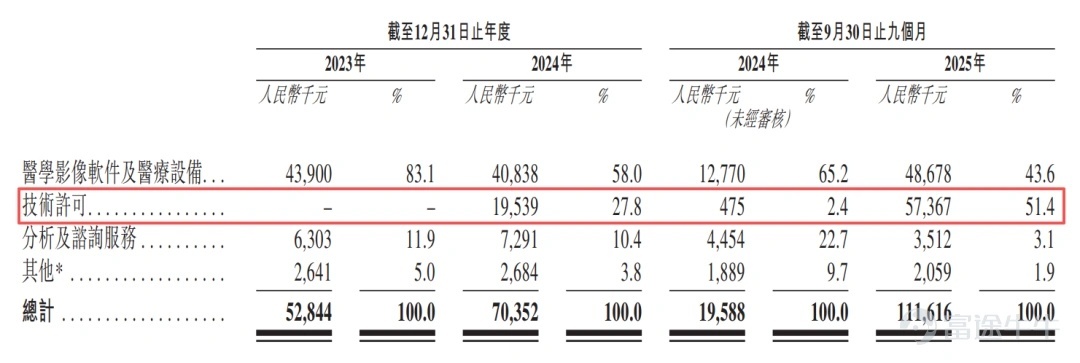
Notably, the company's technology licensing business performed exceptionally well in 2025, with revenue of approximately RMB 57 million, accounting for 51.4% of total revenue, representing a growth of over 193% compared to the full year of 2024. This marked the first time its revenue share surpassed that of the medical imaging software and devices business, making it one of the company's new business pillars.
In detail, the company began operating this business segment in September 2024. It primarily charges customers (currently including digital infrastructure service providers, research institutions, medical technology companies, and medical institutions) licensing fees for using its iMedImage® foundation model via the iMed MaaS® platform.
Furthermore, Deshi can provide services ranging from data upload and processing to model training and deployment, supporting zero-code construction of medical imaging model training workflows. This helps users quickly build and optimize medical imaging analysis models on cloud platforms or through localized deployment.
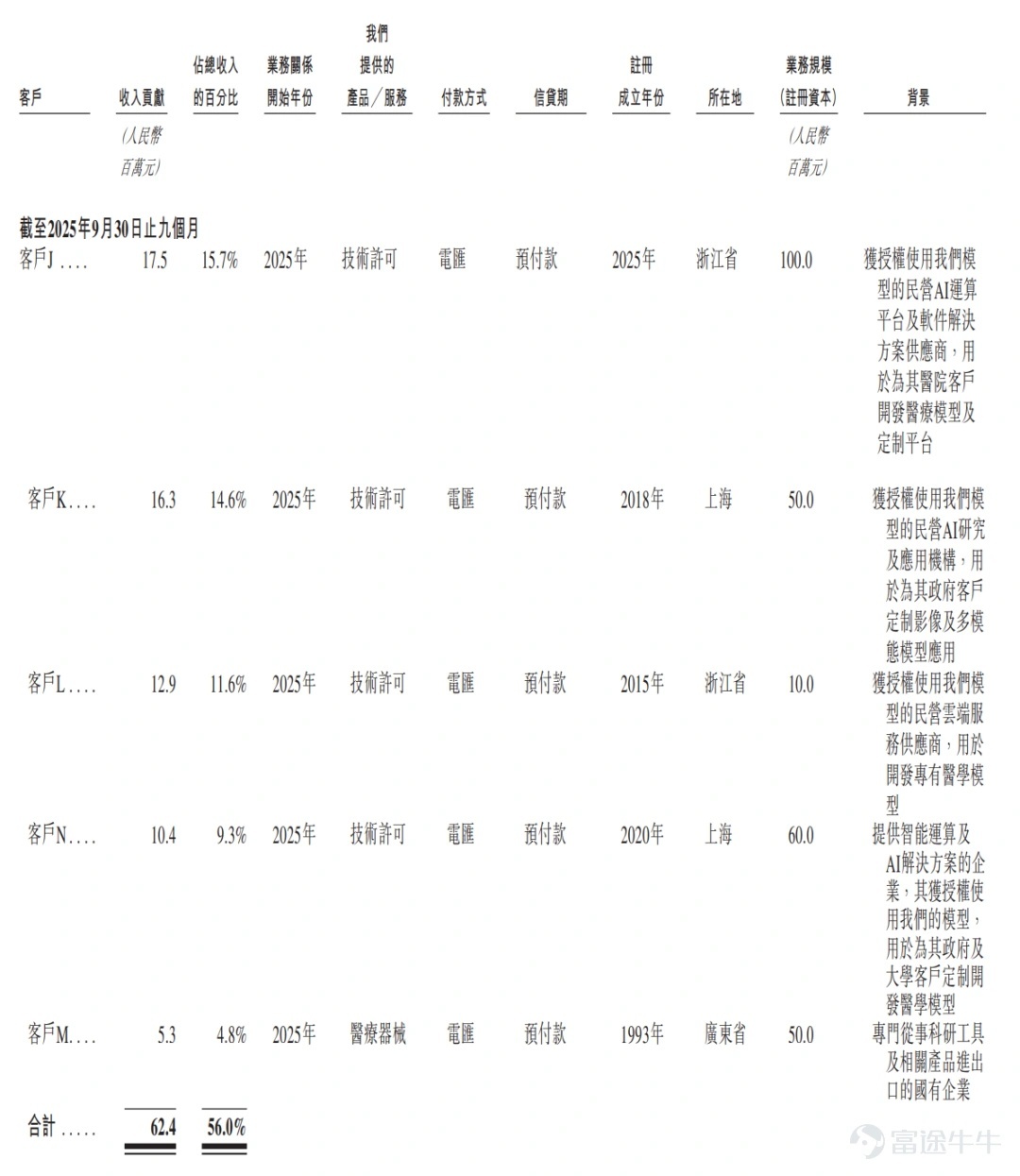
Additionally, looking at the top five customer structure, the top four major customers all came from the technology licensing business (model licensing fees). This directly reflects that this business is not driven by a single large order from one customer but is composed of multiple customers. This, in turn, validates that the company's model is highly competitive in the market and significantly expands the imagination for the sustained growth of this business.
Financially, the company's revenue for the past two years and the first nine months of 2025 was RMB 53 million, RMB 70 million, and RMB 112 million, respectively, representing year-on-year growth of 33.13% and 469.82%. The growth in the first nine months of 2025 was mainly attributable to: 1) increased product and service sales driven by an expanding customer base for medical imaging software and devices, and 2) significant revenue growth from technology licensing (model licensing fees) as it gained market recognition.
In summary, at first glance, Deshi-B appears to be just another medical device company, seemingly unremarkable. However, upon a deeper analysis of its business structure and growth drivers, its essence is revealed not as a device company, but as a medical technology company centered around its "medical imaging foundation model."
More importantly, its business model has been validated, with existing customers willing to pay for its model, moving beyond the stage of having technology without a clear monetization path. The valuation logic between these two scenarios is clearly not comparable.

The copyright of this article belongs to the original author/organization.
The views expressed herein are solely those of the author and do not reflect the stance of the platform. The content is intended for investment reference purposes only and shall not be considered as investment advice. Please contact us if you have any questions or suggestions regarding the content services provided by the platform.
