



The truth behind 30 billion in revenue: Uni-President is experiencing a "silent recession".
In the cyclical fluctuations of China's consumer industry, scale breakthroughs are often both milestones and turning points.
Recently, Uni-President China released its 2025 report card: annual revenue of 317 billion yuan, a year-on-year increase of 4.6%; net profit attributable to shareholders of 20.5 billion yuan, a year-on-year increase of 10.9%.
Both scale and profit reached record highs, but beneath this glossy report, a more interesting change is emerging: instant noodles have once again become the growth engine, while beverages, the once solid foundation, are beginning to show signs of fatigue.
On one hand, products like "Man Han Feast" and "Tomato King" are accelerating volume growth through channel and category innovation; on the other hand, classic items like "Uni-President Green Tea" and "Assam Milk Tea" are entering maturity, making it harder for new products to take over.
Standing at the new starting point of 300 billion yuan, Uni-President is no longer just facing growth issues, but rather how to restructure its growth model in an era of stock consumption and navigate through industry cycles.
The growth structure is changing, with the food business re-emerging as the "core engine"
For over a decade, Uni-President China's growth narrative has always revolved around the logic of "beverages as the main driver, food as a supplement." However, the 2025 financial report data ruthlessly shattered this inertial perception.
The report shows that the food business achieved annual revenue of 104.9 billion yuan, a year-on-year increase of 5%. Not only did it return to the 100-billion-yuan scale, but its growth rate also surpassed that of the beverage segment for the first time, becoming the group's stable growth engine. This also means that Uni-President has completed a passive "value breakthrough" in the stock market through extreme product stratification and channel restructuring.
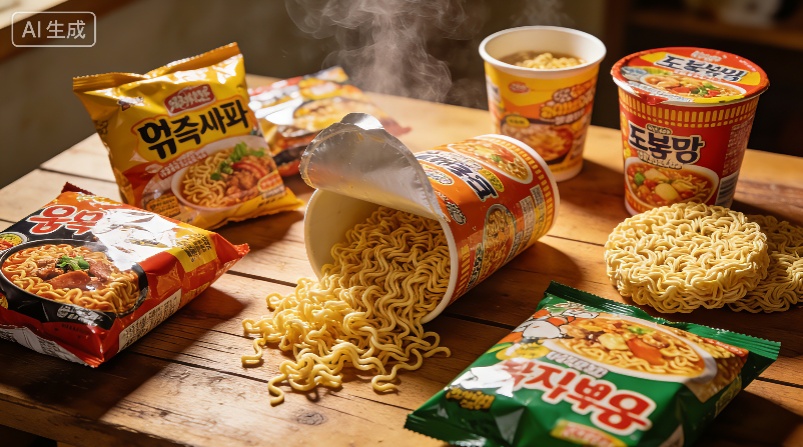
Image generated by Doubao AI
In recent years, new instant noodle products represented by premiumization have continuously emerged, with unit prices gradually extending from the past 3-4 yuan to over 10 yuan. According to industry data, the growth rate of premium instant noodles (unit price ≥8 yuan) reached 20%, and the market size of functional instant noodles exceeded 5 billion yuan.
Uni-President has precisely seized this trend.
In Uni-President's product matrix, "Soup Master" remains the most solid foundation. Products centered on the pork bone flavor have maintained stable market share by continuously strengthening their single-product positioning. At the same time, the company has extended consumption scenarios from main meals to light meals and snacks by introducing innovations like mini-cups.
In contrast, the growth of "Tomato King" comes more from differentiated positioning. Centered on the tomato flavor, this brand has opened up a new market segment beyond traditional instant noodle flavors. This also reflects how Uni-President has completed a passive "value breakthrough" in the stock market through extreme product stratification and channel restructuring.
What truly surprised the market was the explosion of "Man Han Feast." Uni-President collaborated with Sam's Club to launch customized products, including lamb braised noodles and black pork minced meat mixed noodles, which quickly gained volume in family consumption and stockpiling scenarios.
Uni-President is reshaping instant noodles from a traditional "emergency food" into a higher-quality fast-moving consumer good. This reflects Uni-President's new survival philosophy in the instant noodle track: no longer blindly pursuing scale expansion, but instead seizing high-value shares in a shrinking total market through product upgrades and channel innovation.
The beverage empire is gradually fading, and Uni-President needs to accelerate its transformation
The recovery of the food business can be considered a carefully planned breakthrough, while the stagnation of the beverage segment is more like an unavoidable "midlife crisis."
In 2025, Uni-President's beverage business revenue was 194.7 billion yuan, a mere 1.2% year-on-year increase, far below the industry average and in stark contrast to its stellar performance in recent years. As the former cash cow, tea beverages, while still maintaining positive growth, have seen an undeniable cliff-like decline in growth rate.
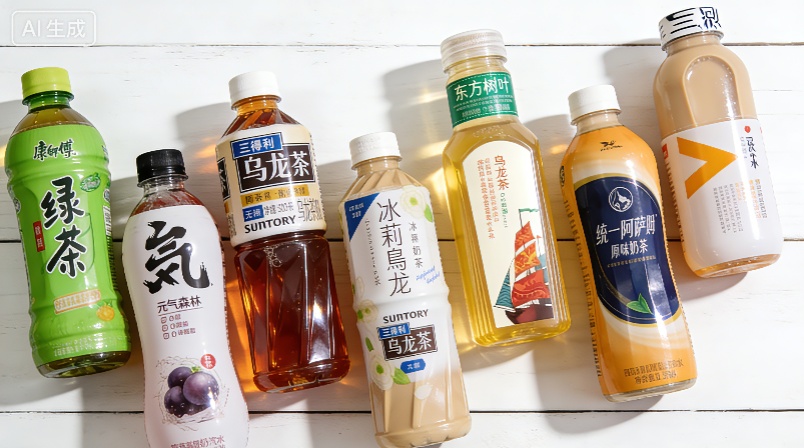
Image generated by Doubao AI
The crux of the problem lies in the severe aging of the product structure. The cornerstones of Uni-President's beverage empire—Uni-President Green Tea, Iced Black Tea, and Assam Milk Tea—these core products that have supported tens of billions in revenue, have generally been on the market for over 15 years.
In today's world, where the life cycle of fast-moving consumer goods is extremely compressed, these "veterans," while still contributing cash flow due to strong brand inertia and channel penetration, are rapidly losing their appeal to young consumers.
Facing the explosive growth of the sugar-free tea segment, Uni-President appears to be faltering. While Dongfang Shuye, Suntory, and Genki Forest are making inroads in the sugar-free field, Uni-President, despite following suit, has failed to create a dominant new-generation blockbuster product.
The juice business continues to be under pressure from the impact of high-concentration NFC juices, and ready-to-drink milk tea is also gradually sliding from an incremental market into the quagmire of stock competition.
To alleviate growth anxiety, Uni-President has tried to patch up its reports through channel sinking and OEM business. It has increased its presence in emerging channels like bulk snack stores and instant retail, attempting to tap into family consumption scenarios with large-packaging strategies; at the same time, it has taken on OEM business through strategic alliances to improve capacity utilization.
However, this "robbing Peter to pay Paul" strategy is fraught with hidden dangers. Emerging channels often come with more intense price competition, and while the OEM business can bring inflated revenue figures, its low gross margin makes it difficult to contribute substantial profits.
Under the dual pressures of rising costs and drastic changes in channel structure, Uni-President's beverage business is facing the awkward situation of "old products not selling well and new products not taking over," and the foundation of its long-term profitability is being shaken.
The cruel revelation of the stock era: the life-and-death game between blockbuster product reliance and structural optimization
From the rise of instant noodles in the 1980s, to the golden age of beverages in the 2000s, to today's stage of stock competition, Uni-President has almost experienced the complete cycle of China's consumer industry. Its ups and downs provide a cruel and realistic revelation for the entire retail industry.
First, blockbuster products remain the most solid moat for consumer brands, but they can also be the biggest path dependency. Whether it's "Soup Master" or "Assam Milk Tea," what has truly supported Uni-President through the cycles are always those super products that can transcend the dimension of time.
However, success and failure both lie in blockbuster products. When core blockbuster products collectively enter maturity or even decline, and a new succession echelon has not yet formed, a growth gap for the enterprise becomes inevitable.
Second, the evolution of channels is reshaping the life-and-death landscape of brands. The rise of new channels like membership stores, bulk snack stores, and instant retail is not just an increase in sales terminals, but a reconstruction of consumption logic.
Traditional FMCG companies, if they cannot adapt to new traffic inlets and consumption scenarios, will inevitably be marginalized even if they possess strong brand power.
Finally, in a stock market, the essence of growth is no longer simple scale expansion, but painful structural optimization. Whether it's the premiumization transformation of instant noodles or the sugar-free breakthrough of the beverage business, it is essentially companies finding new value space in a mature market.
For Uni-President, 30 billion yuan in revenue is by no means a finish line worth celebrating, but a new starting point full of crises. Whether it can achieve the ambitious goal of "50 billion in five years" in the future does not depend on how many conceptual new products it can create, but on whether it can completely rebalance its product matrix, channel structure, and brand mindset amidst the violent fluctuations of the consumption cycle.
Author: Turkey Hot Air Balloon
Source: Hong Kong Stock Research Society
The copyright of this article belongs to the original author/organization.
The views expressed herein are solely those of the author and do not reflect the stance of the platform. The content is intended for investment reference purposes only and shall not be considered as investment advice. Please contact us if you have any questions or suggestions regarding the content services provided by the platform.
