


 Posts
Posts Likes Received
Software Will Eat AI,软件将吞噬 AI
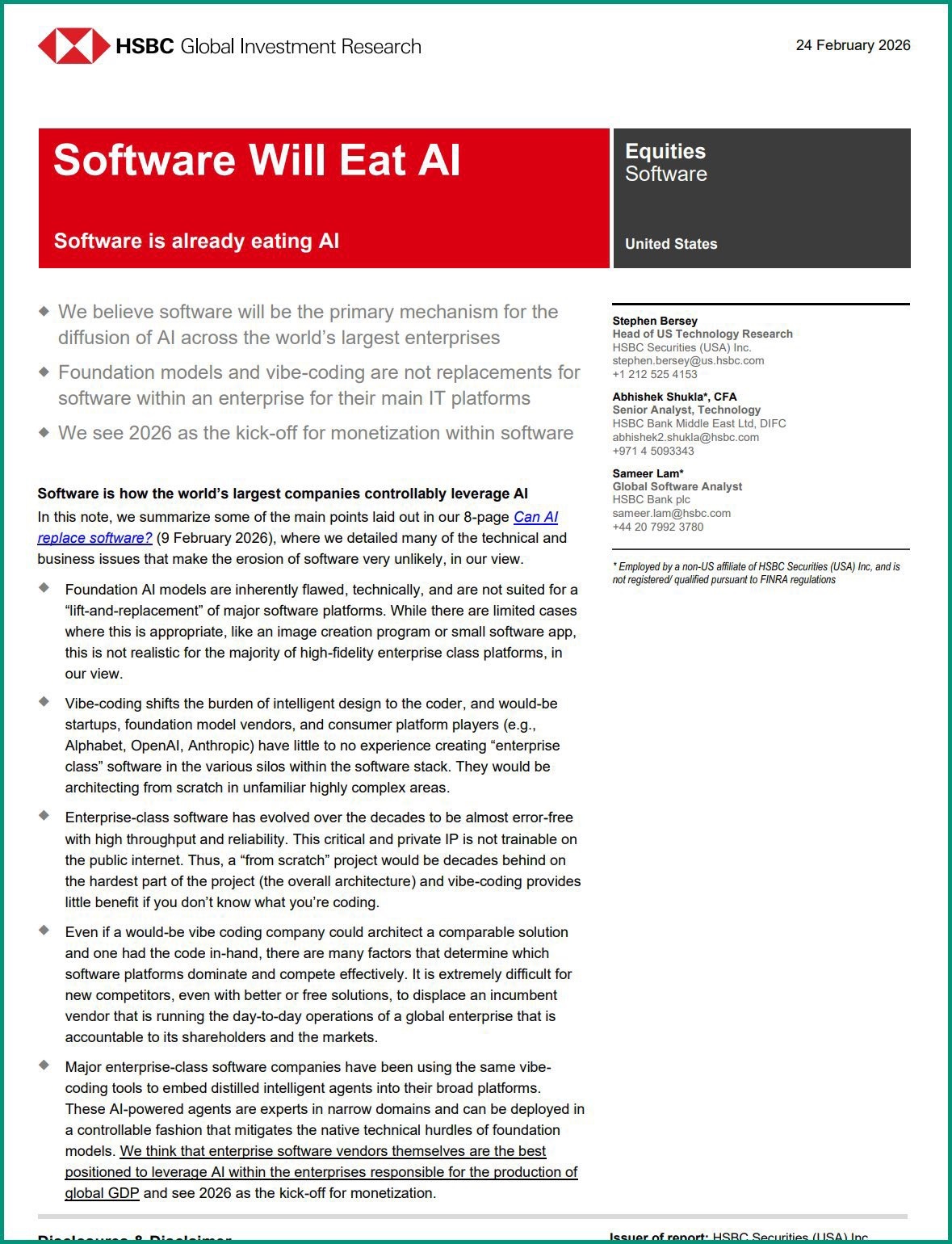
This HSBC Global Investment Research report (published on February 24, 2026, titled “Software Will Eat AI”) is actually a sharp counter-argument in the current AI frenzy debate about "Will AI replace enterprise software?" The main author is Stephen Bersey (Head of US Technology Research at HSBC), along with other analysts. The core thesis is very clear: It's not AI eating software, but software is already eating AI.
- Main Title and Core Judgment
- Software is already eating AI.
- Software is the primary way and vehicle for the world's largest enterprises to adopt AI at scale in a "controlled" manner.
- Foundation models (like those from OpenAI, Anthropic) + "vibe-coding" (roughly referring to generating code directly from natural language prompts) cannot fundamentally replace existing core IT platforms and software systems of enterprises.
- 2026 is the kick-off year for truly monetizing AI at scale at the software level (kick-off for monetization within software).
- Why can't AI replace enterprise software? (They listed several hardcore reasons)
- Foundation models have fatal flaws: Technically unreliable, cannot "lift-and-replace" those high-precision, highly reliable enterprise-grade platforms. Only suitable for small scenarios like generating images or small tools, but completely unrealistic for "high-fidelity" systems like banking, ERP, supply chain, and core databases.
- Vibe-coding (prompt-based coding) shifts the entire burden of intelligent design onto coders: You need to deeply understand architecture yourself. Those AI companies (OpenAI, Anthropic, Google, etc.) and consumer-level players have no experience building "enterprise-grade" software stacks from scratch. Starting from the most difficult part in highly complex domains is basically unworkable for them.
- Enterprise software has evolved for decades, with near-zero errors, high throughput, and high reliability: This critical private intellectual property (IP) is not trained on the public internet. Vibe-coding is useless even if it generates amazing code, if it doesn't understand the overall architecture.
- Even if AI companies could produce similar code, it's very difficult to replace the existing giants: The competitive moat of enterprise software is not the code itself, but who runs the customer's daily operations and who is accountable to shareholders and the market. Switching to a new player (even if free or better) is extremely difficult due to huge switching costs and high risks.
- Large enterprises have long started taming AI into their own platforms: Using "distilled intelligent agents," which are super-specialized in narrow domains and controllable, unlike foundation models that can go off the rails. Therefore, those who will truly profit the most from AI are the established enterprise software players (Salesforce, Oracle, Microsoft, Palantir, etc.).
- Their Implied Market View
- Many in the market now panic that "AI is going to disrupt software stocks," causing software stocks to be hit hard (especially Indian IT services stocks and some traditional software stocks).
- But HSBC believes this panic is wrong and even a buying opportunity. They believe AI will ultimately complement rather than replace core enterprise platforms, and software companies will use AI to expand their market and increase value.
- A prior report ("Can AI replace software?" from February 9, 2026) detailed various technical and commercial issues, concluding: the likelihood of software being eroded by AI is extremely low.
In one sentence
This HSBC report is essentially saying: Don't panic, AI is not here to destroy the software business; it's here to give it wings. The real big money will be made by those established software vendors already running in the core systems of enterprises, not by pure AI model companies. Starting in 2026, this wave of AI dividends will be truly realized and monetized through software.
$Adobe(ADBE.US) $Oracle(ORCL.US) $Palantir Tech(PLTR.US)
$Salesforce(CRM.US) $Unity Software(U.US) $Microsoft(MSFT.US)
The copyright of this article belongs to the original author/organization.
The views expressed herein are solely those of the author and do not reflect the stance of the platform. The content is intended for investment reference purposes only and shall not be considered as investment advice. Please contact us if you have any questions or suggestions regarding the content services provided by the platform.
