


 Likes Received
 Rate Of Return
🚀🔥$Tesla(TSLA.US)'s Most Underestimated Lethal Power: When Others Are Looking for Customers, It Is the End Market Itself
Most companies are worrying about "who to sell to."
Battery factories need to find automakers or energy storage customers.
Chip factories need to find cloud service providers or smartphone brands.
Robotics companies have to knock on the doors of warehouses and factories.
But $Tesla(TSLA.US)'s structure is different.
Almost everything it produces has an internal destination.
This is not simple vertical integration.
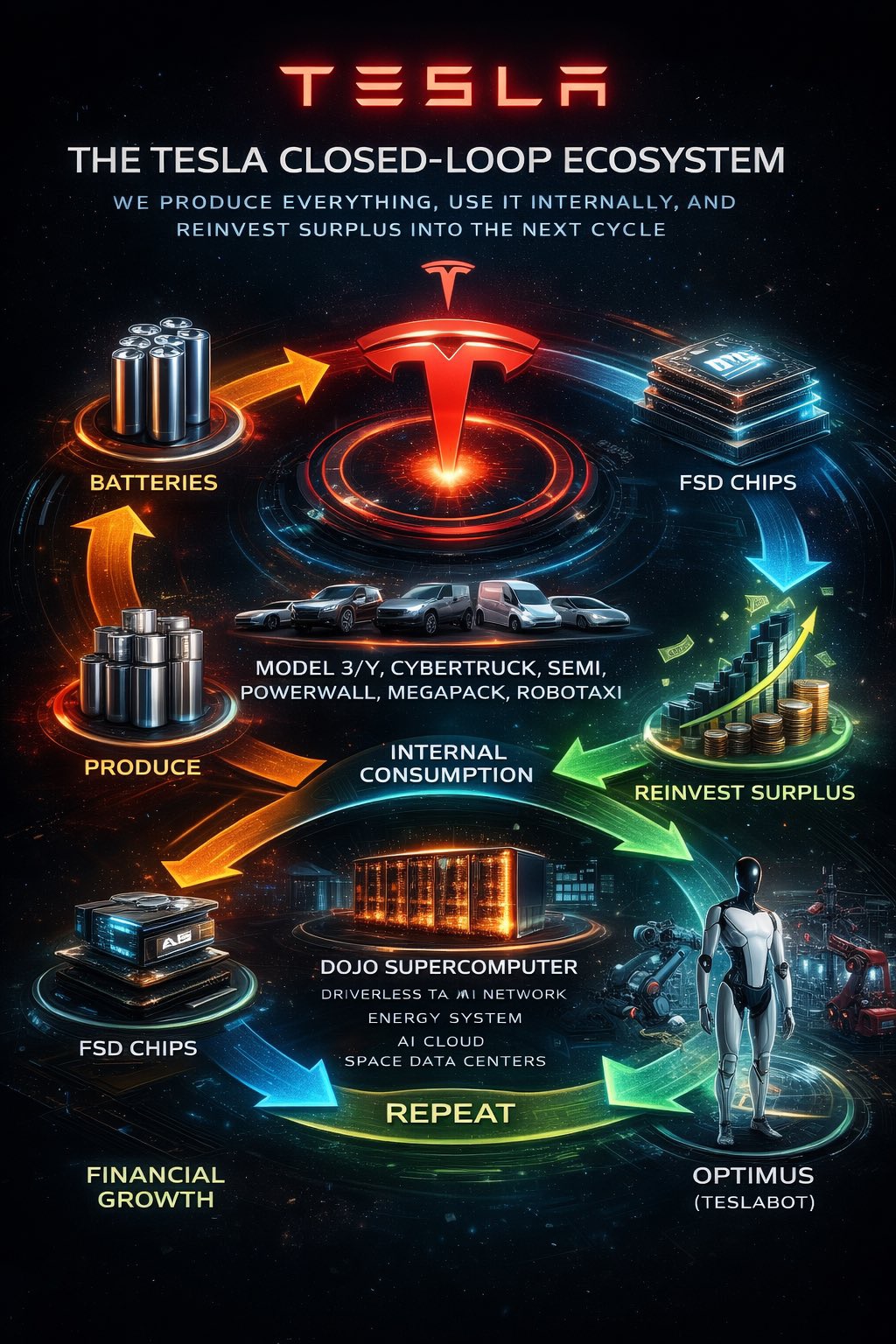
This is a "self-produce, self-consume" circular architecture.
First layer: Batteries.
After the 4680 batteries are produced,
they go directly into Model 3/Y, Cybertruck, Semi, Powerwall, Megapack, and the future Robotaxi fleet.
Internal absorption is the main focus; external sales are not a core variable.
This means the risk of capacity expansion is relatively controllable.
Because the demand side is within its own system.
Second layer: Autonomous driving computing and chips.
From HW4 to AI5, and subsequent platforms,
self-developed chips are prioritized for vehicles and Dojo training.
If inference and training demands continue to grow,
computing power consumption can be prioritized for internal absorption.
A theoretical extension is to use surplus computing power for broader cloud service scenarios.
Once computing power is combined with the Starlink network,
data processing capabilities at the edge and orbital levels will be redefined.
Whether such visions can be fully realized still requires time to verify,
but the structural logic is clear:
Production → Internal application → Expansion into new scenarios → Reinvestment.
Third layer: Optimus.
If the mass production schedule in 2026-2027 materializes,
the first batch of deployments will most likely be in Tesla's own factories.
When robots are used on its own production lines,
they are both products and cost-optimization tools.
The more internal deployments, the faster the marginal cost declines.
By the time external sales begin, economies of scale have already been formed.
The key point is, this is a "closed-loop cash flow cycle."
Technological assets produced
are prioritized to strengthen its own ecosystem.
After strengthening, they then spill over externally.
This differs from the linear path of traditional companies: "Production → Sales → Settlement → Reproduction."
What's truly worth pondering is:
If the revenue structure gradually shifts from vehicle sales to Robotaxi, energy systems, automation, and AI services,
will the market redefine $Tesla(TSLA.US)'s valuation model?
When a company is both the supplier and its own largest customer,
will its growth curve become more stable, or more dependent on execution?
What competitors find difficult to block is not a single product,
but this circular system itself.
Only one question remains:
Do you think $Tesla(TSLA.US)'s main source of future revenue
will still be automobiles,
or will it shift towards the autonomous driving network and robotics ecosystem?
📬 I will continue to dissect $Tesla(TSLA.US)'s structural changes and long-term cash flow logic, tracking how AI and automation reshape industry boundaries.
If you are interested in long-term industrial restructuring and capital structure changes, welcome to subscribe.
The copyright of this article belongs to the original author/organization.
The views expressed herein are solely those of the author and do not reflect the stance of the platform. The content is intended for investment reference purposes only and shall not be considered as investment advice. Please contact us if you have any questions or suggestions regarding the content services provided by the platform.
