


 Likes Received
 Rate Of Return
<p>Bros, <span class="security-tag" type="security-tag" counter_id="ST/US/TSLA" name="Tesla, Inc." trend="0" language="en">$Tesla(TSLA.US)</span> is still falling so much today! I get trapped every time I enter. Coming to pick people up. Last night's night market was stagnant, and at market open, seems like it's over. I can't sleep if it doesn't fall! Losing money, now I see clearly. Bought and crashed it, not rising, not even pretending, so shameless. Watch the show, this nasty character, bagholding. Taking a short position on the main board, going strong tonight! Watch the earnings report, bro, let's go! What price did everyone get in at? Well sold, boss. Fell into a trap, chip.</p>

🚨⚡While others are still arguing about whether AGI will come, Elon Musk has already built a 1.2GW computing power factory.
Many people hear Elon Musk say "AGI within five years," "large-scale humanoid robots reshaping the workforce," "AI will rewrite the structure of healthcare and production," and their first reaction is—too fast, too exaggerated.
But what I care more about is not what he said, but what he has already built.
The reason Musk's predictions are worth listening to is not because he sees far, but because he will personally lay the infrastructure in advance.
While most people are still discussing model capability curves, he is already solving problems of power, cooling, water resources, and computing network synchronization.
This is not storytelling.
This is industrial-scale deployment.
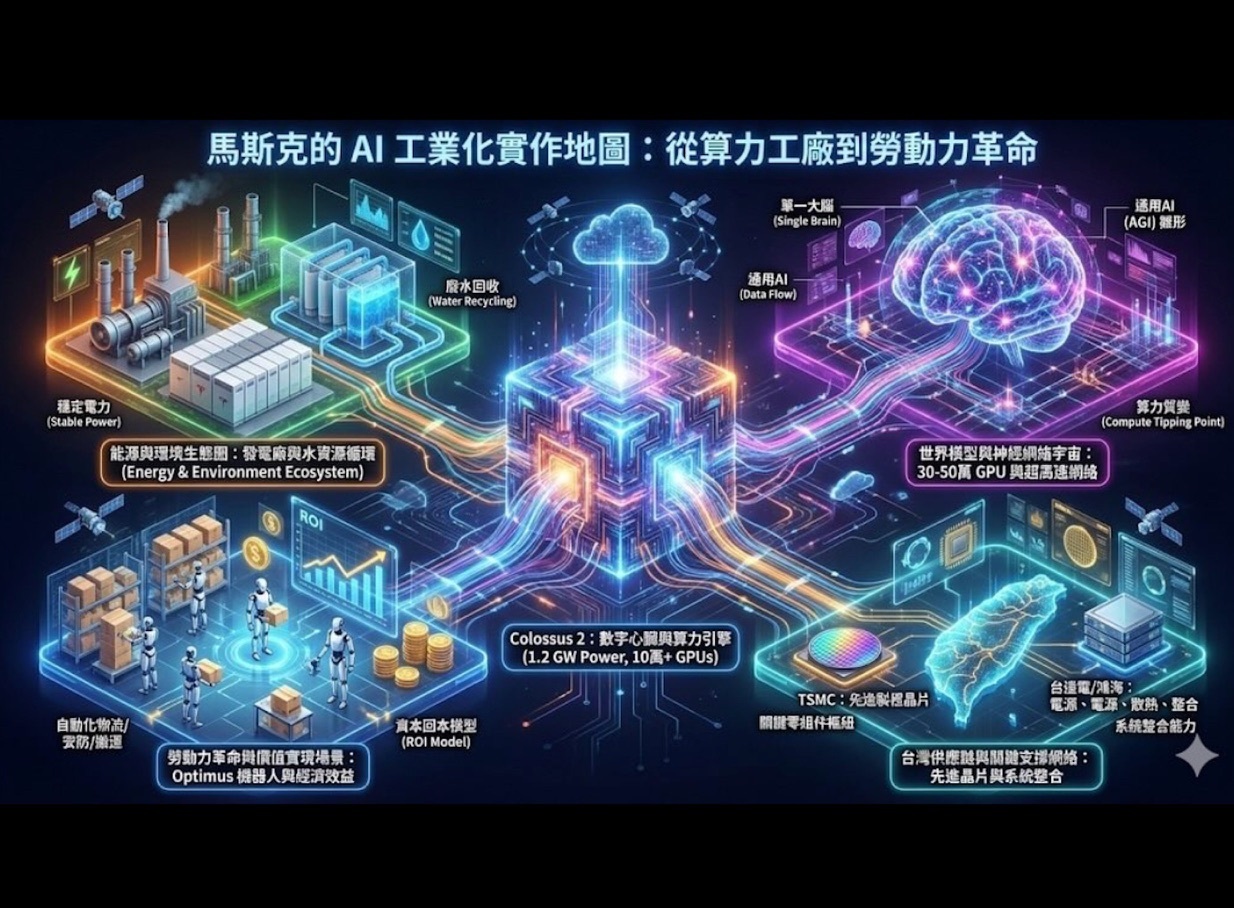
Take the super-large AI factory Colossus 2 built by xAI as an example. Its target power consumption is directly set at 1.2GW—close to the electricity consumption of two million households.
This is no longer a "data center" in the traditional sense.
This is a computing system that must be designed to "power plant grade."
The problem has never been land, but electricity.
When the local grid cannot stably provide this level of load, the solution is not compromise, but turning to abandoned power plant sites to build an energy system independently.
To avoid instantaneous voltage fluctuations causing hundreds of thousands of GPUs to fail in synchronization, they introduced a large number of natural gas turbines, paired with hundreds of Tesla Mega Pack energy storage systems.
The core goal is just one word—stable.
At this scale, GPUs are not afraid of being expensive.
They are afraid of crashing.
One training interruption could mean millions of dollars in costs going to zero.
The cooling system also adopts industrial-grade thinking.
Starting from the chip level, heat is directly removed through cold plates, then sent into a large circulation system, and finally handled by hundreds of air-cooled chillers for heat dissipation.
More critical is the water source.
To avoid extracting underground drinking water, xAI built a large wastewater recycling and treatment plant locally, using ceramic membrane bioreactor technology to convert urban sewage into high-purity cooling water.
What does this mean?
It means this system, from its initial design, considered long-term stable operation, free from resource bottlenecks.
If you see these as just engineering details, you will miss the real structural change.
The real question is—
Why would an AI company force itself into this industrial scale?
Because the goal has never been "a chat model."
It's "the infrastructure for sustainably training world models."
When 300,000, 500,000 GPUs are used as a "single brain" through high-bandwidth, low-latency network architecture, computing power undergoes a qualitative change.
Network architecture is no longer a supporting role, but a core competitive advantage.
If synchronization efficiency drops, training efficiency is directly halved.
Energy, cooling—all lose their meaning.
All this ultimately points to the same endpoint—
Turning computing power into replicable labor.
At this point, humanoid robots are no longer out of place.
When world models are repeatedly trained, iterated, and optimized in factories of this grade, the problem for robots is no longer "how human-like they are," but "whether they can stably execute tasks, whether they can calculate ROI."
This precisely corresponds to the real shift in the current industry.
From general fantasy to specialized implementation.
Security, guidance, logistics, simple handling.
Not pursuing perfect operation, only pursuing non-interruption and error-free execution.
As long as efficiency reaches half that of humans, companies are willing to adopt it, because a payback model of two to three years can already be established.
This is not science fiction.
This is a reality that capital has already begun to accept.
Zooming the perspective out a bit, one can understand why Taiwan is becoming increasingly critical on this path.
When AI enters the industrialization stage, the truly scarce resource is only one—
The key components and integration capabilities that make the system run.
The most advanced AI chips are highly concentrated in $Taiwan Semiconductor(TSM.US).
High-density servers, power supplies, cooling, and system integration capabilities have long been mastered by $2382 and $2317.
When you want to build an AI factory consuming 1.2GW of electricity, you cannot bypass these links.
This is not a narrative.
It's physical reality.
Looking back, you'll find Musk never convinces the market first and then slowly finds a way.
He first secures the power, handles the water, connects the computing network.
Then he turns back and tells you—it's just a matter of time.
What's truly worth thinking about is not whether to believe the prophecy.
But when AI has already entered the industrial-scale implementation stage, are you still trying to understand it by "looking at models, looking at themes"?
If the infrastructure has already been deployed to power plant grade,
Then the future pace is likely to be faster than market expectations.
The copyright of this article belongs to the original author/organization.
The views expressed herein are solely those of the author and do not reflect the stance of the platform. The content is intended for investment reference purposes only and shall not be considered as investment advice. Please contact us if you have any questions or suggestions regarding the content services provided by the platform.
