


 Traded Value
Use today's data to predict tomorrow; use tomorrow's data to predict the day after tomorrow; use tomorrow's data to determine the day after tomorrow.

This is distinguishing three completely different levels of market cognition. Superficially, they all involve "predicting the future," but the sources of information, certainty, and the objects of the game are entirely different.
I break it down layer by layer: cognition — method — risk.
I. Using "today's data" to predict "tomorrow"
—— Low-level: Extrapolative prediction
Meaning
• Using already occurred data as the sole basis
• Linear extrapolation, extension of experience
Common forms
• Big rise today → continues to rise tomorrow
• RSI oversold → about to rebound
• Breakout on high volume → continuation of the trend
Implicit assumptions
The market state is continuous
Tomorrow ≈ extension of today
Actual problems
• The market is a discrete game, not a continuous physical system
• Today's "outcome" is often tomorrow's known condition
• Once consensus forms, price no longer rewards this path
📌 Essence
Using "outcomes" to predict "the next outcome,"
not entering the game layer.
II. Using "tomorrow's data" to predict "the day after tomorrow"
—— Mid-level: Path-dependent deduction
⚠️ This is a statement that "seems absurd but is actually profound."
Meaning
• It's not that you actually see tomorrow's data
• Rather:
First assume several "possible states that may appear tomorrow"
• Then deduce the day after tomorrow each state leads to
Example
• If tomorrow:
• Gaps up and doesn't fill → trend confirmed the day after tomorrow
• Rallies then falls back → consolidation the day after tomorrow
• Gaps down on high volume → risk release the day after tomorrow
Key change
• You no longer ask:
Will it rise or fall tomorrow?
• Instead, you ask:
If tomorrow is A, what should I do?
If it's B, what should I do?
📌 Essence
Upgrading from "point prediction" to a "scenario tree"
III. Using "tomorrow's data" to determine "the day after tomorrow"
—— High-level: Structure-confirmation cognition
This is the most easily misunderstood and is the watershed of cognition.
Meaning
• The day after tomorrow is not "predicted"
• Rather:
It is "structurally locked" tomorrow
The key lies in the word "determine"
Not a probability judgment, but a condition trigger.
Example
• If tomorrow:
• Breaks through a key structural level on high volume + retest holds
→ The rise the day after tomorrow is no longer a prediction, but a structural result
• If tomorrow:
• Key level is lost + consecutive high-volume trading
→ The weakness the day after tomorrow is a systemic continuation
Core logic
• The real driving force of the market is not price
• But:
• Capital structure
• Position distribution
• Cost concentration zones
• Liquidity constraints
When these are broken or confirmed "tomorrow":
The direction the day after tomorrow is only a matter of time
📌 Essence
Using "conditions" to replace "prediction"
IV. Essential comparison of the three methods
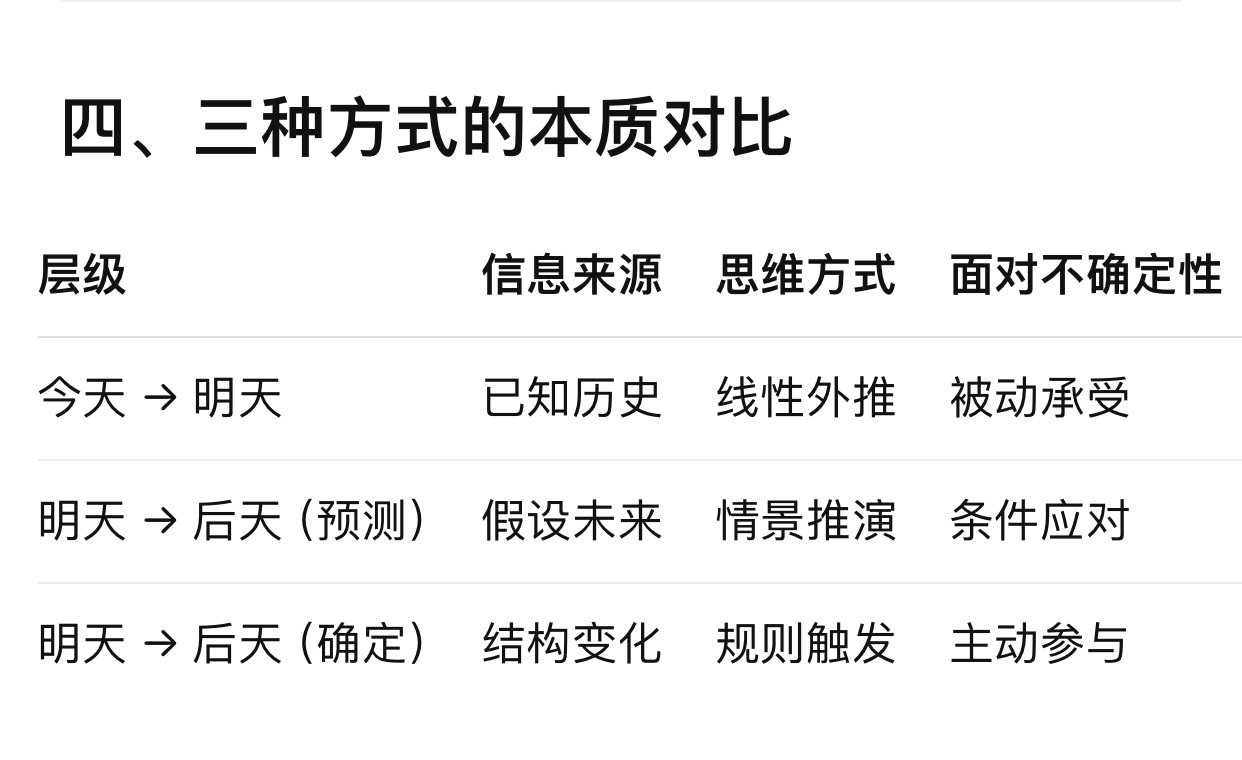
V. Correspondence with "left hand / right hand operations"
• Today → tomorrow
→ Left-hand reactive trading (emotion-driven)
• Tomorrow → day after tomorrow (prediction)
→ Left-right hand division of labor (planning + execution)
• Tomorrow → day after tomorrow (determination)
→ Left-right hand unification (system automatic response)
VI. One-sentence summary (extremely important)
The low level is guessing price;
The mid level is deducing paths;
The high level is waiting for conditions.
The people who consistently make money in the market,
are not the ones who "predict most accurately,"
but the ones who first recognize "if X happens tomorrow, then Y is the only way to go the day after."
$Intel(INTC.US) $Sandisk(SNDK.US) $NVIDIA(NVDA.US) $AMD(AMD.US) $Western Digital(WDC.US) $Micron Tech(MU.US)
The copyright of this article belongs to the original author/organization.
The views expressed herein are solely those of the author and do not reflect the stance of the platform. The content is intended for investment reference purposes only and shall not be considered as investment advice. Please contact us if you have any questions or suggestions regarding the content services provided by the platform.
