


Who Crushed U?---

Hi everyone, this is Dolphin Research. Welcome back.
Before the U.S. open on Feb 11 (ET), game engine leader $Unity Software(U.US) posted Q4 2025 results. After successive hits from Genie, Meta and Cloudx, the stock has dropped ~30% from its peak, leaving confidence in Unity extremely fragile.
Investors had hoped earnings would be a catalyst, but the company again offered what looked like a cautious guide. Coupled with a blowout non-farm print that pushed out rate-cut hopes, the stock did not get the usual benefit of the doubt and sold off hard on top of prior losses.
With Unity now below $9bn in market cap, is the drawdown warranted or an overreaction? We review three issues from this print.
1. Where did the guidance disappoint?
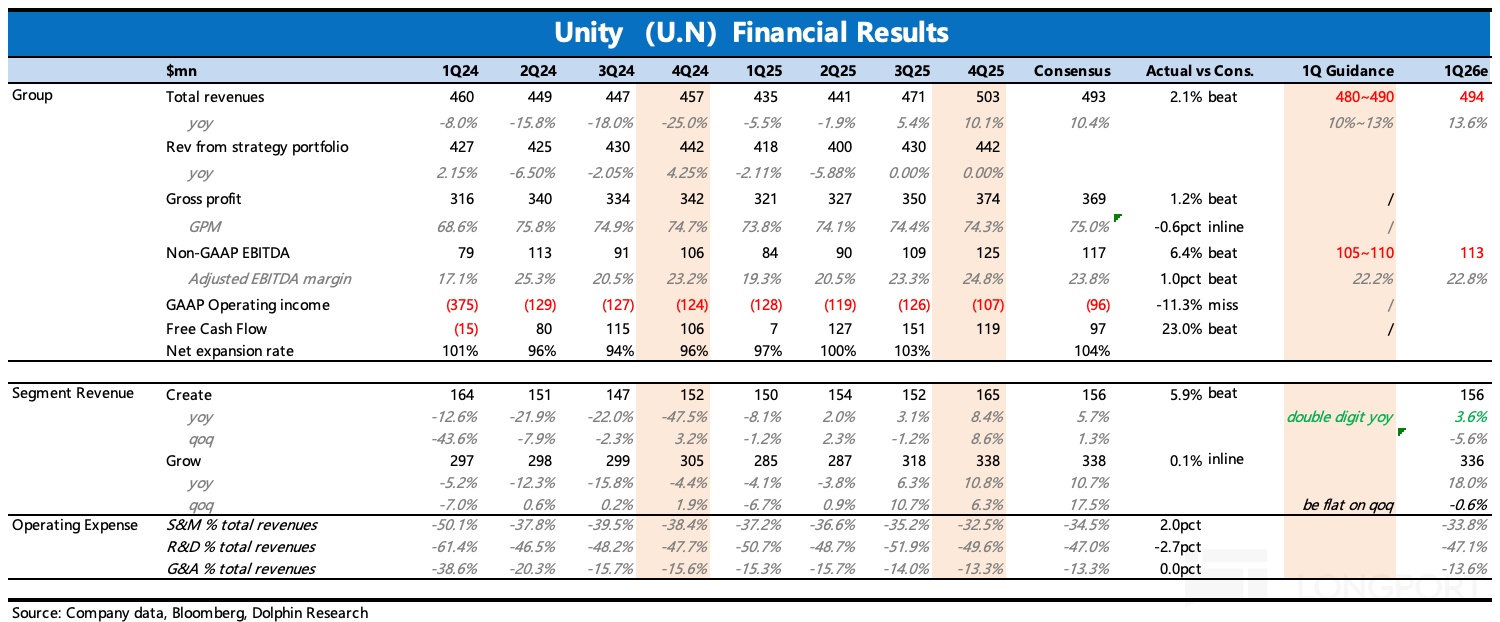
The immediate trigger: Q1 revenue guidance of $480–490mn, slightly below the Street, broadly in line with prior patterns. The issue this time is that the valuation anchor — the Grow solutions — is guided flat QoQ in Q1, implying +19% YoY.
While the guide roughly matches BBG consensus (which often lags real-time buy-side expectations for volatile names), long-onlys in a turnaround trade like Unity buy the growth trajectory, not a point estimate. Hence, Grow’s QoQ trend matters more than a small top-line miss.
Heading into the print, mainstream institutions expected 0–5% QoQ for Grow, while more optimistic funds even looked for ~10% QoQ in Q4 (continuing Q3’s pace), and >5% QoQ in Q1 (allowing for some seasonal slowdown). In that trend framework, Unity’s acceleration would have been clearer. So Q4’s +6.3% QoQ already felt like a miss to the buy side, and a flat QoQ guide for Q1 further disappointed trend-focused investors.
2. Why were expectations so upbeat?
Typically, Q1 is seasonally soft for gaming after the holiday-heavy Q4, and Unity’s historical pattern suggests Q1 tends to be ~7% below Q4. If you assume +5% QoQ in Q1 on top of that seasonality swing, the implied underlying momentum is ~+12% — an acceleration vs. the hoped-for +10% QoQ in Q4.
The bull case mainly came from strong Unity Vector channel checks: Multiple firms cited continued Vector optimization, a rising budget share for Unity Network Ads (though IronSource remains a drag), an expected D28 optimization coming soon this year (predicting a user’s 28-day LTV after ad exposure), and broader Vector deployment to IronSource and Tapjoy. Together with Unity’s Stripe partnership announced last Oct to route around Apple IAP, bulls implicitly raised the bar.
Conversely, the high near-term bar was also valuation-backsolved — to support a 40x EV/EBITDA multiple, EBITDA would need a 3-yr CAGR >47% (0.85x EV/GAAP EBITDA-to-growth). That implies total revenue CAGR of 15–20% and Grow at ~25%, equating to an average 5–6% QoQ run-rate.
3. What else is the market worried about?
Since the Genie launch, Meta’s return to iOS in-app ads, and the Cloudx narrative, Unity no longer trades at 40x EV/EBITDA. If growth undershoots and the market simply compresses the multiple further, ignoring trough value, that starts to look irrational.
In our view, near-term panic also reflects a string of recent ‘ghost stories’ around the name. Some fast money likely chased a rebound or an earnings beat after the pre-print slide, then rushed to the exits on a middling update. Separately, the long-running fear that AI could disintermediate Unity lingers, and a softer guide dents confidence in the company’s longer-term growth path.
4. How to read the collapse? The turnaround remains intact; in fragile sentiment, de-rating can easily overshoot
We usually track several forward-looking operating markers, but the flash release lacked detail. From the call, Unity’s overall trend still looks constructive; it is more a cadence issue than a reversal.
Flat QoQ for Grow in Q1 does not mean the improvement has stalled. Create, meanwhile, is recovering faster than expected — a genuine beat vs. market focus on Grow. These trends line up with pre-earnings channel checks.
(1) Two sources of expectation gaps on Vector: Vector is 56% of Grow, up 15% QoQ in Q4 and guided +10% QoQ in Q1, with Jan YoY growth hitting a record ~70% and an annualized revenue run-rate >$1bn. Within Grow, Vector is currently embedded mainly in Unity Network Ads; IronSource and Tapjoy, acquired years ago, are not yet integrated. IronSource, at ~10% of Grow, has weighed on growth over the past year amid internal changes and tougher competition.
From these details, Vector’s D28 rollout likely lands after Q1, later than some upbeat buy-side timelines. Q1 should still see a drag from IronSource, and we have yet to see signs of Vector being deployed there.
(2) Create meaningfully beat expectations: The market was fixated on Grow and overlooked that Create’s Q1 guide is above consensus, reflecting rapid Unity 6 adoption, with China particularly strong. Create has reached non-GAAP profitability. To address AI disruption risks, Unity is pivoting: in Mar, it will launch an AI version that fuses the traditional engine with AI models to let users generate a full casual game from text.
Overall, results were imperfect, but the steep sell-off looks more about poor sentiment and weak conviction toward growth/software, with ‘ghost stories’ still overhangs. At today’s levels, valuation mostly reflects the ongoing recovery in the engine biz, while the ad asset is not fully priced.
Back when ads were sluggish and the engine was stuck, we used conservative multiples (7x PS for engine, 4x PS for ads) and projected 2026 growth (engine +10%, ads +15%) to arrive at ~$11bn equity value. Versus sub-$9bn now, that is excessive — effectively pricing in the erosion or even disruption of at least one of Unity’s core businesses.
5. KPI snapshot
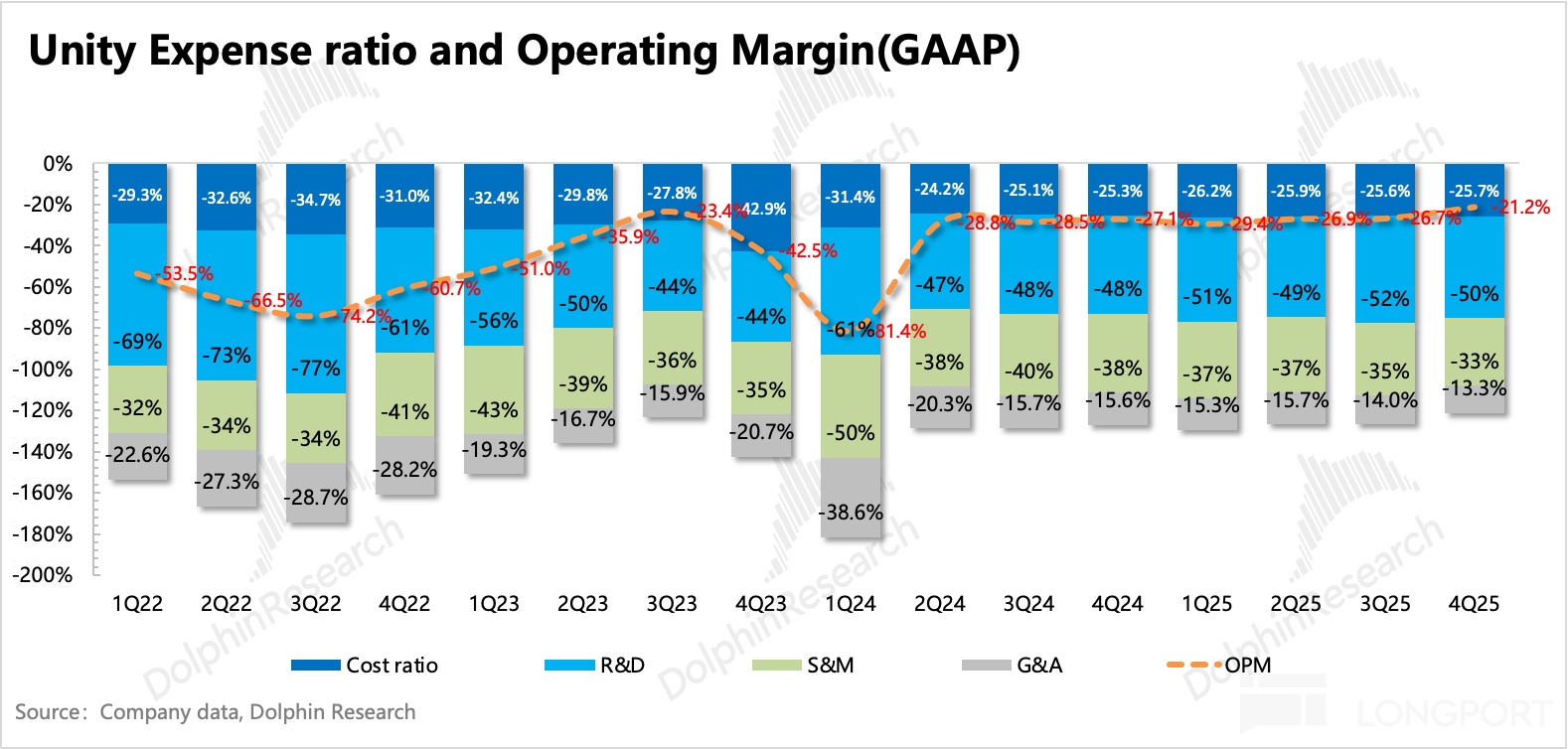
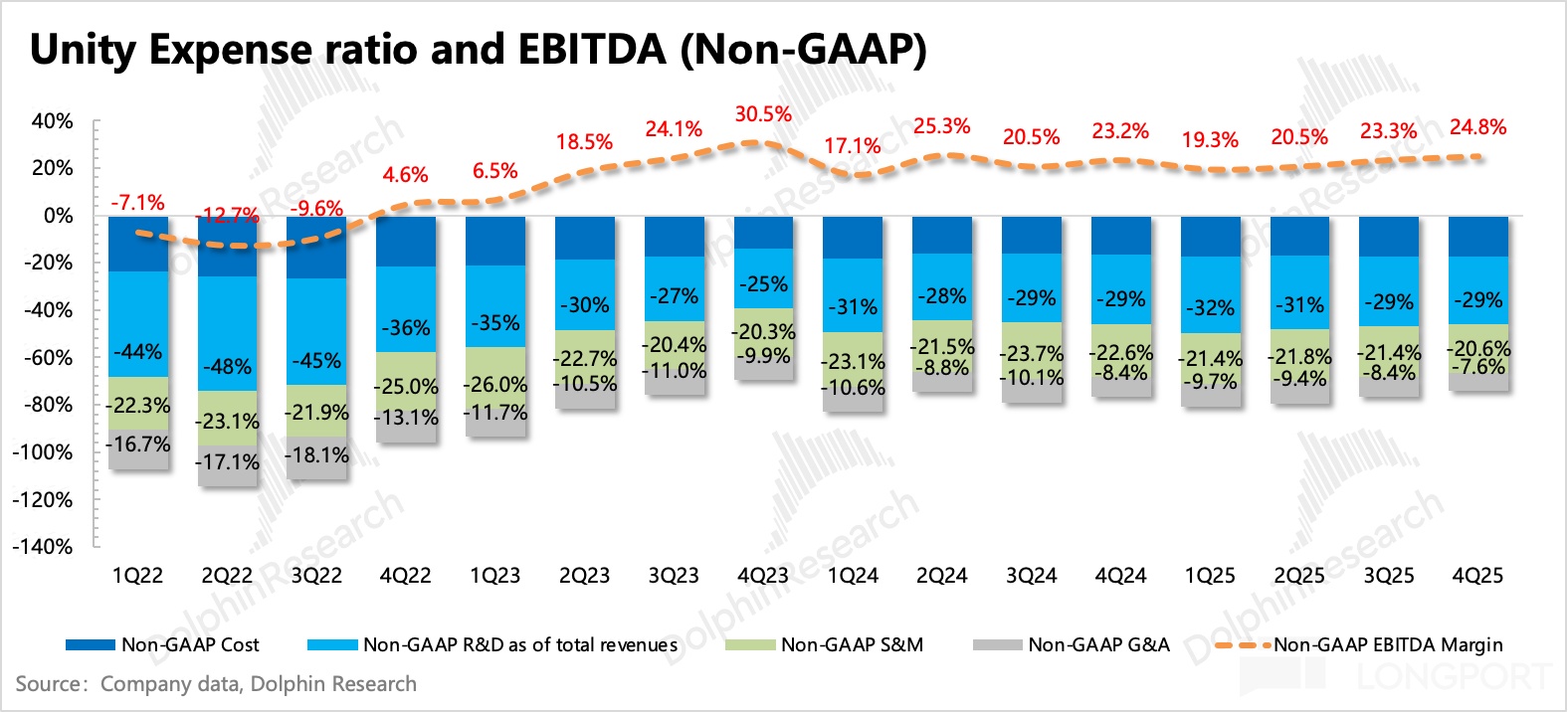
Detailed charts below
I. Unity biz. overview
In Q1 2023, Unity consolidated IronSource and also reshaped segment disclosures, moving from three segments (Create, Operate, Strategic) to two (Create, Grow).
The new Create solutions include the prior Create products (core engine) plus UGS that used to sit in Operate (Unity Game Services: full-stack solutions for game dev, publishing, UA and ops), and the former Strategy revenue. From 2023, Professional Services and Weta have been wound down.
Grow includes Operate’s ads business plus IronSource’s marketing (mainly Aura; Luna was shut in Q1 2024) and game publishing (Supersonic). Revenue stems from engine seat subscriptions, ad marketplace take-rates, publishing, etc.
II. Detailed charts
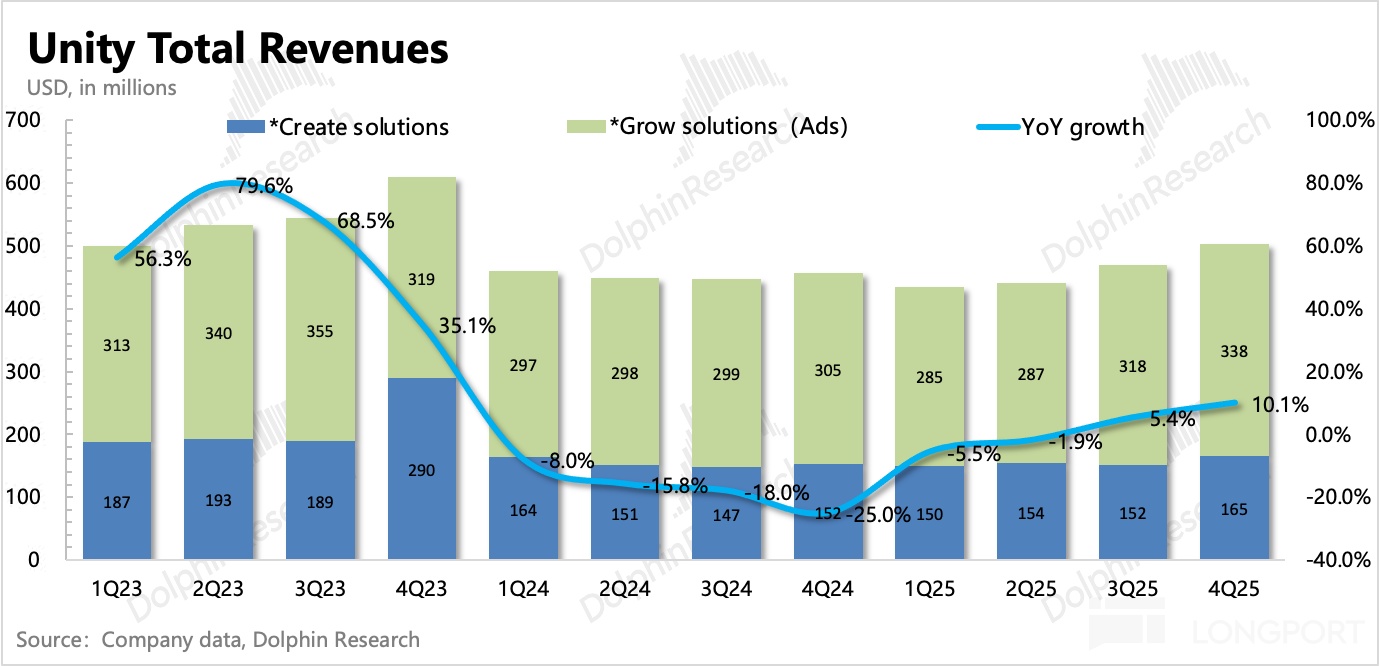
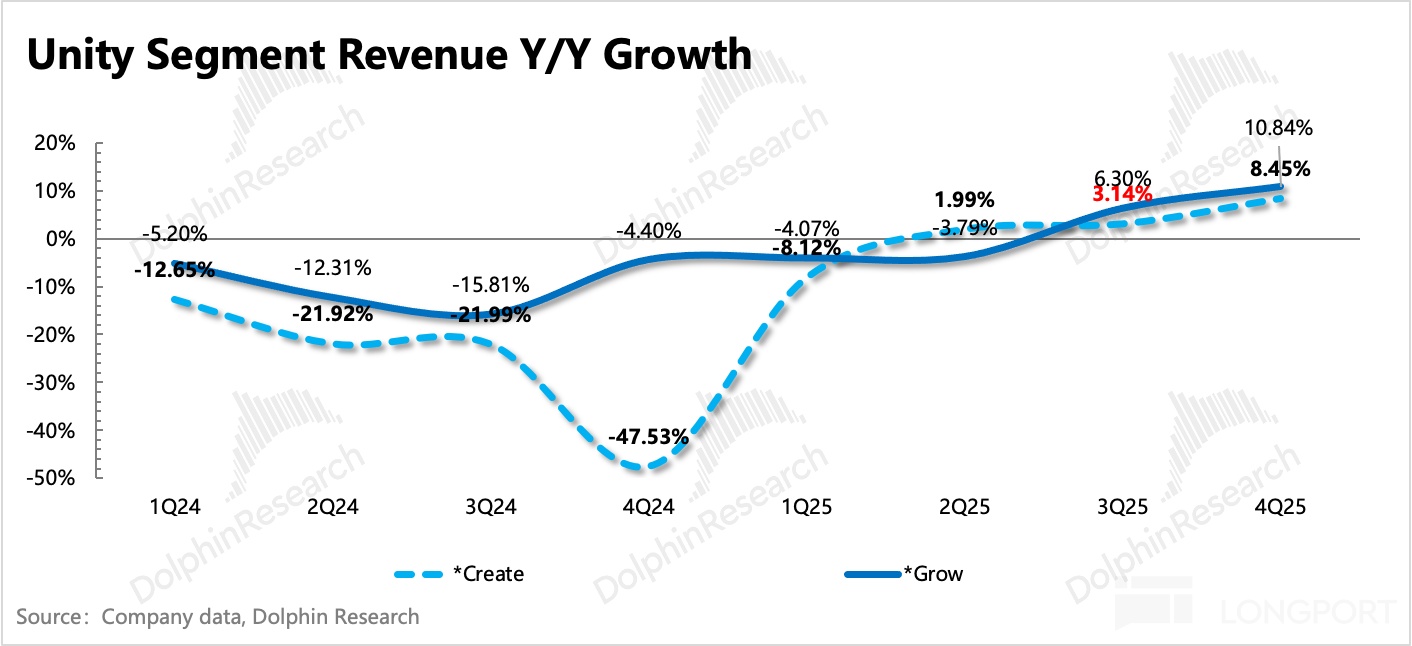
Q3 revenue was $503mn (+10% YoY), a modest beat vs. company guidance and the Street. By segment, Create grew 8% and Grow 11%.
On management’s near-term guide:
Q4 revenue and adj. profit are roughly in line — revenue of $480–490mn (+10–13% YoY), slightly below expectations; adj. EBITDA of $105–110mn, also a touch light. Given the new team’s conservative bias, actual delivery could be better, but buy-side expectations were high.
Q4 non-GAAP EBITDA margin expanded by ~150bps QoQ, mainly on opex optimization. With core ops improving, FCF reached ~$120mn.
<Ends here>
Dolphin Research 'Unity' related reads:
Earnings season (prior qtr)
Nov 5, 2025 call Trans: Unity (Trans): Unique Runtime data has monetization value
Nov 5, 2025 earnings take: Unity: Be patient — metamorphosis in progress
Aug 6, 2025 call Trans: Unity (Trans): Vector is still early — a steady, gradual process
Aug 6, 2025 earnings take: Rollercoaster ride — does Unity have a true 'U' inflection?
Hot take
Jul 17, 2025: Unity surges — quick take
Deep dive
Jan 10, 2025: Can Unity replicate AppLovin’s cash machine?
Risk disclosure and disclaimer: Dolphin Research disclaimer and general disclosure
The copyright of this article belongs to the original author/organization.
The views expressed herein are solely those of the author and do not reflect the stance of the platform. The content is intended for investment reference purposes only and shall not be considered as investment advice. Please contact us if you have any questions or suggestions regarding the content services provided by the platform.
