


 Rate Of Return
💢💢💢

🚨🧠 Musk's Rare Warning: Chips Aren't in Short Supply—They 'Can't Run'—The Real Bottleneck Is Power, Not Computing Power
Elon Musk recently made a judgment that clearly goes against market consensus:
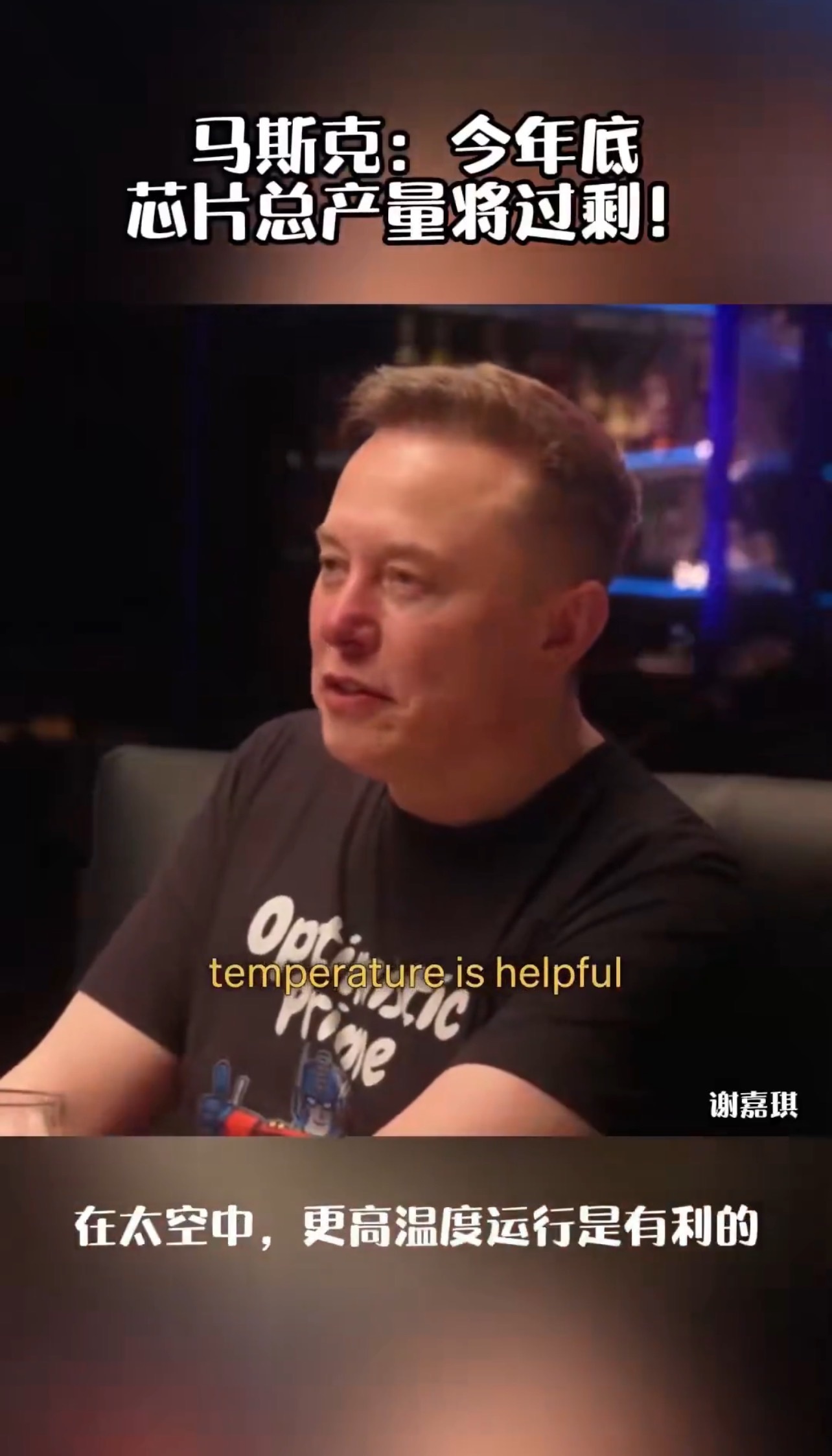
By the end of this year, global chip production capacity may become oversupplied.
It’s not that demand has suddenly disappeared, nor is it AI cooling off, but a more 'fundamental' problem is emerging—
There isn’t enough power to actually run these chips.
The lethality of this statement lies in its direct challenge to the most deeply rooted narrative in today’s capital markets:
'As long as there are GPUs, there will be demand.'
But the reality is becoming:
GPU ≠ Usable computing power
Computing power ≠ Sustainably operational computing power
What’s truly scarce is no longer the chips themselves, but power + cooling + the physical conditions for long-term operation.
Musk then proposed a highly controversial but logically coherent direction:
Move some of the computing power directly into deep space.
Why deep space?
Because, in his view, ground-based AI infrastructure is hitting three walls simultaneously:
Grid expansion speed
Cooling limits
Energy costs
And space, in theory, bypasses two of these.
He outlined three core points of logic:
First, space chips can be 'redesigned' rather than following ground-based logic.
Deep-space chips can tolerate higher operating temperatures, and the requirements for extreme performance are less stringent, resulting in—
Cooling systems that can be significantly lighter.
Second, radiation isn’t a fatal issue.
Space radiation does cause 'bit flips,' but for large models with trillions of parameters,
such random errors are statistically almost negligible as noise.
The scale of the model itself becomes a 'self-correcting mechanism.'
Third, the real energy source isn’t nuclear or ground-based transmission, but the sun itself.
Deep-space solar power doesn’t need to pass through the atmosphere and isn’t affected by day-night cycles, making it a theoretically continuous, stable, and scalable energy pool.
Connecting these points, you’ll realize:
This isn’t a solution that 'can be implemented this year,'
but it does answer an increasingly pressing question:
When the world is frantically stockpiling GPUs,
if power can’t keep up, what will these chips ultimately become?
Musk’s answer is straightforward:
They won’t disappear but will be relocated to 'places more suitable for their operation.'
This also explains why he said:
'Chips will pile up like mountains, but they won’t run.'
This isn’t bearish on AI,
but rather shifts the AI competition from 'who can buy more chips'
to who can solve the long-term operational conditions for computing power.
From an investment perspective, this statement is actually a reminder:
The real differentiator going forward may not be model parameters,
but energy, cooling, infrastructure, and system-level integration capabilities.
If this judgment holds, the future winners
may not be the companies hoarding the most GPUs,
but those who first realize that 'computing power must have a physical home.'
Do you see this as Musk’s usual 'thinking a decade ahead,'
or is it already approaching the next phase of real-world bottlenecks?
📬 I’ll continue tracking the emerging constraints between AI, computing power, energy, and space infrastructure, dissecting what’s conceptual and what’s becoming unavoidable physical reality.
#ElonMusk #AIInfrastructure #Semiconductors #NVIDIA #DataCenters #Energy #SpaceTech
The copyright of this article belongs to the original author/organization.
The views expressed herein are solely those of the author and do not reflect the stance of the platform. The content is intended for investment reference purposes only and shall not be considered as investment advice. Please contact us if you have any questions or suggestions regarding the content services provided by the platform.
