


Tianrun Cloud (02167.HK) Analysis: Musk's Three Sentences Are Reshaping the Entire Customer Service Industry

$TI CLOUD(02167.HK)
Recently, Musk gave an interview in Texas, where he shared a series of explosive viewpoints that once again ignited the industry.
Regarding AI, energy, and the future of society, he made many predictions, three of which are most relevant to the customer service industry:
· First, apart from tasks requiring physical labor, AI can already handle over half of white-collar jobs. Any work involving "typing, clicking, and processing information" will be taken over by AI, and this process is accelerating.
· Second, true Artificial General Intelligence (AGI) will emerge by 2026, and by 2030, AI's total intelligence will surpass that of all humanity.
· Third, the window from AGI's emergence to exponential self-evolution will be extremely short.
In the context of customer service, this isn't a vision of the future but a stark wake-up call. Because today, most customer service organizations still rely on "humans" to run processes: request comes in → human understands → human checks the system → human fills out forms → human pushes the process → human is accountable for results.
In the world Musk describes, it will become: request comes in → AI understands → AI operates the system → AI pushes the process → AI is accountable for results.
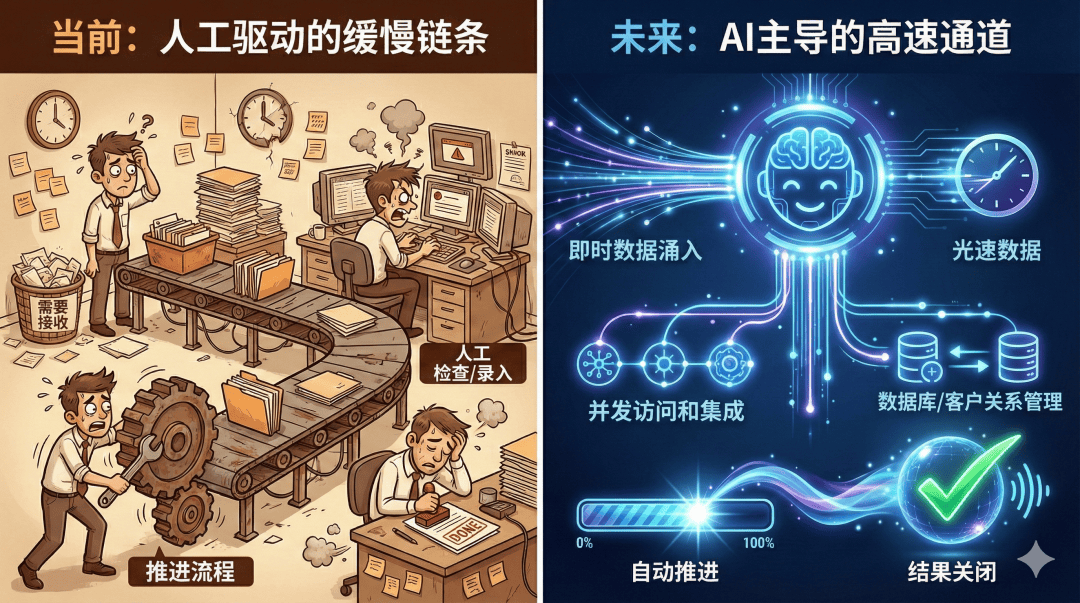
This means what's being rewritten isn't just a tool but the entire operational model of customer service organizations.
Under Musk's timeline, the question is no longer "what will happen in the future" but—as a customer service leader, are you ready to make the critical decisions for this transformation?
1. Why Customer Service Will Be the First Department Driven by AI
If Musk describes a future where "AI becomes the execution backbone of organizations," then customer service is almost tailor-made for this future.
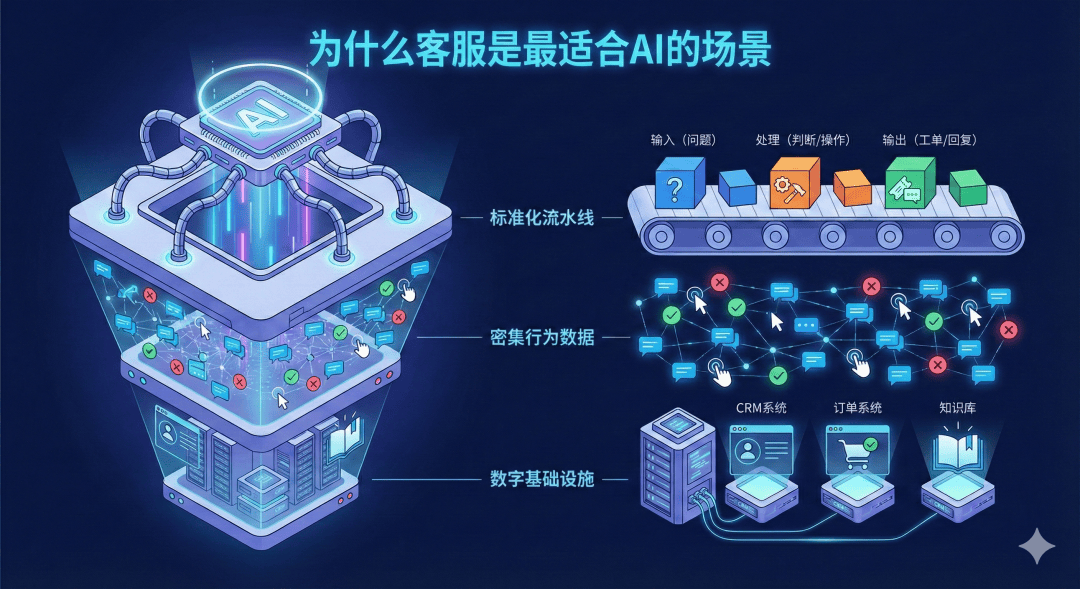
First, customer service is already the most standardized information pipeline in enterprises. User inquiries are the input; queries, judgments, and system operations are the processing; tickets, refunds, responses, and follow-ups are the output. The entire process is highly structured, almost entirely revolving around "understanding information + operating systems"—precisely what AI excels at.
Second, customer service has the densest real behavioral data in the enterprise: conversation logs, click records, operational paths, and the success or failure of each resolution. This data not only describes customers but also records how the organization responds to problems, making it the ideal training ground for AGI.
Most importantly, customer service already has a complete digital infrastructure that AI can directly operate: CRM, ticketing systems, order systems, knowledge bases. These were originally designed for humans, but once AI can read interfaces, call APIs, and fill forms, it can take over execution directly.
This is why customer service isn't a department that "will be transformed by AI in the future" but the first department already equipped to be AI-driven.
2. Three Questions Customer Service Leaders Must Answer Before AGI Arrives
If AGI's timeline holds, the challenge for customer service leaders is no longer "whether to use AI" but how every organizational choice today will amplify the gap in three years.
Under this premise, companies must accelerate the shift from "human-driven" to "AI-driven." Before this transformation truly begins, every customer service leader must answer three critical questions.
The first question: Is your customer service data "machine-usable"?
Many companies claim to have data, but data truly usable by AI must be structured, traceable, and trainable. AI doesn't just need chat logs—it needs to clearly understand how a problem was judged, handled, and whether it was successfully resolved. If these links are broken in your system, AI can only serve as an auxiliary tool, not a true execution unit.
The second question: Is your AI a "Q&A tool" or a "digital employee"?
A true Agent doesn't just answer questions—it can check orders, create tickets, modify information, push processes, and take accountability for results. Only when AI can complete the full cycle of "check, create, modify, push, close" does it truly enter the execution layer of the organization. Otherwise, it merely saves some labor without changing how the organization operates.
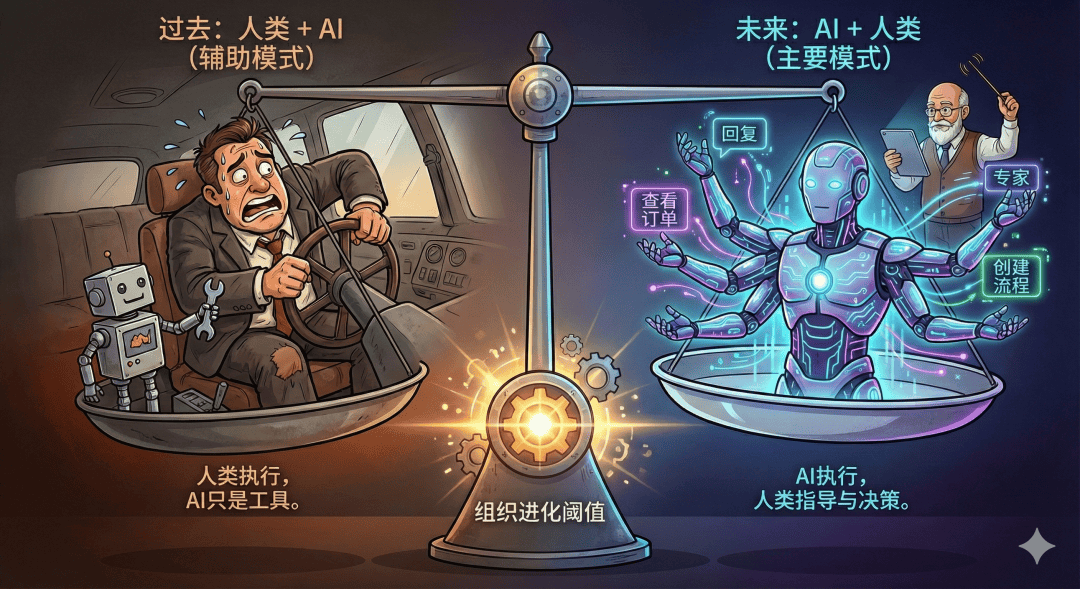
The third question: Is your customer service organization "human + AI" or "AI + human"?
These two may seem similar but are fundamentally different. The former uses AI to assist humans; the latter makes AI the primary executor while humans transition to business experts, trainers, and decision-makers. The truly competitive customer service organizations of the future will consist of a small number of business-savvy humans leading a large number of executable, trainable AI Agents.
These three questions appear to address data, systems, and organization separately, but they ultimately point to the same thing: Does your customer service system already have the foundational conditions to shift from "human-run" to "AI-run"?
Under Musk's timeline, what truly creates a gap isn't who deploys a bot first but who completes the organizational shift from human-driven to AI-driven sooner.
3. Conclusion
In the future, the most valuable asset of a customer service center won't be the number of seats but how many truly capable Agents you've trained and their skill levels.
Before AGI arrives, companies still have a critical window. At this stage, the most important task isn't to "lay off people" but to complete a deeper transformation—upgrading a human-centric customer service organization into an AI-centric service system.
Those who complete this shift first will establish a true first-mover advantage in the next-generation customer engagement system. Meanwhile, organizations still clinging to the "more people, faster results" logic will soon find themselves running in the wrong direction.
$TI CLOUD(02167.HK)
The copyright of this article belongs to the original author/organization.
The views expressed herein are solely those of the author and do not reflect the stance of the platform. The content is intended for investment reference purposes only and shall not be considered as investment advice. Please contact us if you have any questions or suggestions regarding the content services provided by the platform.
