


Silver volatility, dollar weakness, commodities rally: Who will take over the second half of the Hong Kong and US stock bull market?

Recently, the market has shown a unique trend: gold and silver prices have experienced parabolic fluctuations, with silver recording its largest single-day swing since the financial crisis; the US dollar has fallen to its lowest level since 2022, while the energy sector has surged strongly. Despite various news disturbances, the stock market continues to climb steadily. Behind these seemingly contradictory market performances, it is not simply driven by risk aversion but by the deeper logic of capital flows and sector rotation, which also signals that new changes in the market are brewing.
The Rally in Precious Metals: Driven by Speculation, Not Fundamentals
The recent surge in gold (GLD) and silver (SLV) prices has been interpreted by many professionals as a sign of heightened market concerns over currency depreciation, high inflation, and geopolitical instability, viewing it as a "warning signal" for the market. However, looking beyond the surface, the core driver of this precious metals rally is not fundamental support but a speculative frenzy led by retail investors.
It is undeniable that gold prices have indeed been supported by a weaker US dollar and increased central bank demand, while the silver market itself faces structural supply-demand imbalances. However, these factors are not the main reasons for the sharp rise in gold and silver prices in recent weeks. The real catalyst is the influx of investors who have never held precious metals before, sparking a speculative wave. This has led silver to exhibit extreme volatility comparable to "meme stocks": it once surged over 14% in a single day, marking the largest single-day gain since the 2008 global financial crisis, only to close 12% lower later. Such wild swings are typical characteristics of speculative trading.
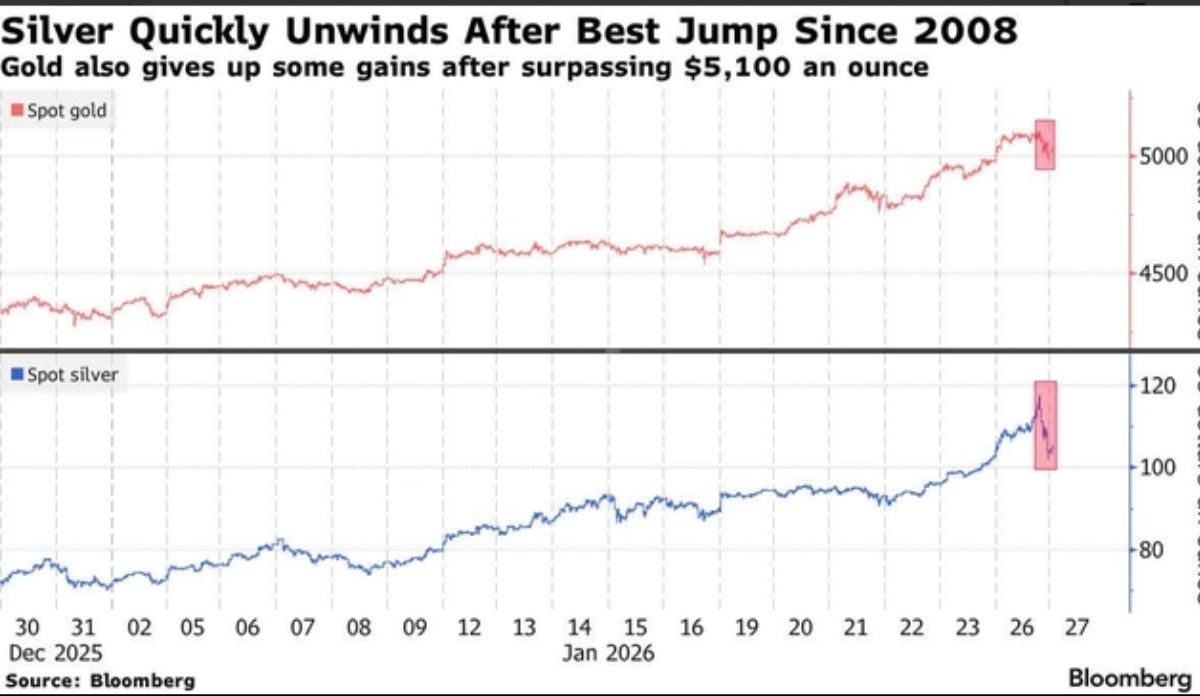
As an industrial metal, silver's demand in sectors like solar panels, electric vehicles, and AI data centers is indeed promising in the long term. However, these trends have long existed and cannot suddenly triple demand in just three weeks. The stark contrast between stable fundamentals and extreme price volatility can only be explained by speculative behavior.
This has completely deviated precious metals from their former role as a "safe haven," turning them into "hot targets" in the market. Behind this speculative wave is likely the shift of investors who participated in the "meme stock" frenzy of 2021 to the precious metals sector, which has also contributed to the cooling of cryptocurrency hype this year. For investors trying to hitch a ride for quick gains, the short-term price predictions for precious metals are highly uncertain and carry significant risks. Blindly following the trend will most likely end in disappointment. Just as it is difficult to set a price target for Bitcoin, trying to predict silver's trajectory over the next 12 months is like trying to catch fish by climbing a tree.
Even in an all-weather investment strategy, precious metals are a core holding for risk diversification, with their value lying in their low correlation with the stock market. However, the current speculative rally has stripped them of their original allocation significance, turning them into a stage for capital games.
Energy Sector Sends Strong Signal, Indicating Market Strength
In stark contrast to the speculative frenzy in precious metals, the strong rise of the energy sector (XLE) is not short-term hype but reflects a trend of sustained improvement. The performance of this sector also sends a strong bullish signal for the S&P 500's trajectory.
The energy sector's current performance can only be described as "stellar": 31% of stocks in the sector have hit 52-week highs, the highest in over 300 days; 95% of stocks are above their 200-day moving averages, a first in a year. Historically, these two metrics have clear implications: when the energy sector shows such performance, although the S&P 500's short-term performance may be mixed, it is highly likely to show a broad upward trend over the next 6, 9, and 12 months. Even the next three months tend to see strong market performance.
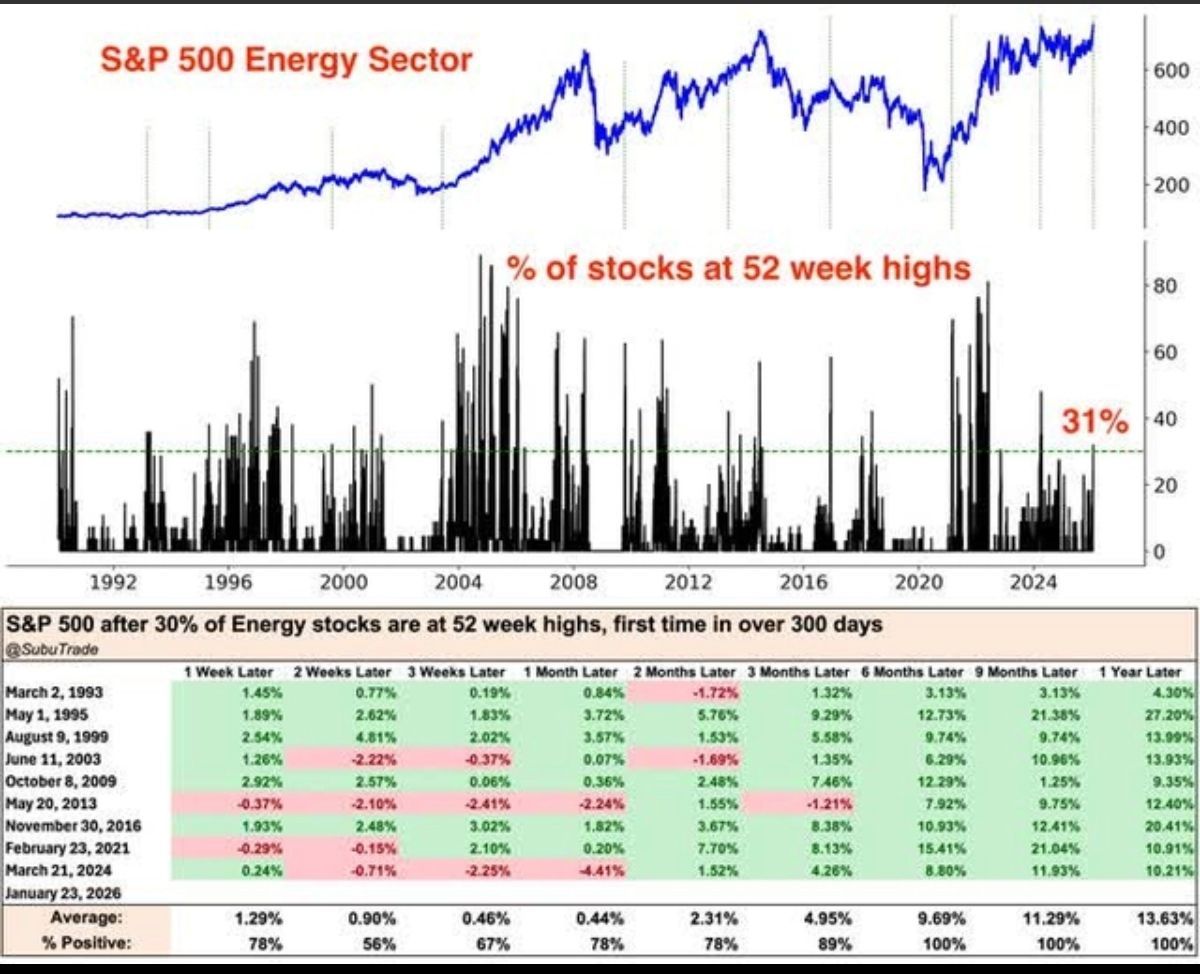
The collective strength of energy stocks may have different immediate causes each time, but the core logic points to stronger global economic growth expectations, with cyclical sectors beginning to outperform the broader market. This trend aligns with the market's forward-looking economic judgments. Despite the prevalence of worrisome headlines in current news, the market always looks ahead. The simultaneous rise in volume and price in the energy sector reflects capital's early positioning for an economic recovery.
Sector Rotation Looms, Small- and Mid-Cap Companies May Take the Lead
If the energy sector's strength is a signal of broader market health, the internal structural changes in the market suggest an upcoming rotation in leadership: small- and mid-cap companies are poised to take over as the market's performance leaders, while the widespread profit growth of companies outside the "Magnificent Seven" will drive valuation expansion.
In previous market trends, the performance of leading giants was key to driving the broader market. However, as market logic shifts and cyclical sectors rise, capital is gradually spreading from core leaders to a wider range of targets. The energy sector's strength is a microcosm of capital's positioning in cyclical and small- to mid-cap stocks. As economic growth expectations improve, the profit elasticity of small and medium-sized enterprises will be unleashed, with their potential for earnings improvement in both scope and speed likely surpassing that of previous market leaders.
The current market is at a critical juncture of logic shift. In such an environment, rather than chasing the short-term speculative frenzy in precious metals, it is wiser to focus on sectors and targets with improving fundamentals and positive trends, seizing opportunities brought by market rotation. This is a more stable investment choice. The market's future trajectory will continue to prove that only gains supported by earnings growth can last longer and go further.
The copyright of this article belongs to the original author/organization.
The views expressed herein are solely those of the author and do not reflect the stance of the platform. The content is intended for investment reference purposes only and shall not be considered as investment advice. Please contact us if you have any questions or suggestions regarding the content services provided by the platform.
