


TSMC (Minutes): 2nm mass production by the end of the year, increased investment next year
The following are the Minutes of TSMC's Q3 2025 earnings call. For earnings interpretation, please refer to "Is the 'Dominant' TSMC the Strongest King in the AI Era?"
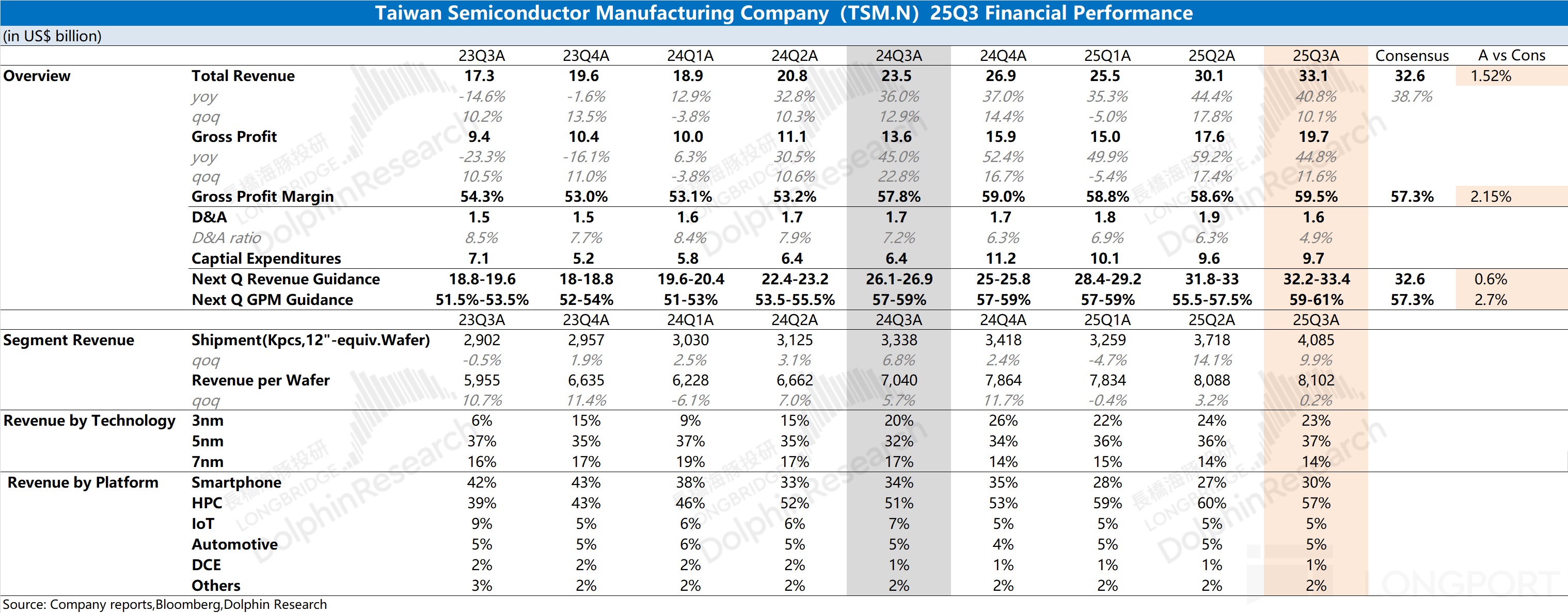
I.$Taiwan Semiconductor(TSM.US) Core Financial Data Review
Financial Performance
Revenue: Q3 revenue reached USD 33.1 billion, a quarter-on-quarter increase of 10.1%. In New Taiwan Dollars, it grew by 6% QoQ, mainly due to strong demand for advanced process technologies.
Profitability: Gross margin increased by 0.9 percentage points QoQ to 59.5%, mainly due to cost optimization measures and improved capacity utilization; operating margin increased by 1.0 percentage points QoQ to 50.6%.
Earnings Per Share (EPS): Q3 EPS was NTD 17.4, a year-on-year increase of 39%.
Return on Equity (ROE): was 37.8%.
Cash Flow: Q3 operating cash flow was NTD 427 billion.
Revenue Share by Technology Node
The 3nm process contributed 23% of wafer revenue, continuing to ramp up.
The 5nm process accounted for 37%, remaining the main revenue driver.
The 7nm process accounted for 14%.
Advanced processes (7nm and below) collectively accounted for 74% of wafer revenue, highlighting the technological leadership.
Revenue Share by Platform
High-Performance Computing (HPC): accounted for 57%, still the largest revenue source, supported by AI-related demand.
Smartphones: accounted for 30% (up 19% QoQ), indicating a moderate recovery in consumer electronics demand.
Internet of Things (IoT): accounted for 5% (up 20% QoQ), reflecting the accelerating trend of "Internet of Everything".
Automotive Electronics: accounted for 5% (up 18% QoQ), with continued demand for automotive intelligence.
Digital Consumer Electronics (DCE): accounted for 1% (down 20% QoQ), with noticeable fluctuations due to smaller business scale.
Capital Expenditure and Cash Flow
Q3 capital expenditure was USD 9.7 billion (NTD 287 billion).
2025 full-year capital expenditure guidance raised to USD 40-42 billion (previously USD 38-42 billion), with approximately 70% allocated to advanced process technologies, 10%-20% to specialty technologies, and 10%-20% to advanced packaging, testing, and other fields.
Assets and Liabilities
Cash and marketable securities: balance of NTD 2.6 trillion (approximately USD 90 billion), maintaining strong financial strength.
Current liabilities: decreased by NTD 22 billion QoQ, mainly due to a reduction in accrued liabilities and other items from tax payments.
II. TSMC Management Discussion
Demand Outlook and Performance Guidance
Q4 2025 guidance: Revenue expected to be between USD 32.2 billion and USD 33.4 billion, with a gross margin of 59%-61% and an operating margin of 49%-51%.
Full-year 2025: Revenue in USD terms is expected to grow nearly 35% year-on-year (previously expected 30%, the upward revision is reasonable), mainly driven by demand for advanced technologies.
Artificial Intelligence: AI-related demand shows "structural growth," stronger than three months ago. The explosive growth in token volume indicates increasing consumer adoption of AI models, driving demand for advanced chips. The company is enhancing productivity through internal AI applications, creating more value.
Technological Progress and Planning
N2 (2nm): Scheduled for mass production in the second half of 2025, with a capacity ramp-up curve similar to N3, expected to ramp up faster in 2026, with smartphones and high-performance computing applications as the main drivers.
N2P: As an enhanced version of N2, further optimizing performance and power consumption, planned for mass production in the second half of 2026.
A16: Optimized for high-performance computing, particularly suitable for products with compressed signal paths and high-density power networks, planned for mass production in the second half of 2026.
Global Manufacturing Layout
Arizona, USA: Capacity expansion is accelerating, with plans to adopt more advanced processes, soon acquiring a second large plot of land to support expansion plans, forming an independent gigafab cluster.
Japan: The first specialty process fab in Kumamoto was mass-produced by the end of 2024 with excellent yield; construction of the second fab has started, with production schedules flexibly adjusted according to customer demand.
Europe: The construction of the specialty process fab in Dresden, Germany, is progressing as planned, with support from the European Commission and various levels of government.
Taiwan, China: Preparing for multiple phases of 2nm fab construction in the Hsinchu and Kaohsiung central parks, continuing to invest in advanced process and advanced packaging facilities.
Profitability and Cost Control
The increase in gross margin in Q3 was mainly due to cost optimization and improved capacity utilization, with actual gross margin exceeding expectations by 200 basis points, partly due to a favorable exchange rate (USD to NTD at 29.91 compared to the expected 29).
The dilution effect of overseas fab capacity ramp-up on gross margin is expected to be close to 2% in the second half of 2025, with a full-year impact of 1%-2% (lower than the previous expectation of 2%-3%). In the long term, this dilution effect is initially 2%-3%, possibly reaching 3%-4% later.
The company is committed to managing costs through scale effects in Arizona, optimizing operations, and collaborating with customers and suppliers.
III. Q&A
Q: Will the future growth expectations for AI accelerators (previously forecasted CAGR of about 45% from 2024-2029) be adjusted? What is the future trend of capital expenditure?
A: AI demand is stronger than seen three months ago, the previously announced CAGR for the AI accelerator business was about 45%, but the actual situation is slightly better than this expectation. This expectation will be updated early next year, with a clearer judgment then.
The company plans capital expenditure annually based on business opportunities in the coming years, investing whenever there is a business opportunity. Given the company's current scale, it is "extremely unlikely to see significant growth" in capital expenditure in any single year. When the company continues to invest and business growth outpaces capital expenditure growth, a growth trend similar to the past few years can be observed.
The higher the capital expenditure (CapEx) scale, the greater the corresponding growth opportunities. The overall situation next year is expected to improve, and we are confident in the current major trends, continuing to increase investment in the future.
Q: What are the 2026 CoWoS capacity plans and the 2025 AI accelerator revenue share (will it approach 30%)?
A: Efforts are underway to increase 2026 CoWoS capacity to narrow the supply-demand gap, with specific numbers to be updated next year. No specific AI revenue share data provided.
Q: How do you explain the contradiction between a customer's claim that "Moore's Law is dead" and TSMC's continued strong demand for advanced processes?
A: What he meant was not "we no longer rely on chip technology," but rather "we can't rely solely on chip technology anymore." Customers are now more focused on overall system performance. TSMC collaborates with customers to provide complete technology solutions from front-end to back-end, combined with advanced packaging, to meet demand.
Q: Will US export controls affect TSMC's ability to seize AI market opportunities in China and hinder long-term growth? On one hand, there are US-imposed restrictions, and on the other, the Chinese government is somewhat discouraging the purchase of US chips.
A: Even if we cannot enter the Chinese market, the growth of the AI industry will still be very rapid, and the overall situation is very positive. Moreover, the company is confident in the performance of its customers, who will continue to grow, and the company will provide support.
Even if potential business opportunities in the Chinese market are limited, the company is still confident in achieving a CAGR of 14% or higher in the coming years.
Q: What is the trend of gross margin in 2026, especially the dilution impact of the N2 process?
A: N2 will have a dilutive effect on gross margin in 2026, but the dilution impact of N3 has gradually weakened and will reach the company's average level at some point in 2026.
Other influencing factors include the dilution effect of overseas factories, which will persist. In the early years, its dilution on gross margin is about 2% to 3%, and this situation will continue.
Exchange rate impact: for every 1% fluctuation in the USD to NTD exchange rate, our gross margin will change by 40 basis points.
Q: Can you provide more details on the dilution effect of the 2nm process? Can it still be understood as "a dilution period of 7 to 8 quarters, or 6 to 8 quarters"?
A: The structural profitability of the 2nm process (N2) is stronger than that of the 3nm process (N3). Overall, the company's gross margin is on an upward trend.
Q: The core of the industry used to be the trend of smartphones and personal computers (PCs), but now it has shifted to artificial intelligence (AI) and cloud AI; does this trend change make it more difficult to predict the capacity planning process?
A: We are still in the early stages of AI applications, so it is very difficult to make accurate predictions at this moment.
Now the company will pay special attention to "customers' customers" (i.e., end customers). Understanding specific application scenarios—such as demand in search engines or social media applications—and communicating with them to see how they view the application prospects of AI in these functions. Based on this, we then judge the future growth trend of the AI business.
Previously, we only communicated with our direct customers (chip customers) and conducted internal research; the current model is completely different.
Q: TSMC's forecast for AI infrastructure growth? Can its AI revenue growth match the capital expenditure growth of cloud service providers?
A: The compound annual growth rate of AI-related semiconductor demand is "about 45%," this data does not include all infrastructure in Europe and aligns with the forecasts of the company's major customers.
The exponential growth in the number of tokens will be met by customers migrating to more advanced process nodes, enhancing single-chip performance and enabling systems to handle more loads.
Q: What is the capacity situation of wafer-level system integration packaging (CoWoS), the progress of advanced packaging capacity in Arizona, and cooperation with outsourced semiconductor assembly and test (OSAT) partners?
A: Plans are underway to build two advanced packaging plants in Arizona, while collaborating with an OSAT company on a local project in Arizona, progressing faster, with the common goal of supporting customers to achieve more US-based manufacturing.
Q: What will be the core driving force for growth in 2026? Is it more from technology portfolio iteration (such as the advancement of the 2nm (N2) process)? ASP increase? Or shipment volume?
A: Technology portfolio migration (to N2, N3, etc.), average selling price (ASP) increase, and wafer shipment growth "all factors will influence".
Q: Is there a need for additional capacity? Will capacity conversion continue? What is the strong growth trend in the advanced process field next year?
A: We will continue to optimize the capacity of 5nm (N5) and 3nm (N3) to support customer demand. As for the additional capacity originally planned for expanding 3nm (N3) capacity, we are now adjusting it to be used for 2nm (N2) process capacity construction. This is the current plan.
Q: How much revenue does a 1-gigawatt (GW) AI data center capacity bring to TSMC?
A: When customers mention (building) a 1-gigawatt (computing power) (data center), they need to invest about USD 50 billion—how much of TSMC's wafer (related business scale) accounts for this is not convenient to disclose at the moment, as different projects have different situations.
What is needed now is not just a single chip. In fact, multiple chips need to be combined to form a system
Q: What is the impact of AI demand being realized through GPUs or ASICs on TSMC's revenue and gross margin?
A: Whether GPU or ASIC, both use the company's advanced processes. TSMC supports all types of solutions, and customer growth prospects are strong.
Q: In the "Foundry 2.0" era, how does TSMC consolidate its competitive advantage? How will it respond to competition in an environment where a competitor is located in the US?
A: The core of "Foundry 2.0" is to integrate front-end and back-end full-process services, providing system-level solutions. Revenue from advanced packaging business is approaching 10% of the company's total revenue. For US market competitors (Intel), which is also a company customer, TSMC is collaborating with them to develop advanced products.
Q: Are there concerns about pre-production (stockpiling) by customers in the smartphone field?
A: Not worried, the current inventory level is in a "very seasonal healthy state." There is no need to worry about (stockpiling) issues.
Risk Disclosure and Statement of this Article:Dolphin Research Disclaimer and General Disclosure
