


Broadcom: ASIC Growth 'Malfunctioning', Trillion-Dollar ASIC Story Facing 'Pitfalls' or Welcoming 'Opportunities'?
$Broadcom(AVGO.US) In the early morning of June 6th Beijing time, Broadcom released its Q2 FY2025 financial report (ending April 2025) after the U.S. stock market closed:
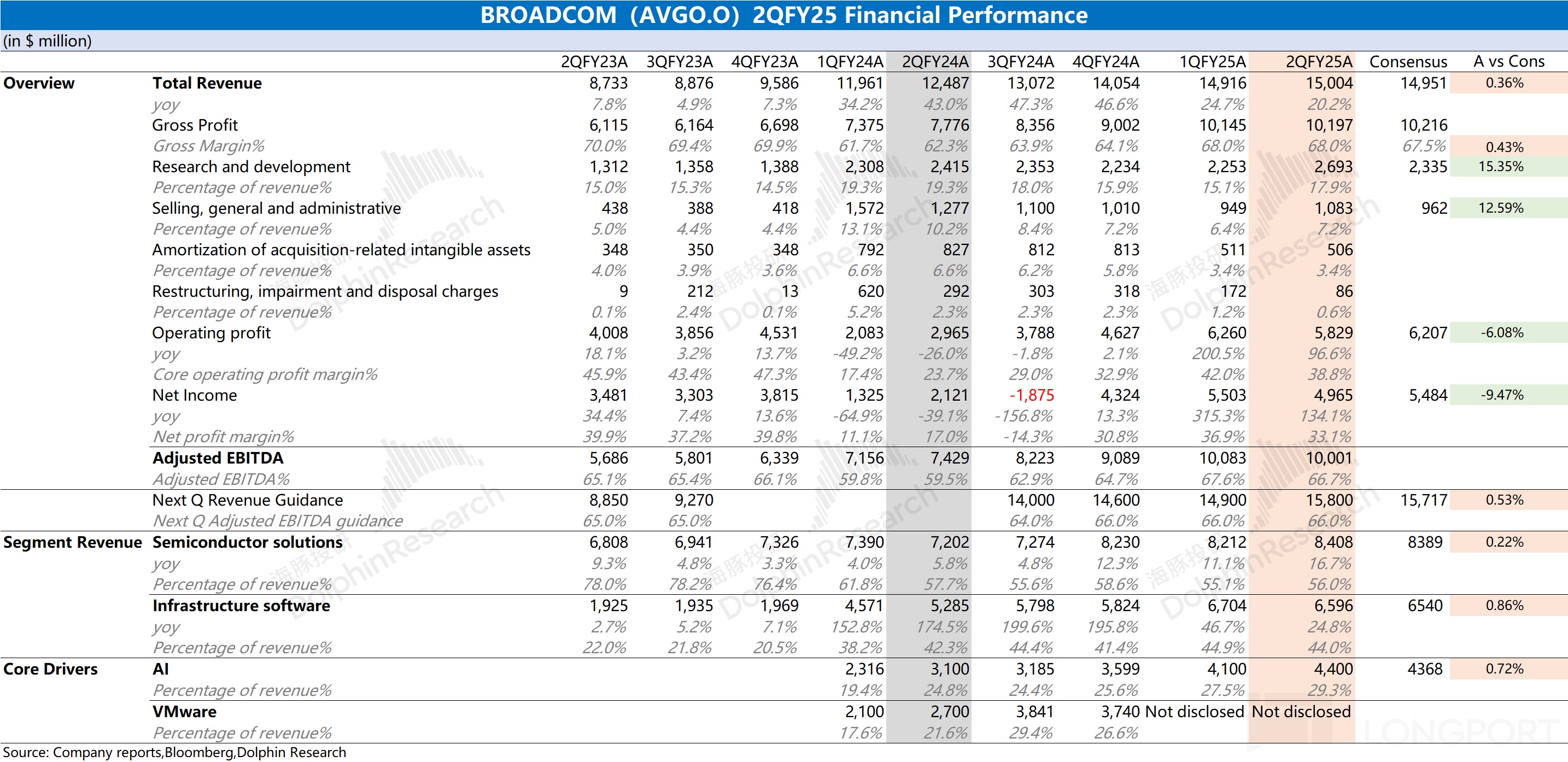
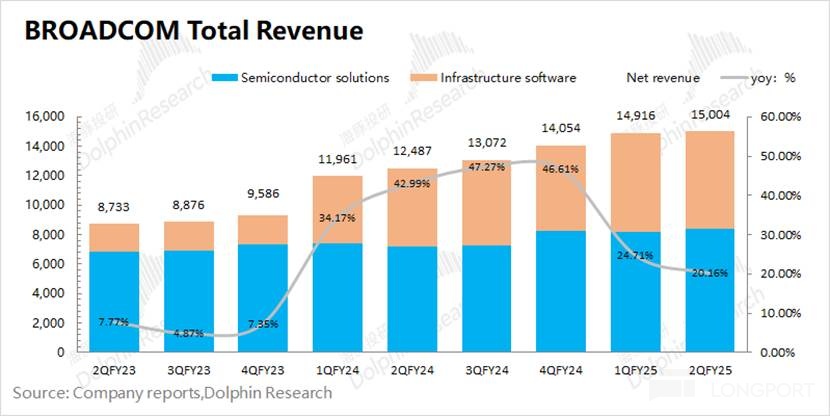
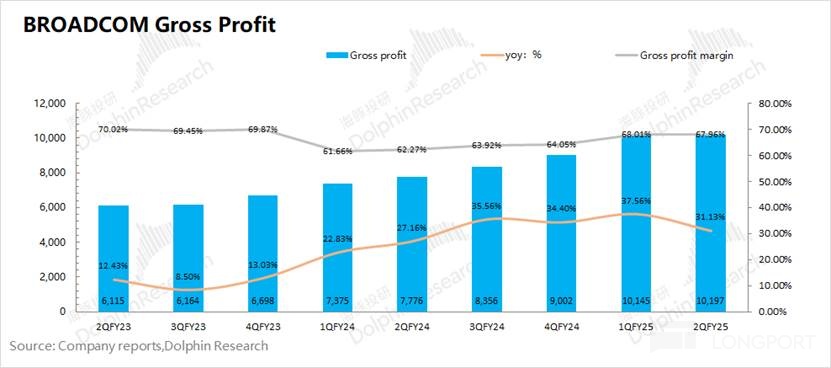
1. Overall Performance: Broadcom (AVGO.O) achieved $15 billion this quarter, a year-on-year increase of 20%, meeting market expectations ($14.95 billion). The year-on-year growth mainly came from the growth of AI business and the consolidation of VMware. The company's gross margin this quarter was 68%, with the integration of VMware's higher-margin business driving the gradual improvement of the company's overall gross margin.
2. Semiconductor Business: This quarter achieved $8.4 billion, a quarter-on-quarter increase of $200 million, with AI business contributing the main increment. Specifically:
① AI Business: $4.4 billion, a quarter-on-quarter increase of $300 million, meeting market expectations. The quarter-on-quarter growth of AI business slowed down, mainly due to the impact of Google's TPU product generational switch. As the mass production of TPUv6 increases, AI business is expected to accelerate growth in the second half of the year, with the company expecting AI business revenue of $5.1 billion next quarter, a quarter-on-quarter increase of $700 million.
② Non-AI Business: $4 billion, slightly declined. Among various downstream sectors, although enterprise storage and broadband business grew quarter-on-quarter, wireless and industrial businesses continued to decline.
3. Infrastructure Software: This quarter achieved $6.6 billion, a quarter-on-quarter decline of $100 million. Due to the impact of VMware acquisition integration and fee model adjustment (from perpetual license mode to subscription mode), the company's software business has continued to grow over the past year, but this quarter saw a decline for the first time. The software business will continue to benefit from the improvement of VMware's subscription model, but the high growth phase has come to an end.
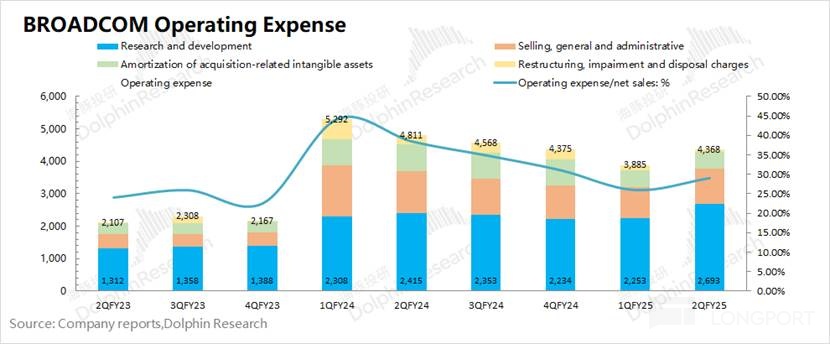
4. Operating Expenses: This quarter's core operating expenses (R&D expenses + sales and management expenses) were $3.77 billion, a quarter-on-quarter increase of $570 million, with the core operating expense ratio around 25%. After acquiring VMware, the company is committed to compressing and integrating operating expenses, and this quarter's increase was mainly due to the company's increased equity incentives. Excluding the impact of equity incentives, the company's core operating expenses this quarter were $2.2 billion, a quarter-on-quarter increase of $130 million, with increased investment in AI semiconductor R&D.
5. Broadcom's Performance Guidance: FY2025 Q3 expected revenue is around $15.8 billion, market expectation ($15.7 billion), with the company expecting adjusted EBITDA profit margin of 66% for FY2025 Q3. AI business is expected to continue growing to $5.1 billion.
Dolphin Research's Overall View: Mediocre, no obvious highlights
Broadcom AVGO's revenue performance this quarter met expectations, with a slight quarter-on-quarter increase. The increment mainly came from the semiconductor AI business, while the software business and VMware remained relatively stable. The company's core profit declined quarter-on-quarter, mainly due to increased equity incentives and related expenses this quarter. Excluding this impact, the company's performance in this financial report basically met expectations.
Specifically, the market's focus on Broadcom AVGO is on AI business and VMware, which contributed the main increment over the past year:
1) VMware's Acquisition Integration: Basically completed. Specifically, it can be viewed from two perspectives: impact on performance and impact on debt:
① Impact on Performance: In terms of revenue, the company's acquisition of VMware has been completed for more than a year, and the conversion rate of subscription fees has exceeded 60%. This quarter's software business saw a quarter-on-quarter decline, further indicating that the high growth phase brought by acquisition integration has passed; In terms of operating expenses, after completing the acquisition, the company also began to compress core expenses. Excluding the impact of equity incentives, the company's core operating expenses (R&D expenses + sales and management expenses) have remained relatively stable at around $2.1-2.2 billion for three consecutive quarters;
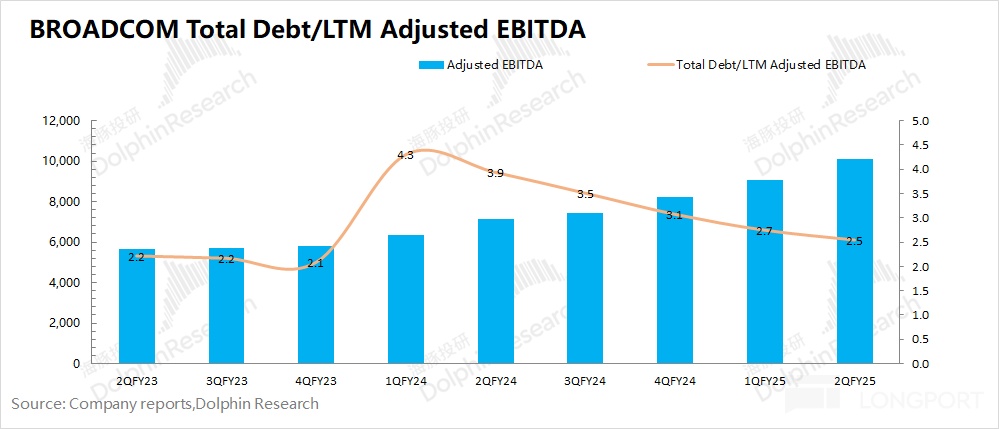
② Impact on Debt: Dolphin Research introduced a debt repayment indicator (Total Debt/LTM Adjusted EBITDA), and calculated that this indicator further declined to 2.5 this quarter. Historically, each acquisition consolidation occurred when the indicator fell to around 2, and with the continued decline of this indicator, Dolphin Research believes that the impact of this acquisition of VMware on the company's debt has been basically digested;
2) AI Business: As the impact of VMware gradually weakens, the performance of AI business becomes more of a focus. The company achieved $4.4 billion in AI business revenue this quarter, meeting market expectations. Since AI business represents growth potential, the market is more concerned with quarter-on-quarter performance.
The company's AI business only grew by $300 million quarter-on-quarter this quarter, with a significant narrowing of quarter-on-quarter growth (over the past three quarters: $400 million-$500 million-$300 million), mainly because the company's major customer Google TPU is in the product generational switch stage. As the mass production of TPUv6 increases in the second half of the year, the company's AI business growth is expected to accelerate again. The company expects AI business revenue of $5.1 billion next quarter, with a quarter-on-quarter increase of $700 million.
Currently, the proportion of computing and network revenue in the company's AI revenue is approximately 6:4. With the mass production and shipment of custom ASICs, the proportion of computing revenue is expected to continue to increase in the future, thus AI revenue also has a clear product-driven attribute, and the company's customer situation and product rhythm will be relatively important focus points.
① From the customer situation: Broadcom's customer situation in the ASIC field is quite healthy, with the company already cooperating with 7 customers on custom ASIC business, including Google, Meta, ByteDance, OpenAI, SoftBank, and two other new customers.
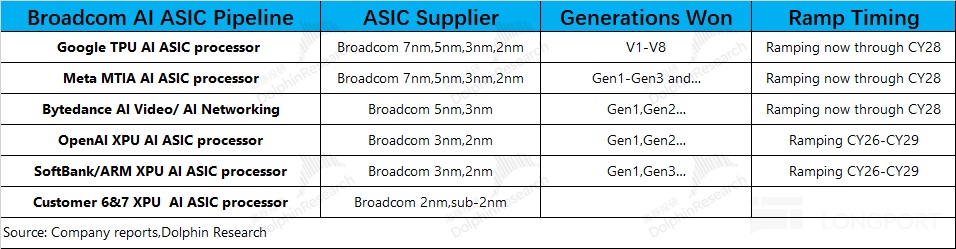
Currently, the company's AI revenue is mainly contributed by Google, Meta, and ByteDance, and with the mass production of OpenAI and SoftBank products in 2026, it is expected to bring new increments to the company.
② Current major customers' product rhythm: The custom ASIC chips of Google, Meta, and ByteDance have already achieved mass production, with Google contributing most of the current AI business revenue, mainly based on the company's long-term cooperation with Google. The increase in mass production of Google's TPUv6 will also contribute to the main increment of the company's AI business in the second half of the year. Entering 2026, Google's TPUv7, Meta's 3nm new products, and OpenAI and SoftBank's products will all bring relatively sustained growth expectations to the company's AI business.
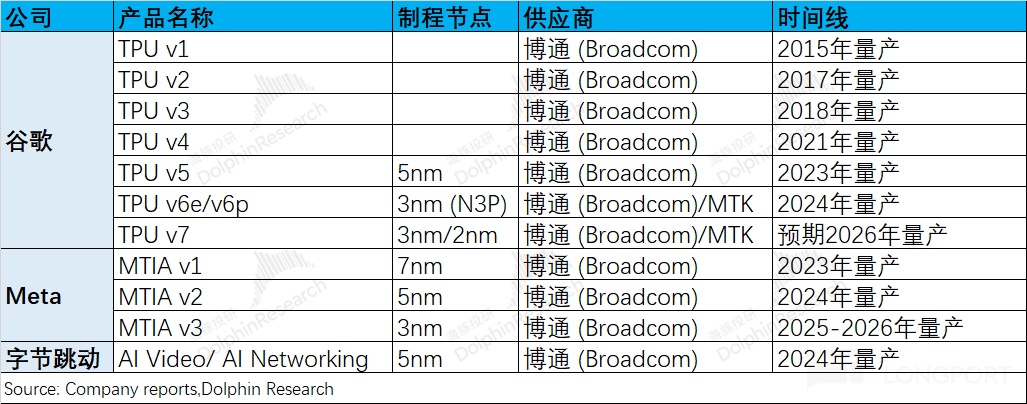
Since Google contributes the vast majority of current AI business revenue, the situation of Google's TPUv7 is also a market focus. Although Broadcom AVGO also faces competition from MediaTek, there is little concern about Google's TPUv7 orders. Combining industry conditions, Dolphin Research expects Google to still launch two versions of TPU v7, v7p and v7e. The v7p will still be designed by Broadcom, while the v7e version will be designed by Google's team with MediaTek's I/O solution. Although Google collaborated with MediaTek on the e-series products, the core p-series products are still entirely entrusted to Broadcom.
From Google's perspective, introducing MediaTek can reduce costs while enhancing self-research capabilities. However, the current impact on Broadcom is relatively small, and core products still need Broadcom to complete.
[Note: Google has provided different versions of TPU, usually distinguished as "e" series (focused on efficiency and inference, running pre-trained models) and "p" series (focused on raw performance for training large models).]
Combining next quarter's guidance, the company expects next quarter's revenue to be $15.8 billion, a quarter-on-quarter increase of $800 million, with AI business accelerating quarter-on-quarter growth, meeting market expectations for TPUv6 volume growth, without providing more unexpected highlights. Considering the company's current market capitalization of $1.2 trillion, it corresponds to the company's expected post-tax core operating profit for FY2026 (revenue +23%, gross margin -1pct, tax rate 14%) at approximately 33 times PE.
Overall, Broadcom AVGO's financial report this time is mediocre, and the current stock price already includes market expectations for Google's TPU mass production and 2026 new product growth. Further breakthroughs in stock price still require the company to provide more unexpected performance in terms of customers, products, and AI expectations.
The following is Dolphin Research's detailed interpretation of Broadcom's financial report:
I. Broadcom's Main Business Situation
Broadcom's previous performance growth mainly came from AI business and VMware's acquisition consolidation, so the custom ASIC chips in AI business and VMware's pricing adjustment strategy are the main focus of the market. Specifically, the business includes:
1) Semiconductor Solutions: Mainly benefiting from the growth of AI revenue, mainly benefiting from the demand for custom ASICs from customers such as Google, Meta, and ByteDance. Other non-AI businesses are greatly affected by downstream demand and perform relatively poorly.
2) Infrastructure Software: VMware consolidation, software revenue proportion increased to over 40%. The company adjusted the pricing strategy for VMware's customers, and price increases can drive revenue growth, but this impact has significantly weakened.

II. Overall Performance: Mediocre
2.1 Revenue Side
Broadcom BROADCOM (AVGO.O) achieved revenue of $15 billion in Q2 FY2025, a year-on-year increase of 20%, market expectation ($14.9 billion). This quarter's growth mainly came from the endogenous growth of AI business and VMware.
On a quarter-on-quarter basis, the company's revenue this quarter slightly increased by $100 million, mainly driven by AI business, while software business saw a quarter-on-quarter decline.
2.2 Gross Margin Side
Broadcom BROADCOM (AVGO.O) achieved a gross profit of $10.2 billion in Q2 FY2025, a year-on-year increase of 31%.
Among them, Broadcom's gross margin this quarter was 68%, slightly declined quarter-on-quarter. This is mainly due to the relatively low gross margin of the company's AI semiconductor business, and as the proportion of AI increases, it structurally drives the decline in gross margin.
2.3 Operating Expenses
Broadcom BROADCOM (AVGO.O) had operating expenses of $4.37 billion in Q2 FY2025, a quarter-on-quarter increase of $500 million, mainly due to the company's increased equity incentives this quarter.
Excluding the impact of equity incentives, the company's core operating expenses (R&D expenses + sales and management expenses) were $2.2 billion this quarter, a quarter-on-quarter increase of $120 million, with increased investment in AI R&D.
After completing the consolidation of VMware, the company is committed to integrating and reducing operating expenses, and the increase in core operating expenses this quarter indicates that the impact of VMware on the expense side has basically weakened.
2.4 Profit Side
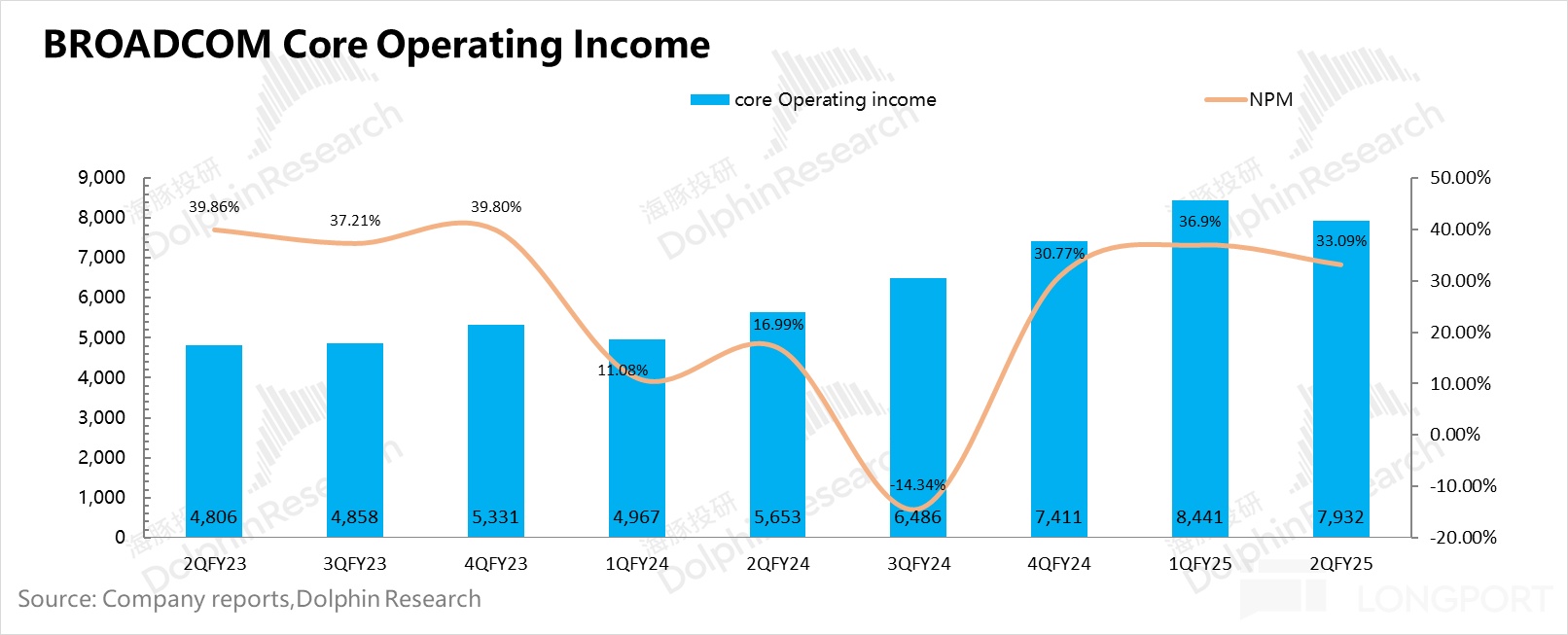
Broadcom BROADCOM (AVGO.O) achieved a net profit of $4.96 billion in Q2 FY2025. Compared to net profit, Dolphin Research believes that core operating profit (= gross profit - R&D expenses - sales and management expenses) better reflects the company's true operating situation. Broadcom achieved core operating profit of $7.94 billion this quarter, a quarter-on-quarter decline of $500 million, mainly due to the company's increased equity incentives this quarter. Among them, the company's equity incentives increased by $490 million this quarter, and excluding this impact, the company's profit side was basically flat quarter-on-quarter.
2.5 Broadcom's EBITDA
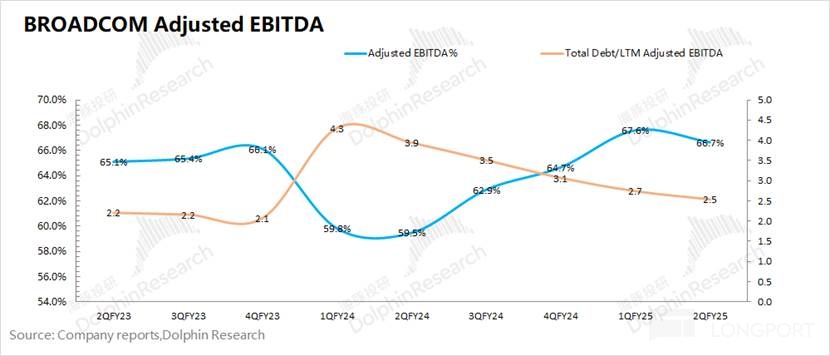
Since Broadcom is good at external acquisitions, the company usually uses adjusted EBITDA% as one of the company's operating indicators. Dolphin Research calculated that the company's adjusted EBITDA% for Q2 FY2025 rebounded to 66.7%, reaching the company's previous guidance (66%).
Further observing the company's debt repayment ability, the company's total debt/LTM Adjusted EBITDA ratio continued to fall to 2.5 this quarter. As performance grows, this ratio continues to decline, indicating that the impact of the company's acquisition of VMware has been basically digested. As this ratio approaches the position around 2, the company may start looking for new acquisition opportunities again.
III. Specific Business Situation: AI "Gear Shift", Continued Growth
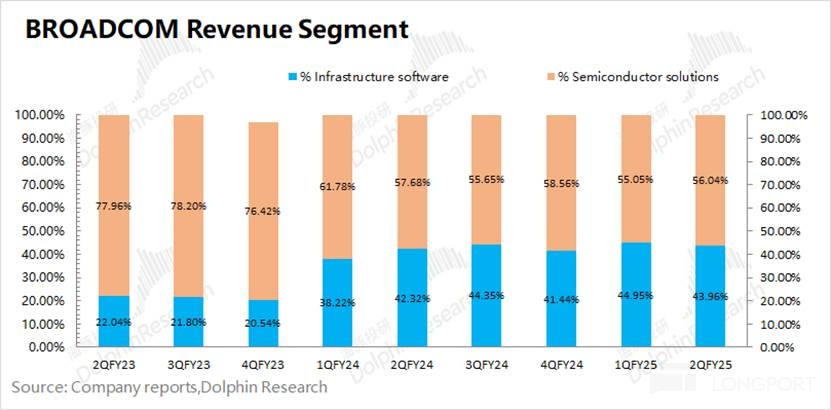
Broadcom BROADCOM (AVGO.O) has two main businesses: semiconductor solutions and infrastructure software. With the completion of the company's acquisition consolidation of VMware, the proportion of infrastructure software business has significantly increased, and the current software business revenue proportion has reached 44%.
Among the two major categories of business, 1) Semiconductor Solutions: Network, wireless, storage connectivity, broadband, industrial, and others; 2) Infrastructure Software: VMware, CA, Symantec, Brocade, etc.
3.1 Semiconductor Solutions
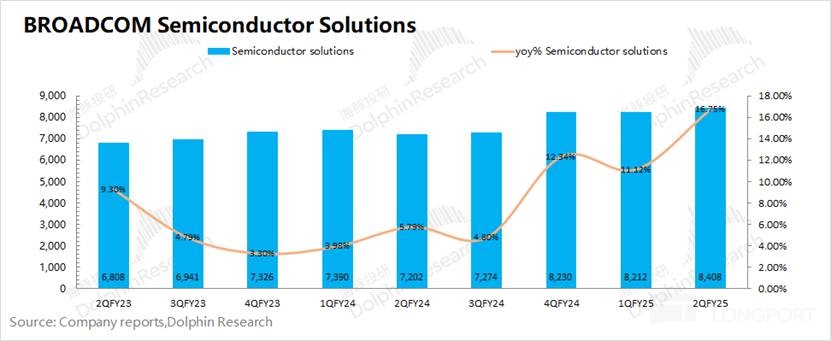
Broadcom BROADCOM (AVGO.O) achieved semiconductor solutions revenue of $8.4 billion in Q2 FY2025, a year-on-year increase of 17%. The growth of the company's semiconductor business this quarter mainly came from the drive of AI business, while non-AI business was relatively sluggish.
1) AI Business
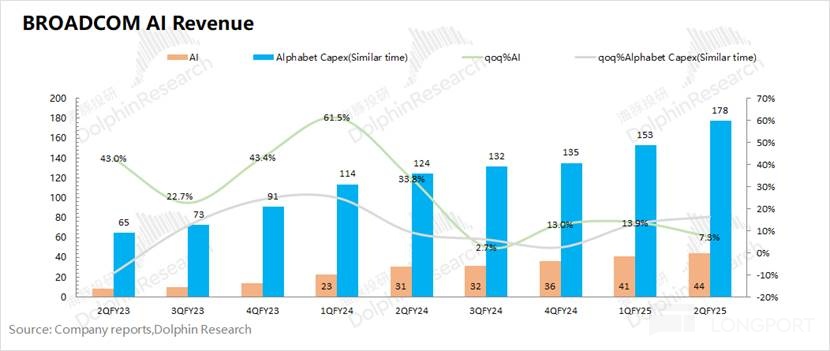
Currently, AI business is the company's performance focus, with AI revenue of $4.4 billion this quarter, a quarter-on-quarter growth of only $300 million, with a significant narrowing of quarter-on-quarter growth (over the past three quarters: $400 million-$500 million-$300 million), mainly because the company's major customer Google TPU is in the product generational switch stage. As the mass production of Google's TPUv6 increases, the company's AI business growth will accelerate again in the second half of the year, with the company expecting AI revenue of $5.1 billion next quarter, a quarter-on-quarter increase of $700 million.
In the company's AI business, the proportion of computing revenue and network revenue is approximately 6:4. As more customers and custom ASIC products are mass-produced, the proportion of computing revenue is expected to continue to increase in the future.
Although the company currently has products from 3 customers (Google, Meta, and ByteDance) that have achieved mass production, Google is still the largest source of revenue for the company's AI business. Combining data, the trend of quarter-on-quarter changes in the company's AI revenue is also close to the trend of changes in Google's capital expenditure. This is mainly because the company's custom ASIC business has a clear product-driven attribute, affected by the customer's new product mass production rhythm.
When Google's TPU is in the generational switch stage, the growth rate of capital expenditure is also relatively low. When the generational switch is completed and new product mass production increases, Google's capital expenditure and the company's AI revenue growth rate will both increase.
For the short-term performance of AI business, attention is still focused on Google's TPUv6 and v7 products. The current increase in v6 mass production will be the main driving force for the company's AI business in the second half of the year. The v7 orders will be the growth point for AI business next year.
Combining industry conditions, Dolphin Research expects Google to still launch two versions of TPU v7, v7p and v7e. The v7p will still be designed by Broadcom, while the v7e version will be designed by Google's team with MediaTek's I/O solution. Although Google collaborated with MediaTek on the e-series products, the core p-series products are still entirely entrusted to Broadcom, the current impact on Broadcom is relatively small.
[Note: Google has provided different versions of TPU, usually distinguished as "e" series (focused on efficiency and inference, running pre-trained models) and "p" series (focused on raw performance for training large models).]
From a medium to long-term perspective, with a rich customer base, Broadcom's AI business has stronger risk resistance. Since the company has already obtained 7 ASIC customers (Google, Meta, ByteDance, OpenAI, SoftBank/ARM, and two other new customers), although Google's impact on the company's AI business is relatively large at the current stage, as new products from customers are gradually mass-produced, it provides more assurance for the growth of the company's AI business.
2) Non-AI Business
The company's non-AI semiconductor business revenue this quarter was $4 billion, with both year-on-year and quarter-on-quarter declines. The company's non-AI business mainly includes: enterprise storage, broadband business, wireless business, and industrial and others, with different fields having different performances.
Specifically: enterprise network and broadband business saw quarter-on-quarter growth this quarter, while wireless communication business, industrial, and others continued to decline quarter-on-quarter.
Apple is a major customer of the wireless communication business, so the wireless business is affected by seasonal fluctuations. However, it should be noted that Apple is continuously self-developing related chips. If Apple's self-developed chips are implemented in the future, it will have a potential impact of 10-20% on the company's overall revenue.
3.2 Infrastructure Software
Broadcom BROADCOM (AVGO.O) achieved infrastructure software revenue of $6.6 billion in Q2 FY2025, a quarter-on-quarter decline of $100 million. The growth of software business over the past year mainly came from the acquisition integration of VMware. This quarter's software revenue decline indicates that this impact has basically come to an end.
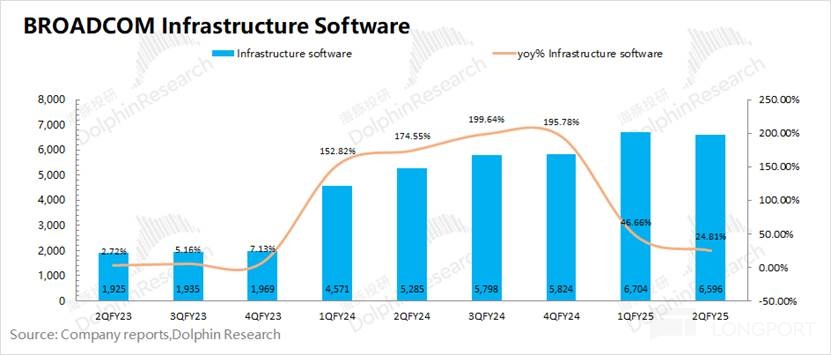
Broadcom's software business is mainly divided into VMware and CA & Symantec & Brocade and other original software businesses. Since the company's CA & Symantec & Brocade and other original software businesses have basically maintained quarterly revenue of around $2 billion, the main focus of the company's software business is the acquired VMware.
The impact of VMware on the company's performance, Dolphin Research believes, is mainly two aspects: "external part of acquisition consolidation" and "full transition from perpetual license to subscription mode". Combining this quarter's software business performance, Dolphin Research expects VMware's revenue this quarter to still reach over $4 billion, but no significant quarter-on-quarter growth was seen. The current proportion of license users transitioning to the subscription model has exceeded 60%. As the penetration rate of the subscription model increases, VMware and software business revenue are still expected to grow, but it is difficult to have another high growth performance.
From three perspectives: ① Revenue declined quarter-on-quarter; ② Operating expense ratio no longer decreases; ③ Debt repayment indicator fell to 2.5, VMware's impact has been digested by the company, and the company no longer separately discloses VMware's detailed data, AI business has become the market's most focused "focus".
<End here>
Dolphin Research Broadcom BROADCOM (AVGO.O) article retrospectives:
In-depth:
December 4, 2024, company in-depth "Broadcom (AVGO.O): Soft and Hard Dual Eating, An Alternative Winner in the AI Computing Power Era"
September 13, 2024, company in-depth "Broadcom: "Buy Buy Buy" Paving the "Trillion" Road? Tencent and Alibaba Learn!"
Financial Report:
March 7, 2025, conference call "Broadcom (Minutes): ASIC Customers Add 2 to Become "3+4", No Consideration for Acquisition"
March 7, 2025, financial report commentary "Marvell Collapse, NVIDIA Dormant? Broadcom Becomes the Stabilizing Force"
December 13, 2024, conference call "Broadcom: AI Serviceable Market Size Will Reach 60-90 Billion in FY2027 (FY24Q4 Minutes)"
December 13, 2024, financial report commentary "ASIC to Surpass GPU? Broadcom's Good Days Are Ahead"
September 6, 2024, conference call "Broadcom: ASIC Demand Will Be More in 2025 (FY24Q3 Conference Call)"
September 6, 2024, financial report commentary "Broadcom "Surge"? AI Can't Support the Collapse of Traditional Semiconductors"
This article's risk disclosure and statement: Dolphin Research Disclaimer and General Disclosure
The copyright of this article belongs to the original author/organization.
The views expressed herein are solely those of the author and do not reflect the stance of the platform. The content is intended for investment reference purposes only and shall not be considered as investment advice. Please contact us if you have any questions or suggestions regarding the content services provided by the platform.
