


Howard Marks: There is a bubble in 2025, but it's not crazy!
The year-end investment memo from Howard Marks, founder of Oak Tree Capital (derived from The Intelligent Investor).
Howard Marks' year-end memo from Oak Tree Capital has arrived as scheduled. This time, it discusses bubbles.
Howard says that since he entered the investment business, the terms "bubble" and "crash" have always been closely associated, and they will likely continue to exist for future generations.
"But in my view, bubbles or crashes are less about quantitative calculations and more about a psychological state."
In several interviews last year, Howard was asked this question, and he would say, "I don't think the stock market is wildly high right now. It's a bit high, but far from crazy."
This time he uses a longer format to carefully dissect it, including the definition of "bubble," and considers it from various angles such as historical data, investment patterns, market reflexivity, and technological innovation.
He does not provide a clear answer, but his views may lie in the arguments at the end of the article.
Howard's early exposure to real investment bubbles prompted him to establish some principles that have guided him through more than 50 years of ups and downs. These principles are arguably more beneficial than providing a conclusion or prediction:
1. What you buy is not the focus; the focus is on how much you paid for it (price).
2. Good investing is not about buying good things, but about buying well.
3. There is no asset so good that its price is never "overvalued," nor is there an asset so bad that its price is never "undervalued."
Repeatedly marked down.
The Intelligent Investor is authorized by Oak Tree Capital to share with everyone.
Exactly 25 years ago today, I received my first reader response to a memo I published (prior to this, I had written memos for nearly 10 years without receiving any replies).
That memo was titled "The Internet Technology Bubble," and the theme was the irrational investment behavior I believed was occurring in technology stocks, internet stocks, and e-commerce stocks.
There were two notable points about that memo: it was correct, and it was quickly validated. One of the first great investment maxims I learned in the early 1970s is "It's hard to distinguish between being too early and being wrong."
In the case of this memo, it is clear that I was not too early.
This milestone anniversary rekindles my thoughts on bubbles, and today, bubbles are a very eye-catching topic.
As is well known, I am a credit investor, and I stopped engaging in stock analysis fifty years ago, nor have I conducted in-depth research in the technology sector, so I will not comment on today's popular companies and their stocks. All my observations may be general, but I still hope they have some relevance.
In the first decade of the 21st century, investors had the opportunity to participate in, and even suffer losses from, two massive bubbles. The first was the technology, media, and telecommunications ("TMT") bubble that emerged in the late 1990s and burst in the middle of the millennium; the second was the real estate bubble that formed in the middle of this period It has led to:
(1) Issuing real estate mortgages to subprime borrowers who are unable or unwilling to provide proof of income or assets;
(2) Securitizing these loans into leveraged, tiered mortgage-backed securities, ultimately resulting in
(3) Significant losses for investors in such securities, particularly financial institutions that created and held some of these securities.
Considering these experiences, many people today are highly vigilant about bubbles.
I am often asked whether there is a bubble in the S&P 500 index and a few leading stocks.
The seven major stocks in the S&P 500—known as the "Magnificent Seven"—are Apple, Microsoft, Alphabet (the parent company of Google), Amazon, Nvidia, Meta (the owner of Facebook, WhatsApp, and Instagram), and Tesla.
The performance of these stocks is evident and needs no further explanation from me.
In summary, a few stocks have dominated the performance of the S&P 500 over the past few years, accounting for a very high proportion of its gains.
A chart by Michael Cembalest, Chief Strategist at Morgan Asset Management, shows that:
As of the end of October 2024, the market capitalization of the seven major S&P 500 stocks accounted for 32-33% of the total market capitalization of the index;
This proportion is about twice that of the leading stocks five years ago;
Before the rise of the "Magnificent Seven," the highest proportion of the top seven stocks over the past 28 years was about 22% during the peak of the TMT bubble in 2000.
It is also noteworthy that, according to another chart by Michael Cembalest, as of the end of November 2024, U.S. stocks accounted for over 70% of the MSCI World Index, the highest level since 1970.
Therefore, it is clearly visible:
(1) U.S. companies are highly valued compared to companies in other regions;
(2) The market capitalization of the top seven U.S. stocks is higher than that of the remaining U.S. stocks.
But is this a bubble?
1. What is a bubble?
Investment terminology is constantly evolving. Today, young colleagues at Oak Tree Capital use many investment terms that I also need to "translate" to understand.
However, since I entered the investment field, the terms "bubble" and "crash" have always been closely associated with me, and I believe they will continue to exist for future generations.
Today, mainstream media widely uses them, and people seem to think they can be objectively defined.
But in my view, a bubble or crash is more of a psychological state than a quantifiable calculation.
I believe that a bubble not only reflects a rapid rise in stock prices but is also a temporary frenzy characterized by the following:
A highly irrational exuberance (to borrow a phrase from former Federal Reserve Chairman Alan Greenspan),
A complete adoration of the underlying company or asset, and a firm belief in the fear of missing out,
A tremendous fear of missing out ("FOMO"), and Therefore, it is believed that these stocks "are worth any price."
"Are worth any price" particularly impressed me.
When you cannot imagine any flaws in the arguments and fear that your colleagues/golf partners/brothers-in-law/competitors will hold assets that you do not, it is difficult to conclude that you should not buy at a certain price.
As Charles Kindleberger and Robert Aliber pointed out in "Manias, Panics, and Crashes: A History of Financial Crises" (5th edition), “Nothing influences thought and judgment more than seeing your friends get rich.”
Thus, to identify a bubble, while investors can observe valuation parameters, I have always believed that psychological diagnostics are more effective.
Whenever I hear "are worth any price" or similar statements (more prudent investors might say, "Of course, there will be times when prices are too high, but we are not there yet"), I consider it a clear signal that a bubble is brewing.
About fifty years ago, an elder shared one of my favorite maxims.
I have mentioned this maxim multiple times in memos, but in my view, it cannot be mentioned too often.
That is "the three stages of a bull market":
The first stage usually follows a market decline or crash that leaves most investors licking their wounds and feeling extremely low. At this point, only a few insightful individuals can imagine that there might be improvements in the future.
In the second stage, the economy, companies, and markets perform well, and most people believe that things are indeed improving.
In the third stage, after a period of very good economic news, soaring corporate profits, and significant stock increases, everyone believes that things can only get better.
The important inferences are not related to economic or corporate activity; they are often related to investor psychology. It is not a question of what is happening in the macro world, but rather how people perceive the developments.
When few believe that things will improve, security prices will certainly not reflect much optimism.
However, when everyone believes that things can only get better, it becomes difficult to find anything reasonably priced.
Bubbles are marked by bubble thinking. Or for work purposes, we should say that bubbles and crashes are extreme events that cause people to lose objectivity and view the world through highly distorted psychology—either overly positive or overly negative.
The following is what Kindleberger stated in "Manias, Panics, and Crashes" (1st edition):
...when businesses or households see others profiting from speculative buying and reselling, they often follow suit.
As more and more businesses and households become addicted to these behaviors, drawing in groups that would normally stay away from such risky behavior, speculative profit-seeking can lead normal and rational behavior into what is called "madness" or "bubble."
The term "madness" emphasizes irrationality; "bubble" implies a rupture.
In my view, bubbles are marked by extreme investment psychology As Kindleberger pointed out, this can be inferred from the widespread participation in the current investment frenzy, especially among non-financial individuals.
Legend has it that when John Pierpont Morgan's shoeshiner started recommending stocks to him, it was a sign that something was wrong.
My partner John Frank said he noticed this issue back in 2000 when he heard fathers bragging about the tech stocks they held at his son's soccer game; then in 2006, he saw the bubble again when a Las Vegas taxi driver told him he had bought three apartments.
Mark Twain once said, "History doesn't repeat itself, but it often rhymes." This is exactly the situation he was referring to.
II. The New Things
If bubble thinking is irrational, what causes investors to break free from rational thought, as if the thrust of a rocket ship has surpassed the limits of gravity to reach escape velocity? The answer is simple: novelty.
This phenomenon relies on another well-known investment adage: "This time is different."
Bubbles are always associated with new developments.
Historical bubbles include: the "Nifty Fifty" stocks of the 1960s (which will be detailed later), disk drive companies of the 1980s, TMT/internet stocks of the late 1990s, and subprime mortgage-backed securities from 2004 to 2006.
These relatively recent crazes followed in the footsteps of older bubbles:
(1) The Dutch frenzy over newly introduced tulips in the 1630s; and (2) The South Sea Bubble of 1720 in England, which involved a royal grant of trade monopoly privileges to the South Sea Company that was expected to bring wealth.
Under normal circumstances, if a sector or a country's securities receive unusual attention and become overvalued, "historians" in the investment field often point out that the premiums on these stocks have never exceeded the average level or similar indicators by x%.
In this way, attention to history acts like a rope, firmly tying the favored group to the ground.
But if it is something new, it means there is no historical record, and thus the enthusiasm for investment cannot be suppressed.
After all, new things are owned by the smartest people (those who appear in headlines and on television) who make a fortune. Who would want to rain on the parade or refrain from dancing wildly?
Hans Christian Andersen's story "The Emperor's New Clothes" often explains this issue.
The swindlers sell the emperor a set of magnificent clothes that they claim can only be seen by the wise, but in reality, there are no clothes. When the emperor parades naked through the town, the citizens dare not say they do not see the clothes, as it would make them seem foolish.
This situation continues until a little boy steps out of the crowd and innocently points out that the emperor has no clothes on.
Most people would rather accept a shared illusion that allows investors to make big money than say something contrary that makes them look like fools.
When the entire market or a class of securities is being hyped up, and a seemingly plausible idea is making its followers rich, few will dare to expose it.
3. My Baptism of Fire
People often say that experience is what you gain when you don't get what you want, and I gained the most impactful experience early in my career.
Most people who have read my memos know that I joined the stock research department of First National City Bank (now Citibank) in September 1969.
Like most so-called "money center banks," Citibank primarily invested in the "Nifty Fifty"—the best and fastest-growing company stocks in the United States.
Investors believed these companies were so good that (1) nothing bad would ever happen to them, and (2) no price was too high for their holdings...
There were three factors that captivated investors about these stocks:
First, the U.S. economy grew strongly after World War II.
Second, these stocks participated in various innovative fields (such as computers, pharmaceuticals, and consumer goods) and thus benefited.
Third, these stocks represented the first wave of "growth stocks," a new investment style that had become fashionable in itself.
The "Nifty Fifty" was the first major bubble in the past 40 years, and because there hadn't been a bubble for so long, investors had forgotten what a bubble looked like.
Because these stocks were highly favored at the time, if you had bought these stocks on the day I started working and held them for five years, you would have lost over 90% of your investment in the best companies in America... What exactly happened?
The "Nifty Fifty" was put on a pedestal, and once it fell from that pedestal, it was the investors who got hurt.
The entire stock market fell by about half between 1973 and 1974.
It turned out that these stocks were indeed overpriced; the price-to-earnings ratios of most stocks fell from the range of 60 to 90 down to the range of 6 to 9 (this is how you easily lose 90%).
Moreover, several companies did experience a deterioration in their fundamentals.
My early exposure to a real investment bubble prompted me to establish some principles that have guided me through the ups and downs of the past 50 years:
What you buy is not the point; the point is how much you paid for it (the price).
Good investing is not about buying good things, but about buying well.
There is no asset that is so good that its price can never be "overvalued," and there are few assets that are so bad that their price can never present a "buying opportunity."
4. Things Will Only Get Better
The bubbles I have experienced, as mentioned earlier, were all related to innovation, and most innovations were either overvalued or not fully understood.
A new product or business model often shows obvious appeal, but the traps and risks within are often difficult to detect, sometimes only becoming apparent during tough times.
New companies may completely surpass their predecessors, but investors lacking experience in this new field often fail to understand that even promising new companies can be replaced.
Disruptors can also be disrupted, either by competitors with superior technology or by more advanced technologies In the first few decades of my career, technology seemed to develop in a gradual manner. Computers, pharmaceuticals, and other innovative products progressed at a steady pace.
However, entering the 1990s, innovation emerged one after another.
When Oak Capital was founded in 1995, I insisted that word processing could only be done with WordPerfect software, and spreadsheets could only be done with Lotus 1-2-3 software.
But when we moved to our current office in 1998, I gave in and had the IT team install an email system and internet browser (of course, WordPerfect was replaced by Word and Lotus 1-2-3 was replaced by Excel).
At that time, investors were convinced that "the internet would change the world." It certainly seemed that way, and this assumption gave rise to a huge demand for various internet-related things.
E-commerce stocks went public at seemingly high prices and then tripled on the first day. What followed was a real gold rush.
Behind every wave of frenzy and bubble, there is usually a kernel of truth, but this rationality is often exaggerated.
Clearly, the internet did change the world—in fact, we cannot imagine a world without the internet. However, the vast majority of internet and e-commerce companies that soared during the late 1990s bubble ultimately became worthless.
During one bubble burst early in my investment career, The Wall Street Journal would feature a column on the front page listing stocks that had fallen by 90%.
In the period following the TMT bubble, some of those companies saw declines of up to 99%.
When something is hyped to its peak, the risk of its fall is very high. When people assume and expect that things will only get better, the damage caused by unexpected negative situations will be deeply felt.
When something is just emerging, competitors and disruptive technologies have not yet surfaced.
There may indeed be merits, but if overvalued, the price becomes too high, and when everyone realizes the reality, everything dissipates. In the real world, trees do not grow to the sky.
The above discussion focuses on the risks of overestimating fundamental capabilities. However, an optimistic attitude towards the power and potential of new things often leads to them being assigned excessively high stock values, complicating the errors.
As mentioned earlier, there are inevitably no historical metrics to measure appropriate valuations for new things.
Moreover, the potential of these companies has not yet translated into stable profits, meaning what is being valued is merely speculation. During the TMT bubble, these companies were not profitable, so there were no price-to-earnings ratios to check. Additionally, as startups, they often had no revenue to value. Thus, new metrics emerged, and investors blindly chased "click-through rates" or "viewing rates" as standards of value, ignoring whether these metrics could actually translate into revenue and profits.
Because bubble participants cannot imagine any adverse situations, the valuations they assign are often based on the assumption of success.
In fact, it is not uncommon for investors to believe that all competitors in an emerging field have the potential to succeed, but the reality is often that only a few companies can thrive, or even survive Finally, investors may adopt what I call a "lottery mentality" towards extremely popular new things. If a successful startup in a hot sector can provide a 200-fold return, then mathematically speaking, even if the probability of success is only 1%, it is worth investing. So, what investment has even less than a 1% chance of success? If investors think this way, there is virtually no upper limit to what they support or what price they are willing to pay.
Clearly, investors can get stuck in the quagmire of competing to buy new things. This is the source of bubbles.
5. What is a reasonable price for a bright future?
If there is a company for sale that will make $1 million next year and then go bankrupt, how much would you pay for that company? The correct answer is slightly less than $1 million; only then can your investment yield a positive return.
However, stocks are priced based on the "price-to-earnings ratio" (i.e., the multiple of next year's earnings).
Why? Because it is very likely that the company will not only be profitable for one year; it will continue to be profitable for many years to come. When you buy a stock, you are buying a portion of the company's future earnings each year.
After World War II, the average price-to-earnings ratio of the S&P 500 was about 16 times, meaning "you are paying for 16 years of earnings." But in reality, it is much more than that, because the discounting algorithm makes the value of future $1 profit less than today's $1.
If a company's current value is the discounted present value of its future earnings, then a 16 times price-to-earnings ratio actually means you are paying for more than 20 years of earnings (depending on the discount rate for future earnings).
Moreover, during bubble periods, the price-to-earnings ratios of popular stocks are far higher than 16 times. The price-to-earnings ratio of the "Nifty Fifty" back then reached 60 to 90 times!
Even if they are indeed expected to see significant earnings growth, investors in 1969 were paying for the company's earnings for "decades" into the future.
Were they doing this consciously and analytically? I don't remember that being the case. Investors thought the price-to-earnings ratio was just a number... if they even thought about the price-to-earnings ratio at all.
Today, the leading companies in the S&P 500 are superior in many ways to the best companies of the past. These companies enjoy significant technological advantages, have large scales, dominate market shares, and achieve above-average profit levels.
Additionally, because their products are more based on creativity rather than physical raw materials, the marginal cost of producing additional units is very low; in other words, the marginal profit margin is very high.
Furthermore, the price-to-earnings ratios of today's leading companies are not as high as those of the "Nifty Fifty."
Among the "seven giants of U.S. stocks," the most attractive may be NVIDIA, the leading designer of artificial intelligence chips. The company's current future price-to-earnings ratio is just over 30, depending on which earnings estimation method you use Although it is twice the average price-to-earnings ratio of the post-war S&P 500 index, it is still far below the "Nifty Fifty."
But what does a 30 times price-to-earnings ratio mean?
First, investors believe that NVIDIA will continue to operate for decades to come.
Second, the company's profits will continue to grow over these decades.
Third, the company will not be replaced by competitors.
In other words, investors are assuming that $NVIDIA(NVDA.US) will be able to endure for a long time.
However, enduring for a long time is not easy, especially in the high-tech field where new technologies emerge endlessly and new competitors may surpass existing companies.
For example, it is noteworthy that only about half of the "Nifty Fifty" still remain in the S&P 500 today (this number undoubtedly looks worse than reality, as the disappearance of some "old brands" is due to mergers and acquisitions, rather than operational failures).
The leading companies that have disappeared from the S&P 500 since 1969 include Xerox, Kodak, Polaroid, Avon, Burroughs, Digital Equipment, and my favorite, Simplicity Pattern (how many people still make their own clothes?).
Moreover, from the names of the top twenty companies in the S&P 500, it is evident how difficult it is to endure for a long time. According to data from finhacker.cz, at the beginning of 2000, the following 20 companies had the highest market share in the index:
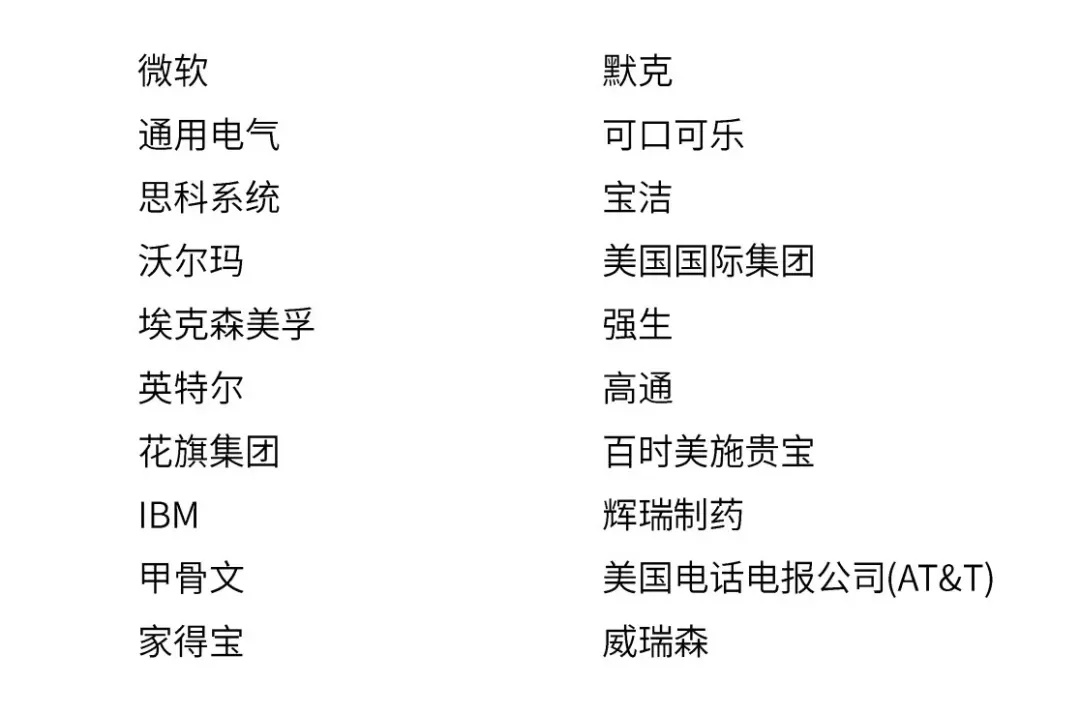
However, by the beginning of 2024, only six of these companies still ranked among the top twenty:

In particular, among today's seven giants of the U.S. stock market, only Microsoft is one of the top twenty companies from 24 years ago.
During the bubble period, investors were willing to pay high stock prices for leading companies, believing that these leading enterprises would surely maintain their dominance for decades. However, some companies can do it, while others cannot. Change is the only constant rule, not permanence.
6. The Entire Market
The biggest bubbles usually originate in the field of innovation, often related to technological or financial innovations, initially affecting only a small number of stocks.
But sometimes it expands to the entire market, as the enthusiasm for a particular bubble group spreads to everything.
In the 1990s, the S&P 500 rose sharply due to (1) the continued decline in interest rates from the peak in the early 1980s to combat inflation; and (2) the rekindled enthusiasm for stocks among investors who had suffered painful experiences in the 1970s.
The rapid profit growth of technology innovations and high-tech companies also fueled the market's exuberance.
Academic research at the time pointed out that the S&P 500 had never experienced a prolonged period of underperformance compared to bonds, cash, and inflation, further boosting the popularity of stocks.
Under the combined influence of these positive factors, the S&P 500 index achieved an annualized return of over 20% during that decade, a phenomenon I had never witnessed before.
I often say that the biggest risk in this world is thinking there is no risk.
Similarly, the intense buying triggered by the observation that stocks have never underperformed for long led to stock prices rising to levels where such a situation was bound to occur.
In my view, this is the investment "reflexivity" of George Soros at work.
Stocks were severely impacted when the TMT bubble burst, and the S&P 500 fell in 2000, 2001, and 2002, marking the first consecutive three-year decline since the Great Depression of 1939.
Affected by this poor performance, investors rushed to sell stocks, resulting in a cumulative return of zero for the S&P 500 from the peak of the bubble in mid-2000 to December 2011, a period of over eleven years.
Recently, I have been repeating a quote from Warren Buffett: "When investors forget that corporate profits grow at an annual rate of about 7%, they often get into trouble."
This means that if corporate profits grow by 7% each year, and stocks (representing a portion of corporate profits) rise by 20% annually for a period, then eventually the price-to-earnings ratio of the stocks will become too high, leading to risk. (I recently asked Warren Buffett about the origin of this quote, and he told me he never said it. But I think it's a great quote, so I keep citing it.)
The key point is that when stocks rise too quickly (disproportionate to the earnings growth of the issuing companies), it is unlikely to sustain appreciation. Michael Cembalest illustrated this in another chart.
The chart shows that two years ago, the S&P 500 had only four instances in its history where the consecutive two-year return reached or exceeded 20%.
In these four instances (note that this is just a small sample), the index experienced a pullback in three of the following two years. (The period from 1995 to 1998 was an exception—the strong TMT bubble delayed the pullback until 2000, during which the index fell by 40% over the next three years.) In the past two years, this situation has occurred for the fifth time, with the S&P 500 rising 26% in 2023 and 25% in 2024, marking the best two-year performance since 1997-1998.
Then we enter 2025. What will the future hold?
The warning signals that have emerged today include:
The optimism that has flooded the market since the end of 2022;
The valuation of the S&P 500 index is above average, and most industry groups have price-to-earnings ratios higher than those of similar companies in other parts of the world;
The enthusiasm for artificial intelligence as an emerging phenomenon, and the possibility that this optimistic sentiment may spread to other high-tech fields;
The assumption that the "seven giants of U.S. stocks" will continue to succeed; and
Part of the rise in the S&P 500 index is due to index investors automatically buying these stocks without considering their intrinsic value.
Finally, let's talk about Bitcoin, although it is not directly related to stocks. Setting aside the advantages of Bitcoin, the fact that its price has risen 465% in the past two years clearly cannot serve as a testament for investors to be overly cautious.
As I have often said, I frequently find that just when I am about to release a memo, something happens, and this time is no exception.
On the last day of 2024, I received something from two sources that fits this description:
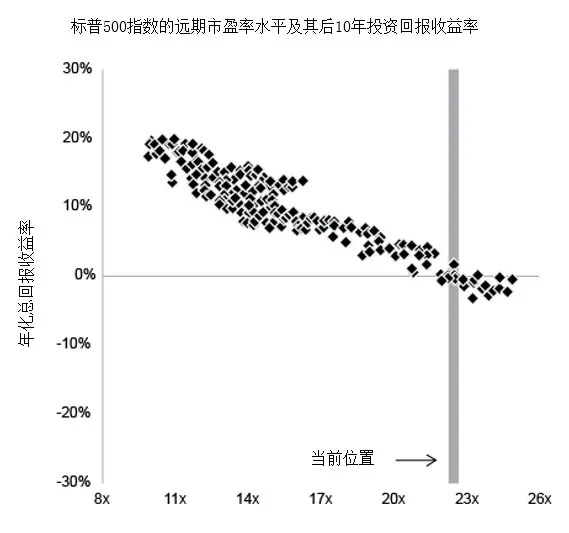
This chart from JP Morgan Asset Management observes each month from 1988 to the end of 2014, represented by squares, totaling 324 monthly observations (27 years x 12).
Each square represents the forward price-to-earnings ratio of the S&P 500 index at that time and the annualized return over the subsequent ten years. This chart is thought-provoking:
There is a strong relationship between initial valuations and the annualized returns over the subsequent ten years. Higher initial valuations often lead to lower returns, and vice versa. While there are some subtle differences in the observations, there are no serious exceptions.
Today's price-to-earnings ratio is clearly in the highest decile of the observation sample range.
During the 27 years from 1988 to 2014, when investors purchased the S&P 500 index at a price-to-earnings ratio comparable to today’s, namely 22 times, they often only achieved a ten-year return rate between positive 2% and negative 2%.
In November, several leading banks in the industry released forecasts for the ten-year return rate of the S&P 500 index, predicting values in the low single digits. The aforementioned relationship between price-to-earnings ratio valuation and investment returns is precisely the annotation.
Investment returns significantly depend on the price paid for the investment, which is not surprising. Therefore, investors should clearly not be indifferent to the current stock market valuations.
You might say, "Achieving an annualized return of positive or negative 2% is not the worst thing in the world." If stock prices remain unchanged over the next ten years while company earnings rise, then the price-to-earnings ratio will return from an overvalued position to a normal level, which is true But another possibility exists, which is that the price-to-earnings ratio may be squeezed within one to two years, leading to a significant drop in stock prices, just as we saw in 1973-1974 and 2000-2002. In this case, the outcome would be really bad.
These are the things to worry about.
Next is the counterargument:
The price-to-earnings ratio of the S&P 500 is high, but not outrageous;
The "seven giants" of the U.S. stock market are astonishingly high-quality companies, and their price-to-earnings ratios are not outrageous;
I have not heard people say "the price is not too high"; and
Although the market is highly priced and may still have a bubble, it does not seem crazy to me.
As I mentioned at the beginning of this memorandum, I am not a stock investor, nor am I an expert in technology.
Therefore, I cannot make authoritative statements about whether we are currently in a bubble. I just want to list the facts I see and provide suggestions on how to view these facts... just as I did 25 years ago.
I hope you will continue to read my memorandums for the next 25 years!
The copyright of this article belongs to the original author/organization.
The views expressed herein are solely those of the author and do not reflect the stance of the platform. The content is intended for investment reference purposes only and shall not be considered as investment advice. Please contact us if you have any questions or suggestions regarding the content services provided by the platform.
