


Crossroads Capital @CrossroadsOnX is now short on Bloom Energy $Bloom Energy(BE.US) today after @hntrbrkmedia went short yesterday.
Core Short Thesis> The Scandium Bottleneck: Bloom Energy’s aggressive multi-gigawatt growth story relies entirely on scandium oxide, a rare metal used to stabilize the ceramic electrolyte in its solid-oxide fuel cells (SOFC). There is no viable substitute for scandium without significantly reducing the cell's power output and increasing build costs.> Physical Supply Wall: Wall Street models ~4.5 GW in deployments by 2030, and Bloom markets a manufacturing capacity of 5 GW. However, Crossroads estimates the actual physical supply ceiling of scandium will limit production to under 2.5 GW by 2030.> Opaque Disclosures: Bloom does not disclose true long-term guidance, scandium volumes, procurement costs, or supply contract terms. Management explicitly structures updates around manufacturing footprint capacity rather than actual contracted shipments or revenue.Hidden China Risks & Geopolitical Chokepoints> Undisclosed Chinese Reliance: Despite Bloom’s CEO stating "there is no China supply chain for us," Crossroads calculates that Bloom's 2025 consumption (~30–36 tonnes) exceeded the entire global supply produced outside of China. They estimate roughly two-thirds of Bloom's scandium originates from China, likely washed and relabeled through Japanese refiners.> Dual-Gate Export Controls: China's temporarily suspended extraterritorial rare-earth export controls are set to snap back into effect on November 10, 2026. If reinstated, it would give Beijing direct influence over 60% of global scandium availability, creating imminent risk of supply disruptions and forcing Bloom or its partners to apply for secondary Chinese export licenses.Margin Compression> Zero Cost Pass-Through: Bloom's joint venture and customer service agreements feature fixed pricing where Bloom explicitly absorbs all material cost overruns. This applies to both new equipment sales and the five-year stack replacement lifecycle across its $20 billion backlog.> The Defense Pricing Threat: Legacy low-cost procurement contracts (estimated at $800–$1,000/kg) are set to roll over the next 4–6 quarters into a market where new supply is underwriting scandium at $3,000–$4,500/kg. Furthermore, the Pentagon acts as the price-insensitive marginal buyer, anchoring future refined tons near its stockpile contract ceiling of ~$6,250/kg.> Margin Erosion: As scandium escalates from 2% of the build cost toward 6%–12%, Crossroads projects Bloom’s EBITDA margins will compress from the current ~20% baseline down to 13%–17%, starkly contrasting Wall Street’s expectation of expansion toward 30%.Evaporating Competitive Advantage> The Moat is a Temporary Backlog: Bloom’s premium-priced on-site power ($3,500/kW installed) is currently tolerated by AI hyperscalers solely for its quick "time-to-power" relative to backlogged large-frame utility gas turbines.> Lower-Cost Competitors Scaling: Lower-cost modular gas engines and aeroderivative peakers are entering the market at $1,500–$2,000/kW (roughly half Bloom's cost). As these alternative supply chains scale into 2027–2028, and as data centers shift to areas with less restrictive air permitting, Bloom’s demand advantage is expected to rapidly evaporate.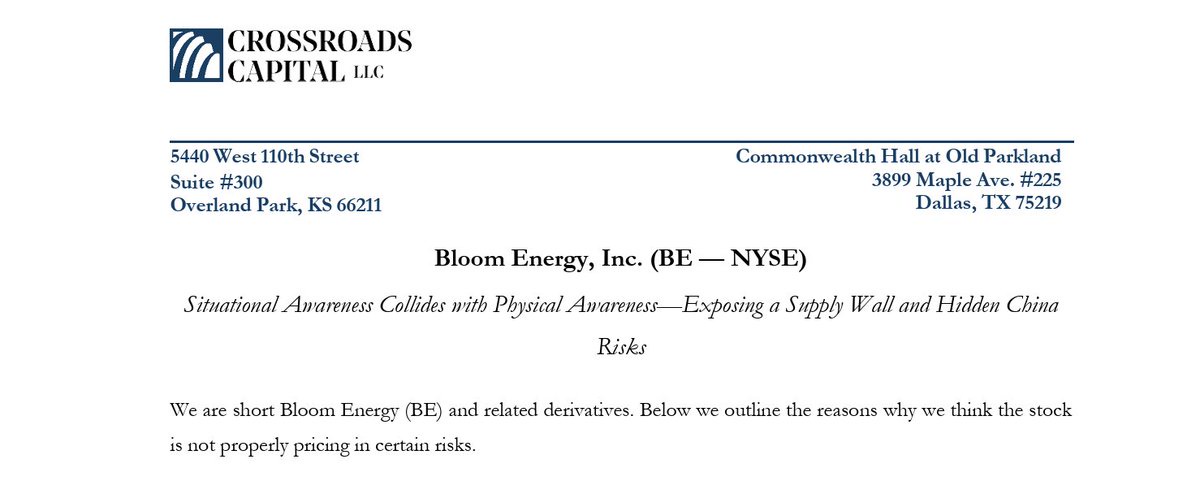
The copyright of this article belongs to the original author/organization.
The views expressed herein are solely those of the author and do not reflect the stance of the platform. The content is intended for investment reference purposes only and shall not be considered as investment advice. Please contact us if you have any questions or suggestions regarding the content services provided by the platform.
Post your comment

No Comments