


 Rate Of Return
 OCBC Bank Return Rate
Two Industrial REITs, One Forensic Lens: CapLand Ascendas REIT versus Mapletree Industrial Trust
Behind the 6% Yields: What Balance Sheets Reveal About Retirement Safety

Both of these industrial REITs yield above 6 percent, and both have data centre exposure everyone is excited about. One REIT fails three of my balance sheet gates. The other is balanced precariously on two of them. If you hold either for retirement income, you need to see what the balance sheet is hiding.

Growth chasers may accept the risk. Retirees focused on wealth preservation and dependable drawdown income should not. My forensic standard, built around a 4.7 percent minimum yield hurdle and strict balance sheet gates, is designed to protect that. Today, we put two of the biggest heavyweights on the Singapore Exchange under the microscope to see if their income foundations match their blue‑chip branding.
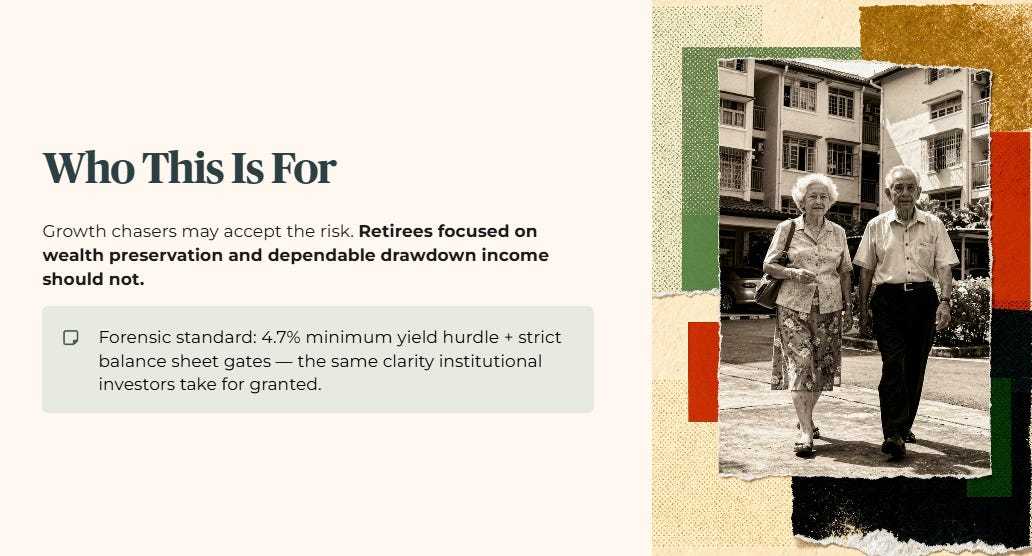
Think of these ratios like health markers in a medical report. I check them so retirees in Singapore building dividend portfolios get the same forensic clarity that institutional investors take for granted.
The Yield Picture
The Gearing Picture
The ICR Picture
Financial Health Checklist
How Iggy Rates Every Stock
The Occupancy and Data Centre Picture
Valuation and Analyst Consensus
The Bottom Line
Why These Two Names Now
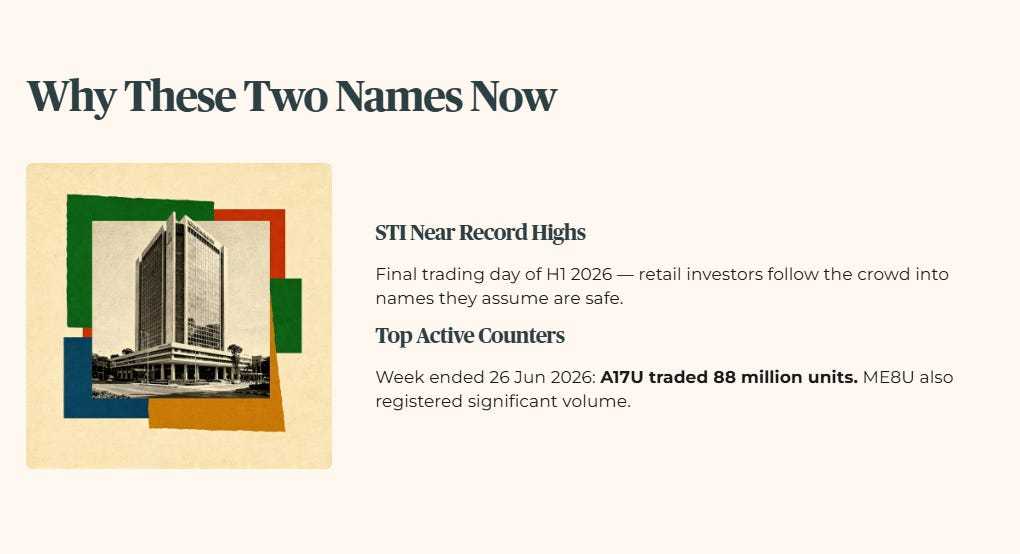
We are sitting at the final trading day of the first half of 2026, and the STI is consolidating near record highs. That kind of market attention matters because when a stock trades actively at record-high valuations, retail investors follow the crowd into names they assume are safe simply because everyone else is buying. For the week ended June 26 2026, CapLand Ascendas REIT (SGX: A17U) alone saw 88 million units traded, with Mapletree Industrial Trust (SGX: ME8U) also registering significant volume, and both sat comfortably within the weekly top active counters.

Both are industrial giants aggressively repositioning toward digital infrastructure. Both yield above 6 percent at current market prices, comfortably clearing my minimum 4.7 percent forensic hurdle. Most importantly for retail investors, both are backed by powerhouse sponsors, CapitaLand Investment and Mapletree Investments respectively.
The forensic question here is not whether these are good businesses or whether their sponsors have deep pockets. They do. The question is whether the income they distribute is sitting on a foundation strong enough for retirement capital at current valuations. In an all-time-high market regime where the STI is operating above 5,000, balance sheet discipline is non-negotiable for incremental buying decisions.
The Yield Picture
Let us begin with the good news: both names clear my minimum yield hurdle early and clearly. But passing the yield test is merely the entry ticket. The direction of travel matters just as much as the headline number today.
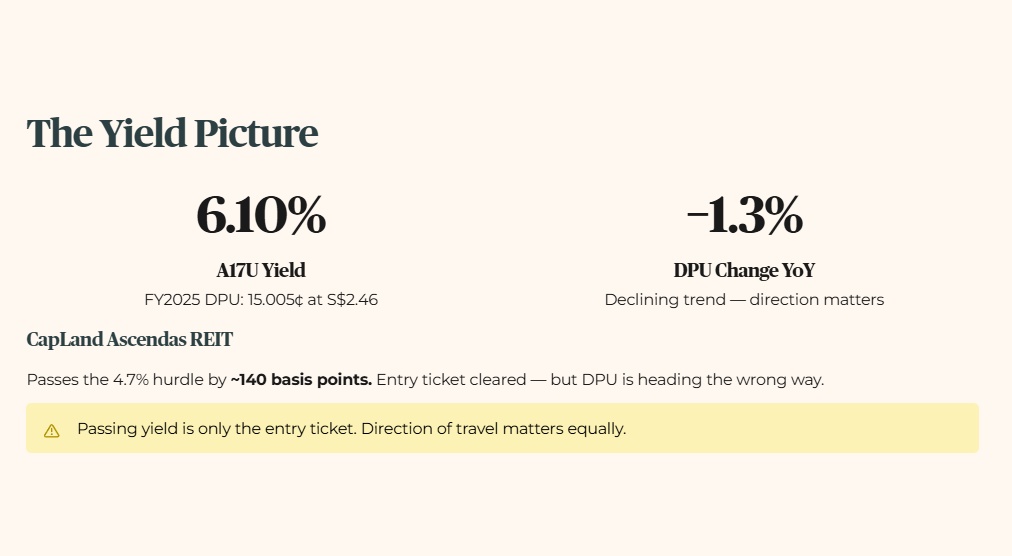
For CapLand Ascendas REIT, the FY2025 DPU came in at 15.005 cents, confirmed from the CapitaLand primary results release. At a stock price of S$2.46, this translates to a trailing yield of approximately 6.10 percent. It passes my minimum hurdle of 4.7 percent by roughly 140 basis points. However, this DPU declined 1.3 percent year on year.
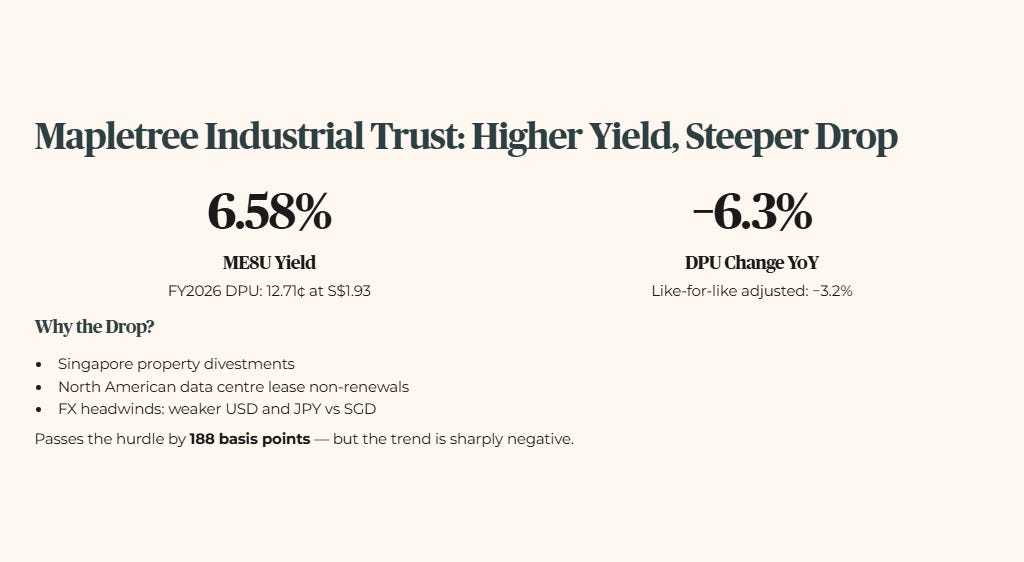
Mapletree Industrial Trust presents a higher headline number. Its FY2026 DPU stands confirmed at 12.71 cents. At a stock price of S$1.93, this gives us a trailing yield of approximately 6.58 percent, passing my hurdle by a very healthy 188 basis points. But looking closer reveals a sharper decline, DPU dropped 6.3 percent year on year. If we exclude a prior year divestment gain to get an honest, like-for-like read, the adjusted DPU still declined by 3.2 percent. Management cites property divestments in Singapore, North America data centre lease non-renewals, and foreign exchange headwinds from a weaker US dollar and Japanese yen against our strong Singapore dollar as the primary culprits.
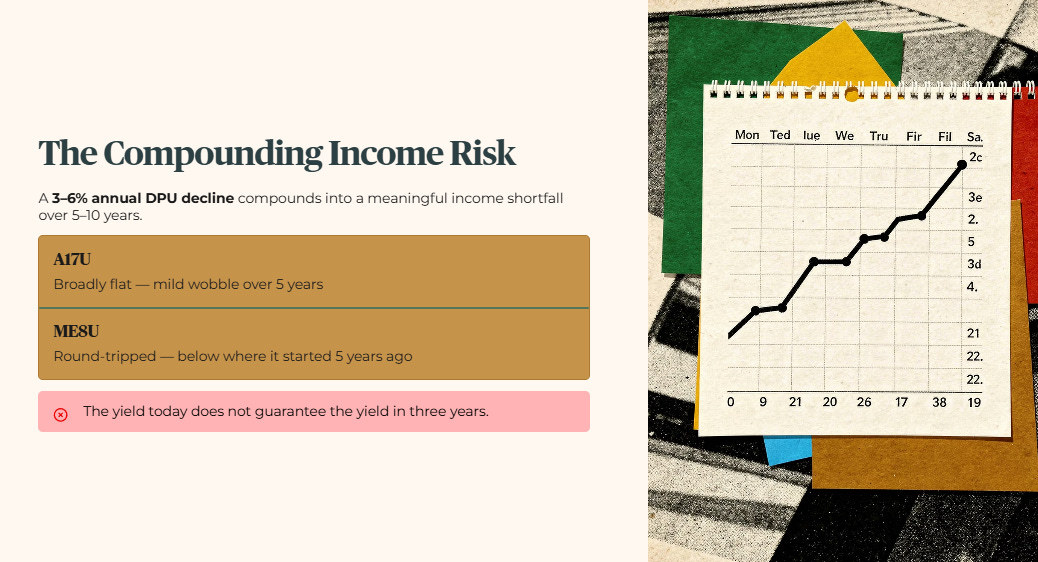
If you are drawing on these distributions for retirement living expenses, a 3 to 6 percent annual DPU decline compounds into a meaningful income shortfall over a five to ten year horizon. The yield today does not guarantee the yield in three years. Zoom out to five years and the picture sharpens further: CapLand Ascendas REIT has been broadly flat with a mild wobble, while Mapletree Industrial Trust has round-tripped a period of growth back down to below where it started.
Dividend Trajectory, Five-Year View
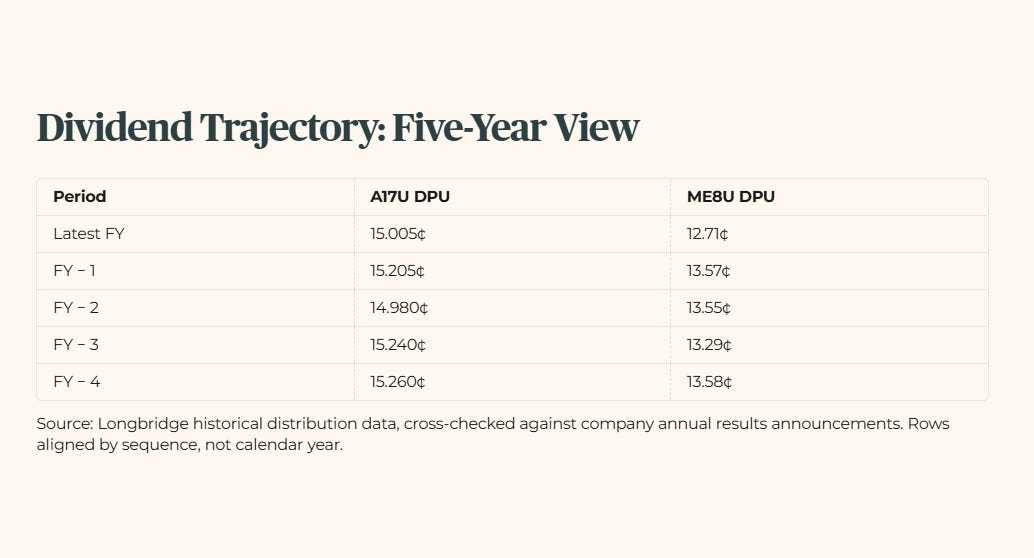
Note: A17U and ME8U report on different fiscal year ends, so rows are aligned by sequence, latest complete financial year and four years prior, not by calendar year. Source: Longbridge historical distribution data, cross-checked against company annual results announcements.
The Gearing Picture
This is where the structural paths of these two trusts diverge most visibly under our forensic lens.
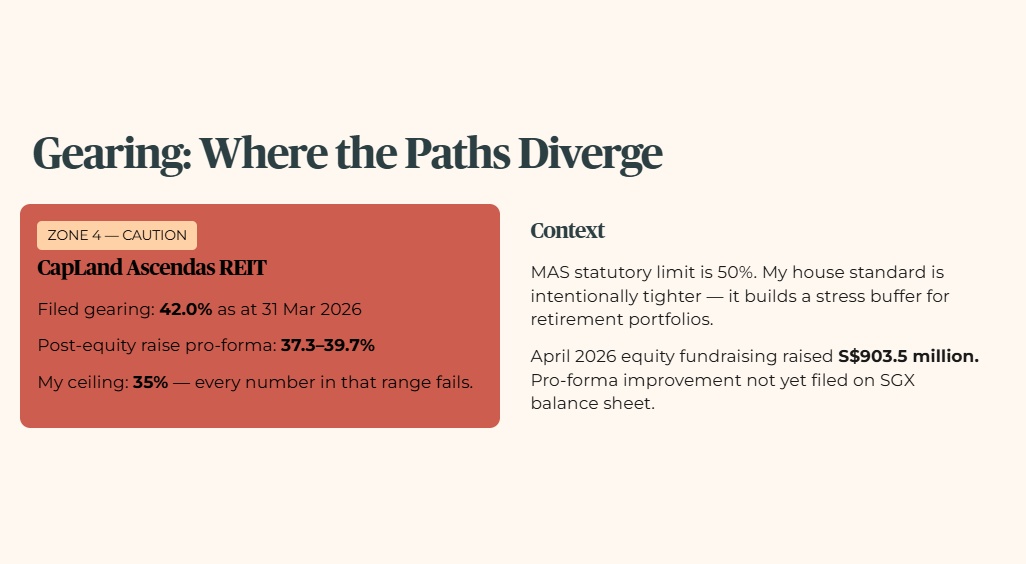
Iggy’s Forensic Zone: Zone 4, Caution (CapLand Ascendas REIT, SGX: A17U)
GEARING ALERT
CapLand Ascendas REIT filed an aggregate leverage (gearing ratio, the percentage of a REIT’s total assets that are funded through borrowed debt) of 42.0 percent as at 31 March 2026. This is a clear hard gate failure against my strict 35 percent house ceiling. Management has guided a pro-forma leverage of approximately 37.3 percent following their April 2026 equity fundraising that raised S$903.5 million. However, a separate DBS research note paints a more conservative pro-forma picture of 39.7 percent post-acquisitions. The honest range for retail investors to track is 37 to 40 percent. Every number in that range breaches my 35 percent ceiling.
To be entirely fair, CapLand Ascendas REIT is not in regulatory distress. The Monetary Authority of Singapore sets a statutory limit of 50 percent. My house standard is intentionally tighter because it builds in a necessary stress buffer for retirement portfolios.
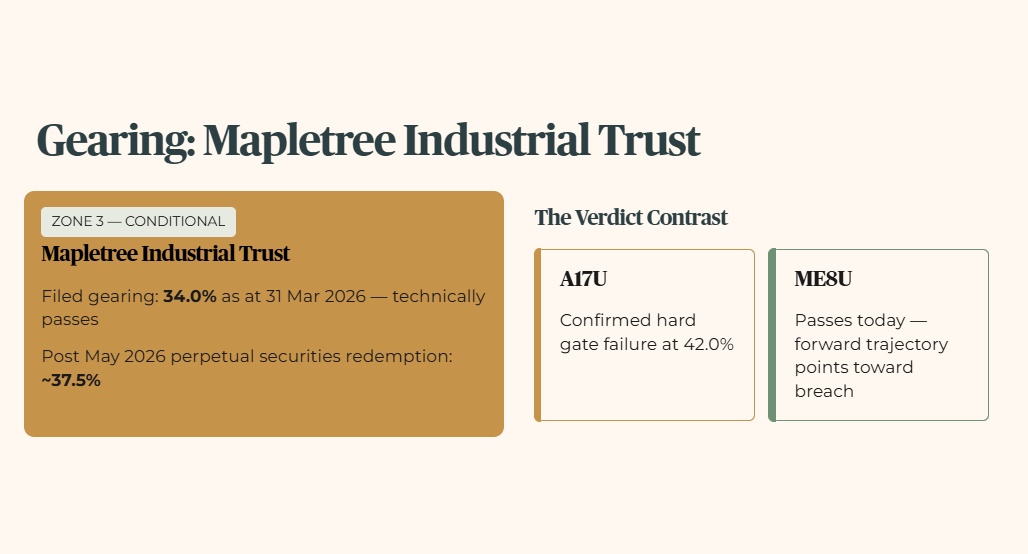
Iggy’s Forensic Zone: Zone 3, Conditional (Mapletree Industrial Trust, SGX: ME8U)
Mapletree Industrial Trust filed an aggregate leverage of 34.0 percent as at 31 March 2026. This technically passes my 35 percent ceiling at the filed level. However, this was completed before their May 2026 redemption of existing perpetual securities, a type of bond with no fixed maturity date, which a REIT can redeem or keep paying interest on indefinitely. Management’s pro-forma guidance indicates that post-redemption, gearing will rise to approximately 37.5 percent.
The gearing verdict is distinct. CapLand Ascendas REIT has a confirmed, filed hard gate failure at 42.0 percent. Mapletree Industrial Trust passes on paper today but its forward trajectory points toward a breach.
The gearing figures clear the statutory ceiling comfortably, but the next section’s full forensic verdict on those same ratios is where the retirement‑grade risk picture finally comes into focus.
The ICR Picture
Income is only as safe as a trust’s capacity to service its financial obligations.
CapLand Ascendas REIT reported an ICR (interest coverage ratio, a metric showing how many times a company’s operating profit can cover its interest expenses) of 3.4 times on a trailing four quarter basis, per its 1Q 2026 business update presented at the J.P. Morgan ASEAN Real Assets Forum on 30 June 2026. On a trailing twelve month basis the reading is slightly higher at 3.6 times. Either way, this is a hard gate failure against my 4.0 times minimum floor. Its average cost of debt stands at 3.5 percent, with 75.4 percent of borrowings hedged at fixed interest rates, and a weighted average debt maturity, the average length of time before a REIT’s outstanding loans need to be refinanced, of 3.1 years.
Mapletree Industrial Trust delivered an ICR of 4.0 times for its full FY2026 results. This is a marginal pass, sitting exactly on my forensic floor. Its average cost of debt is slightly lower at 3.2 percent, with over 75 percent of its debt hedged at fixed rates, and a weighted average debt maturity of 3.4 years. The concern here is a debt concentration wall, approximately 42 percent of its total borrowings mature across FY2027 and FY2028.
Financial Health Checklist
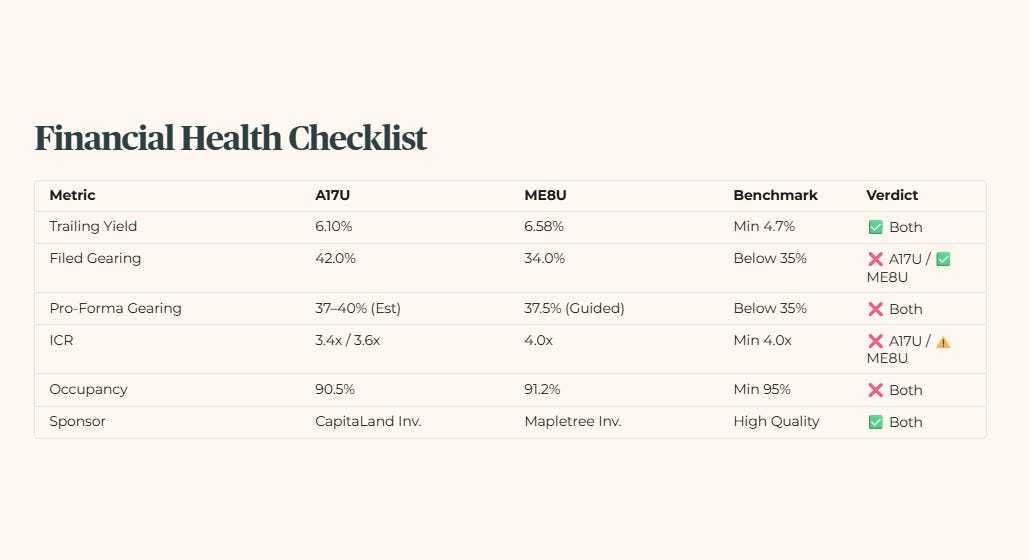
Iggy Insights: Both REITs look attractive on yield, but the balance sheet tells a different story. CapLand Ascendas is weighed down by high gearing and weak coverage, while Mapletree Industrial edges closer to the line with tighter interest protection and occupancy shortfalls. Neither clears every gate needed for retirement‑grade safety. For a retiree drawing income, the lesson is simple: headline yields may look like kopi money in the pocket, but without strong balance sheet health, those payouts can wobble. Always audit the foundations before trusting the dividends.
How Iggy Rates Every Stock
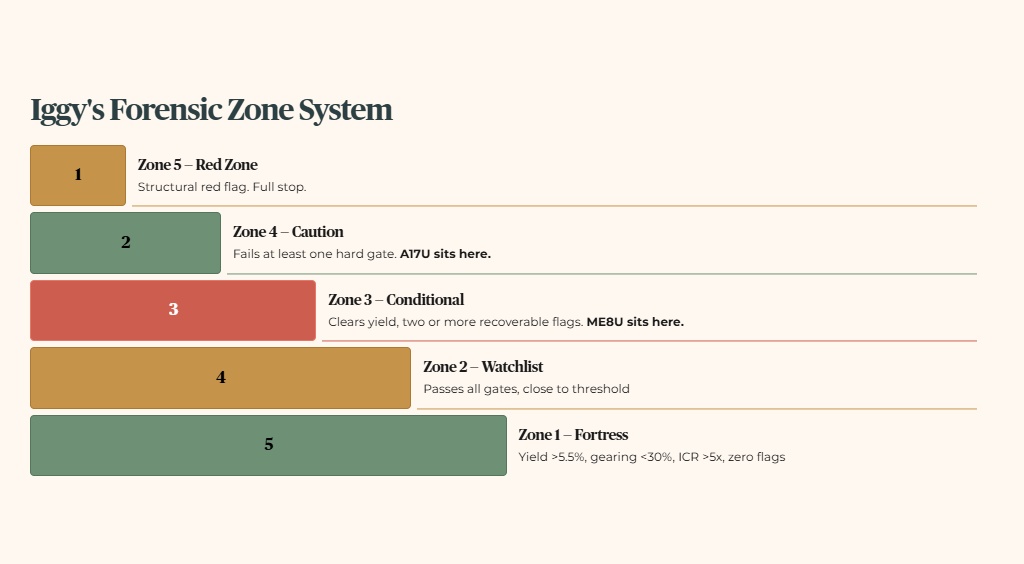
Every stock I track is assigned a Forensic Zone, a structured rating based on yield, gearing, interest coverage, and balance sheet flags. There are five zones. Zone 1 Fortress is retirement grade: yield above 5.5%, gearing below 30%, ICR above 5x, and zero structural flags. Zone 2 Watchlist passes all forensic gates but sits close to threshold. Zone 3 Conditional clears the yield hurdle but carries two or more recoverable flags. Zone 4 Caution fails at least one hard gate. Zone 5 Red Zone carries a structural red flag, full stop. Elite Investors receive the full forensic rationale, soft flag breakdown, and zone trajectory commentary for every stock I cover.
The Occupancy and Data Centre Picture
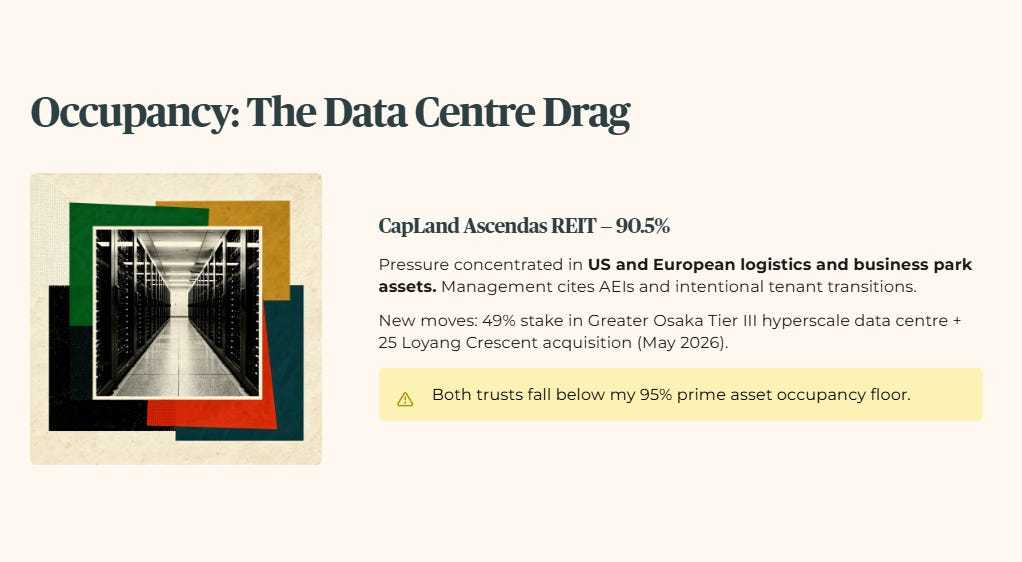
Both trusts suffer from weak asset utilisation, falling below my 95 percent prime asset occupancy floor.
CapLand Ascendas REIT recorded a total portfolio occupancy of 90.5 percent as at 31 March 2026. While its domestic Singapore portfolio remains relatively stable and stronger, operational pressure is highly concentrated in its overseas assets, specifically certain US and European logistics and business park properties. Management notes this is due to asset enhancement initiatives and intentional tenant transitions rather than structural demand destruction. To combat this, they completed a 49 percent stake acquisition in a Greater Osaka Tier III hyperscale data centre in May 2026 alongside buying 25 Loyang Crescent in Singapore.
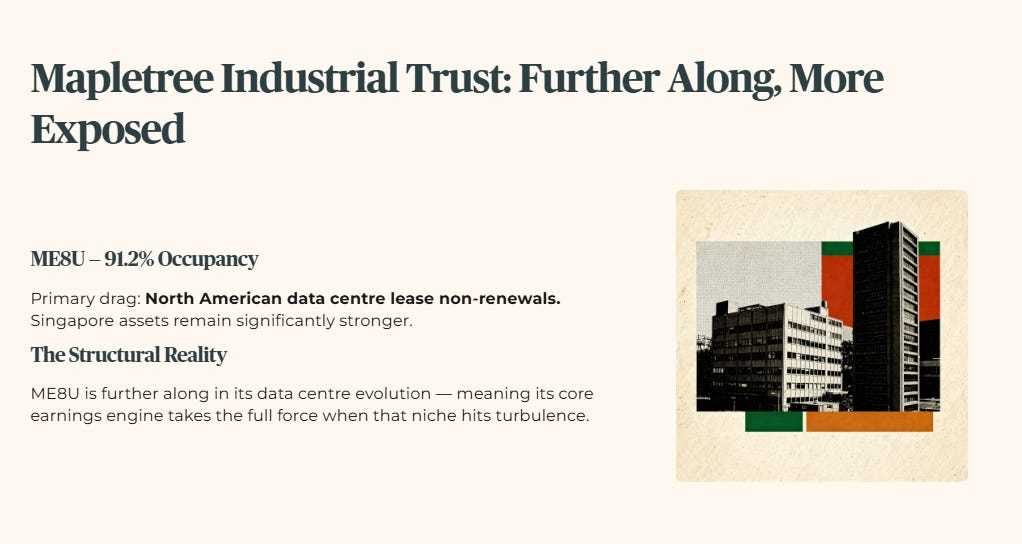
Mapletree Industrial Trust posted a total portfolio occupancy of 91.2 percent as at 31 March 2026, confirmed against its FY2026 results release. The primary drag here is its North American data centre portfolio, heavily impacted by recent lease non-renewals. Its Singapore industrial and data centre assets remain significantly stronger.
This highlights a key structural reality. Mapletree Industrial Trust is further along in its data centre evolution, meaning its core earnings engine is directly exposed when that niche market hits operational turbulence. CapLand Ascendas REIT’s data centre allocation is expanding but remains anchored within a much larger, highly diversified traditional industrial footprint.

🦎 Iggy’s Insight
Mapletree Industrial Trust exposes a critical lesson about chasing sector trends blindly. For years, retail investors cheered the aggressive pivot into premium data centres, treating it as an automatic growth driver. But when North American tenants walk away and vacancies spike, that high-tech engine stalls quickly. Because data centres represent a larger portion of its assets, these lease non-renewals drag overall occupancy down to a weak 91.2 percent. The transition is advanced, but being advanced means you take the full force of the headwind when the wind shifts. Operational focus must override structural narratives.
You Shouldn’t Be Reading This Alone
One Community. One Forensic Lens. In this market, the difference between a “Sanctuary” and a “Yield Trap” is decided in a single trading session. While free subscribers are reading yesterday’s story, Iggy’s Elite Investors are already cross-checking the next setup — together, in real time.

Iggy’s Elite Investors don’t just get the report earlier. They get the full forensic picture the moment it’s finalised — zero-day breakdowns, the complete “Red Zone” watchlist, and institutional-grade cheatsheets built around the same Five-Layer Audit you see here. The difference is they get it before the market opens, not after it has already moved.

For S$9/month — less than a kopi and kaya toast set at Raffles Place — you stop being the Exit Liquidity and start being the Analyst.
Valuation and Analyst Consensus
Let us look at how the institutional broker community views these counters relative to market prices. For consistency, I am anchoring both names to a single data vendor, TipRanks, rather than blending multiple feeds with different methodologies.
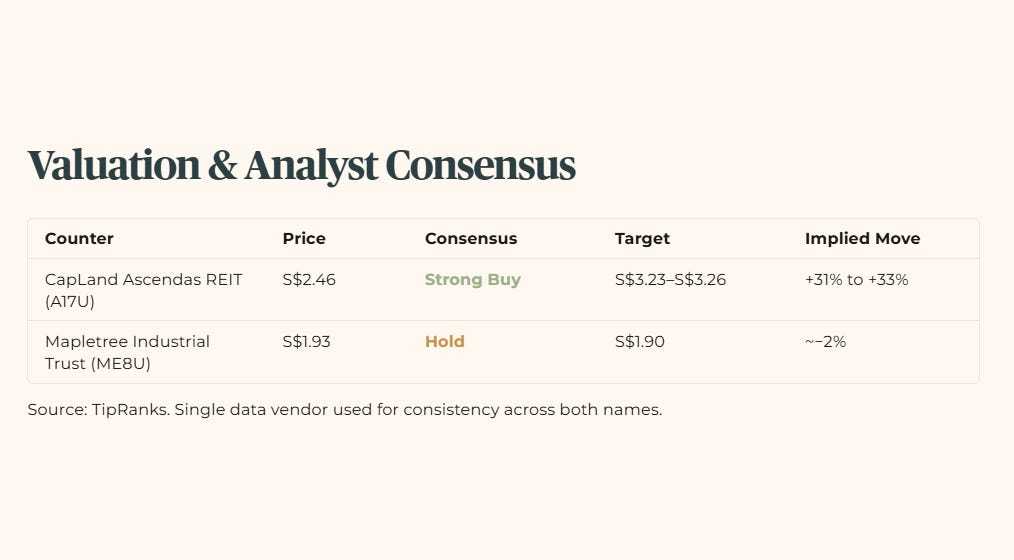
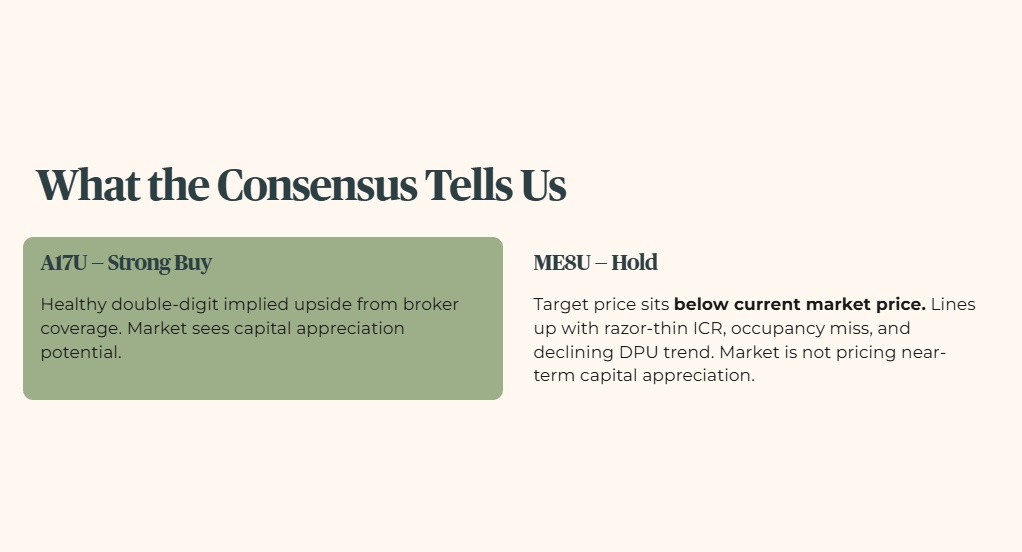
Note: CapLand Ascendas REIT carries a Strong Buy consensus with a healthy double-digit implied upside from brokers covering the name. Mapletree Industrial Trust tells a different story. Its TipRanks consensus is Hold, and the target price actually sits slightly below the current market price. This is not a small gap, and it lines up with everything else already stacked against Mapletree Industrial Trust in this piece, the razor-thin ICR, the occupancy miss, and the declining DPU trend. The market is not pricing this as a name with obvious near-term capital appreciation.
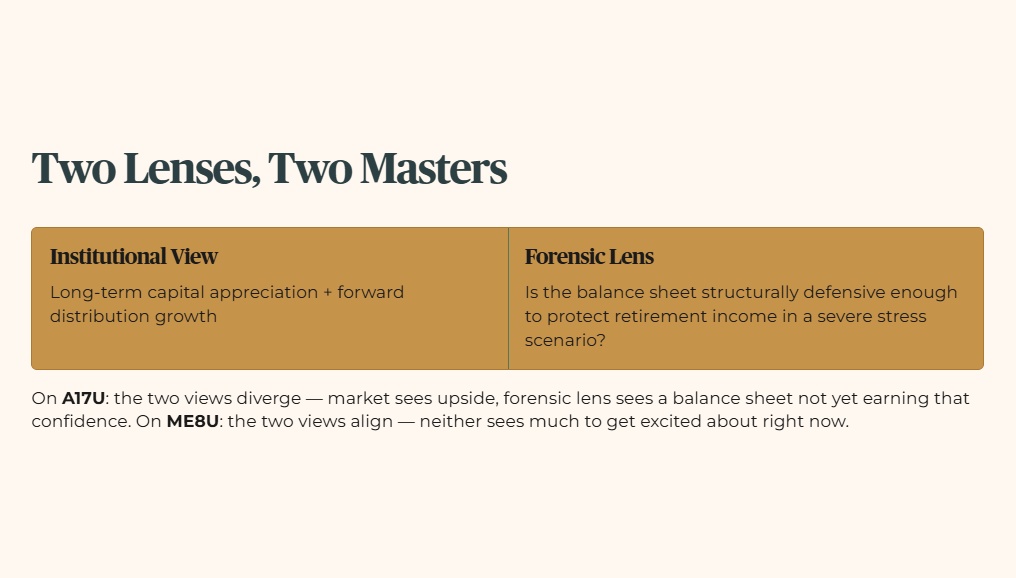
Institutional targets focus heavily on long-term capital appreciation and forward distribution growth. My forensic lens asks a simpler, colder question, is the balance sheet structurally defensive enough to protect your retirement income if a severe economic stress scenario hits tomorrow? Both perspectives are valid, but they serve entirely different masters. On CapLand Ascendas REIT, the two views diverge, the market sees capital appreciation potential while my forensic lens sees a balance sheet that has not yet earned that confidence. On Mapletree Industrial Trust, the two views are closer to aligned, neither the market nor my forensic lens sees much to get excited about right now.
🦎 Iggy’s Insight
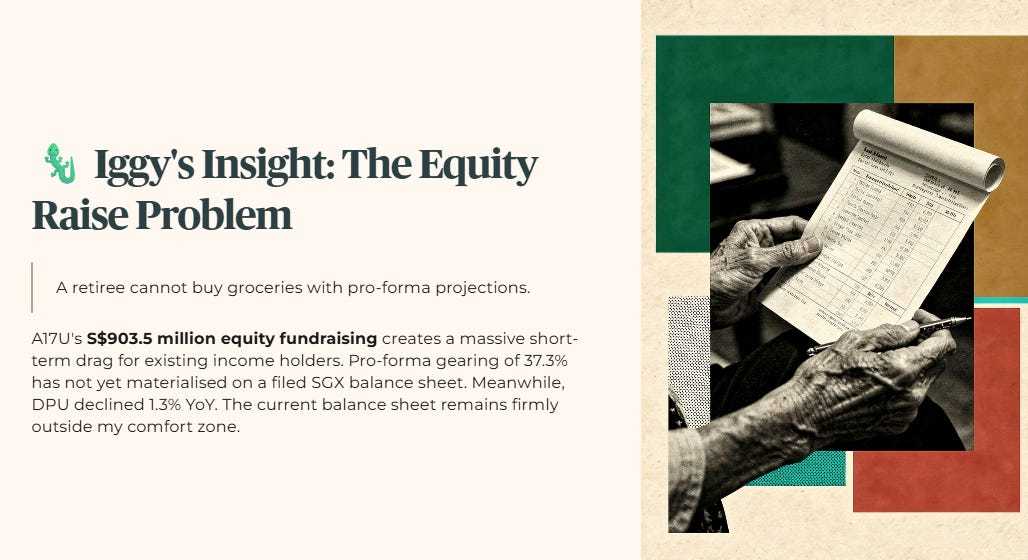
CapLand Ascendas REIT’s recent S$903.5 million equity fundraising is an aggressive move that creates a massive short-term drag for existing income holders. While management guides that pro-forma gearing will fall to 37.3 percent, the hard truth is that this figure has not yet materialised on a filed SGX balance sheet. We are forced to wait for formal accounting verification while absorbing a 1.3 percent year-on-year DPU decline. Chasing scale is fine for a sovereign fund, but a retiree cannot buy groceries with pro-forma projections. The current balance sheet remains firmly outside my comfort zone.
The Bottom Line
Note on the Stress‑Test Buffer: For this audit, I apply a conservative floor of 3.2 percent. We audit for the storm, not just the sunny day. The 6‑month T‑bill sits at about 1.48 percent. I do not lower my standards to match a temporary dip. My floor remains at 3.2 percent to ensure sanctuary assets can withstand a return to long‑term average interest rates. The minimum yield hurdle is 4.7 percent, that is the 3.2 percent floor plus 150 basis points of mandatory risk premium.
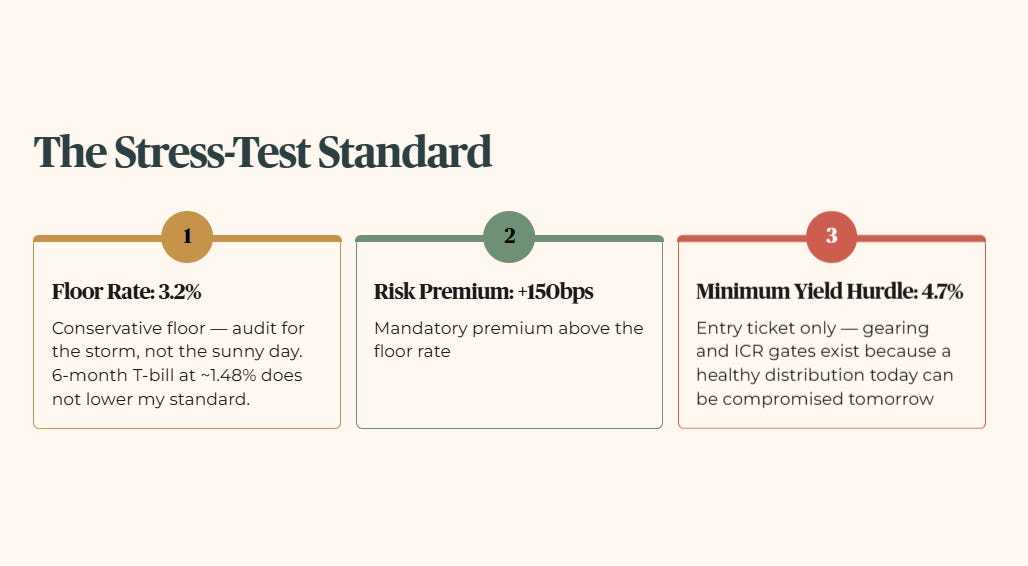
Passing the yield hurdle is only the first step. Gearing and interest coverage gates exist because a distribution that looks healthy today can be compromised tomorrow if the balance sheet weakens. Both trusts clear the yield test, but neither clears every essential gate.
CapLand Ascendas REIT sits in my caution zone. Its yield clears the hurdle and its sponsor strength is undeniable, but three critical markers are flashing red. To shift this stance, I need to see gearing confirmed below 38 percent, interest coverage climbing back toward 4.0 times, and overseas occupancy stabilizing above 92 percent. I’ll check again at the next earnings release.
Mapletree Industrial Trust sits in my conditional zone. Its balance sheet is stronger, but occupancy is below my threshold, interest coverage is on the razor’s edge, and its DPU trend is pointing down. To move forward, management must prove re‑leasing timelines for its North American data centres and show gearing settling safely below 37 percent after bond redemption. I’ll revisit this at the next quarterly update.
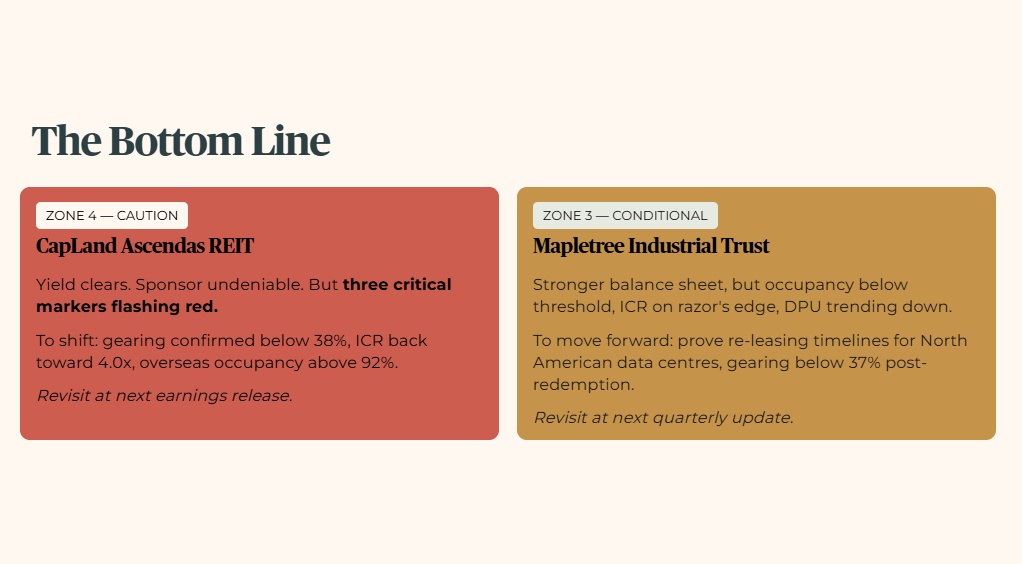
Neither name clears every gate required for a pristine retirement‑grade classification today. For a 60‑year‑old investor in Bedok drawing down on SRS capital, relying only on headline yields without watching these balance sheet shifts could put monthly kopi money at risk. The distributions are real, but the foundations demand close observation before you commit more capital.

The Window Is Already Open
Zero-day access on Substack and YouTube, full Red Zone watchlist, and institutional-grade cheatsheets for S$9/month. Sign up for Iggy’s Elite Investors today to secure your seven-day early access embargo window before the broader market reacts.

Iggy’s Forensic Disclaimer
This content is produced for educational and informational purposes only. I am not a financial advisor — I am a retail investor who applies forensic analysis to my own portfolio and shares that process publicly. Nothing here constitutes a recommendation to buy, sell, or hold any security, and no specific target prices or personalised financial advice are offered. Stocks assessed under Iggy’s Forensic Yield Standard are benchmarked against a 4.7% minimum yield hurdle; stocks flagged as Growth Watch fall below this threshold but demonstrate clean balance sheet metrics and an identifiable growth catalyst — these carry a materially different risk profile and are not suitable as yield replacements for income-dependent investors. All data is sourced from public filings and verified sources; where data is unverified it is explicitly flagged. All investments carry risk, including the potential loss of principal, and past performance is not indicative of future results. If you are making investment decisions involving CPF, SRS, or personal capital, please conduct your own due diligence or consult a MAS-licensed financial adviser before committing funds.
The copyright of this article belongs to the original author/organization.
The views expressed herein are solely those of the author and do not reflect the stance of the platform. The content is intended for investment reference purposes only and shall not be considered as investment advice. Please contact us if you have any questions or suggestions regarding the content services provided by the platform.
