


Besenet's buyback fails to ease long-term bond pressure, U.S. Treasury yields become the biggest test for U.S. stocks
Despite the rise in U.S. Treasury yields being seen as the biggest threat to the stock market, global fund managers' equity allocation has reached a new high since November 2021, indicating that investor sentiment remains bullish. The U.S. Treasury Department announced it would double its long-term Treasury bond repurchase efforts to stabilize the market. Following the announcement, yields briefly fell, but the pressure on long-term bonds has not been completely alleviated, becoming a key test for the subsequent performance of U.S. stocks
According to the Zhitong Finance APP, if professional investors are truly concerned that rising global bond yields will derail the stock market bull run, their actual allocation of managed funds shows little evidence of such worries. The latest survey from Bank of America indicates that stocks currently account for 56% of global fund managers' portfolios, the highest level since November 2021. Although the same survey shows that "disorderly rises in bond yields" are considered the second biggest risk to the stock market after concerns about the AI bubble, investors remain bullish on stocks.
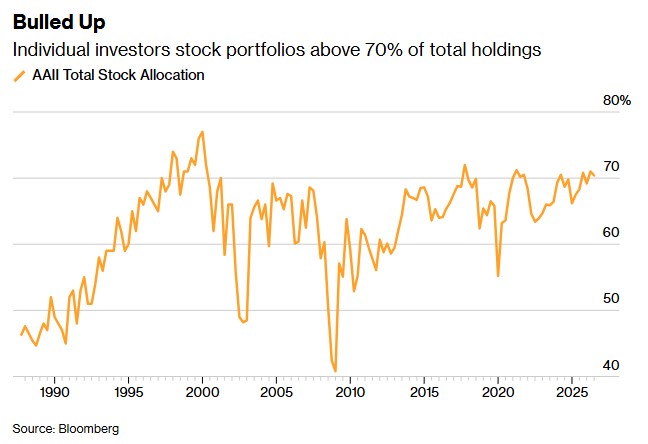
Bullish sentiment in the U.S. stock market
Despite various strategists on Wall Street focusing on the rise in U.S. Treasury yields and expressing some concerns, most conclude that the current increase in yields is not sufficient to disrupt the bullish logic of the stock market. After all, history shows that sudden spikes in yields are not always "poison" for the stock market.
JC O'Hara, Chief Technical Strategist at Roth Capital Partners LLC, stated that despite rising yields and the stock market being near historical highs, "now is the time to be bullish, or at least to seize the opportunity." He noted that risk appetite is improving, mainly due to "stronger earnings expectations, better economic outlook, and reduced market focus on the situation in the Middle East." He also pointed out that when risk appetite improves, the forward returns of the S&P 500 index tend to perform strongly.
For those worried about rising U.S. Treasury yields, there were some signs of relief on Wednesday. As long-term U.S. Treasury yields recently climbed to multi-year highs, the U.S. Treasury unexpectedly announced on Wednesday that it would increase its repurchase efforts for long-term Treasuries. The Treasury stated that it would at least double the scale of its "liquidity support repurchase operations" targeting bonds with maturities ranging from 10 to 30 years. U.S. Treasury Secretary Janet Yellen had initiated the bond repurchase program last year, viewing it as part of a "toolkit that the Treasury can deploy when necessary" to address disorder in the Treasury market. Following the announcement, yields on Treasuries across all maturities fell.
However, currently, U.S. Treasuries have given back all the gains made after the Treasury's announcement of support—on Thursday, the yield on the 30-year Treasury rose sharply by 6 basis points to 5.26%, returning to levels seen before the Treasury's announcement to increase long-term Treasury repurchases on Wednesday; the yield on the 10-year Treasury also rose by a similar magnitude. This indicates that investors believe the Treasury's measures may only have a short-term effect in curbing borrowing costs.
Tyler Richey, Editor of Sevens Report Technicals, stated in an interview that the rise in U.S. Treasury yields is the "elephant in the room" threatening the stock market. Matt Maley, Chief Market Strategist at Miller Tabak + Co., remarked, "Bond yields are starting to rise, and the stock market is ignoring it—until it no longer ignores it." U.S. Treasury yields are the benchmark for global borrowing costs, and their rise will gradually transmit along the chain of "government bonds - market interest rates - real economy," while simultaneously triggering repricing within the capital markets. The essence of stock valuation is to discount future earnings to the present using interest rates; a rise in long-term rates compresses valuations, with high-valuation growth stocks in the U.S. stock market being the most affected. Over the past year, the U.S. stock market reached historic highs, but subsequently struggled to maintain those record levels, with persistently high U.S. Treasury yields being one of the significant reasons.
However, for analysts in other stock markets, what is truly worth paying attention to is the U.S. Treasury yield curve—the difference between short-term and long-term U.S. Treasury yields. Currently, the yield on the 10-year Treasury is about 49 basis points higher than that of the 2-year Treasury.
Ed Clissold, Chief U.S. Strategist at Ned Davis Research, wrote in a report to clients on Tuesday that the stock market is currently at the "sweet spot" of the yield curve. He described this "gently upward-sloping yield curve" as a favorable environment. In this scenario, the 10-year yield can be as much as 1.5 percentage points higher than the 2-year yield, and this environment often brings the largest and most stable gains for the S&P 500 index. According to NDR's analysis of data since 1976, the average annual return of the S&P 500 index within this yield curve range is about 11%.
Of course, even the current stock market bulls acknowledge that if U.S. Treasury yields continue to rise, they may eventually reach a critical point that begins to exert pressure on the stock market. Liz Ann Sonders, Chief Investment Strategist at Schwab Center for Financial Research, stated, "I think this level is still acceptable, but if the 10-year Treasury yield approaches 5% further, it could genuinely make the market uneasy, similar to what happened in 2023." In 2023, amid a surge in the 10-year Treasury yield that briefly touched 5%, the S&P 500 index fell by 10% from the end of July to the end of October.
Institutions Warn: U.S. Treasury's Increased Long-Debt Buybacks May Not Prevent Steepening Yield Curve
Although the measures announced by the U.S. Treasury on Wednesday provided a brief respite for the pressured U.S. Treasury market, the renewed rise in Treasury yields on Thursday highlighted investors' skepticism about the actual effectiveness of the measures and echoed warnings from some market institutions about the possibility of U.S. Treasury yields rising again.
Reportedly, JPMorgan strategists warned that the market may perceive the U.S. Treasury's unexpected measures to curb long-term financing costs as lacking credibility, which could raise term premiums and yields over time. JPMorgan strategists, including Jay Barry, wrote in a report, "Without genuine fiscal consolidation, we are concerned that the market will view this action as lacking credibility," and "If the Treasury becomes more opportunistic in its debt management approach and further deviates from its 'conventional and predictable' principles, this could lead to higher term premiums and yields over time." JP Morgan also bluntly stated that the U.S. Treasury's expansion of repurchases is a "band-aid solution." Strategists pointed out that this operation essentially only addresses the "symptoms" of rising long-term yields and does not touch on the fundamental issue—the current U.S. economy is close to full employment, and the fiscal deficit still accounts for about 6% of GDP. The sustained high financing demand is the core reason putting pressure on long-term interest rates. The bank expects that in the coming fiscal years, the U.S. financing gap will exceed $3.5 trillion, and unless substantial fiscal consolidation is advanced, the impact of this repurchase adjustment on long-term rates is likely to be only temporary.
Aegon Asset Management, an asset management company, firmly bets that the gap between short-term and long-term U.S. Treasury yields will continue to widen. According to the company's portfolio manager, James Lynch, expanding the scale of long-term Treasury repurchases "is not very meaningful" and will not change his view that the yield curve in the U.S. and even Europe will continue to steepen. Lynch stated, "The fiscal issues—large deficits, the impact of massive corporate debt flooding the market, inflation rates still above target levels, coupled with the Federal Reserve's unclear communication—have injected additional premiums into the market. I do not believe these factors will disappear quickly."
Barclays believes that although the actual market impact of the U.S. Treasury's latest measures is limited, the policy signal is significant—investors are clearly aware that if long-term yields continue to rise, the U.S. Treasury is willing to adjust the issuance structure. In the future, the U.S. Treasury could further increase the scale of repurchases or clarify a reduction in long-term Treasury issuance at the financing meeting in November. However, the bank cited Japan's experience as a reminder that compressing long-term bond supply can only buy time—after Japan reduced ultra-long-term Treasury issuance in 2025, the 40-year yield once fell by about 50 basis points, but then reached new highs again—the real solution to the problem ultimately requires a return to fiscal consolidation.
In addition, economists and bond traders believe that if the U.S. Treasury continues to lower long-term rates through adjustments to the debt structure, it may stimulate economic activity and increase inflation stickiness, while making the U.S. government's debt financing costs more susceptible to changes in short-term rates. Furthermore, this could also put greater pressure on the Federal Reserve to maintain its policy independence.
Joseph Brusuelas, Chief Economist at RSM US, stated that policy is gradually moving towards a direction that may require central bank support for fiscal goals. He believes that the Treasury's intervention could distort the market and put the Federal Reserve, under the leadership of Powell, in a more difficult policy environment. Wil Stith, Senior Bond Portfolio Manager at Wilmington Trust, stated that if inflation remains unchanged or continues to rise, the easing effect brought by the Treasury's suppression of long-term yields may force the Federal Reserve to be more aggressive in raising interest rates.
More importantly, the U.S. Treasury market, which has been under pressure recently, will face another wave of large-scale debt financing. The U.S. investment-grade corporate bond market typically sees a peak in issuance after Labor Day. With the financing demand from massive cloud computing companies increasing, corporate bond issuance in September could reach $200 billion, potentially posing a new round of impact on the already pressured Treasury market. As some market participants have warned, U.S. Treasury yields may ultimately rise to levels that cannot be ignored, and at that time, this "elephant in the room" may overturn the currently optimistic stock market bulls
