Alibaba Q2 Revenue Rises 9% Year-on-Year, Slightly Beating Expectations; AI Infrastructure Spending Pushes Up Capital Expenditure; Net Outflow of Free Cash Flow Widens to RMB 44.7 Billion | Financial Report Insights
In Q1 of fiscal year 2027 (Q2 of calendar year 2026), Alibaba's revenue grew 9% year-on-year to RMB 268.95 billion, but profits were significantly pressured by AI investments and one-off expenses. Alibaba Cloud's external commercial revenue grew 45%, with AI-related revenue posting triple-digit growth for the 12th consecutive quarter, while profitability improved simultaneously. Instant retail became the growth engine for e-commerce, but traditional e-commerce faced pressure. Single-quarter capital expenditure reached RMB 67.678 billion, turning free cash flow significantly negative, as the company trades short-term profits for long-term AI competitiveness
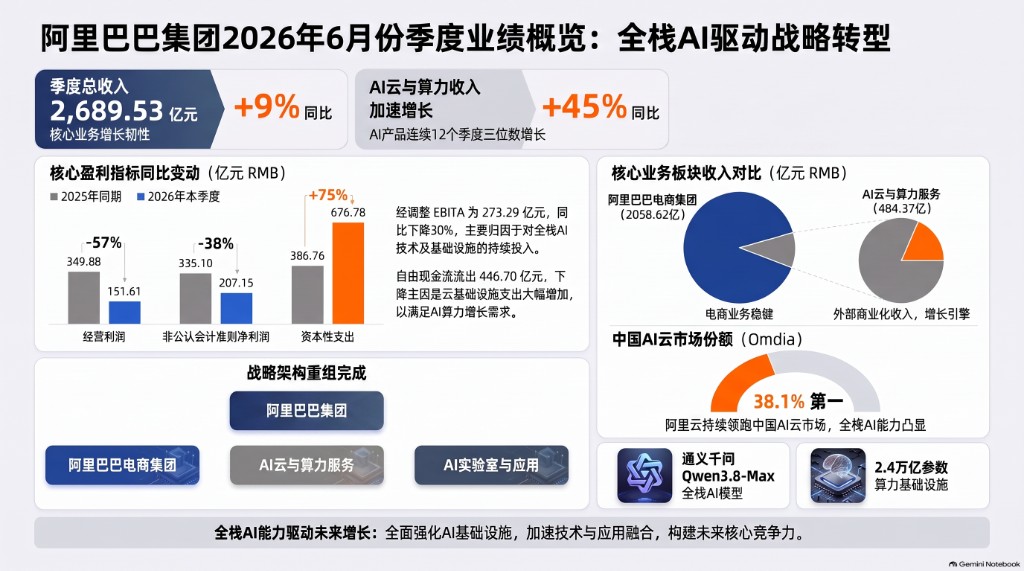
Alibaba is exchanging higher capital expenditure for accelerated growth in its AI business.
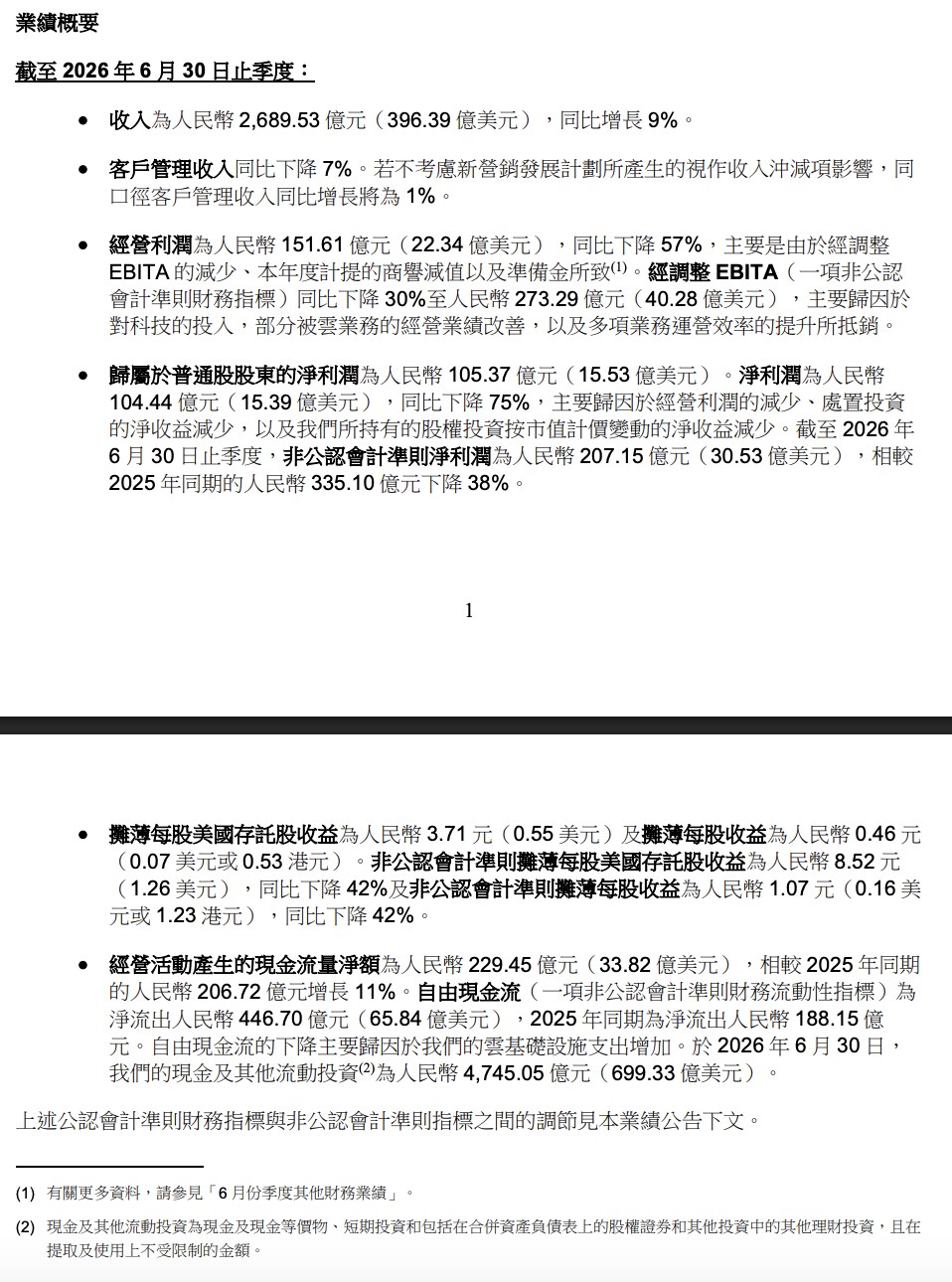
On August 20, data released by Alibaba Group for the first quarter of fiscal year 2027 (the second quarter of calendar year 2026) showed that the group achieved revenue of RMB 268.953 billion during the period, a 9% year-on-year increase, exceeding the expected RMB 268.52 billion. However, against the backdrop of continued increased investment in AI infrastructure, profitability was clearly under pressure, with operating profit falling 57% year-on-year to RMB 15.161 billion, and non-GAAP net profit declining 38% year-on-year to RMB 20.715 billion.
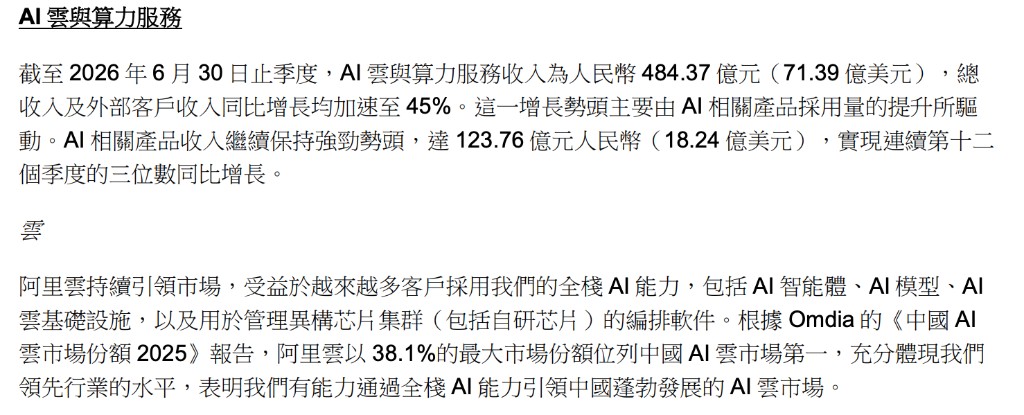
Meanwhile, AI and cloud businesses became the highlight of this financial report. Alibaba Cloud's external commercial revenue increased by 45% year-on-year this quarter, marking the highest growth rate in 22 quarters; AI-related product quarterly revenue reached RMB 12.376 billion, achieving triple-digit year-on-year growth for the 12th consecutive quarter. The adjusted EBITA of the AI Cloud and Computing Power Services segment surged 133% year-on-year, with the profit margin rising to 12%, indicating that the AI business is realizing "high growth + profitability improvement."
Another major growth engine comes from instant retail. China's instant retail revenue increased by 45% year-on-year to RMB 53.295 billion, becoming the fastest-growing business in the e-commerce sector.
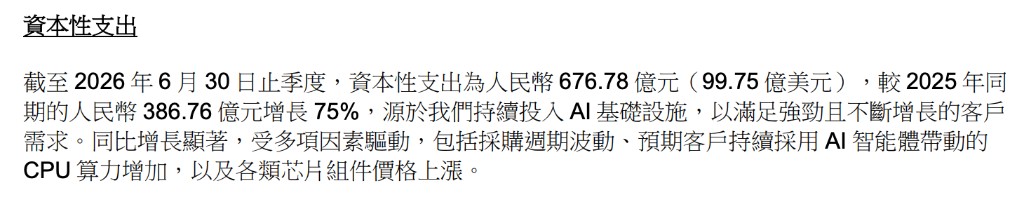
However, at the same time, Alibaba is entering a cycle of heavy capital expansion. Capital expenditure for this quarter reached RMB 67.678 billion, a 75% year-on-year increase, with a net outflow of free cash flow of RMB 44.670 billion. Continuous investment in AI computing power, chips, and data centers has become one of the core reasons for the short-term pressure on profits.
This quarter, Alibaba restructured its business segments, integrating existing businesses into four major sectors: Alibaba E-commerce Group, AI Cloud and Computing Power Services, AI Labs and Applications, and All Others. Among them, Cloud Intelligence Group and T-Head Semiconductor were included in "AI Cloud and Computing Power Services," while the Qwen model, Qwen App, and Qwen Office formed "AI Labs and Applications."
The new architecture reinforces the core position of AI in Alibaba's business system: from chips and computing power to large models and applications, Alibaba is accelerating the integration of the entire AI industry chain, making the revenue, investment, and profitability of AI-related businesses clearer.
Alibaba Cloud Revenue Hits 22-Quarter High, Profitability Improves Simultaneously
AI Cloud and Computing Power Services became the business segment attracting the most market attention this quarter.
This quarter, Alibaba Cloud's external commercial revenue increased by 45% year-on-year, marking the highest growth rate in 22 quarters, further accelerating from the 40% growth rate in the previous quarter. AI-related product quarterly revenue reached RMB 12.376 billion, achieving triple-digit year-on-year growth for the 12th consecutive quarter, indicating that AI demand remains strong.
More noteworthy is the profitability. The adjusted EBITA of the AI Cloud and Computing Power Services segment reached RMB 5.628 billion, a 133% year-on-year increase, with the profit margin rising to 12%. This means that Alibaba Cloud is not only expanding AI computing power and cloud service revenue but also beginning to release scale effects and operating leverage.
At the chip level, T-Head has formed a full-stack system covering GPUs, CPUs, and network chips. The latest generation AI processor, Zhenwu M890, has achieved commercial deployment through Alibaba Cloud and is currently applied in more than 20 industries including autonomous driving, internet, and finance, serving over 650 external customers.
Supply-side computing infrastructure is also expanding simultaneously. Alibaba Cloud has compressed the delivery cycle of large-scale AI data centers to 100 days and expects the production efficiency of its self-developed modular data centers to more than double this year to meet the continuously growing demand for AI computing power.
From chips to cloud, and from data centers to models, Alibaba is forming a more complete AI infrastructure system.
Instant Retail Explodes, Traditional E-commerce Still Under Pressure
The E-commerce Group's revenue this quarter was RMB 205.862 billion, a 4% year-on-year increase, but internal business differentiation was significant.
Among them, China's instant retail revenue was RMB 53.295 billion, a 45% year-on-year increase, becoming the fastest-growing business in the entire E-commerce Group. Taobao Flash Sales continued to optimize unit economics while maintaining market share, while Hema benefited from expansion into emerging counties and cities and synergy with Taobao Flash Sales, achieving double-digit growth in both orders and revenue.
In contrast, Alibaba's traditional China commerce revenue decreased by 8% year-on-year to RMB 110.9 billion, and customer management revenue decreased by 7% year-on-year. However, due to accounting treatment changes brought about by the new marketing development plan, the year-on-year data was affected by comparability issues; excluding relevant factors, the comparable growth rate of customer management revenue was approximately 1%.
International digital commerce revenue slightly decreased by 1% year-on-year to RMB 27.761 billion, but AliExpress achieved operating profit this quarter, showing an improvement in profitability.
Overall, the E-commerce Group's adjusted EBITA was RMB 39.749 billion, a slight year-on-year decrease of only 1%. The growth and efficiency improvement of the instant retail business offset the pressure on traditional e-commerce to some extent.
Increased Investment in Qwen, AI Applications Drag Down Short-Term Profits
If AI Cloud is becoming a new growth and profit engine, AI applications are still in a stage of high investment.
This quarter, the adjusted EBITA loss of the AI Labs and Applications segment reached RMB 13.861 billion, compared to a loss of RMB 3.224 billion in the same period last year, with the loss scale expanding more than threefold, mainly due to rising inference costs for the Qwen App and increased investment in AI capability building.
User-side expansion remains rapid. Since the launch of the Qwen App, 250 million users have experienced AI-driven shopping scenarios through agent features, and ecological synergy with businesses such as Taobao Tmall and Taobao Flash Sales is accelerating. However, the rapid growth in user scale and model capabilities also means higher inference costs. While AI applications are still in the scale expansion phase, model training, inference, and product iteration will continue to pressure short-term profits.
This creates a distinct duality in Alibaba's current AI business: AI Cloud has begun to reflect revenue growth and profitability improvement, while AI applications are still trading profits for user and ecosystem scale.
Surge in R&D Spending, One-off Expenses Further Suppress Profits
The pressure on profits does not come entirely from the AI business itself; changes in expense structure and one-off items also had a significant impact.
Alibaba's cost of revenue this quarter reached RMB 254.081 billion, with the cost of revenue ratio rising from 55.1% in the same period last year to 61.8%, mainly affected by the increased proportion of revenue from cloud and AI businesses and changes in the accounting treatment of marketing revenue. Product development expenses reached RMB 22.529 billion, a 50% year-on-year increase, with the proportion of revenue rising from 6.1% to 8.4%, reflecting the company's continuous increase in investment in AI R&D personnel and technical infrastructure.
In addition, one-off expenses further suppressed operating profit. General and administrative expenses rose to RMB 12.708 billion, with the proportion of revenue rising from 2.5% to 4.7%, mainly due to the accrual of a EUR 550 million provision for fines under the EU Digital Services Act; meanwhile, the company also recognized RMB 4.458 billion in goodwill impairment.
Therefore, the 57% year-on-year decline in operating profit this quarter was influenced by both structural factors such as increased AI investment and one-off factors including fine provisions and goodwill impairment.
Single-Quarter Capital Expenditure of RMB 67.678 Billion, AI Enters Heavy Capital Cycle
Cash flow data more intuitively reflects Alibaba's strategic choices.
As of the end of June, the company held cash and other current investments of RMB 474.505 billion, with liquidity remaining ample. However, capital expenditure for this quarter reached RMB 67.678 billion, a 75% year-on-year increase; the net outflow of free cash flow was RMB 44.670 billion, significantly wider than the RMB 18.815 billion in the same period last year.
The growth in capital expenditure is mainly related to AI computing power procurement, increased demand for CPU computing power, and rising prices of chip components.
Notably, the net cash generated from operating activities still reached RMB 22.945 billion, an 11% year-on-year increase, indicating that the cash-generating ability of core businesses has not deteriorated. The significant turn to negative in free cash flow is more a result of the surge in capital expenditure.
Meanwhile, the scale of share repurchases this quarter was only USD 162 million, a significant contraction from before. In the cycle of massive AI investment, Alibaba is prioritizing more capital towards computing power, chips, and data centers rather than shareholder returns.
For Alibaba, the core changes in this financial report are clear: traditional e-commerce growth is slowing, but AI Cloud is accelerating to become a new growth and profit engine; meanwhile, the company is actively entering a heavy capital investment cycle, sacrificing some short-term profits and cash flow in exchange for long-term competitive advantages in AI infrastructure and full-stack capabilities.