


The US Needs a Controlled Release of Credit Risk
On August 18, 2026, the yield on the 30-year US Treasury note surged to 5.33%, hitting a new high since the financial crisis, triggering a rise in global long-term yields and a significant correction in tech stocks. The article argues that explaining this solely through opportunity cost is ineffective; the core logic lies in the AI capital expenditure boom driving an expansion of private financing, which crowded out government financing, leading to unchecked credit expansion and a subsequent release of risk
Introduction
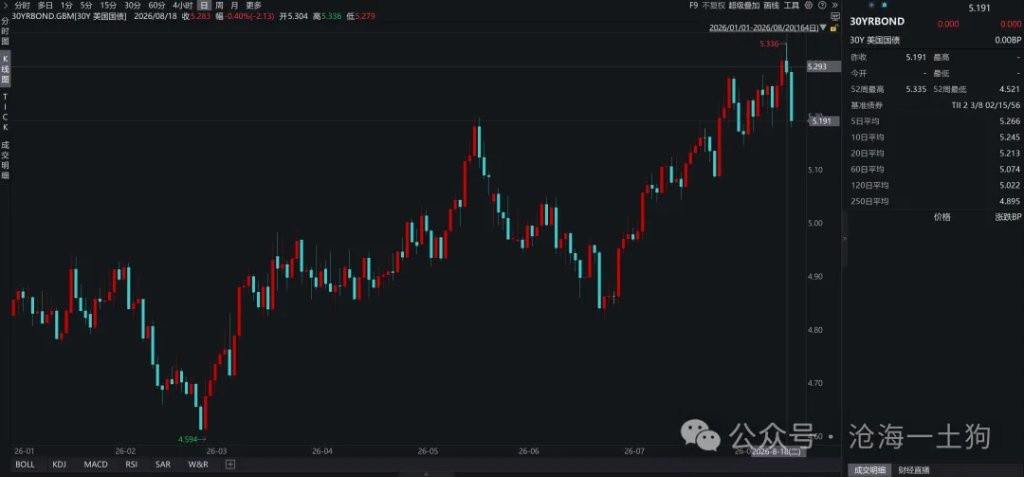
As shown in the chart above, on August 18, 2026, the yield on the 30-year US Treasury note rose rapidly, climbing to a high of 5.33%, marking a new peak since the 2007 financial crisis.
Meanwhile, long-term yields in developed countries such as the UK, France, Germany, and Japan also rose quickly, creating an atmosphere of tension in global markets.
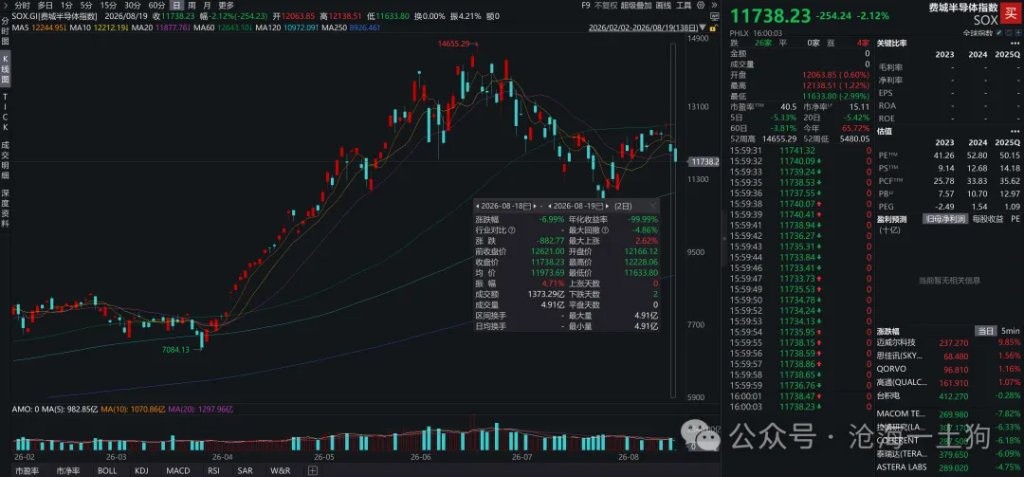
Affected by this, the Philadelphia Semiconductor Index dropped nearly 7% within two trading days.
A very popular explanation for this phenomenon is that the rise in 30-year Treasury yields significantly increased the opportunity cost faced by tech stocks, leading to a major adjustment in the tech sector.
This explanation has become ubiquitous because the DCF model is deeply ingrained in investors' minds. However, this explanation fails to answer the following two questions:
1. Why was there previously a positive correlation between 30-year Treasury yields and the performance of tech stocks?
2. Why did it suddenly turn into a negative correlation around the 5.33% level?
In fact, some tech stock investors have raised valid counterarguments, believing that tech stocks generate sufficient returns, and they simply do not care about the slight increase in opportunity cost.
So, where does the problem really lie?? The explanatory framework is too simple, containing only one dimension: price. This framework is insufficient to explain the entire phenomenon, leading to circular reasoning that goes nowhere. A competent framework needs to introduce an additional dimension—credit risk.
Unchecked Credit Expansion
In the article "The Deep Logic Behind the New High in 30-Year US Treasury Yields," we provided a basic explanatory framework—the expansion of private financing driven by the AI capex boom crowded out government financing.
Let us briefly recall this proposition, taking our minds back to the era of trust products in China:
At that time, there were various non-standard assets whose underlying assets were real estate and local government financing vehicles (LGFVs). These assets offered extremely high yields, easily exceeding 8%. Even more tempting was that these assets basically promised rigid redemption. So, the question arises: in such a scenario, would anyone still invest in long-term bonds yielding 5%? No. In those days, there was a surefire strategy for bond fund managers: blindly buy LGFV bonds, and do so with leverage. This strategy guaranteed that managers' performance remained in the top 5% for the long term.
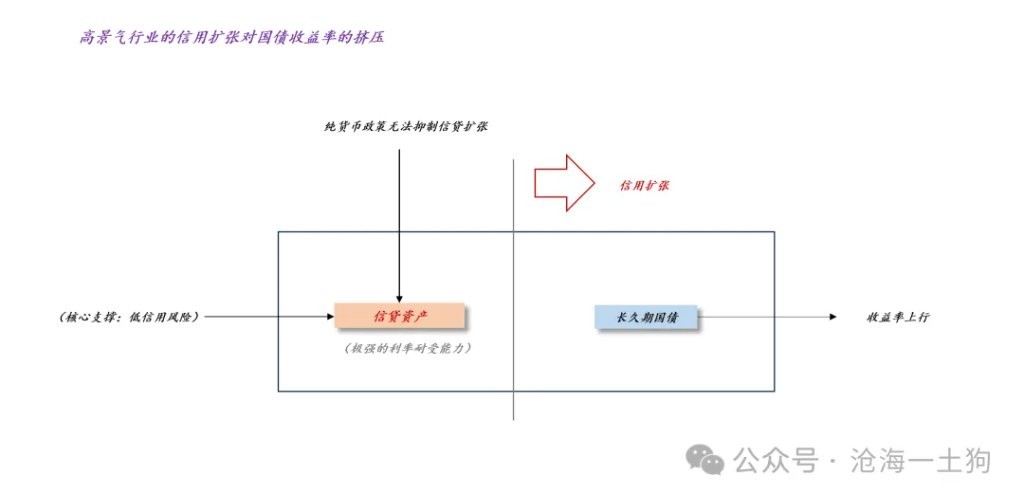
Thus, we have the chart above. If bank balance sheets or the entire financial system's balance sheet is scarce (PS: this corresponds to Waller's scarce reserves framework), investors are forced to compare the yields of credit assets in hot industries with those of long-duration government bonds.
It is obvious that companies in hot industries have strong interest rate tolerance; they are willing to pay high interest rates. Furthermore, the public has great confidence in the solvency of these hot industries, believing that these credit assets carry low credit risk and will continue to do so.

In this situation, monetary policy becomes ineffective. Not only can a federal funds rate of 3.75% fail to stop it, but even a rate of 5.5% would be ineffective.
Therefore, those who criticize Waller for delaying rate hikes are simply laymen. Raising rates will not suppress the credit expansion brought about by the AI capex boom; instead, it will only further increase the government's financing costs, thereby pushing up the yield on 30-year US Treasuries.
Clearly, what the Federal Reserve needs is to cut rates to support other sectors and government financing; suppressing the credit expansion caused by the AI capex boom should be left to other departments. The Fed is not a trash can where all dirty work should be swept.
How to Suppress Credit Expansion
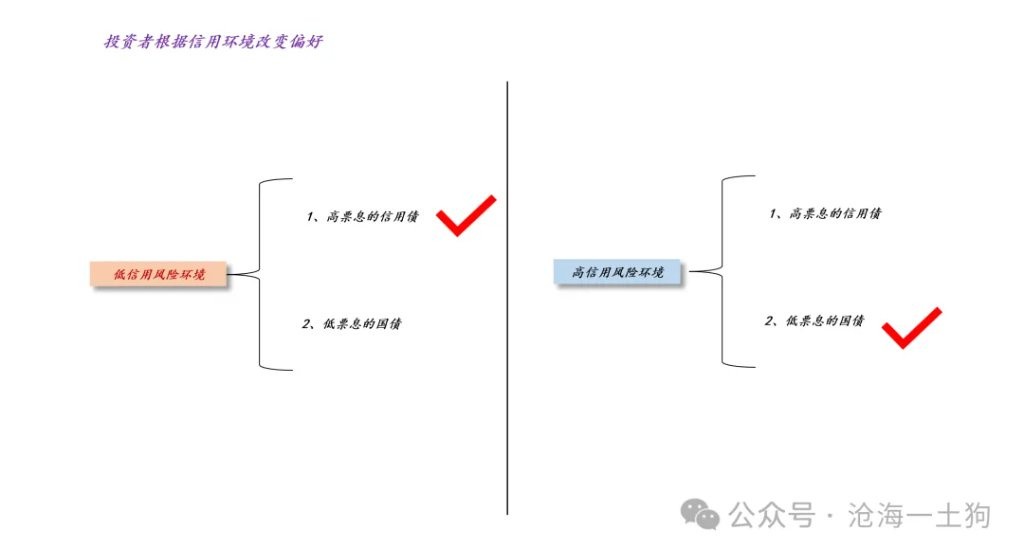
Regarding credit bonds, we have practical experience: Would you be willing to buy a real estate bond with default risk at a 10% yield? No. What if the yield were raised to 15%? Still no.
Therefore, for credit bonds, investment decisions are sensitive to credit risk, but completely insensitive to the level of interest rates.

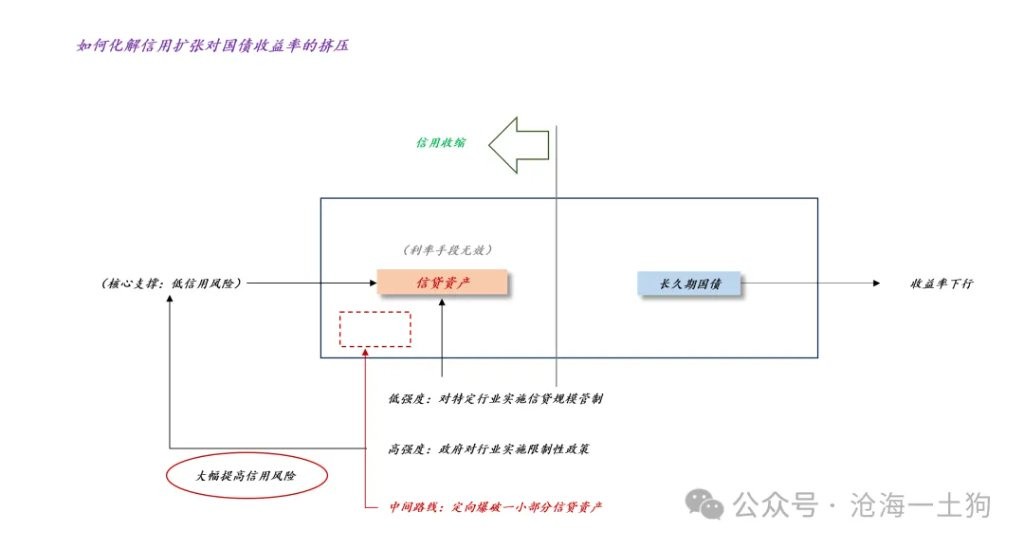
As shown in the chart above, to alleviate the squeeze on Treasury yields caused by credit expansion, there are two methods: 1. Low intensity: Implement credit scale controls on specific industries; 2. High intensity: The government implements restrictive policies on the industry.
Chinese investors are very familiar with credit controls. When the real estate sector was booming, we had controls on real estate credit quotas. However, this approach is suitable for our system, which is dominated by indirect financing, and is not applicable to the US, because the US has a massive shadow banking system that can easily bypass credit controls.
Consequently, we are left with only the high-intensity method—implementing restrictive policies on the industry.
Only by reasoning to this point do we truly understand why tech stocks fear a 30-year US Treasury yield of 5.33%?? It is because they worry that the government, unable to bear such high financing costs, will take drastic measures from the root—implementing restrictive measures on the AI industry. To be honest, such high interest rates have backed the US government into a corner. Without restrictions, US interest expenses will soon exceed 30% of US fiscal revenue.
If the government can barely afford to pay interest, what is there to say about AI capex?? Investors are quite rational on this issue; they worry that high financing rates will force the federal government to take extreme actions.
The Middle Path
So, is there a middle path between the continued surge in AI capex and federal government financing?? Theoretically, yes.

The chart above provides a theoretical solution: Targeted demolition of a small portion of credit assets. This operation can free up certain credit spaces and inject a certain amount of credit risk into the system, suppressing blind credit expansion. The latter plays the primary role.
In fact, this is a market-oriented approach. The credit market itself should possess the function of survival of the fittest, continuously creating small crises to eliminate junk assets, avoiding their accumulation into a major financial crisis in the end. However, the boom in hot industries causes the credit system to temporarily lose its "survival of the fittest" function.
Since the conflict between private financing and government financing is now so sharp, actively restoring the "survival of the fittest" function of the credit system is a good way to resolve the contradiction.
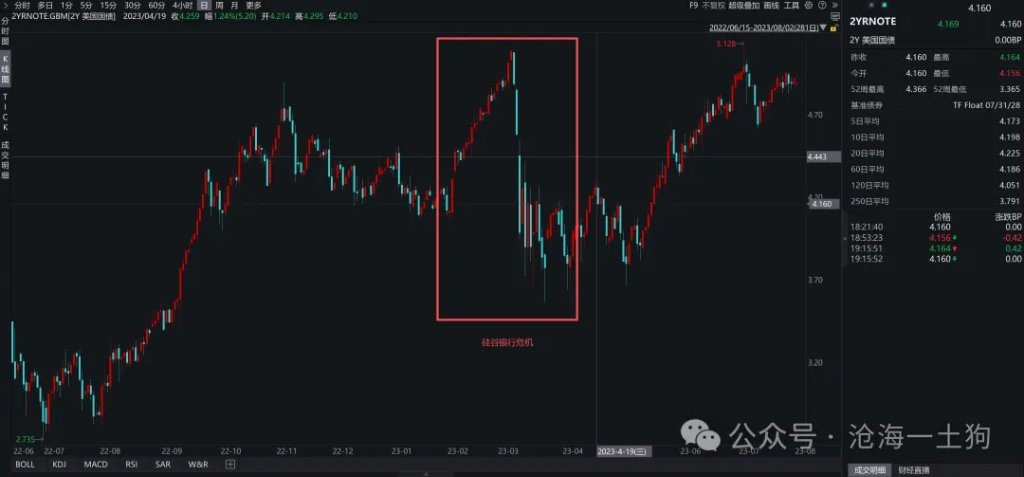
In fact, the "Silicon Valley Bank crisis" back then played a similar role. It prevented a rapid rise in the federal funds rate and freed up considerable space for federal government financing. Therefore, from the perspective of the federal government, a controlled release of credit risk similar to the "Silicon Valley Bank crisis" is a good thing, indeed a tremendous good thing.
However, this path is like walking a tightrope. After all, credit risk is a dangerous thing, and containing its spread is a technical challenge.
A Stopgap Measure—Structural Rate Cuts
Once we clearly recognize the real contradiction in the US financial system—the AI capex boom versus US government financing—then continuing to let the Federal Reserve cut rates becomes a way to resolve it.
The reasoning behind this is simple. Since the AI capex boom has driven a large amount of private financing, and raising rates cannot suppress this financing frenzy, we might as well do the opposite: lower the federal funds rate to compensate for government financing and financing for other industries that have been squeezed into a corner by AI financing.
In other words, Fed rate cuts can temporarily ease the contradiction between the AI capex boom and US government financing.
So, will the Fed cut rates in Q4?? I believe the probability remains high, for two reasons: one is historical inertia; the other is forward-looking signals.
In the article "Will the Fed Cut Rates in Q4?," we have already discussed historical inertia. In 2024 and 2025, we repeated the same series of events: H1 bluffing about rate hikes → August Jackson Hole signaling rate cuts → September rate cut implementation → October start of the new fiscal year.
Yesterday, the US Treasury Department announced:
The size of liquidity support repurchase operations for long-term nominal coupon securities will be at least doubled, covering two maturity buckets: 10-to-20 years and 20-to-30 years. Currently, the maximum size per operation is $2 billion, and in the future, the size per operation will be increased to at least $4 billion. The adjustment will take effect on September 9, 2026, and will be implemented for the remainder of this refinancing quarter (until November 4, 2026).
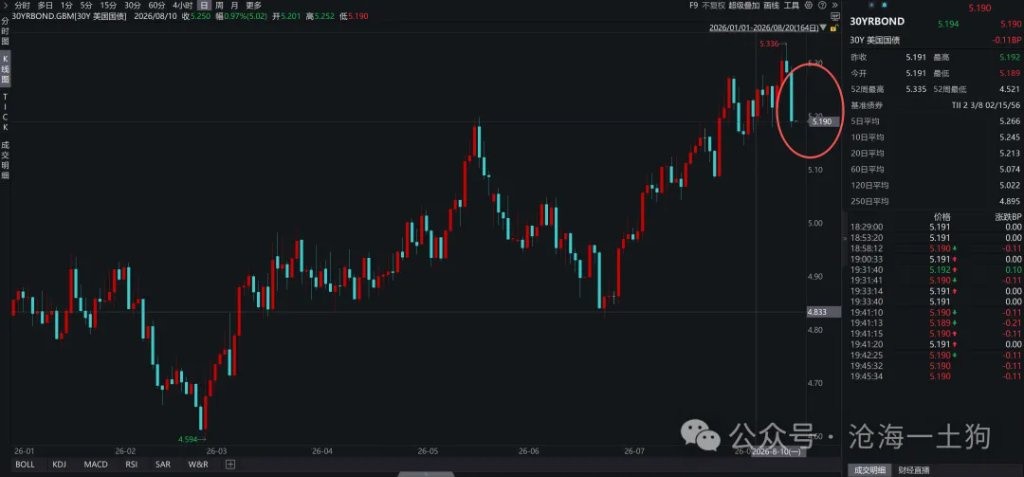
Affected by this, the 30-year US Treasury yield fell sharply by nearly 9bp, reaching around 5.19%. If viewed in isolation, the interpretation of this event is simple: Bessent was forced into a corner and could only perform this kind of "mini-QE," using money from the TGA account to buy more long-term bonds and then swap them for an equivalent amount of short-term debt.
However, if we look at the US Treasury and the Federal Reserve together, the event becomes more interesting. The TGA account is itself part of the Federal Reserve's balance sheet. Therefore, Bessent's operation is equivalent to paving the way for Waller: Will the market buy it? Will the term spread decrease??
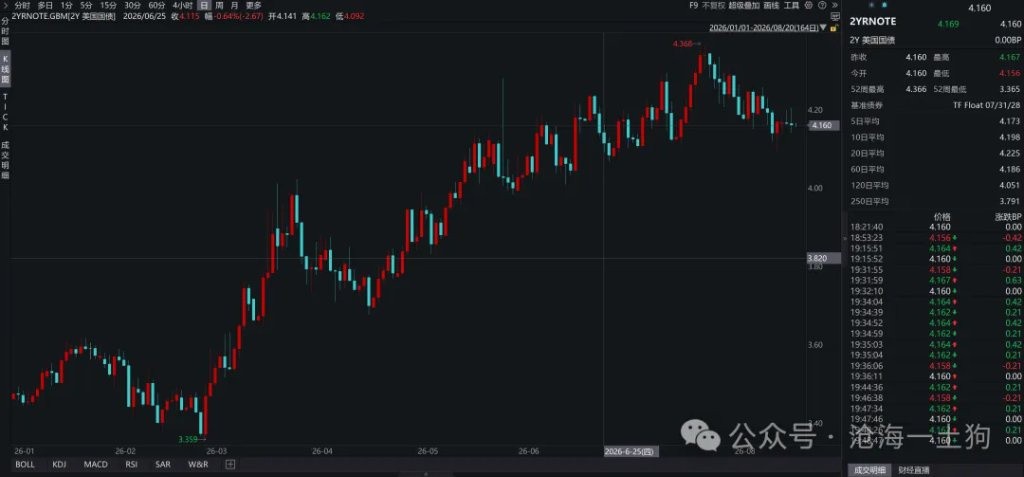
Proof shows that this operation was effective. The 2-year US Treasury yield remained unchanged, but the 30-year US Treasury yield dropped by 9bp, meaning the term spread decreased significantly.
Conclusion
In summary, we have clarified the true context of the entire event. The core conflict stems from private financing driven by the AI capex boom versus government financing. There are two ways to handle this conflict:
1. Structural Rate Cuts by the Federal Reserve
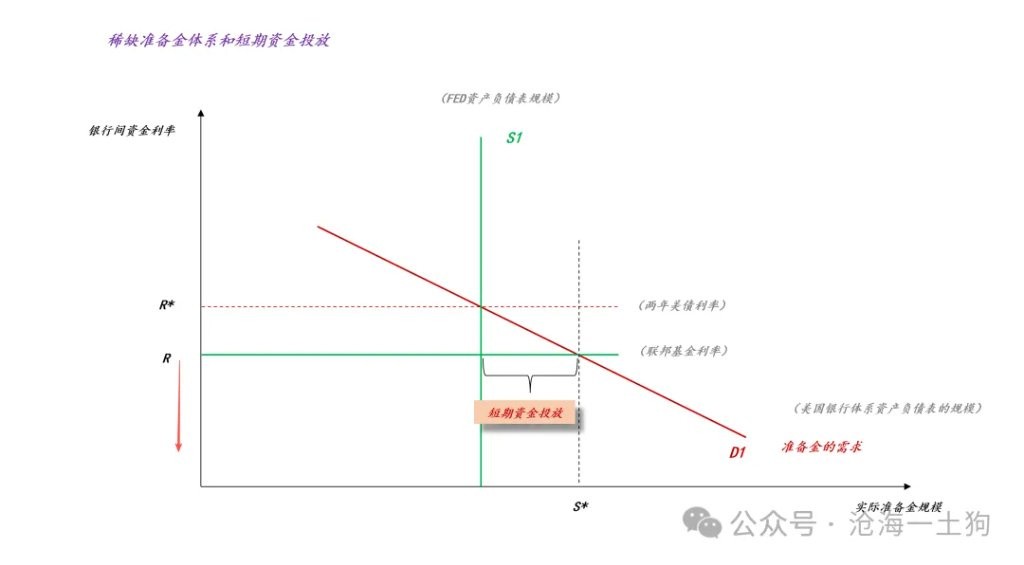
As shown in the chart above, this is a structural rate cut. On one hand, keep the 2-year US Treasury yield R unchanged,* maintaining it around 4%; on the other hand, further lower the federal funds rate R, i.e., from 3.75% to 3.5%. This operation will produce an effect similar to Bessent's YCC (Yield Curve Control): the 2-year US Treasury yield remains unchanged, but long-term yields drop significantly.
To be honest, this method of cutting rates to resolve debt issues is far beyond the comprehension of those who only know how to criticize Waller every day.
2. Controlled Release of Credit Risk
Theoretically, the federal funds rate can be lowered to zero, while the 2-year US Treasury yield can still remain at 4%. At this point, the yield curve might become very flat, or even have the potential to invert.
If the yield curve remains relatively steep at this time, one can attempt a controlled release of credit risk. This move will also significantly reduce the term spread.
Of course, structural rate cuts by the Fed and a controlled release of credit risk are not contradictory; these two methods can be used in combination.
Overall, the first move is to mask the contradiction, while the second move has the potential to truly resolve it. However, the first move is safe, whereas the second involves taking certain risks.
Risk Warning and Disclaimer
The market carries risks; investment requires caution. This article does not constitute personal investment advice, nor does it consider the specific investment objectives, financial status, or needs of individual users. Users should consider whether any opinions, views, or conclusions in this article align with their specific circumstances. Responsibility for investments made based on this content rests solely with the investor.
