


Antitrust crackdown begins to erode Apple's $100 billion services business
Apple has acknowledged for the first time that new antitrust regulations are forcing it to loosen its control over the App Store, which is eroding its service business worth over $100 billion. Financial reports show that revenue and profit margins in this sector are both below expectations, and commission income is at risk of shrinking due to the introduction of third-party payments. Analysts point out that the slowdown in growth poses a hidden danger, leading to a decline in Apple's stock price of about 9%
Apple has for the first time acknowledged that new regulatory rules are forcing it to relax its control over the App Store, putting pressure on its service business, which exceeds $100 billion in scale. This rare statement indicates that antitrust regulatory measures have begun to undermine one of the company's most profitable business segments.
Apple's service revenue and profit margins announced this month fell short of Wall Street expectations, and in its latest regulatory filing, it warned that if users complete transactions through third-party payment systems, Apple "may be completely unable to collect commissions."
This disclosure is the clearest signal to date that court rulings and regulatory interventions in the U.S., Europe, and other regions over the years are gradually eroding the commission revenue that supports Apple's high-profit service business.
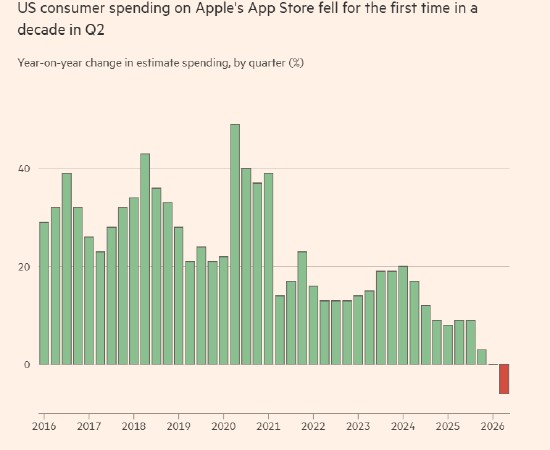
Recent research also confirms this trend. Data from mobile data analytics company Sensor Tower shows that in the second quarter, consumer spending in the App Store in the U.S. market declined by 6% year-on-year, compared to a 9% increase in the same period last year; Appfigures estimates that Apple's commission revenue in the U.S. market has shrunk by 18% so far this year.
UBS analyst David Vogt described the slowdown in App Store growth as a "hidden danger," while Bank of America’s Wamsi Mohan stated that although the $30.7 billion service revenue set a record high, the performance was still "slightly below our expectations."
Apple previously attributed the performance of this business segment to multiple factors, including exchange rate fluctuations. However, Chief Financial Officer Kevin Parker also acknowledged that recent adjustments to the App Store have impacted the business.
Data service provider Visible Alpha reported that Apple's service revenue for the quarter ending in June reached $30.7 billion, below analysts' expectations of $31.4 billion; meanwhile, the business's gross margin of 75.6% also fell short of market predictions. In the days following the earnings report, Apple's stock price dropped by about 9%.
Courts and regulatory agencies in multiple countries have forced Apple to relax its control over app payment and distribution processes, eroding up to 30% of the commission revenue from in-app digital purchases and subscription services.
Last year, Epic Games won a U.S. court injunction that forced Apple to allow app developers to guide users to use third-party payment channels outside the App Store without charging fees, bypassing Apple's traditional commission mechanism.
Sensor Tower indicated that the slowdown in the U.S. market reflects that the aforementioned rulings have had a "significant impact" on user spending within the App Store.
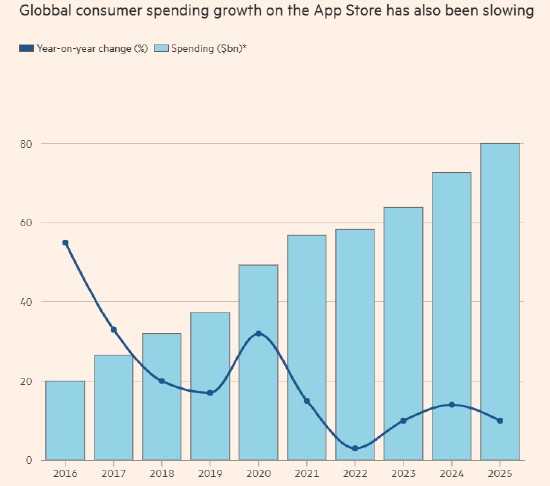
Sensor Tower data shows that in the June quarter, global user spending in the App Store grew by only 3% year-on-year, compared to a 13% increase in the same period last year. The research firm stated that weakened consumer demand and macroeconomic uncertainty may also suppress demand
Another study by Appfigures found that after new regulations were introduced in Brazil and Japan in recent months, local App Store revenues also experienced a decline.
Apple argues that strict control over iPhone applications is a necessary measure to protect users. However, regulators in the European Union, South Korea, and Brazil have demanded that Apple open the iPhone to third-party app stores or alternative payment methods, with the UK and Australia also advancing similar regulatory reforms.
Last year, the European Union fined Apple €500 million on the grounds of violating the Digital Markets Act, and Apple is appealing this penalty. In the United States, after a judge ruled that Apple failed to comply with a previous injunction regarding App Store payment rules, the Supreme Court has agreed to review parts of the Epic Games case.
Nicholas Rodelli, head of legal research at a Washington analysis firm, stated, "It makes sense that regulatory impacts are beginning to show up in financial report data... Previously, this impact was completely unidentifiable from the data, which surprised us."
He added, "Apple's high valuation is built on its services business, and the App Store is the crown jewel of that services business. We believe the market will reassess whether the service business's commission rates can be sustained in the long term."
