


Geely's overseas blitz: the next BYD?
$ GEELY AUTO.HK released its Q2 2026 report during the Hong Kong midday session on Aug 17 Beijing time. Overall, Geely delivered a solid print, with core GPM and per-vehicle operating profit moving higher. This underscores strong operating resilience.
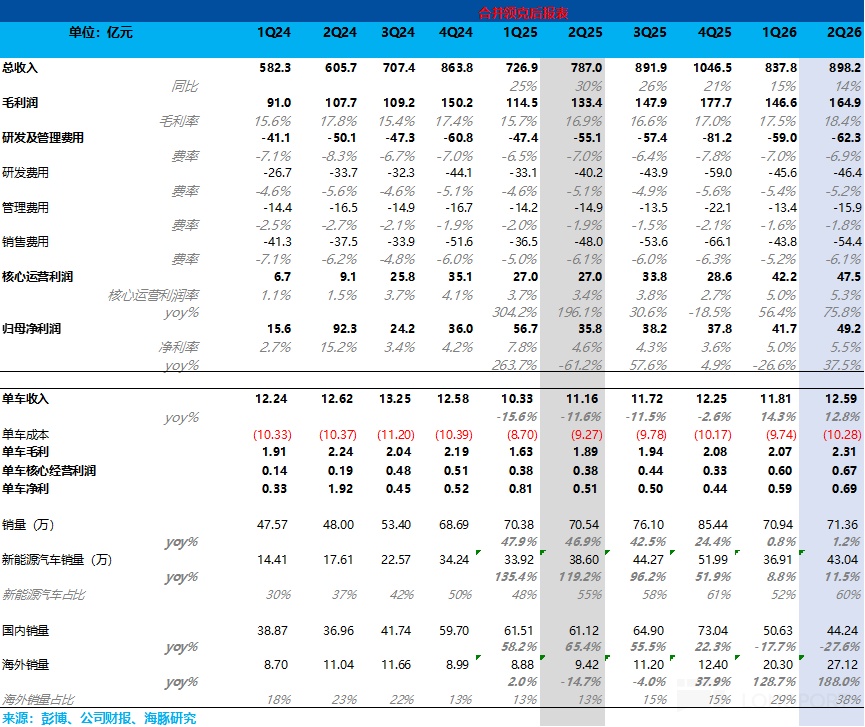
1. Total revenue up 14% YoY, driven mainly by higher revenue per vehicle: Q2 revenue reached RMB 89.8bn. With total sales volume up just 1.2% YoY, the 14% YoY revenue growth was primarily supported by a 12.8% YoY rise in revenue per vehicle. The uplift came from a richer premium mix and higher export contribution.
2. Revenue per vehicle rose YoY and QoQ: Q2 revenue per vehicle was RMB 126k, up 12.8% YoY and 6.6% QoQ, aided by a sharp increase in higher-priced export models. Exports as a share of sales rose from 13% a year ago to 38% this quarter. The premium ZEEKR brand mix also climbed from 7% to 14% (on the ramp of ZEEKR 8X), jointly lifting ASP YoY.
3. GPM continued to improve QoQ: Q2 GPM reached 18.4%, up 90bps QoQ. Mix benefits from exports and premium models, alongside aggressive cost-down actions (nearly 80% of targeted reductions achieved in Q1 and expected full completion in Q2), offset the headwinds from higher lithium carbonate and base metals like copper and aluminum (per-vehicle cost impact approx. RMB 2k). This aligns with prior guidance for Q2 GPM to be stable to slightly higher QoQ.
4. Opex up 14% YoY, driven mainly by R&D and selling expenses: Q2 selling expense was RMB 5.44bn, up 13.4% YoY, reflecting accelerated overseas channel buildout and new model marketing.
R&D expense was RMB 4.64bn, up 15.6% YoY, primarily for:
- New model development: launches during the period included ZEEKR 8X, Lynk & Co 10/10+, Geely Galaxy V900/M7, Xingyao 7/A7 EV, and Xingjian 7 EV. Additional launches in H2 include Galaxy TT, Galaxy Warship 700, Lynk & Co 07 GT, and ZEEKR 9X Guanghui.
- Intelligent features: rollout of a World Behavior Model (WAM), the next-gen ADAS 'Qianli Haohan G-ASD', and a cockpit-driving fusion super agent 'Super Eva'; plus forward-looking investments in power semis, digital chassis, embodied intelligence, and LLMs.
- Electrification: introduction of the next-gen 'i-HEV Smart Hybrid' technology, continued iteration on the 800V high-voltage architecture, next-gen e-drive and battery tech, spanning BEV, PHEV and HEV routes.
5. Core per-vehicle operating profit continued to improve: Benefiting from export and premium mix lifting GPM, core operating profit jumped 76% YoY despite higher opex from R&D and selling. On a per-vehicle basis, core OP rose QoQ from RMB 6.0k to RMB 6.7k.
6. Despite FX losses, net profit attributable to shareholders still rose sharply: H1 2026 recorded FX losses of RMB 550mn (vs FX gains of RMB 2.64bn in H1 2025), which dragged on net profit. Even so, attributable net profit rose 37.5% YoY to RMB 4.92bn, and per-vehicle net profit increased from RMB 5.1k a year ago to RMB 6.9k this quarter.
Dolphin Research View:
Overall, Geely posted a solid Q2. While vehicle sales rose just 1.2% YoY (vs. passenger vehicle market down 5%), ASP gains from premium and export mix helped deliver 14% YoY revenue growth.
Likewise, the twin engines of premiumization and exports (exports now 38% of mix), together with strong cost-down execution, not only kept ASP resilient in a tough, contracting market but also drove notable improvements in GPM and per-vehicle net profit. Per-vehicle net profit rose from RMB 5.0k a year ago to nearly RMB 7.0k this quarter.
On the NEV transition, despite the fade of purchase tax incentives and a 4% YoY decline in industry-wide NEV sales, Geely’s NEV sales rose 12% YoY to 430k units. This marked outperformance against the sector.
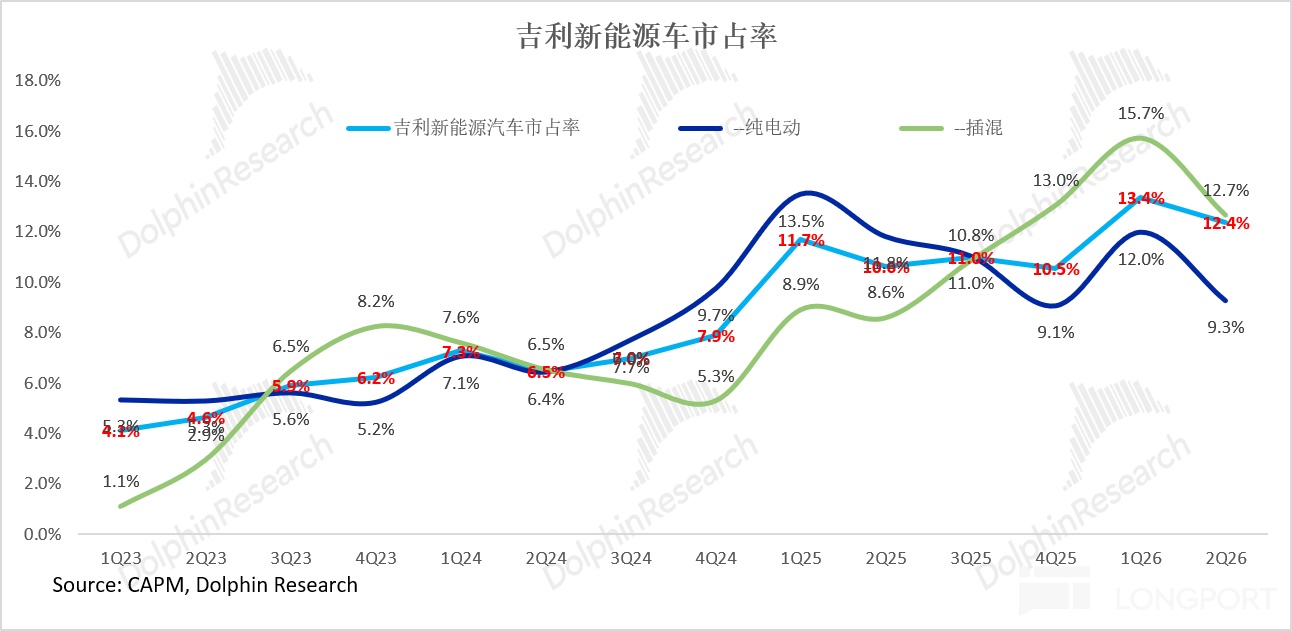
NEV penetration climbed to 60%, up 5ppt YoY. Domestic NEV share also rose from 10.6% to 12.4% this quarter, signaling that in 2026 Geely has fully entered a NEV-led development phase.
By brand:
a. Galaxy series: Q2 NEV sales were 140k units, up 14% YoY. The Galaxy brand returned to positive YoY growth, driven by new models Galaxy M7 and Xingyao 7, the A7 EV, and recovery in legacy models Galaxy E5 and Galaxy Warship 7 PHEV.
b. Lynk & Co: NEV sales fell 11% YoY to 43k units. Although NEVs accounted for 68% of Lynk’s total sales, up 9ppt YoY, there were no major new launches in Q2 and the prior blockbuster Lynk 08 aged, with sales dropping from 17k last quarter to 8.6k this quarter.
c. ZEEKR: NEV sales surged 105.4% YoY to 101k units, led by the hot 8X at 14k units this quarter and a rebound in ZEEKR 007.
In total, Q2 NEV sales were 430k units, up 12% YoY against the trend. This represents a 36% completion rate toward the 2.22mn full-year 2026 sales target.
2026 outlook:
Geely is entering a strong Davis Double, with potential to generate its own alpha. Premiumization and exports should keep expanding margins and lift EPS, while the accelerated NEV transition should raise the PE ceiling.
① Profit engine 1: Sustained product cycle strength, premiumization drives ASP up
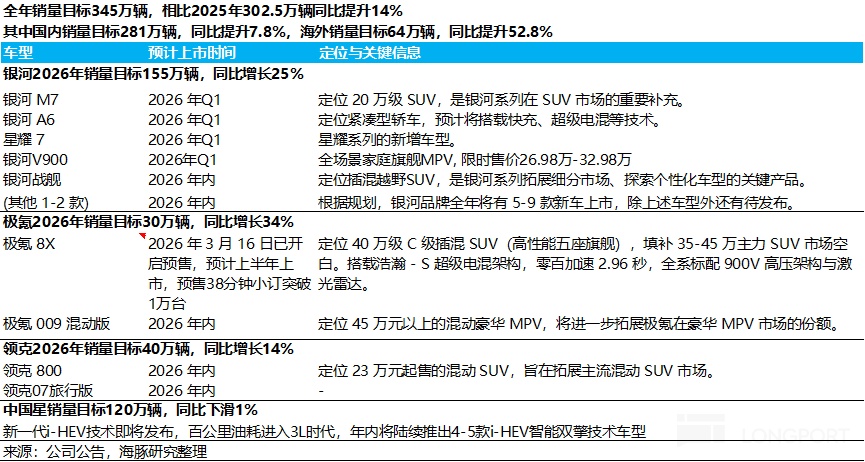
The company targets total 2026 sales of 3.45mn units, up 14% YoY, with growth led by NEVs and an overseas push. The NEV sales target is 2.22mn units, up 32% YoY, with NEV penetration rising 8.5ppt YoY to 64%. ICE sales are targeted at 1.23mn units, down 8% YoY.
By brand plans, Geely will launch nearly 10 new models in 2026 to support the target:
Geely Galaxy (scale core): NEV target of 1.52mn units, up 23% YoY, leveraging new models such as M7 and Xingyao 7 to consolidate the mainstream market.
ZEEKR (premium profit pillar): target of 300k units, up 34% YoY, driven by the 8X (launched in Apr) ramp and sustained volume from 9X. With a shared leading architecture, 8X and 9X form a premium lineup, lifting brand ASP and GPM.
Lynk & Co: target of 400k units, up 14% YoY, with growth driven by the ongoing NEV transition (penetration already above 60%) and new models such as Lynk 800.
② Profit engine 2: Overseas market inflection, highest profit elasticity
Overseas has become Geely’s most certain growth and most elastic profit driver for 2026. The overseas sales target has been raised sharply to 920k units (+120% YoY), and exports have already reached 474k units, half of the updated full-year goal.
Current overseas sales are running at about 100k units per month (annualized near 1.2mn), mainly due to a higher NEV mix in exports. Of the 100k, around 30k are ICE and 70k are EVs (10k ZEEKR 007/ZEEKR X, 10k Lynk & Co, and 45k Galaxy Warship 7 and Galaxy E5).
Even with only two Galaxy export models so far, sales have grown at a rapid clip, and Dolphin Research expects Geely to beat guidance with full-year 2026 exports of around 1.1mn units. In 2027, HEV exports could further increase to 1.5–1.6mn units, leveraging a roughly USD 3,000 cost advantage vs Toyota HEV.
Exports high profitability is key to expanding group earnings. Based on 2025 data, overseas ASP of RMB 176.5k is 1.7x domestic, GPM is roughly 10ppt higher, and per-vehicle net profit is about RMB 12k. As overseas channels expand toward 2,200+ outlets and NEV export mix tops 50%, overseas will be the main profit accretive vector.
③ Cost-out and efficiency as the foundation: 'One Geely' unlocks systemic benefits
With ZEEKR’s privatization completed by end-2025, the 'One Geely' strategy is entering full realization. Deep integration across R&D, procurement, manufacturing and management platforms should materially dilute operating costs, and we expect 2026 selling, admin and R&D ratios to continue trending down, supporting margin release.
NEV transition lifts the PE anchor:
Given the strong fundamentals of accelerated 'exports + premiumization', even though domestic sales lag expectations (H1 2026 domestic down 23% YoY to 950k units), Dolphin Research trims full-year 2026 total sales to 3.32mn units (domestic 2.15mn, -18% YoY). With strong overseas momentum, 2026 overseas sales are expected to reach 1.1mn units (33% of total), and per-vehicle net profit overseas at around RMB 12k is 2–3x the domestic RMB 4–5k.
On this basis, Dolphin Research estimates 2026 net profit of RMB 21.8–23.0bn (+29%–36% YoY). More importantly, as NEV penetration breaks 60% and dominates the fundamentals, the market’s legacy OEM discount should fade, justifying a NEV transition premium. We assign a 12–13x 2026 PE (up from 10x), implying a fair market cap of RMB 261.6–299.0bn, vs. the current RMB 173.0bn, for 51%–73% upside.
