


Goldman Sachs dissects the Q2 earnings of US stocks: AI infrastructure is making a fortune, while profitability on the application side still feels like "drawing a pie"
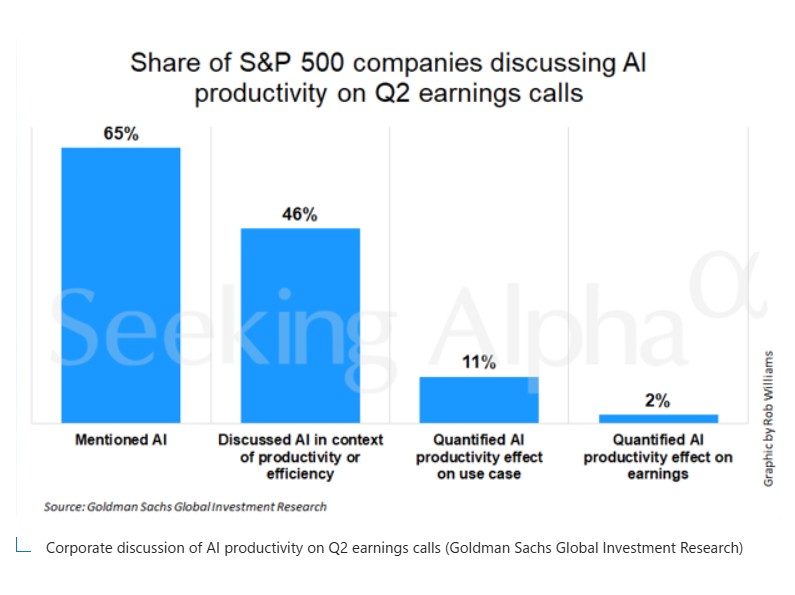
Goldman Sachs strategist Ben Snyder pointed out that despite the surge in corporate AI investments, most companies have yet to achieve substantial profit improvements. The second-quarter earnings reports show that only 2% of S&P 500 companies quantified the specific impact of AI on profits, and the profit growth of efficiency-improving companies is not significantly different from the overall market. In contrast, stocks benefiting from AI infrastructure (such as semiconductors and cloud computing) have seen significant profit growth, while returns on the application side remain to be observed
According to the Zhitong Finance APP, Goldman Sachs strategist Ben Snyder pointed out that companies are increasing their investments in artificial intelligence (AI) at an unprecedented pace; however, for most companies, this technology has not yet translated into substantial profit improvements.
In a report released on August 14, Goldman Sachs stated that during the second quarter earnings season this year, only 2% of S&P 500 companies quantified the specific impact of AI on profits; 11% of companies reported measurable productivity gains in specific areas such as software programming and customer support.
However, the companies that achieved efficiency improvements did not significantly outperform the overall market in profit growth. Data shows that their median profit growth year-on-year was 17%, while those that did not quantify AI's efficiency contribution had a growth of 14%. Goldman Sachs noted that this gap is not statistically significant.
For investors, this finding helps explain the current market landscape: on one hand, semiconductor manufacturers, cloud service providers, and other AI infrastructure beneficiaries continue to be favored; on the other hand, companies promising future efficiency improvements are treated with general caution. Infrastructure spending has led to immediate revenue and profit growth, while the potential returns of companies enhancing efficiency through AI remain difficult to measure and may take several quarters to gradually manifest.
AI Infrastructure Drives Profit Growth
Overall, the second quarter earnings season performed exceptionally well. Goldman Sachs stated that excluding non-recurring gains related to certain private equity investments, the S&P 500's earnings per share grew by 31% compared to the same period last year.
Among large-scale enterprises and other beneficiaries of AI capital expenditures, profit growth reached 54%, contributing to about half of the overall profit growth of the index.
Nevertheless, the growth momentum is not limited to large tech stocks. The median profit growth of S&P 500 companies was 14%; excluding energy companies benefiting from rising oil prices, non-AI infrastructure companies also achieved a growth of 14%.
This broader improvement may help alleviate market concerns about profit growth being overly reliant on a few tech giants. However, the performance gap between infrastructure suppliers and AI application companies remains significant.
Goldman Sachs pointed out that investors prefer infrastructure stocks because their returns are immediate and relatively easy to track. In contrast, companies frequently mentioning AI productivity plans have performed roughly in line with the overall S&P 500 index over the past few years.
Corporate Spending Accelerates Expansion
Various signs indicate that the impact of AI may become clearer in corporate earnings reports over the next few quarters.
Goldman Sachs cited the Ramp AI Index, showing that corporate monthly per capita AI spending has increased from $5 at the beginning of the year to $12 in July; the top 10% of companies saw this spending soar from $240 to $650.
 During the second quarter earnings call, about 7% of S&P 500 companies discussed the costs of AI deployment. Most companies indicated that the scale of related expenditures is still small or emphasized that investments will be advanced with caution. Some companies also stated that the benefits brought by AI have already exceeded the input costs.
Goldman Sachs estimates that the current cost of AI inference accounts for less than 0.5% of the revenues of S&P 500 companies. Its latest IT spending survey shows that 89% of respondents indicated that AI spending accounts for 1% to 5% of their IT budgets.
It is important to note that the above estimates do not cover all costs related to AI deployment, such as staffing and the construction of technical infrastructure.
Reallocating Existing Budgets to Support Transformation
Goldman Sachs' survey found that about two-thirds of companies support AI investments by reallocating resources from existing budgets rather than relying entirely on new funds.
Specifically, 35% of respondents indicated that AI spending comes from new budgets; 18% raised funds through cost efficiency improvement projects; another 18% reallocated from software budgets, 11% shifted from labor costs, 10% came from cloud service budgets, and 9% originated from data analysis expenditures.
Goldman Sachs believes that structural adjustments within IT budgets are more likely to redistribute profits among different companies rather than significantly change the overall profitability of the S&P 500. However, if labor costs are significantly reduced, it could have broader economic implications.
Currently, the impact on the labor market is still concentrated in marketing, graphic design, customer service, and some technical positions, while new jobs created by data center construction have somewhat offset the reduction in these positions.
Goldman Sachs economists expect that AI will eventually replace some labor, but they believe this impact will be temporary and smaller than many investors anticipate.
Impact on the Software Industry Not Yet Apparent
There were previous market concerns that customers would use AI to develop applications themselves, thereby reducing reliance on external software vendors. However, Goldman Sachs found that there has not yet been a widespread industry reshuffle.
In its IT survey, only 17% of responding companies indicated plans to increase internal software development and reduce purchases of off-the-shelf software. The median annual recurring revenue (ARR) growth rate for the software companies covered by Goldman Sachs increased from 18% in the fourth quarter of 2025 to 22% in the first quarter of this year, and further accelerated to 23% in the second quarter.
Of course, this does not mean that individual vendors can rest easy. Goldman Sachs mentioned reports that Starbucks (SBUX.US) is developing internal AI tools to replace some software provided by companies like Microsoft (MSFT.US) and IBM (IBM.US). However, from the overall industry data, there has not been a general trend of deterioration.
Goldman Sachs Identifies Potential Beneficiaries
Goldman Sachs believes that companies with high labor costs and a significant number of positions with automation potential are likely to benefit the most from AI.
Currently, labor costs account for about 12% of the total revenues of S&P 500 companies, with an annual scale of approximately $2.1 trillion. There are significant differences across industries: the proportion is 21% in industrial companies, 16% in the information technology sector, and only 5% in the energy sector Goldman Sachs has selected companies from the Russell 1000 index that have higher labor costs, significant potential for AI automation replacement, and whose management has mentioned AI-related efficiency improvements in their financial reports. The list includes: CoStar (CSGP.US), Dollar Tree (DLTR.US), eBay (EBAY.US), Arthur J. Gallagher (AJG.US), Axon Enterprise (AXON.US), The Trade Desk (TTD.US), Airbnb (ABNB.US), Boeing (BA.US), Lockheed Martin (LMT.US), Charles Schwab (SCHW.US), and Morgan Stanley (MS.US).
However, Goldman Sachs also pointed out that this selection does not mean these companies have achieved significant cost reduction and efficiency improvement through AI—indeed, the earnings data of these potential beneficiaries has not yet shown substantial improvement.
At present, the investment logic of AI remains clear-cut: on one side are infrastructure providers, whose profits are already evident; on the other side are technology deployers, whose financial returns still largely remain at the level of expectations
