


The bull market is back, and market speculation has returned! As the semiconductor sector rebounds and restarts the main upward trend of the stock market, FOMO may trigger significant volatility
Despite the decline in volatility in the U.S. stock market and the VIX index hitting a new low for the year, investor sentiment is rapidly switching between fear and FOMO greed. The market is influenced by NVIDIA's earnings report and the Jackson Hole meeting, leading to a surge in demand for call options. Wall Street strategists point out that the low volatility hides the risk of increased short-term instability, as extreme positions and the Short Gamma effect make the bull market more sensitive to fluctuations
Despite the significant rebound in the semiconductor sector and technology stocks driven by AI computing infrastructure themes since August, the recent volatility in global stock markets is rapidly dissipating. However, statistics on options positions in the U.S. stock market indicate how quickly investor sentiment can switch between extreme fear and the greed-driven FOMO (Fear of Missing Out) mentality.
According to the Zhitong Finance APP, the volatility curve of the benchmark U.S. stock index—the S&P 500—shows that as the earnings season approaches its end and the schedule of important events gradually decreases, traders are generally optimistic about future risk factors. Current market pricing indicates that the daily volatility of the S&P 500 index will be significantly below 0.8% for the remainder of this month, with the performance report of the "AI leader"—global AI chip giant NVIDIA (NVDA.US)—and the annual Jackson Hole global central bank conference being the most critical market focus events. Meanwhile, the Chicago Board Options Exchange Volatility Index (VIX), also known as the fear index, closed at its lowest level of the year last Friday.
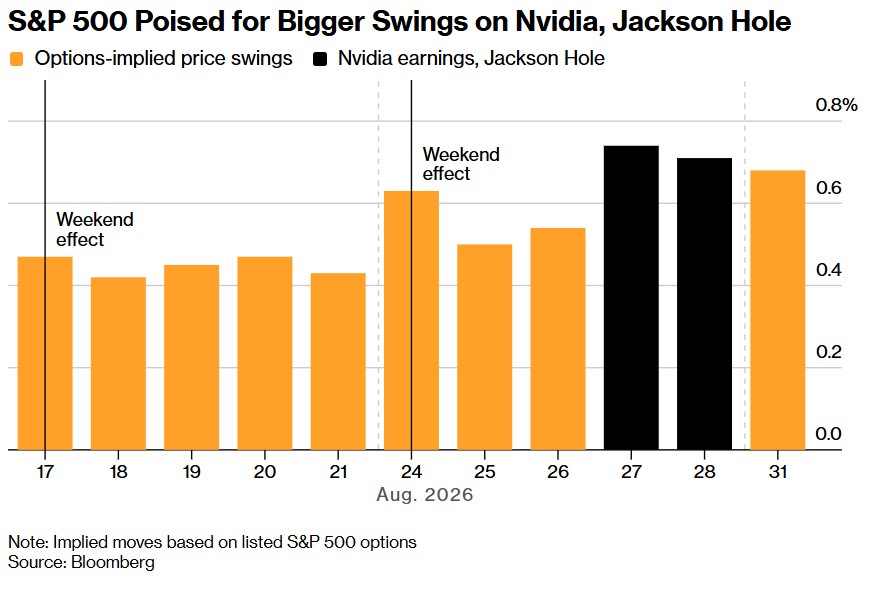
As shown in the above chart, the S&P 500 index may experience greater volatility during the NVIDIA earnings report and the Jackson Hole central bank seminar. Note: Implied volatility is calculated based on listed S&P 500 index options. It is important to note that a low VIX index does not equate to low market risk; Short Gamma, Call FOMO (FOMO-driven bullish options frenzy) extreme sentiment, and rapid position reversals imply that the stronger the bull market, the more sensitive the short-term volatility amplifiers become.
Some more cautious Wall Street strategists believe that behind these very significant bullish indicators lies the potential for increased market instability in the short term.
However, for top hedge funds on Wall Street and most seasoned strategists, the fundamentally driven mid-term outlook remains bullish, although the short-term trading structure may indeed shift to a neutral and cautious stance. The VIX has fallen to a year-to-date low, and the market's pricing of daily volatility for the remainder of this month is below 0.8%, indicating that investors remain calm about macro and earnings risks. Coupled with strong earnings in the stock market and robust fundamentals in the AI computing industry chain, the demand for AI investments remains strong, and the inertia of "buying the dip" continues to support risk assets.
What is truly concerning is that the market has rapidly switched from "buying puts to guard against a crash" at the end of July to "grabbing calls to guard against missing out" in August, while market makers have shifted from long gamma to short gamma territory—under this structure, being forced to buy on the way up and sell on the way down will amplify bidirectional volatility. An increase in volatility does not mean the end of a bull market; rather, it warns that the upward trend is still in place, but the market has transitioned from a "stable bull market" to a phase of "high momentum, high emotional sensitivity, and high tail risk volatility." As Wall Street financial giants such as Morgan Stanley and JP Morgan have recently raised their year-end target for the S&P 500 index to above 8,000 points, coupled with the global high-concentration AI technology theme deleveraging in July that did not destroy the main logic of the global stock market bull run, but rather completed a reset of positions and volatility, the tech/AI-led bull market trajectory has been reestablished. However, this is no longer a "low-risk, low-concentration" early bull market. In other words, the tech stock-led bull market tone has indeed returned, with rare resonance forming from AI earnings, semiconductor fundamentals, corporate buybacks, and re-leveraging funds; but the investment phase has shifted from "buying AI in panic" to "managing AI portfolios in extreme FOMO-style euphoria"—the trend remains bullish, but risks have shifted from fundamentals to positions, Gamma, long bond yields, and valuation expansion tolerance.
The most dangerous aspect may be that "it looks too calm"! Under the rapid switch from fear of selling to FOMO sentiment, is there a "volatility bomb" lurking beneath the calm surface of the U.S. stock market?
Recently, the demand for bullish options driven by FOMO (fear of missing out on rising markets) has led to a sharp collapse in short-term options volatility skew, whereas just before that, in late July, the market had widely bought index volatility and skew, with traders heavily purchasing put options for hedging. This sharp reversal highlights the current market's fragility: the market is increasingly driven by investor sentiment, which is rapidly shifting from "fear of market decline" to "fear of missing out on gains."
The bullish nature of trend strategies can still be maintained, but investors should not misinterpret low VIX as low risk; what needs to be guarded against most is that once Nvidia's earnings report, Jackson Hole, or other significant catalysts interrupt momentum, the Short Gamma mechanism could quickly amplify what would have been a normal pullback.
The current market is beginning to show "surface low volatility, underlying high fragility," meaning that at the end of July, investors were still buying index volatility and Put protection, but just days later, due to FOMO, they were aggressively buying Calls, leading to a rapid reversal in short-term skew; meanwhile, the rebalancing of leveraged ETFs, Short Gamma market maker positions, the contraction of daily expiration options (0DTE) iron condor strategy supply, and summer low liquidity have collectively reduced the market's volatility "shock absorber" effect. Additionally, the S&P 500 index Call/Put ratio has risen to one of the most bullish levels in at least four years, short-term Call skew has reached a two-year high, and there have been typical FOMO options squeeze signals where the index rises while VIX also increases.
Steve Sosnick, Chief Market Strategist at Interactive Brokers Group Inc., stated: "What we are seeing now is because momentum strategies have attracted such a large amount of investor capital and such a high level of market attention. We have become extremely sensitive to changes in momentum." Some technical factors may also make the market more susceptible to sudden shifts in investor sentiment. These include the current state of market makers being in a Short Gamma position, which is driven by S&P 500 index options trading and the rebalancing activities of leveraged exchange-traded funds (i.e., leveraged ETFs). In a negative Gamma environment, when stocks rise rapidly, market makers must buy stocks to hedge; when stocks fall, they must sell stocks, further amplifying market volatility.
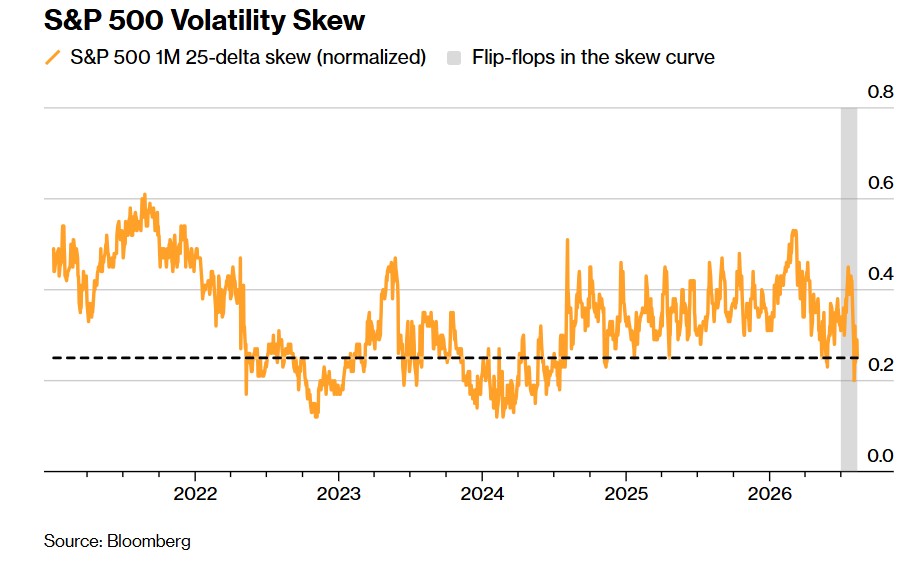
As shown in the above chart, the volatility skew of the S&P 500 index.
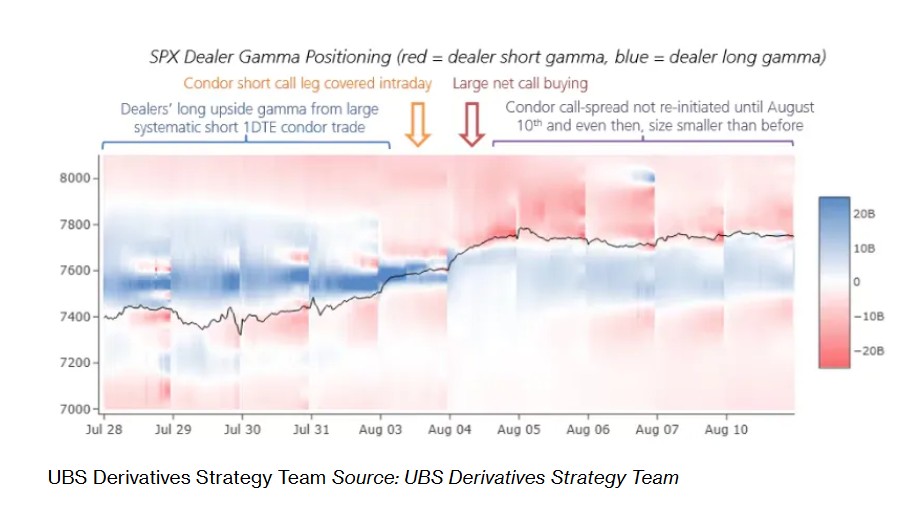
Meanwhile, UBS Group strategists wrote in a recent report that the so-called Short-Dated Iron Condor strategy, which was popular earlier this year and significantly helped to reduce intraday price volatility, has recently re-emerged on a smaller scale, which may open up space for larger price fluctuations. The relatively subdued market trading activity during the summer may also further amplify market movements.
UBS derivatives strategist Kieran Diamond stated, "Since around early August, the positioning pattern of S&P 500 options has undergone quite a dramatic reversal. At that time, the index rose from the area where market makers were in a long Gamma position to the area where they needed to manage Short Gamma risk." He added, "Record bullish options buying further amplified this change, and as the market began to experience a squeeze, one of the most important suppliers of upside options also started to withdraw." He was referring to the previously extremely popular Iron Condor strategy that increasingly targeted daily-expiring S&P 500 index options.
Christopher Jacobson, co-head of derivatives strategy at Susquehanna International Group LLP, believes that the recent trend and direction of bullish options skew is "quite consistent," noting that current options volatility indicators seem "very, very cheap."
However, Ritik Katte, co-founder and chief investment officer of the London-based hedge fund MCD Capital, stated that strategies capable of profiting from rapid shifts in investor sentiment are becoming more popular, while intraday momentum trading aimed at profiting from more severe market volatility is also gaining favor. He mentioned that his company is making corresponding arrangements to "benefit if any side of the skew suddenly experiences a trend breakout." Tanvir Sandhu, Chief Global Derivatives Strategist at Bloomberg Intelligence, stated: "On the surface, the global stock market appears unusually calm. However, beneath the surface, the market is far from stagnant: skew, gamma, and options positions are rapidly flipping."
"The bull market is back, and so is the risk appetite!" With AI earnings, trillion-dollar buybacks, and FOMO coming together, the semiconductor liquidation in July is evolving into a new wave of global tech rally.
Morgan Stanley previously raised its S&P 500 target to 8,000 points by the end of 2026 and to 8,300 points by mid-2027, primarily based on positive operating leverage, the adoption of cutting-edge AI technologies by more global companies, pricing power, and the ongoing expansion of the AI capital expenditure cycle. Goldman Sachs currently also sees 8,000 points, while JPMorgan raised its target from 7,800 to 8,000 points on August 10 and increased its 2026/2027 EPS estimates to $365/$420. Citigroup is looking at 8,100 points. JPMorgan particularly emphasizes the accelerated growth of AI-related cloud businesses from Google’s parent company Alphabet, as well as cloud computing giants like Amazon and Microsoft, noting that the backlog of cloud business orders and cash flow visibility are proving that AI CapEx is beginning to translate into actual revenue, indicating that the market is transitioning from "believing in the AI story" to validating AI return on investment (ROIC).
The most compelling confirmation signal comes from the semiconductor market, which experienced the most severe liquidation in July: the AI computing hardware beta, which suffered the most, is now becoming the vanguard of the rebound. The Philadelphia Semiconductor Index (SOX) plummeted nearly 29% from its record high on June 22 to its low on July 29, but as of August 13, it has rebounded about 20% from the low, nearing the end of its technical bear market in just about 19 trading days. The KOSPI index, heavily weighted by SK Hynix and Samsung, also surged over 20% from its low on July 30, and in the week of August 14, it skyrocketed another 11.5% to 6,977.94 points, re-entering a technical bull market.
The sharp decline in South Korea in July included strong leveraged ETFs and forced liquidation factors, with the scale of leveraged products dropping from about $50 billion to $17 billion; however, the fundamentals of AI Memory (the super bull market for AI-driven memory chips) did not collapse simultaneously, as the industry continues to discuss the tight supply of DRAM/HBM and the demand gap in 2027. Therefore, this round of AI-led bull market increasingly aligns with the positive feedback loop of "de-leveraging - market position reset - risk-taking - rising FOMO sentiment," rather than a dead cat bounce after the peak of an AI earnings cycle Another Wall Street financial giant, Citadel, provided evidence of capital flow indicating that this round of rebound has further entered the "self-reinforcing buying" phase from "fundamental repair." Its official August report shows that the S&P 500's EPS growth rate in the second quarter is about 33%, with the earnings revision path being one of the steepest since at least 2000; meanwhile, the index reached record highs, but the 12-month forward P/E ratio dropped from about 23.1 times last October to 20.1 times, indicating that the index is primarily driven by earnings expansion rather than multiple expansion (valuation/P/E ratio expansion).
More importantly, Citadel's calculations show that systemic deleveraging has matured, with retail investors becoming net buyers again, with net inflows into ETFs of about $1.6 trillion this year, and over $1 trillion in corporate buyback authorizations re-entering the execution window. More than 70% of S&P component stocks are above the 200-day moving average, while low volatility is beginning to release risk budgets for systematic strategies such as CTA and risk parity. This actually constitutes a very typical bull market positive feedback loop: earnings revisions—stock price increases—volatility decreases—systematic capital increases—passive funds and buybacks absorb supply—underweight funds chase gains, which complements the aforementioned deleveraging bull market positive feedback.
However, as the aforementioned options data suggests, the U.S. stock market exhibits "surface low volatility, underlying high fragility," and the microstructural fragility of the bull market is worth investors' attention. The VIX has fallen to a year-to-date low, with the market pricing the daily volatility of the S&P 500 for the remainder of this month at less than 0.8%; however, on August 4, the SPX Call (S&P 500 index call options) trading volume hit a record high, nearly double the daily average of the past year, with nearly 35% of S&P component stocks experiencing inverted 3-month Call Skew. Meanwhile, market makers transitioning from long gamma to short gamma will be forced to buy on the way up and sell on the way down, thus FOMO can create a melt-up while also amplifying the next negative catalyst.
The tech-led bull market has indeed returned, but the investment phase has shifted from "buying AI in panic" to "managing AI investment positions in FOMO frenzy," which is highly consistent with Morgan Stanley's latest proposal of "shifting from early-cycle beta dispersion to mid-cycle quality rotation": in the future, those that can truly sustain outperformance are not just the ones that "rise with AI," but those that can convert AI growth into profitability, free cash flow, and ROIC
