


"AI-Style Financial Innovation": The "Seller Guarantee" Model Behind Broadcom's Sharp Decline in AI Chips
Broadcom's stock price plunged significantly due to market repricing triggered by credit risks associated with the "seller guarantee" model. As traditional cloud giants approach the limits of their capital expenditures, Broadcom and NVIDIA have entered the fray, securitizing computing power by providing guarantees to Special Purpose Vehicles (SPVs) to leverage private credit funds. While this extends AI capital expenditure, concerns have intensified regarding hidden risks such as debt scale, chip residual value, and customer concentration
AI infrastructure financing is undergoing a structural transformation, and the market is beginning to price in this change.
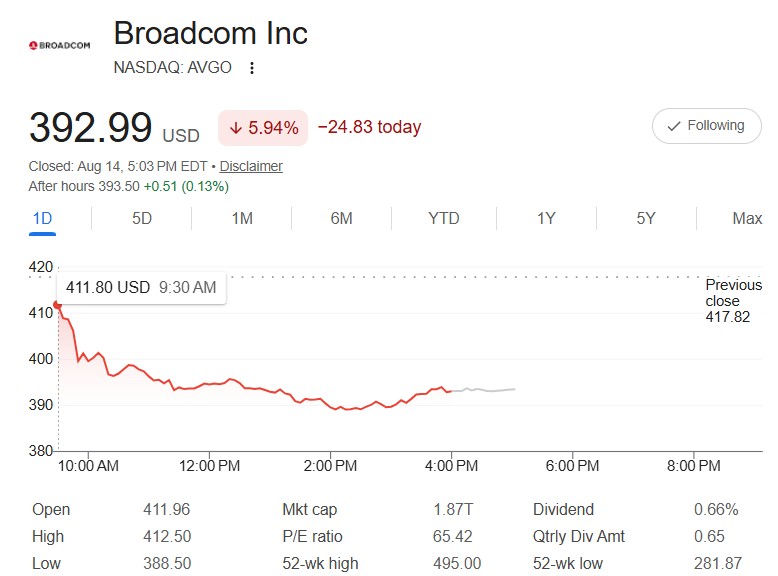
On August 14, Broadcom's stock closed down more than 5.9%, dropping nearly 7% at one point during the session. This sell-off was not driven by a sudden deterioration in performance, but rather by investors beginning to reassess the credit risks inherent in the "seller guarantee" model promoted by Broadcom through its AI XPV financing platform.
Meanwhile, NVIDIA is also pushing forward with a similar but larger-scale plan—reportedly partnering with six Wall Street institutions including Apollo, Blackstone, BlackRock, and Goldman Sachs, aiming to mobilize over $500 billion in third-party capital through a computing financing platform.
The moves by these two AI chip giants mark a new phase in AI infrastructure construction: as hyperscale cloud providers' capital expenditures approach their financial limits, chip sellers are actively stepping in. By providing guarantees to Special Purpose Vehicles (SPVs), they are securitizing expensive computing assets to leverage funds from the private credit market. Concerns have subsequently emerged in the market: Is this model an orderly extension of AI capital expenditure, or does it represent a new type of financial leverage risk?
Hyperscale Cloud Providers Hit Capital Expenditure Ceiling, Forcing Innovation in Financing Structures
According to Zhuifeng Trading Desk, citing a Barclays research report, the direct trigger for the new financing demands spawned by AI infrastructure construction is that hyperscale cloud providers are approaching the natural limit of their capital expenditures.
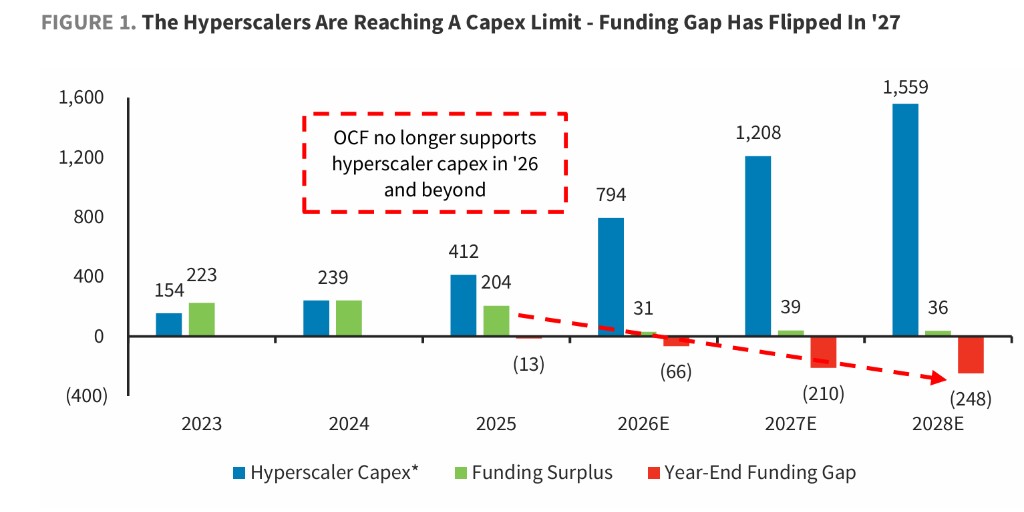
Barclays estimates that the combined capital expenditures of the five major hyperscale cloud providers—Amazon, Google, Meta, Microsoft, and Oracle—will exceed their operating cash flows in 2026, with the projected "funding gap" expected to widen to approximately $210 billion in 2027 and expand further in 2028. The report points out that hyperscale cloud providers face practical constraints in areas such as debt scale and power agreements. Bond issuance has expanded significantly, with capital expenditures exceeding 100% of operating cash flow for some companies.
At the same time, revenue growth for AI labs is extremely strong. According to Barclays' estimates, the Annual Recurring Revenue (ARR) of AI labs is expected to exceed $200 billion by the end of 2026, roughly twice and five times the previous forecasts for OpenAI and Anthropic, respectively. The tension between robust demand for computing power and the tightening capital expenditures of cloud providers has created conditions for the emergence of new financing structures.
In this context, an SPV structure that separates the financing of data center "shells" from computing assets is gaining traction. In 2026, the cost to build a 1GW data center includes approximately $15 billion for non-computing assets and about $35 billion for computing assets. The latter involves larger amounts, faster depreciation, and higher obsolescence risk, which are the core issues the new securitization structures aim to address.
Broadcom's XPV Platform: Chip Seller Provides a "Safety Net" for Private Credit
Broadcom's AI XPV Platform was officially launched in June this year, established jointly by Broadcom, Apollo, and Blackstone. The initial capital scheme scales to $35 billion, with the goal of supporting more than 20GW of AI computing capacity by 2028.
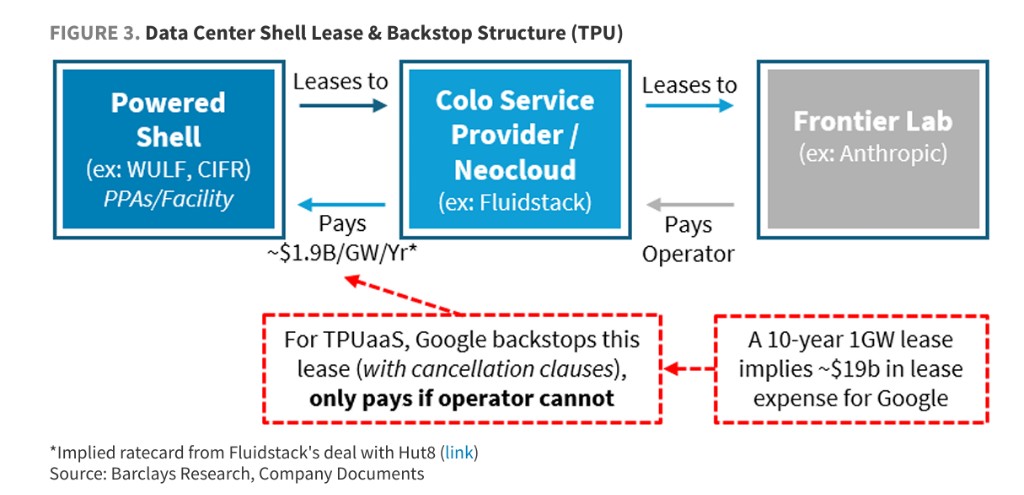
According to Barclays research, the basic logic of this financing structure is as follows: AI labs like Anthropic or emerging cloud providers (neoclouds) purchase TPU computing units commissioned by Google, co-designed by Broadcom, and manufactured by TSMC. These related computing assets are injected into an SPV; Broadcom provides guarantees for approximately 85% of the senior notes issued by the SPV, based on which Blackstone or other financial institutions provide investment-grade financing to the SPV; Anthropic then pays computing rent to the SPV, with neoclouds like Fluidstack responsible for cluster operations and management.
This structure holds clear strategic value for Broadcom: customers can rapidly deploy computing power without bearing large upfront capital expenditures, while Broadcom can leverage financial institutions' funds to amplify the market penetration scale of its XPUs, further expanding AI chip revenue.
However, Broadcom's provision of guarantees for debt in its capacity as a seller means its balance sheet will bear potential contingent liabilities as the platform scales. Barclays estimates that Broadcom's cumulative guarantee exposure could approach $739 billion by 2028.
NVIDIA's $500 Billion Plan: Similar Logic, Larger Scale
Just as Broadcom's XPV platform attracted market attention, NVIDIA announced a similarly structured but much larger plan this week. According to NVIDIA's announcement, it has reached cooperation intentions with Apollo, Blackstone, BlackRock, Goldman Sachs, Brookfield, and KKR to jointly establish an AI computing infrastructure financing platform. The goal is to mobilize over $500 billion in third-party capital, corresponding to the deployment of approximately 8 to 10GW of computing power.
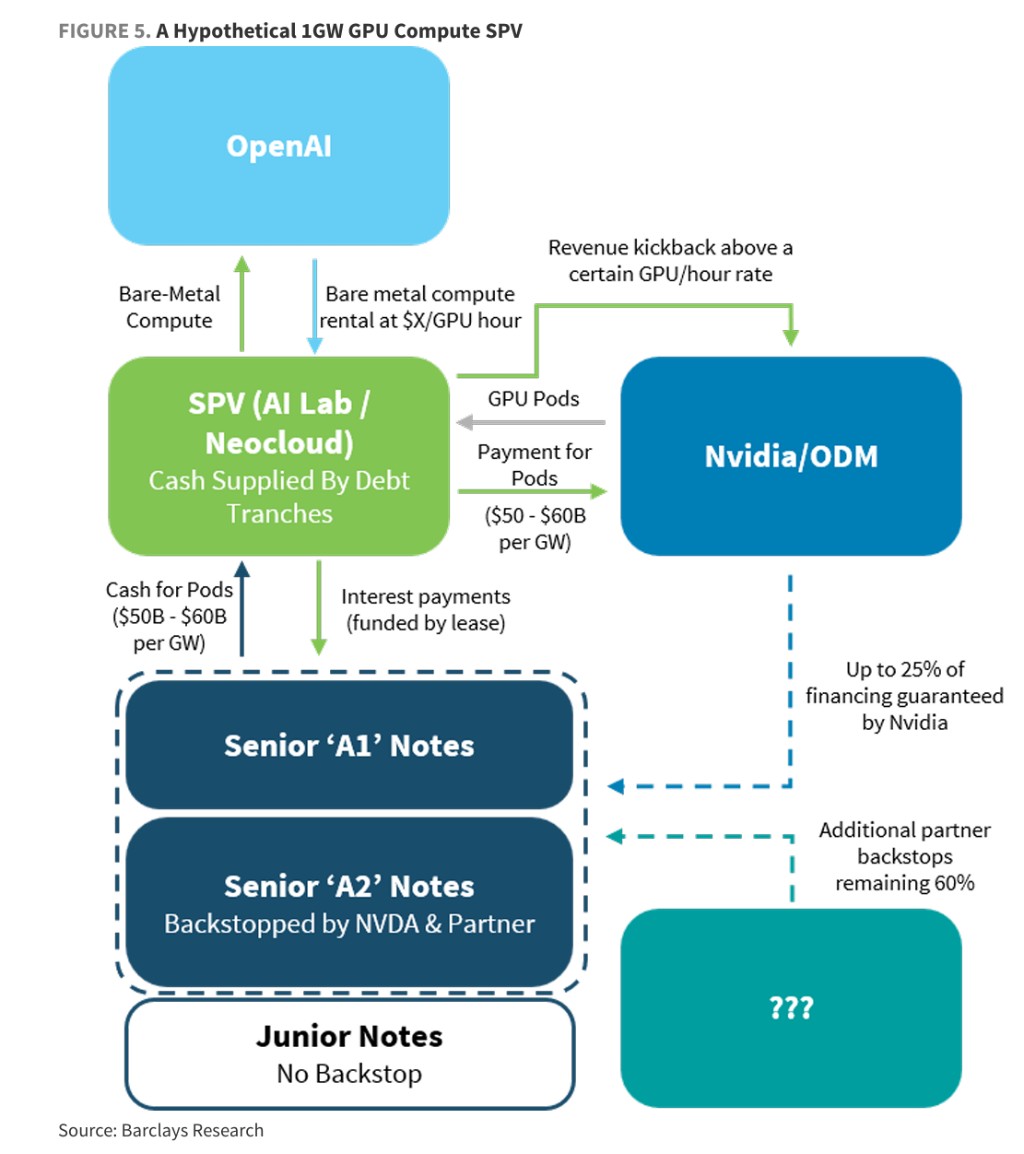
According to Barclays research, the basic structure of NVIDIA's platform is similar to Broadcom's: neoclouds purchase GPUs and inject them into an SPV, and NVIDIA provides guarantees for no more than 25% of the SPV's senior debt, thereby lowering financing costs; end-users like OpenAI rent GPU computing power from the neoclouds. Differing from Broadcom, NVIDIA retains the right to share in GPU rents that exceed preset hourly rates, in addition to providing guarantees.
Barclays expects the scale of this new AI securitization market to expand rapidly: accounting for approximately 20% of the industry's total capital expenditures in 2027, and potentially reaching nearly 50% by 2028 if progress goes smoothly. Meanwhile, related guarantee exposures are expected to gradually reflect in the financial documents of companies like Google, NVIDIA, and Broadcom—Google's procurement obligations disclosed in its 10-Q filing for the second quarter of 2026 had already reached $811 billion, with Barclays believing that about half of this can be attributed to data center guarantee exposures.
Market Repricing: Guarantee Scale, Chip Residual Value, and Lessee Concentration
Broadcom's sharp stock decline reflects the market's reassessment of the credit risks associated with the aforementioned model.
Bank of America analyst Tom Curcuruto pointed out that the current lessee concentration of the XPV platform is relatively high, with the first transaction primarily relying on Anthropic. Although OpenAI may become a future customer, other lessees have not yet been identified. If the platform's lessees are too concentrated, the relevant SPV will face significant pressure if a core customer encounters debt repayment issues.
Furthermore, the uncertainty surrounding the residual value of custom AI chips constitutes a potential risk. Unlike assets such as aircraft and servers that have mature secondary markets, Broadcom's custom XPUs lack sufficient liquidity support. In the event of customer default, there is significant uncertainty regarding the price and speed of disposing of the related chips, which will directly impact the safety cushion of SPV financing.
The Barclays research team offered a relatively positive assessment of these concerns in their report. The report argues that the high level of information transparency and interest coordination mechanisms among AI chip sellers, manufacturers, cloud providers, and AI labs make the probability of large-scale defaults relatively limited. Additionally, the high versatility of NVIDIA GPUs means that even if demand weakens in one area, computing resources can still be allocated to other scenarios with strong demand.
However, the deeper question currently most concerning the market is: If sustaining this boom in AI capital expenditure requires increasing amounts of debt financing and seller guarantees, how solid is the actual cash flow foundation of this growth? The answer to this question may continue to influence the valuation trajectory of the AI chip sector.
