


"AI-Style Financial Innovation": CDO vs. CCO = 2008 vs. 2026?
The current AI boom is not fundamentally a technology cycle, but a credit and real estate cycle driven by "Compute as Collateral" (CCO). NVIDIA and private giants are building a $500 billion financing platform to securitize and distribute risk. With the inflection point in the second derivative of capital expenditure growth among hyperscalers already visible, and key borrowers like OpenAI overly reliant on refinancing, this credit structure—highly isomorphic to the 2008 subprime crisis—is prone to rupture when growth slows
While the market continues to debate whether AI is replaying the 2000 tech bubble, a credit structure highly isomorphic to the 2008 subprime mortgage crisis has quietly been established.
This week, NVIDIA signed memoranda of understanding with Apollo, BlackRock, Blackstone, Brookfield, Goldman Sachs, and KKR, respectively, planning to jointly build a "compute financing platform" aimed at mobilizing over $500 billion in third-party capital. The core logic is that GPU chips can be placed into special purpose vehicles (SPVs) as collateral, with financing based on their expected future cash flows—a model identical to the financing of buildings and toll roads during the subprime crisis.
Meanwhile, CoreWeave completed its first public syndicated GPU-collateralized financing vehicle, DDTL 5.0, in May 2026, amounting to $3.1 billion, with underlying borrowers including OpenAI and Cohere. "Collateralized Compute Obligations" (CCO) have officially debuted.
The credit market is already pricing in plummeting token costs; yet the stock market remains intoxicated by the compute narrative. This divergence mirrors the period in 2006 when subprime default rates began to rise while housing prices still hit record highs. At that time, the market mistakenly believed that price declines were the start of the crisis, ignoring the true trigger: the inflection point in growth rate, not the growth rate itself falling to zero.
Core Misjudgment: Is AI a Tech Cycle or a Credit Cycle?
According to an analysis published by Groundbreaker in July this year, the essence of the current AI boom is not a technological innovation cycle, but a capital formation cycle driven by credit and structurally highly similar to commercial real estate. The two differ fundamentally in their rupture logic: tech cycles die from lack of product demand or competitive elimination, allowing for slow devaluation; credit and real estate cycles die from a slowdown in demand growth—demand does not need to collapse, only stop accelerating, for the structure to break.
This is the essence of the "second derivative." Let a core variable be S. The market focuses solely on its level (S itself) and its first derivative (growth rate); almost no one positions trades based on the second derivative—whether the growth rate itself is still accelerating. However, any financing structure that embeds continuous acceleration of growth as a premise dies precisely at the inflection point of the second derivative, not when the first derivative reaches zero.
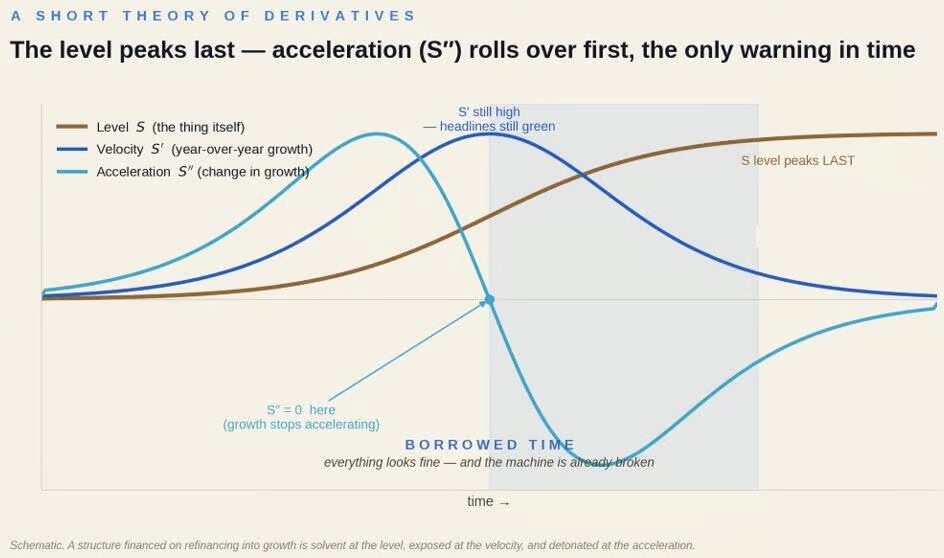
Looking at actual data, the ratio of capital expenditure to operating cash flow for hyperscalers has risen from about 30% in 2022 to about 60% in 2025, and is expected to reach 100% in 2026 according to consensus estimates—thereafter, every marginal investment in compute must rely on debt or equity financing. The acceleration of total capital expenditure (the second derivative) peaked in 2025 and turned negative: the growth rate narrowed gradually from about +81%, with acceleration shifting from approximately +30 percentage points to about -25 percentage points. The level value is still hitting record highs, and the speed remains positive, but the acceleration has reversed.
Compute as Collateral: Structural Analysis of CCO
NVIDIA's moves this week amplify the scale of the aforementioned architecture to $500 billion. Jensen Huang has explicitly stated that tech chips have become collateral. NVIDIA itself provides residual value guarantees of up to 25% for some transactions—identical to residual value guarantees in leveraged leases.
Every feature of this architecture is a compute-based replica of real estate development: data centers are physical collateral, take-or-pay contracts are leases, the remaining performance obligations (RPO) represented by contracts are loan ledgers, capital expenditure is the principal lent, and compute usage fees are debt repayments. When media interpret record-breaking capital expenditures by hyperscalers as "confidence in demand," they are actually reading lending scales—the market is celebrating loan growth but calling it revenue growth.
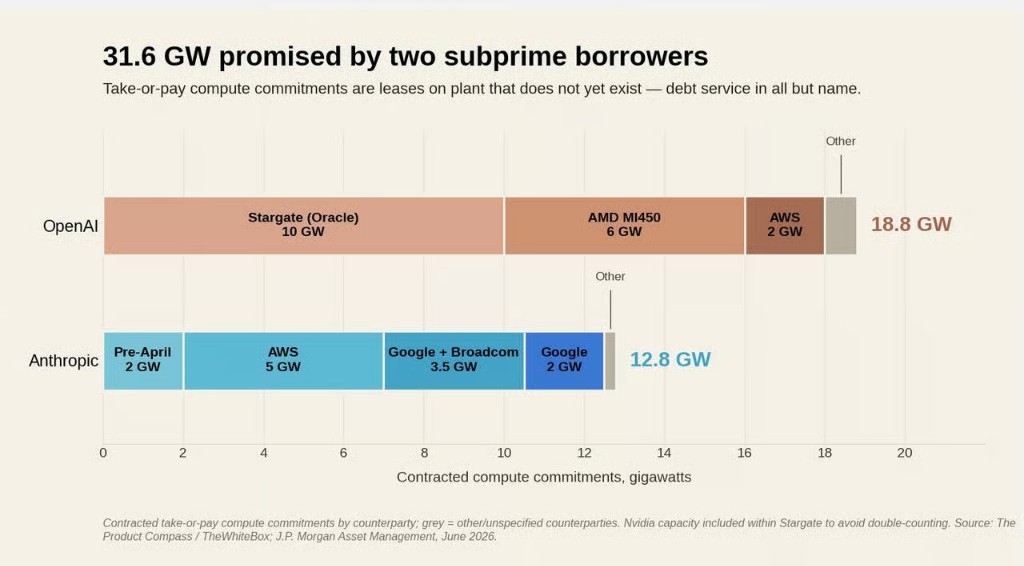
The "originate-to-distribute" mechanism is completing its loop. CoreWeave's DDTL 5.0 is the first publicly syndicated GPU-collateralized instrument, featuring a bankruptcy-remote financing subsidiary and having entered secondary market circulation. This means that risks linked to OpenAI's credit quality have left the original holders' balance sheets and spread to the broader credit market—highly overlapping with the distribution path of CDOs from 2005 to 2007.
"Naked Borrower": Credit Anatomy of OpenAI
Every subprime cycle has a borrower who can only repay old debts through refinancing and can never truly pay off the principal. In this cycle, that role is played by OpenAI.
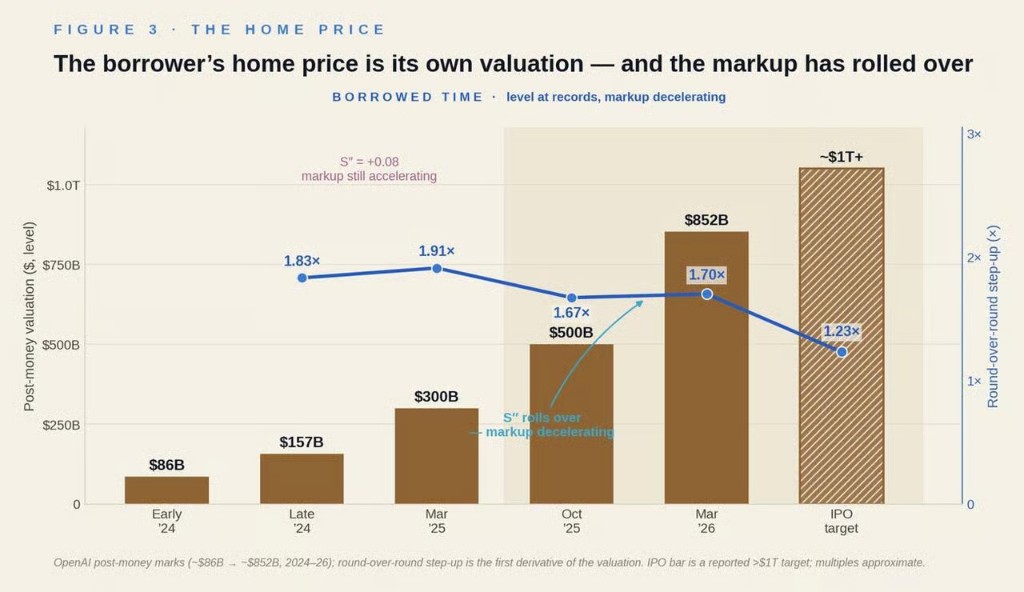
According to Groundbreaker's analysis, about 60% of OpenAI's revenue comes from the consumer side, which is more fragile than the enterprise side; its burn rate accounts for about 57% of revenue, with cumulative cash consumption expected to approach $115 billion by 2029, with no hope of achieving positive cash flow within this decade. Its solvency does not depend on profitability, but on each round of valuation being higher than the previous one—valuation appreciation itself is cash flow.
In terms of financing pace, OpenAI's valuation per round started at about $86 billion in early 2024, progressing through approximately $157 billion, $300 billion, and $500 billion, reaching about $852 billion by spring 2026; the corresponding step-up multiples for each round were 1.83x, 1.91x, 1.67x, and 1.70x, respectively, while the implied IPO step-up multiple is only about 1.23x—both the lowest in the sequence and the final hurdle that must be realized in the public market. The delay in IPO is a direct result of this arithmetic logic.
OpenAI has no true joint guarantor. Microsoft removed all structural support in April 2026—terminating revenue sharing, abandoning exclusivity, and waiving priority compute supply rights, retaining only a 27% equity upside; SoftBank is attempting to raise a $10 billion margin loan secured by its OpenAI stake, requiring personal guarantees, showing that even the co-signer needs a co-signer. In the view of Microsoft, the best-informed counterparty, OpenAI's credit is not worth underwriting—its behavior itself is a signal.
In contrast, Anthropic's credit structure is entirely different: about 80% of its revenue comes from the enterprise side, generating $1.70 in revenue for every $1 of compute, and it possesses substantial credit endorsements from Google and Broadcom for a TPU financing facility of about $35 billion, synthetically boosting its credit quality to investment grade. As frontier large model companies, the essential difference between the two is "secured credit" versus "naked borrower."
$2.1 Trillion Bill: Concentration Risk and Correlation Trap
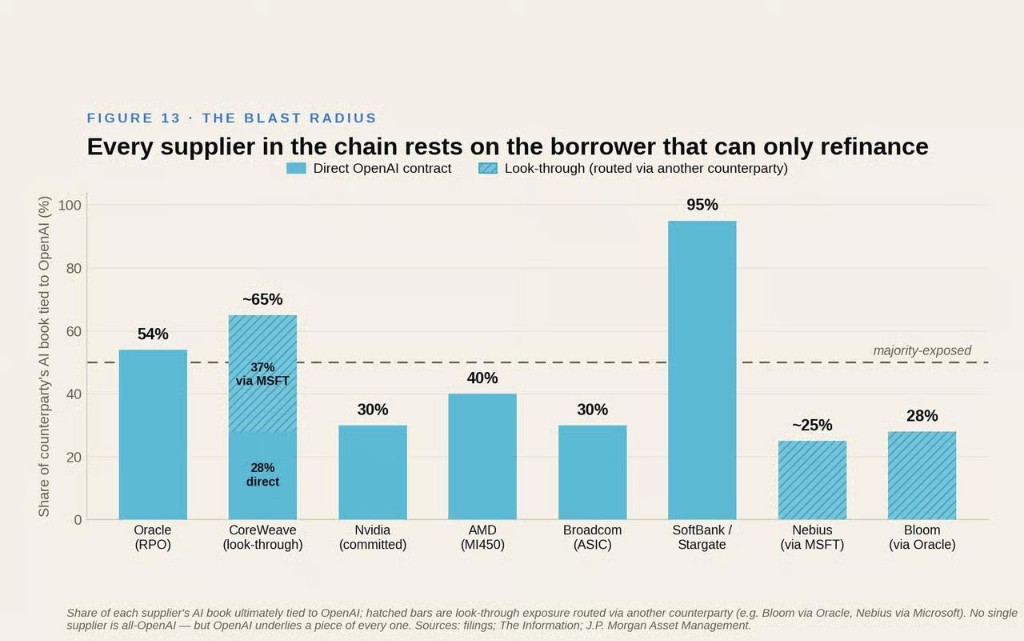
According to Groundbreaker's estimates, the combined RPO of the four major hyperscale cloud platforms is about $2.1 trillion, with about half—approximately $1.05 trillion—coming from OpenAI and Anthropic. These two account for about 49% of Microsoft's ledger; about 54% of Oracle's, with OpenAI alone accounting for about $300 billion; about 43% of Google's; and about 51% of Amazon's.

This is precisely the fatal structural root of high-rated CDO tranches in 2008: seemingly diversified thousands of mortgage loans were actually all exposed to the same macro variable—national housing price trends; when this variable turned, the correlation of all assets instantly shifted from zero to one. In this cycle, that macro variable is not housing prices, but whether OpenAI can complete its next round of financing. Reportedly, chip stocks fell when news emerged that OpenAI's IPO might be delayed from 2026 to 2027, confirming the existence of this transmission chain.
CoreWeave's DDTL 5.0 is securitizing this concentrated risk, highly correlated with OpenAI's credit quality, and distributing it to the market. The repayment of this instrument does not come from OpenAI's profits, but from OpenAI's ability to continue financing—the basis of which is the continued strengthening of the AI capital expenditure narrative.
Reversal of Nash Equilibrium: Who Blinks First?
The capital expenditure arms race is a Nash equilibrium, but conditional: it holds only if the market continues to reward every new compute investment, pricing it as a growth option. Once a hyperscaler announces a cut in capital expenditure and its stock price rises instead of falls—discipline is rewarded rather than punished—the entire game matrix is rewritten: spending shifts from a dominant strategy to a punished one, and restraint shifts from weakness to a signal for repricing. This reversal of equilibrium is not gradual, but a coordinated mutation; the first cutter to be rewarded will simultaneously provide cover and incentive for all other CFOs.
The head of Delta One trading at Goldman Sachs once stated bluntly:
"The first hyperscaler to signal that it can slow its spending pace may see its stock price rewarded (and severely damage semiconductor stocks). If this happens, others will follow. This is the ultimate reflexivity that halts the capital expenditure cycle—not a lack of demand, but investors judging that the marginal return on the next dollar of spending is no longer attractive."
Based stress tests from various firms, Google benefits from competitors' contraction due to its structural cost advantages in TPUs and a cloud business backlog exceeding $460 billion, so it will not move first; Oracle's capital expenditure accounts for about 86% of sales, its balance sheet is highly stretched, and its pressure will manifest as credit events rather than active choice; Amazon's free cash flow has turned negative and may be forced by capital markets; Meta's Mark Zuckerberg holds dual-class voting shares, and the company has no public cloud business selling compute externally, making its capital expenditure defense the weakest and exit the easiest, thus most likely to be the first to blink.
Rupture Sequence: Mechanism, Not Calendar
Groundbreaker outlines a clear rupture transmission chain:
(1) Final refinancing cannot be priced at the required step-up multiple—OpenAI's IPO delay is a signal;
(2) OpenAI cuts compute commitments to preserve cash, triggering defaults on take-or-pay contracts;
(3) Emerging compute cloud platforms (neoclouds) bear the brunt—CoreWeave, Lambda, etc., are essentially "carry trades" with no secondary cash flow, meaning inverted spreads imply structural insolvency; Oracle suffers concentration shocks, manifesting as impairments rather than payment stops;
(4) Credit market freeze: RPOs are repriced from forward demand to counterparty risk, GPU-collateralized notes cannot be rolled over, and the "originate-to-distribute" mechanism jams;
(5) Equity market suffers heavy losses—capital expenditure is repriced from an option to a cost, compressing valuations across the entire industry chain;
(6) Participants with the most capital acquire distressed data centers at low prices, taking over leases that must continue.
Notably, the analysis itself acknowledges uncertainty in the time window—new rounds of large-scale financing in private markets, bailout interventions by sovereign or strategic capital, and hyperscalers continuing to leverage their own books can all extend "borrowed time." However, according to Morgan Stanley's calculations, the total debt leverage of investment-grade hyperscalers has doubled within a year to about 1.8x, higher than the entire energy sector, excluding hundreds of billions in off-balance-sheet vehicles. Rating agencies have little room left.
Historical Echoes: Superposition of Triple Errors
Groundbreaker's argument concludes with three parallel errors, each digestible alone, but together precisely replicating the prerequisites of the last major credit event:
First, the market characterizes AI as a tech cycle, while its financing mechanism is a machine of credit and real estate cycles; second, the market focuses on level values and speed, while structural rupture occurs at acceleration; third, the market prices highly concentrated, single-borrower-dominated loan ledgers as diversified forward demand.
The lessons of 2008 have never been accurately remembered. Defaults did not begin when prices fell, but when prices stopped rising faster—just as subprime default rates quietly rose in 2006 while housing prices were still hitting record highs. This time, this financing architecture is designed with extreme precision, and it breaks precisely at that unwatched number: the acceleration of growth.
