


The Bank of Japan's July meeting minutes released hawkish signals: inflation upward risks intensify, with some members calling for "accelerated interest rate hikes."
The minutes of the July meeting released by the Bank of Japan on August 10 sent a hawkish signal, with several members warning of increasing inflation risks and calling for interest rate hikes that may occur faster than market expectations. As Tokyo's core CPI rose to 1.9%, the market bet on a 60% probability of a rate hike in September, leading to a stronger yen. Members emphasized that the focus of monetary policy has shifted to preventing inflation from rising, advocating for flexible interest rate hikes rather than adhering to a fixed pace
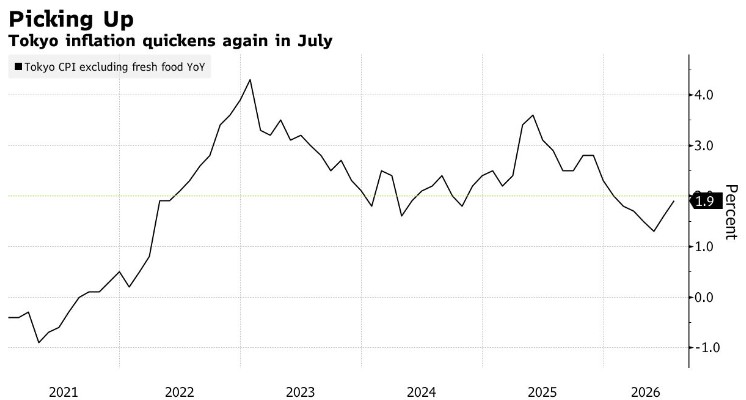
According to the Zhitong Finance APP, just ten days after the "hold steady" decision at the July interest rate meeting, the Bank of Japan released a meeting "summary of opinions" on August 10 that sent out hawkish signals far exceeding market expectations. Several policy committee members explicitly warned that the risks of rising inflation are intensifying and, in a rare move, directly called for "the pace of interest rate hikes may be faster than the market expects." As Tokyo's core CPI accelerated to 1.9% for the second consecutive month, market bets on the likelihood of a rate hike by the Bank of Japan in September surged from about 30% at the end of July to 60%, with the yen maintaining strength around 157.9.
Core Consensus: The Risk of Rising Inflation Can No Longer Be Ignored
The summary of opinions released on August 10 clearly outlines the collective anxiety within the Bank of Japan regarding the inflation outlook. Multiple committee members pointed out that the transmission of rising oil prices to consumer levels, the explosive growth in global demand for artificial intelligence, and Japan's expansionary fiscal policy driving demand are collectively creating significant upward pressure on the inflation outlook.
One committee member bluntly stated in the summary: "Given that the core CPI inflation rate is close to 2%, and that we should pay more attention to the risks of rising prices than before, it can be assumed that the pace of policy interest rate hikes will be faster than the market expects."
More notably, one committee member explicitly pointed out that the focus of monetary policy has fundamentally shifted—from the past goal of "raising the potential CPI inflation rate to 2%" to "avoiding further increases in the potential CPI inflation rate." This member further warned: "'Waiting risks' are no longer marginal. We must accelerate the pace of adjusting the degree of monetary easing."
"Not Bound by a Fixed Rhythm": A New Paradigm of Flexible Rate Hikes
The summary indicates that multiple committee members are calling for a more flexible interest rate hike strategy, which should not be constrained by a fixed rhythm of rate hikes. One member stated that the Bank of Japan "needs to adopt a flexible approach to respond to changes in overseas financial conditions and discuss the magnitude of rate hikes, rather than being bound by a certain rhythm of rate hikes."
Another member further pointed out that, given that global central banks are about to enter a rate hike phase, the Bank of Japan must demonstrate its determination to prevent inflation from spiraling out of control and "may consider allowing the pace of rate hikes to be faster than the market envisions."
Regarding discussions on the endpoint of rate hikes, one member clearly stated that even if the exact neutral interest rate cannot be determined, the Bank of Japan still needs to continue raising the policy interest rate "to lay the groundwork for normalizing monetary policy and ensure the flexibility of policy decisions." The Bank of Japan's official estimate range for the neutral interest rate is 1.1% to 2.5%, while the current policy interest rate is only 1%.
Internal Discrepancies: Takeda's Bold Move and the Expansion of Hawkish Consensus
Although hawkish voices dominated the summary, the actual voting results from the July meeting showed a divided pattern of 8 to 1— the only dissenting vote came from committee member Takeda, who advocated for an immediate rate hike of 25 basis points to 1.25% Moreover, some committee members warned that delaying interest rate hikes would bring "significant costs" and that there should be an "acceleration in the reduction of monetary easing." Other members suggested that "a flexible approach is needed to respond to changes in overseas financial conditions and to discuss the magnitude of interest rate hikes, rather than adhering to a fixed pace of rate increases." Reports from Kyodo News revealed that some members even directly suggested that "consideration could also be given to increasing the pace of rate hikes faster than the market expects."
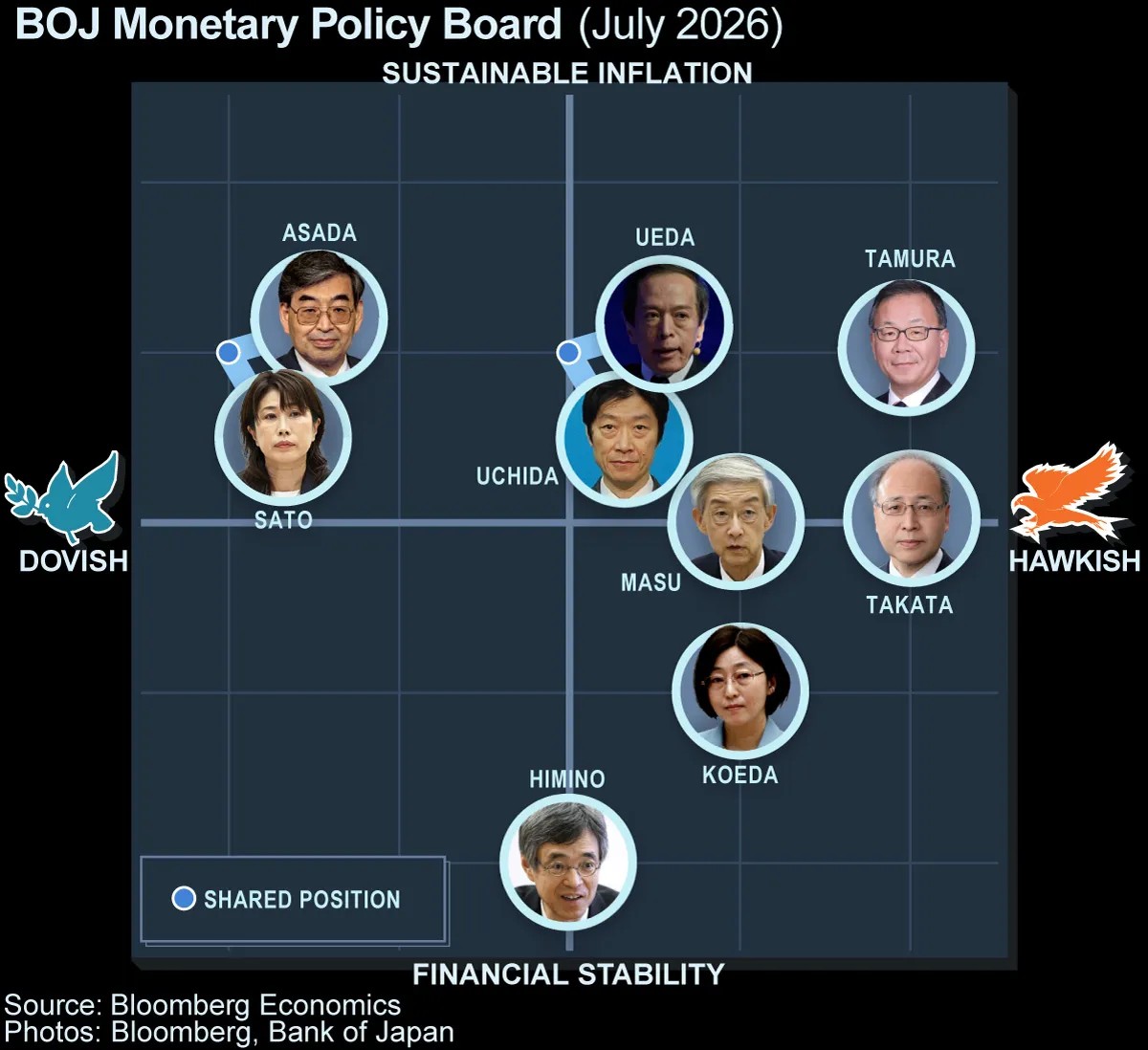
However, it is worth noting that the divergence in voting results does not fully reflect the weight of opinions. As the summary reveals, even those members who chose to remain inactive in the vote clearly expressed their high vigilance regarding inflationary risks and their recognition of the need for accelerated rate hikes.
Some members believe that the actual impact of previous rate hikes on the economy and prices should be observed, and that maintaining the current policy rate is more appropriate. One member specifically pointed out that although producer prices have risen due to increased import costs, consumer inflation remains below the 2% target.
Governor Kazuo Ueda has adopted an overall hawkish stance at the post-decision press conference, emphasizing that there are greater upside risks to the price outlook. He clearly stated, "If we believe that the financial environment remains accommodative, we may accelerate the pace of interest rate hikes."
Policy Background: Triple Pressure from Weak Yen, Oil Prices, and AI Demand
The three key terms that repeatedly appear in the summary—Middle East situation, AI-related demand, and exchange rate trends—reveal the policy dilemma currently faced by the Bank of Japan.
The weak yen is the most urgent transmission channel. In July, the yen fell to a 40-year low of 163 against the dollar, raising widespread concerns in the market about import-driven inflation and the stability risks of global financial markets. Last month, Japanese authorities intervened in the foreign exchange market with the assistance of the United States to support the yen.
Rising oil prices are also a key variable. Ongoing conflicts in the Middle East have continued to drive up energy import costs, while the explosive growth in global AI demand has further exacerbated price pressures related to electricity, equipment, and infrastructure. One member specifically pointed out that when considering the timing and pace of further rate hikes, a careful assessment of the combined impact of these three factors is necessary.
Market Reaction and Outlook: September Rate Hike Has Become a High Probability Event
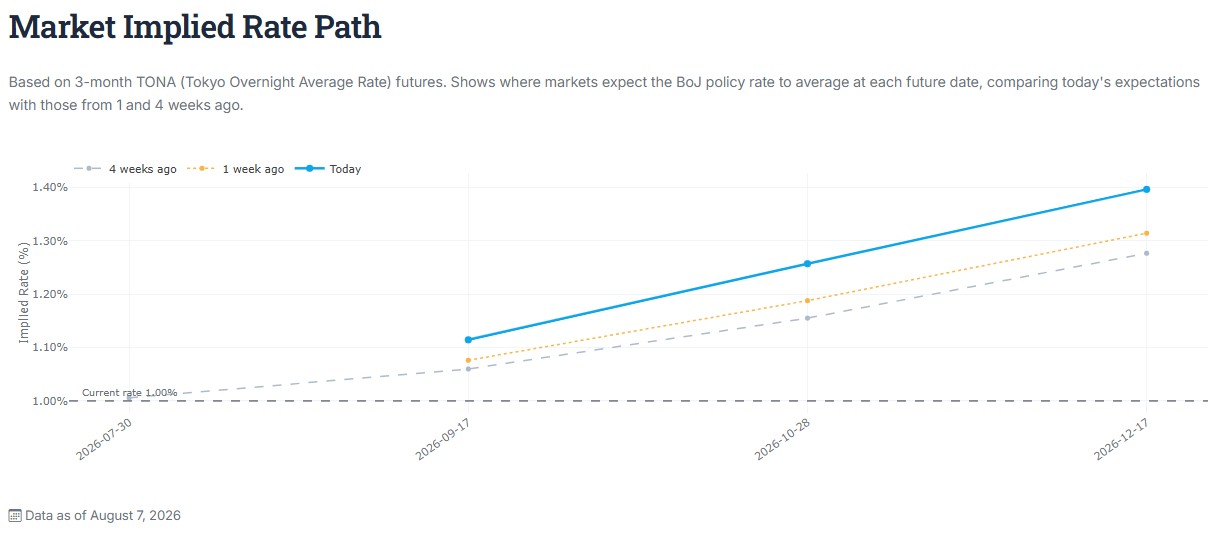
After the summary was released, the yen's exchange rate against the dollar remained basically flat, reflecting that the market has to some extent digested the hawkish signals. According to overnight swap market pricing, traders believe that the likelihood of the Bank of Japan raising interest rates in September is about two-thirds, and the probability of a rate hike in October has reached as high as 96%. Before the Bank of Japan's July meeting and the coordinated intervention with the U.S. on July 29, the market estimated the probability of a rate hike decision in September to be only about 30%.
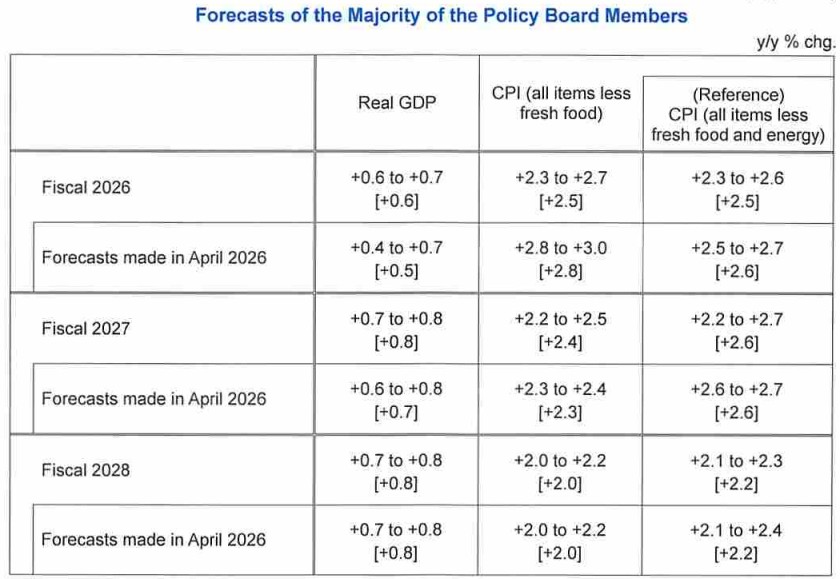
 It is worth noting that the Bank of Japan lowered its core CPI forecast for the fiscal year 2026 (from 2.8% to 2.5%) during the July meeting, but raised its GDP growth expectations (from 0.5% to 0.6%). This combination of "upward revision of growth and downward revision of inflation" has not weakened the central bank's hawkish stance—in fact, the central bank warned in its outlook report that the core inflation rate is likely to accelerate to "significantly above" 2% starting in the second half of the fiscal year 2026.
Although the July meeting kept interest rates unchanged, the central bank has clearly stated that future policy discussions will focus on the upside risks of inflation—this shift has been widely interpreted by the market as opening the door for further interest rate hikes as early as September. Kazuo Ueda made overall hawkish remarks at the post-decision press conference, emphasizing that there are greater upside risks to the price outlook.
However, the path to interest rate hikes is not without obstacles. The latest consumption data shows weak household consumption in Japan, which may significantly reduce the feasibility of a rate hike in September, pushing expectations further back. A Reuters survey shows that most analysts expect the Bank of Japan to raise rates again before December, possibly as early as October. The chief Japan economist at JP Morgan Securities believes that the central bank is likely to prefer waiting until October.
The current policy interest rate in Japan is 1%, just a step away from the lower limit of the neutral rate range at 1.1%. Committee members generally believe that the mechanism of wage and price mutual reinforcement is expected to continue, and the underlying inflation rate may reach a level roughly consistent with the 2% target in the second half of the fiscal year 2026 to the fiscal year 2027. Against this backdrop, the Bank of Japan is on the threshold of the most aggressive interest rate hike cycle since 1995—the next policy meeting on September 18-19 may become the starting point of this historic turning point
