


Bank of America Derivatives Team Warns: Severe Market Volatility Has Become the Norm, AI Bubble Risk Indicators Approach Dotcom Bubble Extremes
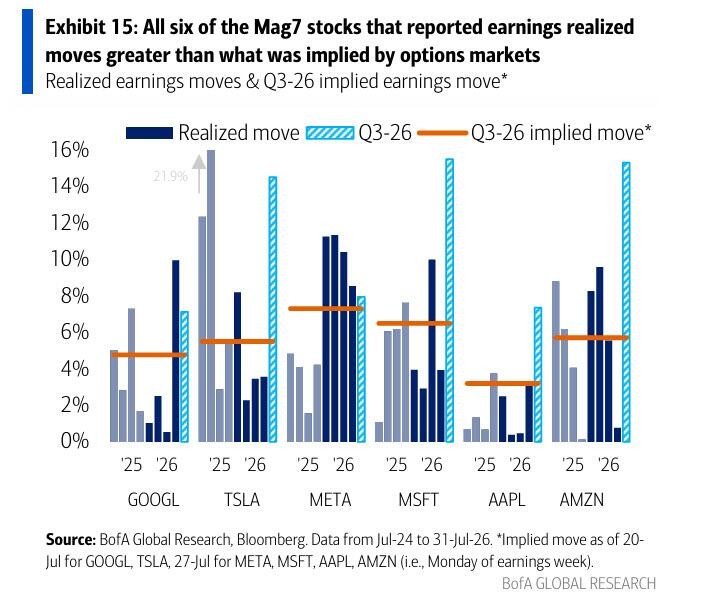
During last week's earnings season, the actual price swings of all six "Magnificent Seven" stocks that reported results significantly exceeded options market expectations, a first in the ChatGPT era. Bank of America's derivatives team warned that the AI bubble continues to accumulate, with market volatility approaching the historical extremes seen during the 2000 Dotcom Bubble. Rising macroeconomic uncertainty is providing strong support for volatility amid the current chaotic backdrop
Bank of America's derivatives team pointed out in its latest report that as the AI bubble continues to accumulate, market volatility and uncertainty are rising simultaneously at both macro and micro levels. Several key indicators have approached or neared the historical extremes seen during the burst of the Dotcom Bubble in 2000.
This week, Benjamin Bowler, head of Bank of America's derivatives team, noted in a report titled "Market Chaos Is a Feature, Not a Bug" that during last week's earnings season, the actual price swings of all six "Magnificent Seven" stocks that reported results on schedule significantly exceeded the implied expectations of the options market. This phenomenon marks the first occurrence in the ChatGPT era.
Meanwhile, the Federal Reserve's press conference last week failed to soothe the market, leading to a drastic reshaping of long-end U.S. Treasury yields and reigniting concerns about the Fed's credibility in fighting inflation. Coupled with the shock of yen intervention before the weekend, overall market volatility was further intensified.
Bowler warned that macroeconomic uncertainty continues to rise, and the current chaotic market background provides strong support for volatility. In response to this environment, Bank of America's derivatives team has positioned for both upside exposure to the AI trend and defensive hedging strategies, listing the purchase of S&P 500 Index put spread structures expiring in December 2026 as the preferred trade.
Tech Stock Fragility Intensifies, Dispersion Hits Record Highs
Last week's earnings season became a concentrated microcosm of market volatility. The actual event-driven price changes of the six "Magnificent Seven" stocks that reported earnings far exceeded options market pricing. Bank of America pointed out that this is a phenomenon never seen since the ChatGPT era, indicating that the market systematically underprices the volatility risk of tech giants.
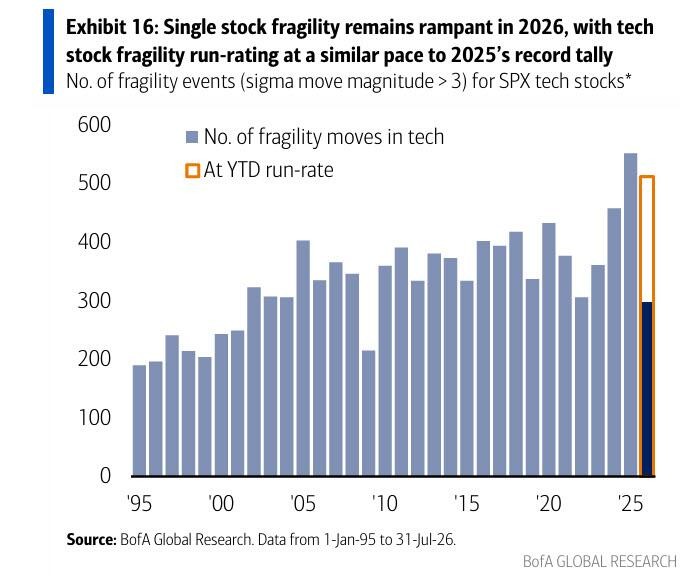
Idiosyncratic volatility events have refreshed historical records in 2025, and the frequency in 2026 currently remains roughly flat with 2025 levels. Bowler's calculations show that the number of fragility events among tech stocks in the S&P 500 is evolving along a trajectory to match the previous year's record.
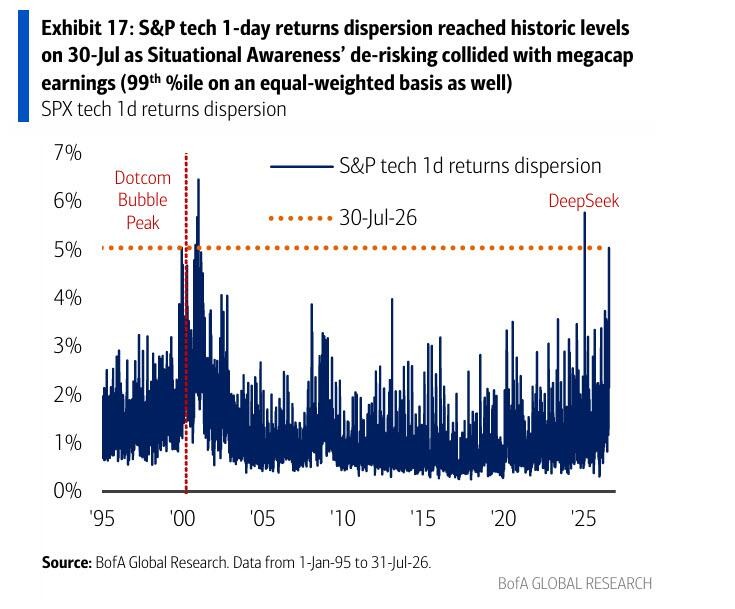
Of greater concern is the trend of dispersion in stock returns. In the current market structure characterized by low correlation and frequent sector rotation, the divergence in individual stock performance continues to widen, even within the technology sector.
On July 30, the single-day return dispersion of S&P 500 tech stocks approached historical highs. On that day, the position impact from the deleveraging operations of "Situational Awareness" coincided highly with the timing of tech giant earnings disclosures, jointly driving this extreme reading.
Macro-level disturbances resonated in sync last week. The Federal Reserve's press conference last week failed to provide sufficient policy certainty for the market, and investor concerns about inflation credibility drove a rapid repricing of long-end interest rates. Meanwhile, yen intervention before the weekend further superimposed market volatility, exacerbating already fragile market sentiment.
Bowler was direct in his report: Macroeconomic uncertainty appears likely to continue rising, and the current chaotic background constitutes extremely strong and persistent support for volatility.
As for how this AI bubble will ultimately end, Bowler admitted that no one can predict it. Historical experience shows that bubbles in their expansion phase can often withstand macro headwinds such as rising interest rates for a considerable period, but frequent short-term sharp declines and sector rotations are also common during these periods.
Bubble Risk Indicators: AI Era Replicating Dotcom Bubble Trajectory
Data from Bank of America shows that the degree of divergence in the performance of S&P 500 components is approaching historical highs seen during the Dotcom Bubble.
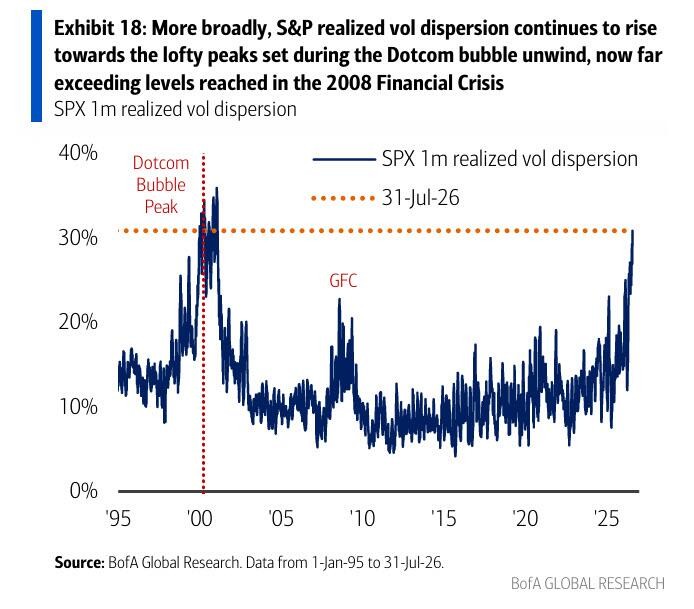
Bank of America had previously warned that as the AI bubble accumulates, the degree of divergence among U.S. stock components is likely to break records set during the Dotcom Bubble. After all, today's tech giants have larger market capitalizations, more violent stock price fluctuations, and far greater dominance over the broader market than in the past.
Bowler emphasized that using the 'degree of divergence between stock prices and volatility' to assess bubble evolution has proven reliable in the market over the past two years. This has led to increasing market recognition of Bank of America's 'Bubble Analysis Framework.'
As the AI boom continues to evolve, Bank of America uses its Bubble Risk Indicator (BRI) to measure the squeeze level of various sectors. The results show that the BRI risk value for the U.S. healthcare sector currently ranks highest among all S&P 500 industries and has surged to its highest point since September 2020, indicating that the sector faces an extremely high risk of correction/reversal in the near term.

Bank of America Strategy: Two-Way Positioning, Balancing Hedging and Upside
Under the above judgment framework, Bank of America's derivatives team has adopted a two-way strategy.
In the medium-to-long term, the team is bullish on buying call spread structures for Nasdaq 100 Index ETFs or Semiconductor ETFs, serving as AI trend upside positions with limited risk, to capture the next phase of upward opportunities in AI trading.
In the short term, Bank of America's derivatives team is pursuing a dual approach:
- On one hand, to guard against the continued impact of rotation into value stocks, the team follows the strategic main line, favoring the S&P 500 Equal Weight Index to outperform the market-cap-weighted index;
- On the other hand, given the high BRI in the healthcare sector and the rising risk of a trend change, the team prefers constructing short-term healthcare ETF call spreads. The team emphasizes that the currently historically flat Call Skew provides an excellent opportunity for low-cost position building.
Regarding the core tail risk of most concern to the market—tech stock declines dragging down U.S. stock indices—Bowler favors positioning for a "gradual decline" structure, including S&P 500 put spreads and Put Discount Options (PDOs). The rationale is that in the current low-correlation regime, the market tends toward rotation rather than indiscriminate selling, a trend that is particularly evident at the S&P 500 level.
