


Google's "Employee No. 30" Jeff Dean Departs with Three Scientists; Gurley Prescribes Replicating the Android Open-Source Playbook as the Last Resort
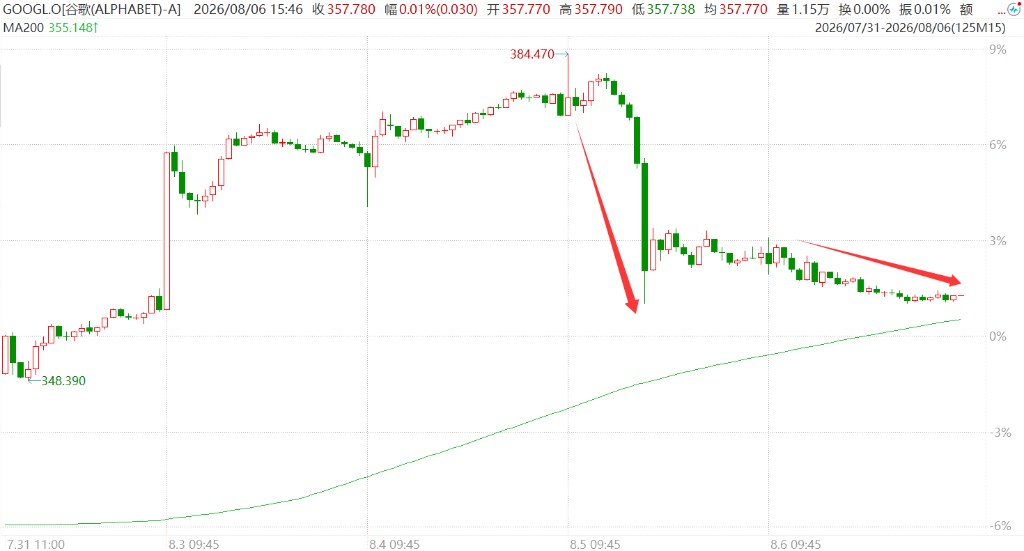
Chief Scientist Jeff Dean has departed alongside three top scientists. Prominent investor Bill Gurley believes Google is not out of the game, but its only path forward is to fully embrace open-source models. The combination of talent drain and sluggish model progress has deepened external doubts about Google's AI competitiveness. The news triggered a cumulative drop of over 5% in Google's stock price over two days
Google is undergoing a deep restructuring of its AI strategy. Executive departures, organizational adjustments, and shifts in frontier research directions are occurring simultaneously.
Wall Street News mentioned that Google's Employee No. 30 and Chief Scientist Jeff Dean announced his departure, ending a 27-year tenure, to co-found an automated scientific research company, Discovery Loop, with three top scientists.
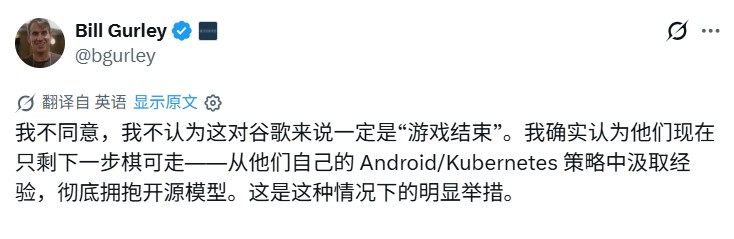
Prominent investor Bill Gurley publicly refuted the market's "game over" narrative on platform X, stating that Google is not out of the game, but its only choice is to "draw lessons from the Android/Kubernetes playbook and fully embrace open-source models."
CEO Sundar Pichai simultaneously announced that Koray Kavukcuoglu, head of technology at DeepMind, would take over daily operations and assume major responsibility for the development of Gemini 4. Former head Demis Hassabis will transition to the roles of Chairman of DeepMind and Chief Scientist at Alphabet.
At a time when the generational gap between Gemini and competing products has yet to be bridged, the mid-stream change in R&D leadership has injected new uncertainty into the project's progress. Following the announcement on Wednesday, Google's stock price plunged 4% on Wednesday and continued to fall by more than 1% on Thursday.
Four Veterans Depart Together; Discovery Loop Targets Scientific Automation
Dean joined Google in 1999 as Employee No. 30 and subsequently led the establishment of the Google Brain deep learning research team and the development of TPU chips.
The three scientists accompanying him also have impressive backgrounds:
- Oriol Vinyals was a key contributor to AlphaFold (2024 Nobel Prize in Chemistry);
- Quoc Le helped guide an AI system to achieve gold-medal-level performance in the International Mathematical Olympiad;
- Sanjay Ghemawat co-built Google's early distributed system infrastructure with Dean.
The core vision of Discovery Loop is to automate complex, multi-step experimental processes in science and engineering through machine learning models. Anthropic announced the launch of a similar project, Claude Science, this June.
Dean stated, "The scientific process involves proposing experimental ideas, setting up and running experiments, and evaluating results, which can be completely computerized." Alphabet will provide cloud computing resources and participate in the investment, with Radical Ventures and Khosla Ventures co-leading the seed round.
Explaining the reason for his departure, Ghemawat stated that Google's existing infrastructure is suitable for consumer applications and advertising systems, but the requirements for building infrastructure for the research field are "entirely different." Dean added that he began seriously considering this direction about five weeks ago.
DeepMind's Autonomy Shrinks as Focus Shifts to Gemini
The core logic behind Google's personnel adjustments is to embed AI research more closely into the company's overall strategy.
Hassabis's successor sees his title downgraded from CEO to Senior Vice President, a change in level implying that DeepMind will have less room for independent operation and will collaborate more closely with other business units within Google.
DeepMind was established in early 2023, at a time when Google was caught off guard by the emergence of ChatGPT, integrating its various AI research teams to cope with challenges from OpenAI and Anthropic.
Three years later, this structure has shown the need for adjustment. It is reported that Google had already begun concentrating AI researchers on the Gemini project, gradually de-emphasizing other priority directions. This high-level change is seen as a continuation and strengthening of this resource integration trend.
While explaining the executive changes, Pichai acknowledged that the company had areas needing improvement but provided no further details. Analysts believe that concentrating resources on Gemini is a direct move by Google to attempt to regain dominance in the programming agent and related application markets.
Hassabis himself stated that stepping down was to "focus on the macro vision." In addition to serving as Alphabet's Chief Scientist, his new responsibilities will involve devoting more energy to Isomorphic Labs, a drug development company he founded within Alphabet in 2021.
Open-Source Models: Gurley's "Last Card"
Tae Kim stated on platform X that Jeff Dean and Demis Hassabis were Google's two most important AI executives:
Jeff is leaving, and Demis is stepping down from his leadership role in DeepMind's daily operations. Game over.
Gurley publicly refuted this:
I disagree. I think they have only one card left—to draw lessons from their own Android/Kubernetes playbook and fully embrace open-source models. This is the most obvious choice.
Pressure from talent loss continues to intensify. It is reported that Noam Shazeer, co-author of the transformer architecture paper, recently left Google to join OpenAI; John Jumper, a co-recipient of the Nobel Prize for AlphaFold, has moved to Anthropic.
The continuous exodus of high-end AI research talent, combined with sluggish progress in frontier models, has deepened external doubts about Google's AI competitiveness. Some new models under Meta have surpassed Gemini in several benchmark tests, further compressing Google's lead.
