


Is the Tech Correction Nearing Its End? How to Allocate for the Next Phase?
Sinolink Securities believes that as disruptions such as deleveraging in South Korea, hawkish expectations from the Federal Reserve, and geopolitical risks in the Middle East ease, the global correction in AI assets since June is drawing to a close. The investment logic for AI is shifting from being driven by "capital expenditure" to being driven by "earnings realization." Future allocation should focus on companies that can continuously improve return on investment and convert computing power investments into revenue, profits, and cash flow, rather than those merely expanding capital expenditure
The correction sweeping through global AI assets since June is gradually nearing its end, but market recovery does not mean AI trading will return to the previous phase of "focusing solely on capital expenditure."
Song Xuetao, macro analyst at Sinolink Securities, pointed out in a report released on August 4 that the four major factors that had previously suppressed valuations of global tech stocks—deleveraging in the South Korean market, hawkish expectations from the Federal Reserve, concerns over returns on capital expenditure by cloud service providers (CSPs), and geopolitical risks in the Middle East—have all seen marginal relief. As the latest earnings reports from Microsoft and Amazon continue to validate strong AI demand, the market is paying more attention to whether capital expenditure can truly translate into revenue and profits, rather than simply chasing the scale of investment.
The report argues that after this round of adjustment ends, the investment logic for AI will gradually shift from being driven by liquidity and risk appetite to being driven by earnings realization. Excess returns in the future supply chain are more likely to come from companies that can continuously improve return on investment and effectively convert computing power into cash flow, rather than those merely expanding capital expenditure.
Deleveraging Pressure in South Korea Significantly Eased
The South Korean market was one of the most volatile markets during this round of global AI asset adjustments. Since the high point on June 19, the KOSPI index once accumulated a drawdown of nearly 40%, with concentrated liquidation of leveraged funds amplifying the contraction in risk appetite for global tech stocks.
However, the report believes that the most intense phase of this deleveraging has passed.
On July 29, the KOSPI index found support after approaching its 250-day moving average. Meanwhile, the scale of single-stock leveraged ETFs related to Samsung Electronics and SK Hynix shrunk significantly. As of July 30, the assets under management (AUM) of the "7709" and "KODEX" products had fallen by 83% and 70% respectively from their peaks, basically returning to the levels seen in April and May this year.
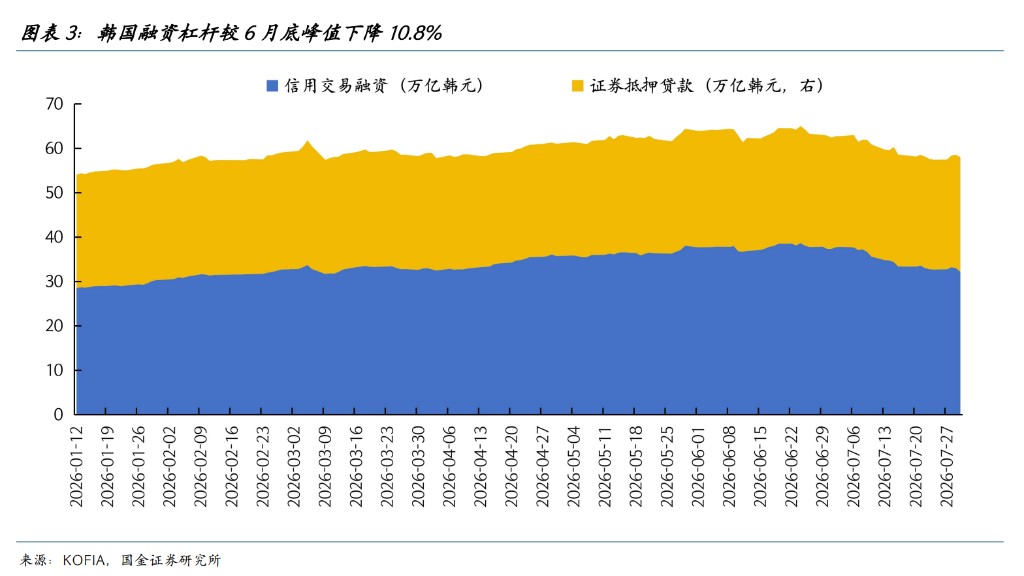
Retail margin leverage also continued to decline. According to KOFIA data, as of July 30, the balance of retail margin financing in South Korea (credit transaction financing + securities collateralized loans) dropped to 57.97 trillion won, a decrease of about 10.8% from the high on June 24, approaching the level seen in early April.
In addition, Choi Tae-won, Chairman of the SK Group, bought SK Hynix shares in his personal capacity for the first time on July 30, purchasing 3,620 shares in the open market for approximately 4.79 billion won. This was also seen by the market as sending a positive signal regarding the long-term prospects of the semiconductor industry.
Hawkish Disruptions from the Fed Cool Down, Rate Hike Expectations Continue to Fall
The report believes that the market was previously concerned that rising oil prices and supply-side inflation brought about by AI might push the Federal Reserve to turn hawkish again, but this risk is currently weakening.
Although the Federal Reserve Chair recently reiterated the 2% inflation target in his speech, he did not further strengthen hawkish guidance, and the overall market interpretation leaned towards "hawkish in name, dovish in reality." From a market performance perspective, the yield on 2-year US Treasury bonds fell, reflecting that investors' concerns about further tightening of policy have cooled.
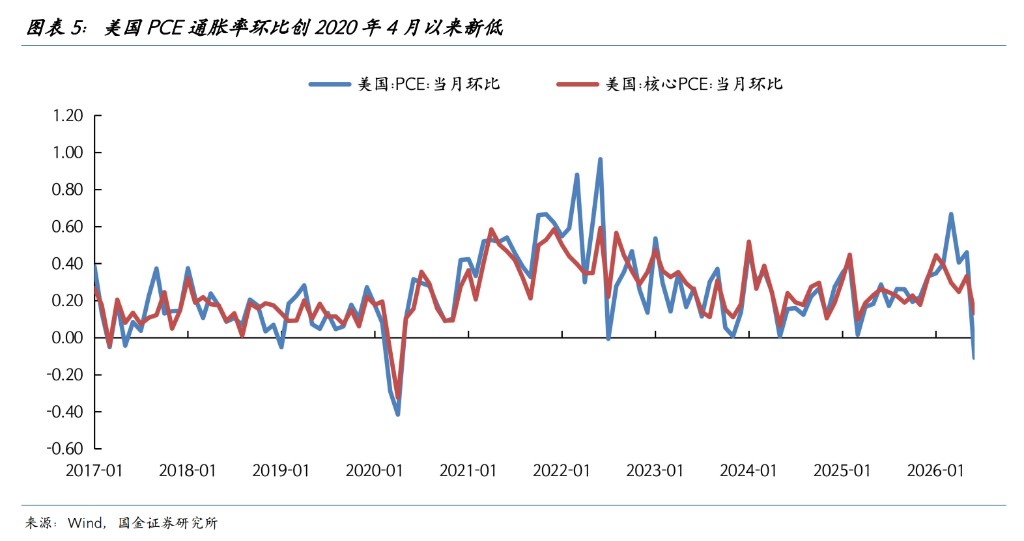
At the same time, recent economic data released in the United States has further reinforced this judgment. The initial estimate of the quarter-on-quarter annualized growth rate of US GDP in the second quarter was 1.5%, lower than the market expectation of 2.1%; the PCE rose by 3.7% year-on-year in June, but fell by 0.1% month-on-month, turning negative for the first time in six years; core PCE rose by 3.3% year-on-year, with a month-on-month growth of only 0.1%, also lower than market expectations.
Sinolink Securities believes that the possibility of further rate hikes by the Federal Reserve within the year continues to decrease, mainly due to the following reasons: long-term interest rates remaining at high levels have already achieved a certain tightening effect; tech companies have become more sensitive to interest rates after their cash flow safety cushion decreased; and the potential deflationary effect brought about by AI improving production efficiency also helps to strengthen expectations for future policy easing.
Middle East Risk Premium Begins to Recede
In addition to liquidity factors, the situation in the Middle East was also an important variable suppressing global risk assets in July.
The market was previously concerned that conflicts between the US and Iran might escalate and affect key energy channels such as the Strait of Hormuz, thereby pushing up oil prices and suppressing tech stock valuations through the chain of "rising oil prices – rebounding inflation – high interest rates."
However, signs of easing emerged in August. The report pointed out that on August 2, Trump signaled a willingness to stop further military actions and promote negotiations, and the market re-entered its usual "TACO (Trump Always Chickens Out)" trading logic. According to Xinhua News Agency, US President Trump stated in an interview with Fox News on the 4th that the Strait of Hormuz would be opened "soon," otherwise Iran would suffer a "severe strike."
Sinolink Securities believes that after experiencing several similar events, investors have gradually adapted to Trump's negotiation pattern of "pressuring first, then easing," and the impact of geopolitical events on market risk appetite is weakening, with the release of risk premium significantly faster than in previous rounds of conflict.
Market Begins to Reassess the Quality of AI Capital Expenditure
The report believes that the core contradiction of the AI sector's adjustment over the past month was not a weakening of AI demand, but rather the market beginning to reassess the return on investment (ROI) of capital expenditure.
The latest earnings reports from Google, Microsoft, and Amazon all showed that AI demand and cloud business growth remain strong, but the market's feedback on the three companies showed significant divergence. Among them, Google further raised its fiscal 2026 capital expenditure to $195–205 billion, but its stock price came under pressure because it failed to fully prove that model advantages and its self-developed system could bring higher investment returns.
In contrast, although Amazon also continued to expand capital expenditure, putting pressure on free cash flow, the company more clearly demonstrated the returns brought by AI infrastructure and cloud business, so the market reaction was significantly more positive. Microsoft maintained a relatively restrained pace of capital expenditure and continued to deliver cloud business growth, receiving positive feedback from the market.
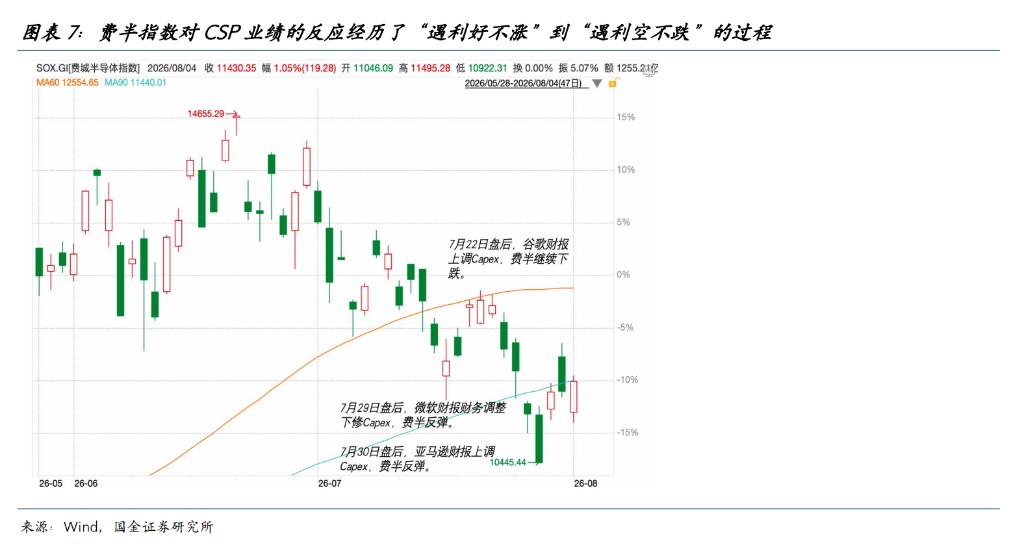
The report believes that this means the market's focus has shifted from "the more capital expenditure, the better" to "whether capital expenditure can bring profit growth." At the same time, the reaction of the Philadelphia Semiconductor Index to the performance of cloud providers has evolved from the previous "good news doesn't lift prices" to gradually becoming "bad news doesn't drop prices." The report believes that this usually means market sentiment is approaching the bottom area.
AI Investment Enters the Second Half, Earnings Realization Becomes the Main Theme
Sinolink Securities believes that after this round of adjustment ends, AI investment will officially enter the earnings verification stage. In the future, whether large cloud providers continue to maintain high-intensity capital expenditure will depend on the revenue growth of model companies, enterprise customer penetration, the degree to which AI Agents transform production processes, and whether AI business can cover the continuously expanding infrastructure depreciation and operating costs.
The report divides future AI investment opportunities into three levels:
First is large Beta, coming from continuous breakthroughs in model capabilities. If AI capabilities further improve and drive revenue growth beyond expectations, the return on investment for the entire industry chain is still expected to continue improving.
Second is small Beta, coming from the redistribution of profits in the industry chain. As bargaining power changes, the profit landscape between the US and South Korea, as well as between upstream and downstream enterprises, may continue to adjust.
Third is Alpha, coming from structural opportunities within the industry chain, including cost reductions, efficiency improvements, improved competitive landscapes, and excess returns brought about by the gradual maturation of business models in some niche segments.
