


SpaceX Earnings Call Outlook: Trillion-Dollar Revenue Target May Be Achieved Early, Chips Locked to NVIDIA, AI Satellite Starmind Launches Next Year
SpaceX expects computing power to exceed 2 GW by the end of this year and potentially reach 5-10 GW by the end of next year; V3 satellite performance will be 10 times that of V2, with launch quantities also 10 times higher; a standalone Starlink Mobile service will be launched by the end of next year; Grok 4.6 will be released next week, Grok 4.7 in three to four weeks, and Grok 5 is planned for release within this year. To be updated
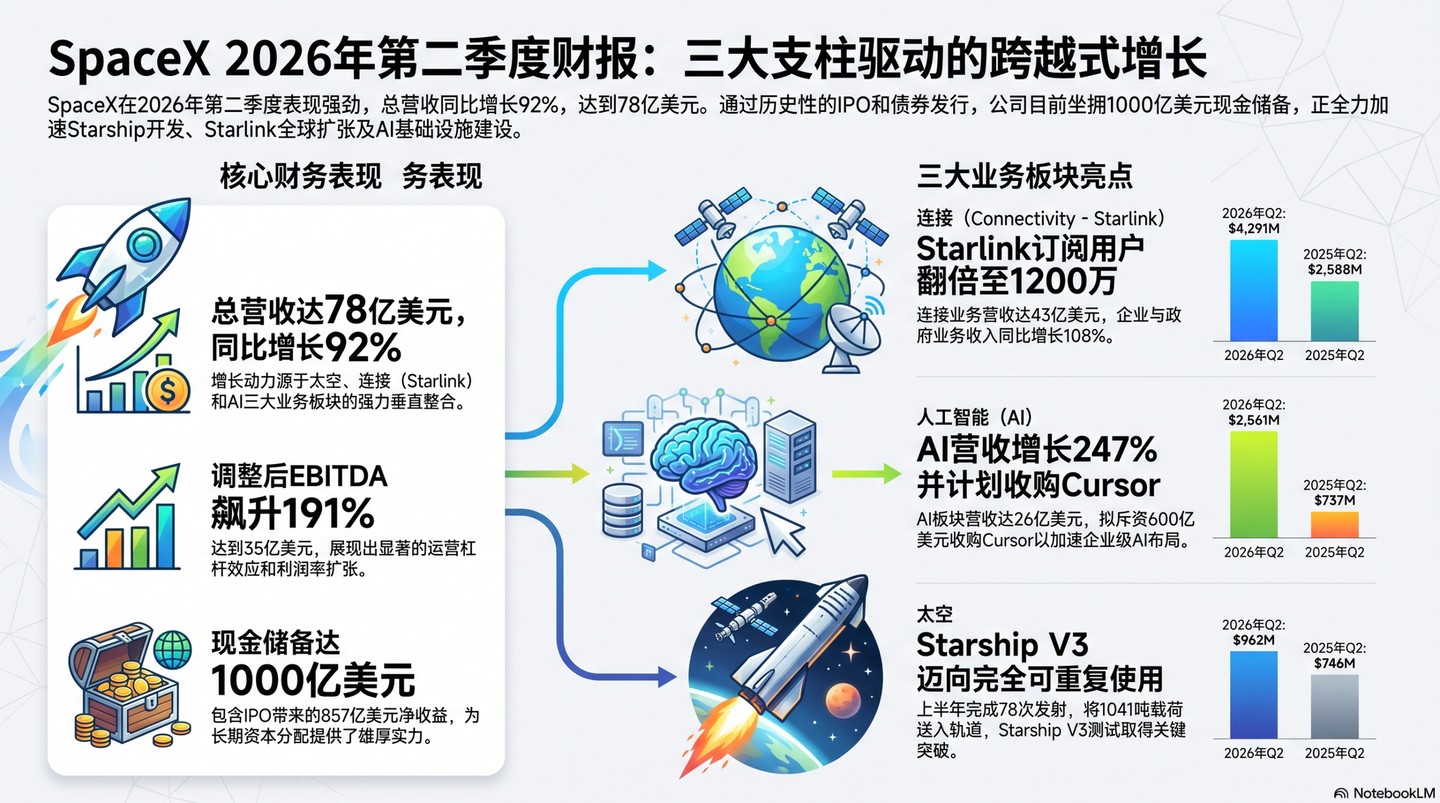
During the earnings conference call after the U.S. stock market close this Tuesday, SpaceX executives did not provide much specific financial guidance, but they predicted that the company's annual recurring revenue would reach at least $100 billion by the end of this year. CEO Elon Musk has advanced the target date for achieving $1 trillion in revenue by one year.
Musk stated that SpaceX's current goal is to achieve $1 trillion in revenue by 2030, rather than the previous target of 2031. He also mentioned that achieving $1 trillion in revenue by 2029 is not impossible.
During the call, SpaceX hinted that capital expenditures would remain high this year. Chief Financial Officer Bret Johnsen indicated that capital expenditure levels in the next two quarters might be comparable to those in the second quarter.
Regarding chips and suppliers, Musk clearly stated that SpaceX exclusively uses NVIDIA GPUs for its chip supply, and the company will build its AI services entirely based on NVIDIA systems in the future. SpaceX expects to secure a "significant share" of NVIDIA's total GPU supply next year.
He said, "We believe the Vera Rubin architecture is the best architecture and the most outstanding AI computer; we highly value our close cooperation and partnership with NVIDIA at multiple levels. Therefore, we will exclusively adopt NVIDIA's technology."
SpaceX expects to have computing power exceeding 2 gigawatts (GW) by the end of this year, and by the end of 2027, the computing power scale could be between 5-10 GW.
In terms of aerospace operations, Musk stated that SpaceX will send the first batch of V3 Starlink satellites into orbit during the next Starship flight. The performance of Starlink V3 satellites is expected to be 10 times that of the previous generation V2, and SpaceX expects the number of V3 satellites launched to also be 10 times that of V2. It is "not impossible" for Starlink to provide internet services to most parts of the world within ten years.
Musk stated that SpaceX plans to deploy NVIDIA's Vera Rubin NVL72 rack-level systems both on the ground and in space. The first batch of "Starmind" AI satellites, optimized for the Vera-Rubin computing platform, will begin launching next year.
Regarding connectivity business, SpaceX Chief Operating Officer Gwynne Shotwell stated that in the second quarter, SpaceX had established "Starlink Mobile" partnerships with international carriers such as SoftBank, NTT DoCoMo, and New Zealand's Spark; in the future, SpaceX aims to "secure a considerable number" of customers from the three major mobile telecommunications operators.
Shotwell confirmed that SpaceX plans to acquire ground spectrum and infrastructure for the Starlink Mobile business and expects to launch a standalone Starlink Mobile service by the end of next year.
In terms of large AI models, Musk revealed that token consumption doubled after the release of Grok 4.5 in July. Grok 4.6 is expected to be released next week, Grok 4.7 will be released in three to four weeks, and Grok 5 is planned for release within this year. SpaceX executives also mentioned that token consumption tripled after the release of Grok 4.5 in July.
Regarding mergers and acquisitions, Musk confirmed that SpaceX's acquisition of the AI programming tool Cursor will be completed soon. He and other SpaceX executives did not disclose the possibility of a merger between SpaceX and Tesla during the conference call.
