


On August 5th, the top 20 trading volumes in the US stock market: SpaceX released its first financial report after the IPO, with revenue growing 92% year-on-year, far exceeding expectations
On August 5th, the top trading volumes in the US stock market: Micron Technology ranked first, with Bank of America reiterating a buy rating; NVIDIA ranked second, releasing the autonomous driving open-source model Alpamayo 2 Super and collaborating with SpaceX; Palantir ranked third, with its stock price soaring due to strong Q2 earnings report
On Tuesday, Micron Technology, the top stock by trading volume in the U.S. market, rose 7.62%, with a trading volume of $32.263 billion. Bank of America reiterated its buy rating on Micron with a target price of $155, stating that the recent stock price sell-off presents an "excellent buying opportunity." The bank expects memory chip prices to return to normal levels by 2027-2028 and noted that the company's fundamentals remain strong. Bank of America predicts earnings per share of about $150 for fiscal year 2028, and around $100 in a pessimistic scenario, still far above the previous cycle peak of about $12.
NVIDIA, the second highest, rose 2.56%, with a trading volume of $27.296 billion. Reports on Tuesday indicated that SpaceX is collaborating with NVIDIA to develop the "Starmind AI1" satellite computing payload.
Additionally, the company's CEO Jensen Huang posted on X, announcing the official launch of Alpamayo 2 Super on Tuesday, which is NVIDIA's cutting-edge open-source inference model aimed at the autonomous vehicle (AV) sector.
In addition to basic visual perception, Alpamayo also possesses the ability to understand and reason about complex worlds—engaging in deep thinking before taking action. It serves as a powerful core pillar for a vast long-tail market of autonomous machines, including self-driving taxis, trucks, shuttles, freight logistics vehicles, tractors, and various mobile robots, empowering billions of autonomous machines in the future. To allow development teams to thoroughly review, fine-tune, and deploy the model, NVIDIA has chosen to open it for commercial use under the OpenMDW-1.1 license—because NVIDIA firmly believes that open-source models can make technology safer and more reliable. The next wave of artificial intelligence is robotics, and autonomous driving is the starting point for all of this.
Palantir, ranked third, surged 29.45%, with a trading volume of $27.227 billion. Under the leadership of CEO Alex Karp, Palantir's stock price soared after the company released a strong second-quarter earnings report on Tuesday.
Palantir Technologies' stock price rose significantly in early trading on Tuesday, following the company's strong quarterly report, which led some analysts to believe it is gaining an edge in the AI competition within the software sector.
The data analytics company exceeded expectations in its second-quarter report with accelerating revenue growth and strong demand. Deutsche Bank analyst Brad Zelnick stated that this "further reinforces our view that Palantir's operations are several steps ahead of other software companies in translating AI into customer value."
Zelnick wrote in a report to clients that while many application software providers are still figuring out how to integrate AI into their products, "Palantir increasingly resembles a time traveler, having arrived at an AI future that other companies are still aspiring to."
AMD, ranked fifth, rose 7%, with a trading volume of $22.472 billion. AMD announced its earnings after the U.S. market closed on Tuesday, reporting second-quarter revenue of $11.54 billion, compared to market analysts' consensus estimate (IBES) of $11.28 billion. The company expects data center sales to accelerate in the second half of 2026 Ranked 7th, SanDisk rose 10.84%, with a transaction volume of $20.072 billion. On Tuesday, August 4, 2026, major storage chip manufacturer SK Hynix and SanDisk jointly released the first standard specification for High Bandwidth Flash (HBF) at the "FMS 2026" flash memory summit, along with a complete performance specification, ecosystem collaboration, and mass production roadmap.
HBF is defined as a new storage tier that sits between High Bandwidth Memory (HBM) and Solid State Drives (SSD). This technology combines the high-speed data transfer capabilities close to HBM with significant capacity expansion enabled by NAND flash memory. In the context of the accelerating adoption of AI inference applications and the continuous surge in data processing scale, HBF has garnered significant attention in the industry for its ability to meet both bandwidth and capacity expansion needs.
Ranked 10th, SpaceX rose 9.43%, with a transaction volume of $15.601 billion. Following its record IPO in June, SpaceX released its first financial report as a publicly traded company, with second-quarter revenue far exceeding market expectations.
In specific numbers, the company reported second-quarter revenue of $7.81 billion, compared to an expected $6.93 billion. The loss per share was $0.09, while analysts had an average expectation of a loss of $0.26 (this metric is not directly comparable). SpaceX stated that second-quarter revenue increased by 92% compared to $4.1 billion in the same period last year.
This marks the first time Elon Musk's reusable rocket manufacturer has faced Wall Street in this capacity, amid tense investor sentiment. Since opening at $150 on June 12, SpaceX's stock price has dropped 16%, and as of Tuesday's close, its market value has significantly shrunk.
SpaceX reported a loss of $4.9 billion last year, primarily due to large-scale investments in artificial intelligence infrastructure. The company merged with Musk's xAI in February this year, claiming a vision to build data centers in space. However, even with its launch business securing large contracts from NASA, it is still operating at a loss.
Ranked 11th, Google's Class A shares rose 1.11%, with a transaction volume of $13.325 billion. Barclays Bank's latest report indicates that if Google adjusts its AI chip business model, its Tensor Processing Units (TPU) could generate up to $252 billion in revenue by 2028. Barclays believes that as one of the most widely used customized AI chips in the industry, if Google collaborates with asset management firms Blackstone, Apollo Global, and chip design company Broadcom to establish a joint venture, it could further expand the TPU ecosystem.
Currently, Google's AI chip business model does not directly sell AI chips to data center operators like CoreWeave, as NVIDIA does, but instead provides TPU computing power services through its Google Cloud. According to Google's second-quarter financial report, Google Cloud revenue grew by 82% year-on-year, reaching $24.8 billion Broadcom, ranked 12th, rose by 6.61%, with a transaction volume of $12.115 billion.
Intel, ranked 14th, rose by 10.84%, with a transaction volume of $11.777 billion. According to media reports, Intel's EMIB-T advanced packaging technology has made progress, with the packaging yield now approaching 90%, and its cost is about 50% lower than TSMC's CoWoS solution.
The report also pointed out that Intel expects to provide this packaging service on a large scale by 2027, but the substrate yield is only about 50%, which has become a major obstacle to capacity expansion. Relevant suppliers are working hard to improve corresponding capacity and yield.
Additionally, it has been disclosed that Intel is fully promoting the construction of a large wafer fab park in Ohio, aiming for full operation by 2031. The park covers approximately 1,000 acres and will produce 18A and 14A processes, with plans for large-scale production of the 14A process by 2031. The company is offering high overtime bonuses to employees to expedite construction progress.
Marvell Technology, ranked 19th, rose by 12.81%, with a transaction volume of $7.23 billion. Marvell Technology announced the expansion of its AI memory infrastructure product portfolio, launching innovative solutions covering server-level AI storage, rack-level CXL memory expansion and pooling, and cluster-level optical interconnect shared memory, aimed at addressing the increasingly prominent memory capacity and bandwidth bottlenecks in agent-based AI inference.
As the scale of AI models expands, context windows lengthen, and the demand for KV Cache surges, traditional tightly coupled architectures of computing and memory are becoming the main obstacles to AI inference efficiency. Marvell Technology's "memory decoupling" architecture allows memory resources to scale more independently of computing resources, thereby reducing the time GPUs spend waiting for data and improving the overall utilization of the infrastructure.
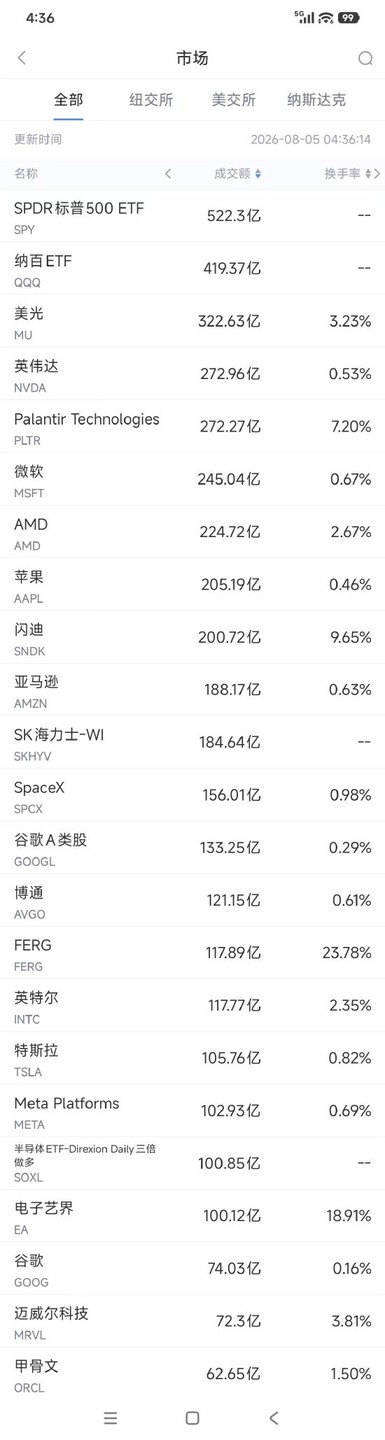
(Screenshot from Sina Finance APP Market - US Stocks - Stock Market Sector Swipe for more data) Download the Sina Finance APP
