


Rare Intervention Move! Bessent Sells Euros, Urges Fed to "Lend Money," Tells Japan "Don't Sell US Treasuries" as Market Fears "Carry Trade Unwind"
The US and Japan jointly intervened in the foreign exchange market. US Treasury Secretary Bessent rarely supported the yen by selling euros to buy yen, and called on the Federal Reserve to expand the FIMA facility limit to help Japan raise intervention funds. Although this move caused a brief rebound in the yen, analysts believe the effect will be difficult to sustain without a shift in the Bank of Japan's monetary policy. The market is concerned that a strengthening yen could trigger massive unwinding of carry trades, impacting global risk assets
The US and Japan jointly intervened in the foreign exchange market, leading to a brief rebound in the yen, but the market remains skeptical about its sustainability.
US Treasury Secretary Bessent took rare action last Friday, participating in the joint intervention by selling euros to buy yen, pulling the yen back from its 40-year low. Meanwhile, Bessent publicly called on the Federal Reserve to expand the quota for the rarely used liquidity tool, the FIMA Repo Facility, so that Japan could raise US dollars for future interventions without selling US Treasuries.
Japanese Finance Minister Satsuki Katayama subsequently confirmed that Japan would use this Federal Reserve tool to fund subsequent interventions.
However, analysts warned that the effects of this intervention would be difficult to sustain without a substantive shift in the Bank of Japan's monetary policy. More alarmingly, if the yen continues to strengthen, it could trigger the large-scale unwinding of carry trades worth over $1 trillion, impacting global risk assets.
Intervention Details: Selling Euros, Bypassing the Dollar
According to The Wall Street Journal, the US Treasury Department's participation in the intervention last Friday was quite unusual—supporting the yen by selling euros and buying yen, rather than directly selling US dollars, thereby avoiding the political sensitivity of directly depressing the US dollar exchange rate.
This intervention pulled the yen up from its 40-year low near 164 (the weakest level since 1986) to around 157 by Monday afternoon. Japanese Finance Minister Satsuki Katayama stated on Monday that Japan "would not hesitate" to intervene jointly with the US again.
Bessent posted on social media that the coordinated foreign exchange action aimed to address "disorderly yen fluctuations" and characterized the US-Japan alliance as a manifestation of "economic security is national security."
Bessent Publicly Pressures the Fed, Drawing Rare Attention
Another move by Bessent during this intervention also drew attention—he publicly called on the Federal Reserve to expand the quota for the "Foreign and International Monetary Authorities Repo Facility" (FIMA Repo Facility).
The FIMA tool allows foreign governments to borrow US dollars from the Federal Reserve using their held US Treasuries as collateral, without directly selling US Treasuries in the open market, thus avoiding impact on US Treasury yields. The tool was created during the pandemic in 2020 and became a standing facility in July 2021, with a current daily cap of $60 billion per counterparty.
Bessent stated in his post that he would "encourage the expansion of this tool in the coming months."
Several Federal Reserve observers pointed out that it is rare for the Treasury Secretary to speak publicly on specific Federal Reserve tools. Mark Sobel, a former senior Treasury official, stated: "This is highly unusual. During my tenure, the Treasury Secretary was always discreet regarding issues involving Federal Reserve monetary operations, communicating privately with the Fed Chair if necessary, rather than making public statements."
Tobin Marcus of Wolfe Research also said: "I can't think of another time when the Treasury publicly requested such adjustments to Federal Reserve tools, rather than coordinating behind the scenes."
It is worth noting that any quota adjustment for the FIMA tool must be approved by the Federal Reserve's Subcommittee on Foreign Currency Operations, which falls under the Federal Open Market Committee (FOMC), and the entire FOMC must be notified of any planned changes. Bessent's public statement occurred against the backdrop of the White House continuously pressuring the Federal Reserve to cut interest rates, further intensifying external concerns about the Federal Reserve's independence.
Short-Term Treasuries: The Main Ammunition for Past Interventions
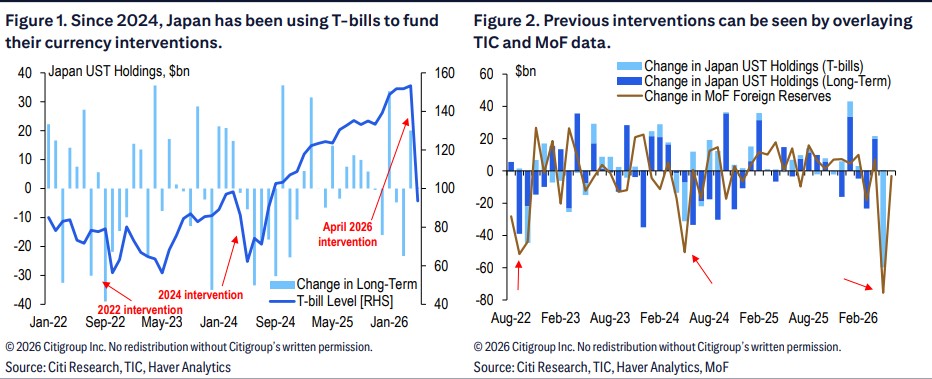
According to Citigroup Research, which reviewed the historical patterns of Japanese foreign exchange interventions and changes in US Treasury holdings, it was found that since 2024, the MoF has systematically used short-term Treasuries (T-bills) rather than long-term bonds as the main source of funding for interventions.
Based on Citigroup's estimates using monthly TIC (Treasury International Capital) data, during the 2022 intervention round, Japan's short-term Treasury holdings were approximately $56 billion, at which time the MoF chose to sell or let about $75 billion in long-term coupon bonds mature to raise funds. Since then, Japan has continued to rebuild its short-term Treasury holdings. By the time of the 2024 intervention, its short-term Treasury holdings had increased significantly, and the MoF subsequently sold about $40 billion in short-term Treasuries, with holdings dropping to about $60 billion by the end of the intervention.
The April 2026 intervention round replicated the same pattern. At that time, Japan's short-term Treasury holdings had been rebuilt to about $150 billion, and the MoF sold about $60 billion to support the yen. The latest TIC data as of the end of May this year shows that Japan's short-term Treasury holdings were approximately $90 billion. Citigroup estimates that the intervention around July 30, with a scale of about $53 billion, was likely completed mainly through the sale of short-term Treasuries.
Limitations of the FIMA Tool: Cap Barely Covers Japan's Daily Intervention Scale
According to Bloomberg, Evercore ISI strategists Marco Casiraghi and Gang Lyu pointed out that the FIMA tool has obvious limitations—the daily cap of $60 billion per counterparty is only slightly higher than the estimated scale of Japan's single-day intervention last Thursday.
This means that once Japan needs to conduct large-scale, sustained interventions, the practicality of this tool will be greatly diminished. Evercore ISI warned in a client report: "We believe that focusing on a capped Federal Reserve repo tool may be counterproductive—once the market realizes that large-scale interventions require selling US Treasuries, it may instead test the determination of both the US and Japan to defend the yen."
In terms of actual usage, the tool is almost idle most of the time. According to the latest Federal Reserve data, the average balance for the week ending July 29 was only about $6 million, with the last significant usage being $3 billion in early February this year.
In addition, the financing cost of this tool is relatively high—the interest rate is 3.75%, with seven-day funding priced at the one-week Overnight Index Swap (OIS) rate plus 25 basis points. Evercore ISI strategists pointed out that the Federal Reserve intentionally set the interest rate higher than the financing cost in the private repo market, indicating that the tool is positioned for short-term liquidity support during periods of market stress, rather than as a regular source of funding for sustained foreign exchange interventions.
Doubts About Intervention Effectiveness: Monetary Policy Is Key
Analysts generally believe that the effects of intervention will be difficult to sustain before a fundamental shift in the Bank of Japan's monetary policy.
Nabil Milali, portfolio manager at Edmond de Rothschild, stated: "If the Bank of Japan does not tighten monetary policy, the yen cannot maintain its upward momentum."
Currently, the short-term interest rate differential between the US and Japan is about 2.5 percentage points, and the market generally expects the Federal Reserve to further raise interest rates at the September meeting, which continues to drive investors toward higher-yielding currencies.
Robin Brooks, a senior fellow at the Brookings Institution, pointed out that the Bank of Japan's policy framework itself contains inherent contradictions: "On one hand, the Bank of Japan is still purchasing about 2.5 trillion yen (about $16 billion) of Japanese government bonds monthly, suppressing long-term yields; on the other hand, the Ministry of Finance is intervening in the forex market to boost the yen, with the two moves working in opposite directions."
Goldman Sachs analysts believe that more sustainable support for the yen may come from Japanese domestic investors repatriating overseas assets, which would be "the most powerful long-term policy affecting exchange rates."
Risk of Carry Trade Reversal: Over $1 Trillion in Exposure Hangs in the Balance
This intervention has triggered market concerns about a large-scale unwinding of global carry trades.
For a long time, Japan's ultra-low interest rates and weak yen have spawned a massive scale of carry trades—investors borrow low-interest yen and then buy high-yield assets such as US tech stocks and the Mexican peso. HSBC estimates that the total scale of such carry trades exceeds $1 trillion.
Milali warned: "Over the past few decades, the simplest carry trade has been borrowing yen at zero interest rates and investing in any high-yield asset. A large number of investors are obviously still betting on the continuation of this trade. Once Japanese interest rates and the yen reverse, it will pose a huge risk to these investors."
The unexpected sharp rise in the yen in 2024 once triggered global market turmoil, forcing investors to unwind carry positions, sell assets, and cover yen. Although the market's reaction to the yen's appreciation has been relatively calm so far—with the Dow Jones Industrial Average rising 1.3% to a record high of 53,178.41 points on Monday, the S&P 500 rising 1.5%, and the Nasdaq Composite rising 2.1%— analysts caution that if the yen strengthens significantly further, the systemic unwinding risk of carry trades cannot be ignored.
Risk Warning and Disclaimer
The market involves risks, and investment requires caution. This article does not constitute personal investment advice, nor does it take into account the specific investment objectives, financial status, or needs of individual users. Users should consider whether any opinions, views, or conclusions in this article align with their specific circumstances. Investment based on this content is at your own risk.
