


Yuyuan Tiantian | Insights into China's AI Development from Three Consecutive NDRC Press Conferences
The National Development and Reform Commission (NDRC) focused on the development of artificial intelligence computing power in its press conferences for three consecutive months. By the end of June, the national scale of intelligent computing power reached 2.8 times that of the same period last year, and the first domestically produced AI supercluster with 100,000 cards was put into use. It is estimated that new investments in the construction of the computing power network during the "15th Five-Year Plan" period will amount to approximately 4 trillion yuan. In addition, major projects such as integrated circuits have been launched, emphasizing full-chain coordination and cross-industry integration to promote independent innovation and secure, inclusive benefits
On July 31, the National Development and Reform Commission (NDRC) held a press conference. Computing power was repeatedly mentioned at the meeting.
Understanding this stance requires viewing it within the context of the times.
Currently, technological innovation in artificial intelligence has entered an unprecedentedly active phase. On one hand, for China to develop, it needs to promote independent innovation. On the other hand, for China to ensure security, it must continuously improve relevant laws and regulations to make artificial intelligence more inclusive and beneficial.
Therefore, the NDRC addressed the layout of computing power development in its regular press conferences for three consecutive months. Before this year, the NDRC rarely directly responded to issues related to computing power. However, today's press conference not only discussed domestic computing power but also covered multiple dimensions:
Scale of computing power. By the end of June, the national scale of intelligent computing power reached 2.8 times that of the same period last year, and China's first fully domestically produced AI supercluster with 100,000 cards has officially been put into operation.

In terms of ecosystem coordination. Domestic models and domestic computing chips are accelerating their adaptation.
Scale of investment. Relevant institutions estimate that during the "15th Five-Year Plan" period, the construction of the computing power network will add approximately 4 trillion yuan in direct investment. Investment will be primarily driven by enterprises, further expanding the space for private investment.
The press conference also made deployments on how other emerging pillar industries should develop.
Next, a batch of major projects covering integrated circuit design, equipment, manufacturing, and packaging and testing will commence construction, with some projects reaching a scale of hundreds of billions of yuan.
These sets of data and series of deployments represent one of China's development directions and are also a focus of global attention.
It is important to note that any change in China's technology sector today triggers overseas attention. Recently, China's progress in large language models and semiconductor equipment has consecutively drawn attention from overseas markets.
Against this backdrop, the concentrated discussion on domestic models, domestic computing chips, AI superclusters, and computing power network construction at this press conference conveys several signals.
First, the incubation model for China's innovation industry places greater emphasis on "full-chain coordination."
China's innovation model is no longer satisfied with breakthroughs at single points. The characteristic of this round of innovation in China is that technological innovation and industrial innovation occur simultaneously. Chips, models, computing power, and application scenarios complement each other, jointly forming a functioning system.
Second, cross-industry integration will become a source of incremental growth.
For example, technologies long accumulated in the new energy vehicle industry, such as batteries, motors, electronic control systems, precision manufacturing, and automated production lines, have directly promoted the rapid development of the embodied intelligence industry.
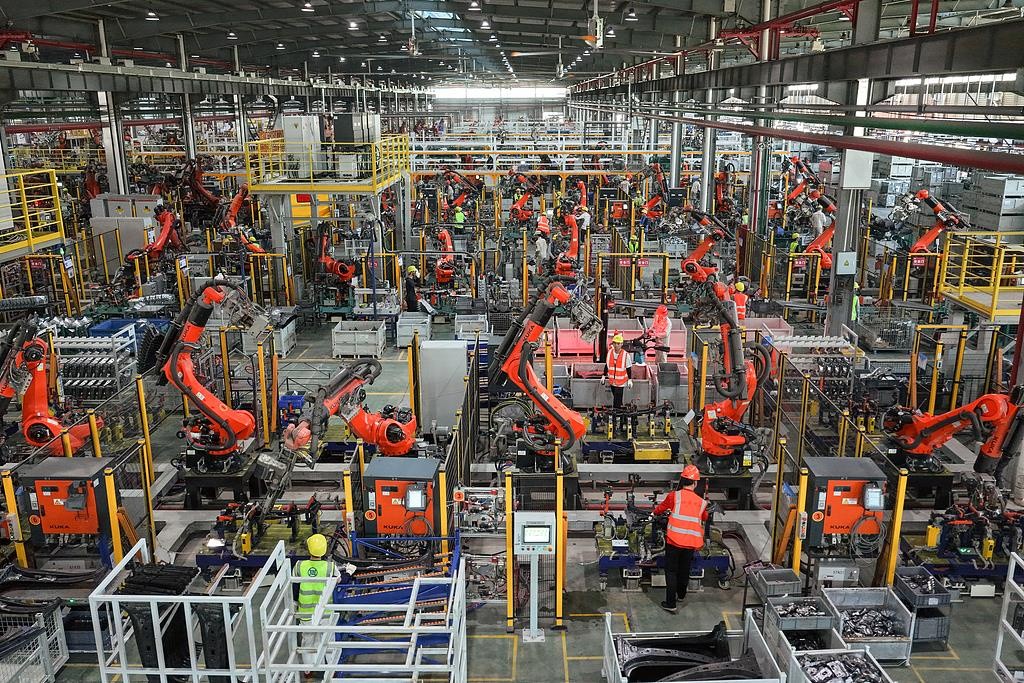
Similar cross-integrations continue to emerge. Among the batch of industries currently emerging, almost none are advancing in isolation: artificial intelligence is combining with various forms of physical entities to form embodiedintelligence; artificial intelligence is entering life sciences, changing the paradigm of drug research and development.
The logic behind this is that the more complete China's industrial system is, the more such intersection points there will be. Each intersection point has the potential to give rise to an entirely new track. This is a unique dividend brought by China's complete industrial system.
Risk Warning and Disclaimer
The market carries risks, and investment should be approached with caution. This article does not constitute personal investment advice, nor does it take into account the specific investment objectives, financial status, or needs of individual users. Users should consider whether any opinions, views, or conclusions in this article align with their specific circumstances. Investors bear full responsibility for their own decisions.
