


Seizing the Enterprise Agent Gateway! A New Round of Battle Between Tencent, Alibaba, and ByteDance Is Imminent
Moving from individual trial-and-error to concentrated efforts, Tencent, Alibaba, and ByteDance have almost simultaneously consolidated their AI fronts, marking the official entry into the decisive phase of competition for enterprise Agents. The contest is no longer just about an AI product, but about securing the primary gateway to daily corporate work—whoever dominates the office scenario is more likely to become the core of the next-generation enterprise AI ecosystem
This summer, the battle for the gateway to China's AI office agents has officially begun!
On July 30, ByteDance initiated an organizational restructuring aimed at its AI business: the Feishu product team merged with the Doubao product team to form a new Doubao product team; the Feishu GTM (Go-To-Market) team merged with the Volcengine team to establish the "Creativity Service Platform," which will be uniformly responsible for the sales and services of MaaS and SaaS.
In plain language: ByteDance has integrated Feishu into Doubao and folded Feishu's sales operations into Volcengine. The enterprise version of Doubao is currently undergoing internal testing among select Feishu customers—it integrates Feishu's documents, spreadsheets, meetings, and group chats, requiring no additional deployment from users.
ByteDance has finally made the same decision as Alibaba.
Just a week earlier, Alibaba announced the integration of three competing products—QoderWork, Wukong, and MuleRun—to launch Qianwen Office, coordinated by Chen Yusen, the new CEO of DingTalk. Ten days prior to that, Tencent merged the entire QClaw product center into Cloud Product Department VI, where WorkBuddy resides.
Three companies, three parallel tracks, all making the same choice in the same summer: concentrate forces and unify the gateway.
Splitting Was for Trial and Error; Uniting Is for War
In early 2026, following the open-sourcing of OpenClaw "Lobster," Chinese internet giants almost simultaneously launched an experiment: allowing multiple teams to develop their own AI office products to see which would succeed.
Tencent internally spawned three products: WorkBuddy, QClaw, and Marvis. ByteDance had four exploration lines: Trae, Coze, Doubao Office, and Feishu aily. Alibaba ran three parallel lines: QoderWork, Wukong, and MuleRun.
The horse-racing mechanism was logical in the industry's early stages. No one knew what form AI Agents would ultimately take, so casting a wider net increased the chances of hitting the right rhythm.
The core value of the OpenClaw open-source AI agent framework is "giving large models hands and feet"—enabling direct operation of user file systems, browsers, terminal commands, and various APIs. The products developed by these giants around it essentially do one thing: package open-source capabilities for enterprise use, lower deployment thresholds, add security and permission controls, and connect to their own ecosystems and user systems.
However, the cost of horse racing is equally real: redundant investment, internal talent poaching, and fragmented user perception. When Alibaba's Wukong was launched, it claimed to be the "world's first enterprise-grade AI-native work platform," but it long remained in a semi-finished state, with even Alibaba employees stating they "basically only use QoderWork." ByteDance's Trae was positioned as a programming tool, Coze followed an agent-building route, while Doubao gradually acquired office capabilities—users were confused about which one to use.
In July, Analysys released a report that became the final straw ending the horse race.
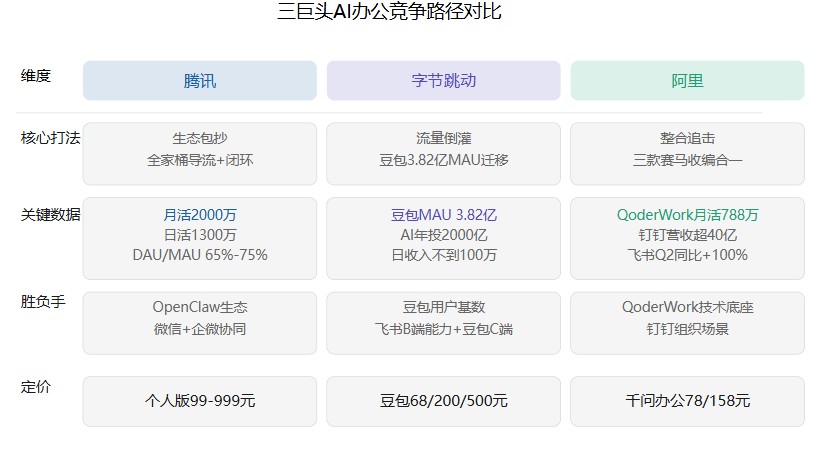
The rankings showed that in June, monthly visits to desktop AI office agents in China exceeded 60 million. Tencent's WorkBuddy topped the list with 20.97 million visits, surpassing the combined total of second-place ByteDance Trae (12.79 million) and third-place Alibaba QoderWork (7.88 million).
The numbers reveal a harsh reality: the market has already made its choice. Continuing experiments means ceding the main battlefield to competitors.
Splitting was for trial and error. Uniting is for war.
Tencent: The Underdog That Fought the Most Impressive Battle
Few predicted WorkBuddy's rise to the top just a few months ago.
In early 2026, Tencent's position in the AI field was subtle. It possessed large models, cloud computing, and social networks, but lacked an AI product remembered by the public. "Tencent is falling behind in AI" was nearly an industry consensus.
WorkBuddy started merely as an internal tool within Tencent Cloud, developed by a small team of about 10 people. The change occurred in March when Tencent decided to bring it to market. The key decision was not to position it as a "second coding assistant," but as an "AI-native workstation."
The former helps programmers write code faster; the latter enables everyone sitting in front of a computer to complete tasks using natural language. This positioning difference determined that WorkBuddy's subsequent user structure completely exceeded everyone's expectations.
Tencent's strategy was to rapidly package capabilities on top of the OpenClaw ecosystem: WorkBuddy is directly compatible with OpenClaw's skill ecosystem, allowing users to start using it out-of-the-box without configuration from scratch. This wasn't reinventing the wheel, but rather applying an enterprise-grade wrapper to a mature community framework—lowering deployment thresholds, adding security and permission controls, and integrating with its own ecosystem.
After the public beta, the fastest-growing user group was not programmers, but HR, administrative staff, operations, finance, and production line engineers. It was those who "never write a single line of code" who drove WorkBuddy's monthly active users to 20 million.
Citibank disclosed several key figures in its July research report: WorkBuddy's cross-platform deduplicated monthly active users reached 20 million, daily active users exceeded 13 million, and the DAU/MAU ratio reached 65%-75%. In enterprise SaaS, this represents the highest tier of stickiness. Citibank concluded: "The payment ratio of high-value users is expected to be higher than typical consumer subscription services like music, video, and even games."
Tencent's ecosystem advantage is also something others cannot copy—WorkBuddy integrates Tencent Docs, Tencent Meeting, WeCom, and QQ Mail, supporting remote task dispatching via WeChat and WeCom. Users do not need to install any additional software; they can command an Agent to work directly within the chat box.
However, Tencent still has unanswered questions. Retention and payment rates are calculated collectively for CodeBuddy and WorkBuddy; whether WorkBuddy's business model stands on its own still requires time to verify.
Moreover, Tencent's true trump card may not have been fully revealed yet—the AI Agent "Da Yuan" currently in internal testing within WeCom is embedded directly into every interface of WeCom, accessible via a left swipe. According to Sina Technology, Pony Ma attaches such importance to this project that he "almost never misses" related meetings.
ByteDance: After Spending the Most Money, Finally Decides to Consolidate Fronts
Today's organizational adjustment is ByteDance's clearest statement in the AI office sector.
The adjustment path is almost identical to Alibaba's: merging Feishu's product team with Doubao's product team, and merging the GTM teams of Feishu and Volcengine. As the first product post-integration, the enterprise version of Doubao is already being tested internally with select customers.
Why did ByteDance do this? Because its AI business faces a fatal awkwardness.
Looking solely at Doubao's data, ByteDance appears to be the company with the strongest AI capabilities in China: 382 million monthly active users, ranking first among domestic AI applications, more than the sum of second-place Qianwen (167 million) and third-place DeepSeek (130 million).
But the problem lies in how to convert these 382 million users into revenue from enterprise office scenarios. ByteDance's AI infrastructure spending is projected to reach 200 billion yuan in 2026, but according to LatePost, Doubao generates less than 1 million yuan in daily revenue—amounting to only 365 million yuan annually.
In the battle for the office gateway, ByteDance's product line was also the most fragmented. Trae leaned towards programming, Coze was an agent-building platform, Feishu had its own aily agent, and Doubao was gradually opening up office capabilities. The four lines fought separately, lacking a unified gateway.
However, Feishu demonstrated an undeniable trend over the past year. Its revenue exceeded 3 billion yuan in 2025, with year-on-year growth of 100% in Q2 2026, narrowing the revenue gap with DingTalk to a historic low. More critically, there was a structural change: since 2026, over 90% of Feishu's new customers simultaneously purchased AI features. The customer base is penetrating from internet and new energy sectors into retail, manufacturing, and energy—Luckin Coffee, Haitian Flavoring, Deli, and Nanjing Iron & Steel all appear on the latest customer list.
Feishu proved one thing: enterprise customers are willing to pay for AI embedded in workflows. But it lacked Doubao's C-end influence.
This integration essentially combines Feishu's B-end capabilities (enterprise workflows, customer payment systems) with Doubao's C-end influence (382 million monthly active users). If successful, ByteDance's competitiveness in the office gateway will leap to a new level.
Alibaba: Earliest to Integrate, Longest Growing Pains
Alibaba was the first of the three to initiate integration, but also suffered the most painful process.
In June, DingTalk founder Chen Hang stepped down as CEO, succeeded by post-90s executive Chen Yusen. His first move was to merge the three products—QoderWork, Wukong, and MuleRun—into Qianwen Office.
Each product had its origins. QoderWork came from Alibaba Cloud, Wukong from DingTalk, and MuleRun from a startup team. With similar positioning and overlapping functions, they formed de facto internal competition. Limited computing power and R&D resources were scattered across multiple projects.
An insider familiar with DingTalk told Caijing Magazine: "Both palms and backs of hands are flesh. Integrating products is easy; integrating hearts is not."
The integrated Qianwen Office uses QoderWork as its technical foundation, supporting Wukong's DingTalk enterprise scenarios and MuleRun's overseas growth. Alibaba Cloud also found its place in the OpenClaw ecosystem—providing one-click deployment solutions. Users can run OpenClaw via lightweight application servers at a cost as low as 56 yuan/month, with the 52 pre-installed official Skills seeing over 120 million daily calls.
But Alibaba still needs to solve two problems: First, how can Qianwen Office, which has a reputation in the tech circle, accommodate DingTalk's large customer system? Second, how can DingTalk's vast customer base in traditional industries like manufacturing, government, and education be converted into revenue for AI businesses?
DingTalk's revenue exceeded 4 billion yuan in 2025, making it the largest in scale among the three. However, there is a clear disconnect between the digitalization stage and AI acceptance of these customers and the user groups in the internet circle who naturally use Agents. Getting them to pay extra for AI is "a matter requiring patience and gradual effort."
Ownership of the Gateway Determines Ownership of the Era
The gateways of the PC era were browsers and search bars, with Google and Baidu emerging as winners. The gateway of the mobile era was super apps, with WeChat and Douyin winning. Generative AI is turning the gateway into a sentence spoken to an AI, and the office desk is the most natural starting point for this sentence—a person spends half their waking hours at their workstation, and every interaction accumulates the most valuable work data.
WorkBuddy's data reveals a fact ignored by most: the first batch of heavy users of AI office tools are not programmers, but those who "need AI help the most to get work done." HR, administrative staff, operations, finance, and production workers. An HR professional who doesn't know how to code uses WorkBuddy to automatically screen resumes and generate interview reports; she needs an AI colleague more than a programmer does.
This means the competitive logic of AI office products is completely different from that of programming tools. Programming tools compete on model benchmarks and capability ceilings; office products compete on who can enable a completely non-technical white-collar worker to get started in 3 minutes and become indispensable within 3 weeks.
The previous round of gateway wars, moving from group buying to food delivery and then to ride-hailing, took ten years to determine a winner. DingTalk CEO Chen Yusen offered another judgment at the Alibaba Cloud Summit in May: "In the next 18 months, very strong productivity transformations will occur across all industries."
With ByteDance completing its integration today, major domestic internet giants have all entered the phase of resource consolidation. Next comes the moment of truth for products: whose Agent can truly integrate into the daily lives of white-collar workers will have a better chance of becoming the core of the next-generation enterprise AI ecosystem.
Source: AI Native Lab
