


Meta's AI gamble: Q2 revenue hits a new high but struggles to hide profit pain, free cash flow plummets to a four-year low
Meta released its Q2 2026 financial report, with revenue reaching a historic high of $60.8 billion, but net profit fell 14% year-on-year to $15.85 billion, below expectations. Affected by massive capital expenditures in AI, free cash flow plummeted 91% to $784 million. The company's revenue guidance for the next quarter is below analyst expectations, leading to a post-market stock price drop of over 10%
According to Zhitong Finance APP, after the market closed on July 29, Meta Platforms (META.US) announced its Q2 2026 financial report for the period ending June 30. This report presents a stark "tear" — the core advertising business remains strong, revenue hits a new high, but profits are severely impacted by heavy investments in AI and one-time expenses. Additionally, the revenue guidance provided by the company fell short of market expectations, while cash reserves experienced a significant shrinkage. In after-hours trading on Wednesday, Meta's stock price plummeted by more than 10%.
Data shows that the company's Q2 revenue was $60.8 billion, compared to the expected $60.17 billion, with earnings per share of $6.18, below the expected $7.22. Net profit dropped from $18.34 billion in the same period last year to $15.85 billion, a year-on-year decline of 14%.
In Q2, advertising revenue was $59.3 billion, slightly above the expected $59.07 billion. Daily active users (DAU) reached 3.6 billion, slightly below the expected 3.61 billion according to StreetAccount statistics. The DAU metric measures the total user base of Meta's application matrix.
Meta expects revenue for this quarter to be between $61 billion and $64 billion, with a midpoint of $62.5 billion. However, LSEG data shows that analysts' average expectation is $63.15 billion. The company stated that this guidance "assumes current exchange rates, and foreign exchange factors will drag down year-on-year revenue growth by about 1 percentage point for the full year."
Free Cash Flow Plummets 91%: The Real Cost of AI Spending
The EPS falling short of expectations may be attributed to one-time projects, while the significant shrinkage in free cash flow exposes the pressure that heavy investments in AI exert on financial liquidity.
In Q2, Meta's operating cash flow reached $31.86 billion, but capital expenditures soared to $31.08 billion, an increase of 83% year-on-year. After offsetting, free cash flow was only $784 million, a staggering 91% drop from $8.55 billion in the same period last year, marking the lowest level since Q3 2022.
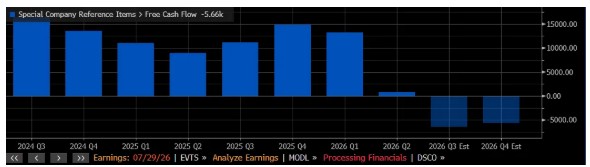
This figure represents a cliff-like decline from $12.39 billion at the end of Q1. Some analysts pointed out that based on current trends, Meta's free cash flow is likely to turn negative in the current quarter.
Regarding capital expenditures, the company narrowed its full-year forecast range for 2026 from $125 billion to $145 billion down to $130 billion to $145 billion. Although the upper limit remains unchanged, the increase in the lower limit indicates that the company has confirmed a minimum investment baseline of at least $130 billion in AI — still one of the most aggressive capital expenditure plans in the global tech industry.
Investors are highly focused on Meta's progress in directly monetizing AI-related outcomes. Earlier this month, Meta released the Muse Spark 1.1 model, which AI business head Alexander Wang described as "the strongest agent and code generation model to date," priced lower than similar products from OpenAI and Anthropic Since investing $14.3 billion in Scale AI and recruiting Wang in June 2025, Meta has been aggressively advancing its AI strategic layout.
"Overall, we expect most of the computing power to be used for training models, expanding core businesses, and delivering personal intelligent agents and new products," said Meta CEO Mark Zuckerberg during a conference call on Wednesday. "But we also anticipate developing scaled businesses aimed at large enterprise clients."
Last week, competitor Alphabet disclosed that due to massive AI expenditures, its free cash flow recorded a negative for the first time in history. Unlike Alphabet and other large-scale cloud providers like Amazon and Microsoft, Meta does not yet have a mature cloud computing business. However, this situation may change as Meta is considering renting out excess computing power to third parties.
"We have received a large number of computing power leasing offers, with bids significantly higher than our acquisition costs," Zuckerberg revealed during the call.
On Tuesday, Meta announced a partnership with BlackRock to launch a $14 billion data center project in El Paso, Texas. Just weeks ago, the company disclosed that its "Hyperion" large data center project in rural Louisiana would have a total investment exceeding $50 billion. Earlier in July, Meta also announced plans to build a $9 billion data center in Alberta, Canada.
Behind the EPS "miss": One-time expenses are not everything
Meta stated that total costs and expenses for the second quarter were $42.03 billion, a staggering 55% increase year-over-year. This amount includes $2.4 billion in legal litigation-related expenses and $1.18 billion in severance costs incurred since layoffs began in May.
CFO Susan Li mentioned during the call that excluding the aforementioned one-time items, operating profit would increase by 9% year-over-year.
Net profit for the quarter fell from $18.34 billion in the same period last year to $15.85 billion, with earnings per share dropping from $7.14 to $6.18.
Meta's Reality Labs division generated revenue of $431 million in the second quarter, with an operating loss of $4.6 billion. Wall Street had previously expected the division (responsible for virtual reality and AI-driven wearable devices) to incur a loss of $5.07 billion, with revenue of $423.4 million.
After the earnings report was released, Meta's stock price fell more than 10% in after-hours trading. As of Wednesday's close, the company's stock price had declined for 10 consecutive trading days, with a cumulative drop of about 11% year-to-date, while the Nasdaq index rose about 5% during the same period.
David Wagner, head of equity at Aptus Capital Advisors, provided a representative comment: "Raising the lower limit of capital expenditures and increasing the median, but not providing much positive guidance on revenue—this really doesn't make for a good story."
However, despite short-term pressures, some Wall Street institutions remain optimistic. Bank of America has given a buy rating with a target price of $835; Goldman Sachs has also given a buy rating with a target price of $815. Deutsche Bank slightly lowered its target price from $810 to $800 before the earnings report but maintained a buy rating
