


European Natural Resources Fund: September interest rate hike expectations resurface, with copper and uranium temporarily looking relatively optimistic
Analysts from the European Natural Resources Fund pointed out that the market is reassessing the expectations for U.S. interest rate hikes, with the probabilities for hikes in September and December significantly increasing. Geopolitical tensions support oil prices, and China's supply advantages in key materials such as rare earths benefit related commodities. Despite fluctuations in gold prices, Newmont's second-quarter earnings exceeded expectations and cash flow remained strong. Funds prefer to chase long-term visions rather than short-term profits, leading to a net long rebound in U.S. gold and copper funds
According to the Zhitong Finance APP, Li Gangfeng, a special analyst for the European Natural Resources Fund Commodity Discovery, stated that the market is once again reassessing the likelihood of interest rate hikes in the U.S. this year. The probability of a rate hike in September surged from 53.7% two weeks ago to 81.9% last Friday, while the probability for December increased from 76% to 92.1%. Li Gangfeng emphasized that the futures market's positioning typically has high reference value for predicting U.S. short-term interest rates, but its accuracy over a longer period (six months or more) is lacking. Last week, the gold price in U.S. dollars remained above $4,100 for only about two days before falling back below that level, with the technical trend being self-evident.
In addition, international giant Newmont just released its operational data for the second quarter of this year. Although revenue was slightly below the average expectations of sellers, earnings per share of $2.10 exceeded the market expectation of $1.98. Despite a significant drop in gold prices in the second quarter, Newmont still maintained strong cash flow.
As Li Gangfeng previously judged, the market is waiting for positive news to materialize before exiting, and Newmont's stock price fell after the earnings announcement – even though the decline in Newmont's stock price may be reasonable (for example, if the market determines that gold prices have entered a bear market and are expected to fall below $2,000), the cash flow and earnings the company has at this moment are real. Looking back, market investments in stocks were aimed at chasing profits, but now funds are more focused on visions and collective trading. Currently, the market prefers a potential profit of $100 billion that may be realized in ten years over a tangible $60 billion at this moment.
LSEG Workspace users can find the latest data at CFTC:
Data source: CFTC/LSEG Workspace
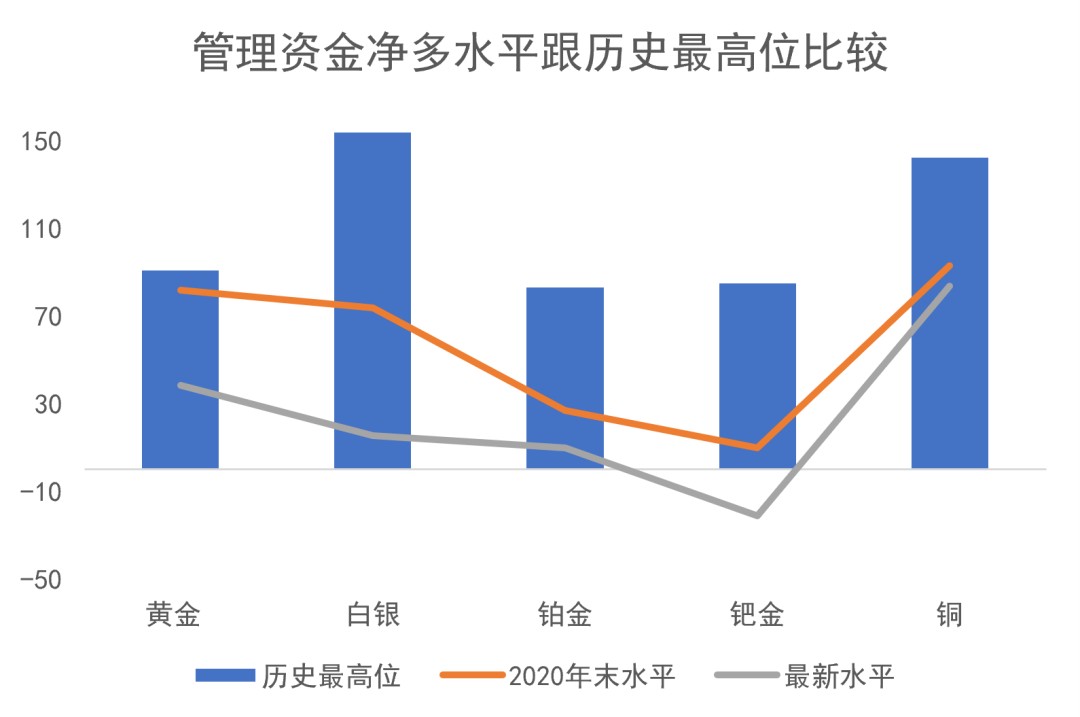
*For comparison purposes, the metal equivalent of COMEX gold is divided by 10, and the metal equivalent of COMEX silver is divided by 100.
**Currently, the reference for Nymex palladium is very low.
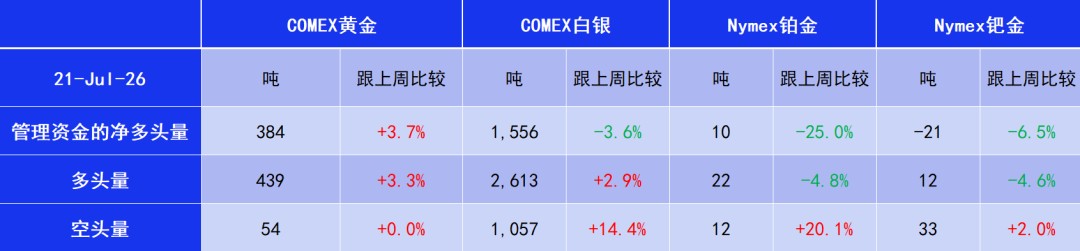
As of July 21, the net long positions in gold and copper funds in the U.S. futures market showed a quarter-on-quarter rebound. Meanwhile, the palladium contracts have been in a net short position for the 19th consecutive week after experiencing six weeks of net long positions.
The net long position in U.S. gold funds increased by 3% quarter-on-quarter to 439 tons; the net short position remained flat at 54 tons, resulting in a net long position increase of 4% to 384 tons.
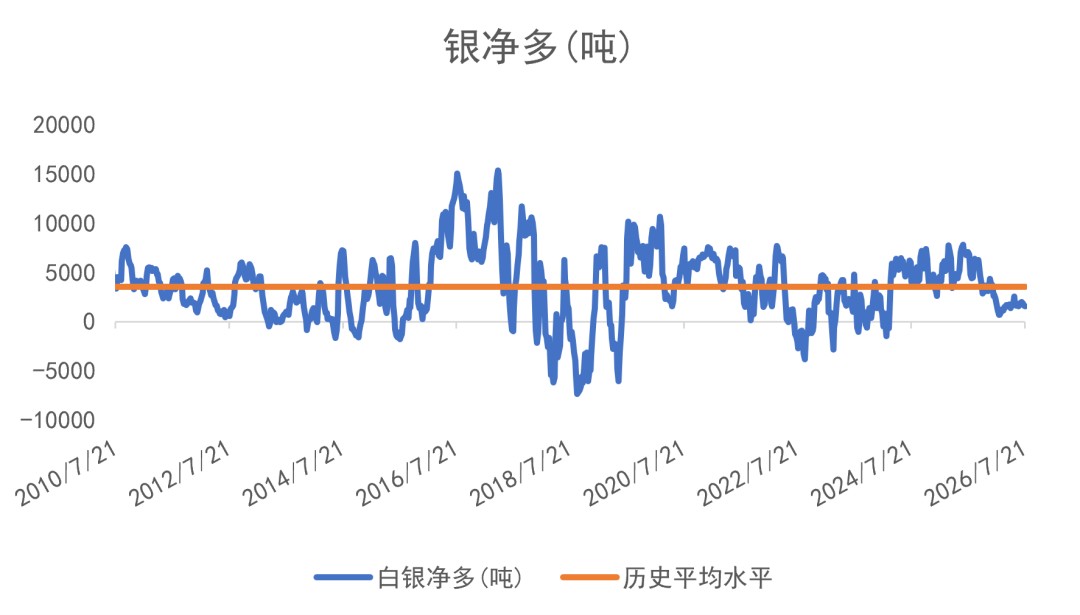
The net long position in silver funds rose by 3% quarter-on-quarter to 2,613 tons; the net short position surged by 14% to 1,057 tons, leading to a net long position decrease of 4% to 1,556 tons, the lowest level in the past seven weeks The long position of platinum funds fell by 5% month-on-month to 22 tons; the short position of funds rose by 20% month-on-month to 12 tons. The net long position of funds fell by 25% month-on-month to 10 tons.
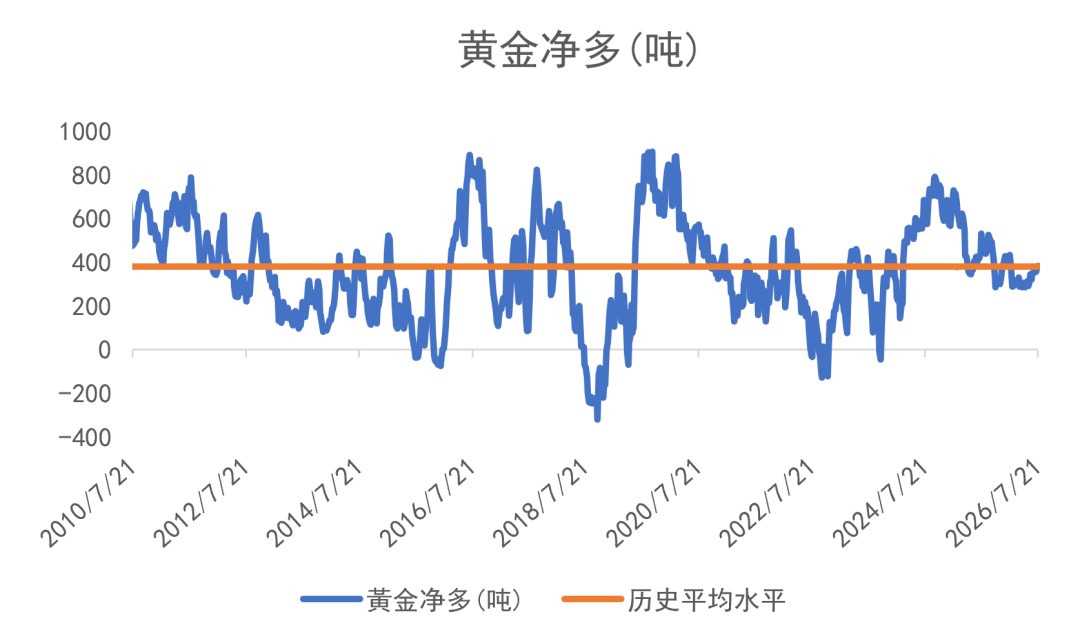
The net long position of funds in U.S. futures gold has decreased by 3% year-to-date (cumulative decline of 30% in 2025)
Data source: CFTC/LSEG Workspace
The net long position of funds in U.S. futures silver has decreased by 40% year-to-date (cumulative decline of 1% in 2025)
Data source: CFTC/LSEG Workspace
The net long position of funds in U.S. futures platinum has increased by 50% year-to-date (turning from negative to positive in 2025)
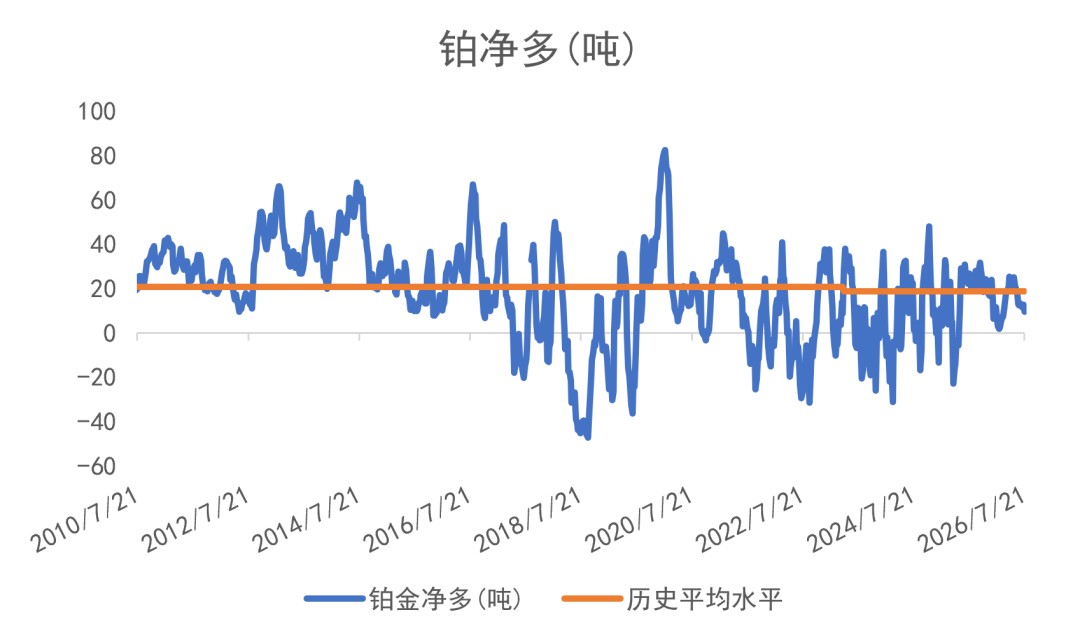
Data source: CFTC/LSEG Workspace
The net long position of funds in U.S. futures copper has increased by 5% year-to-date (turning from negative to positive in 2025)
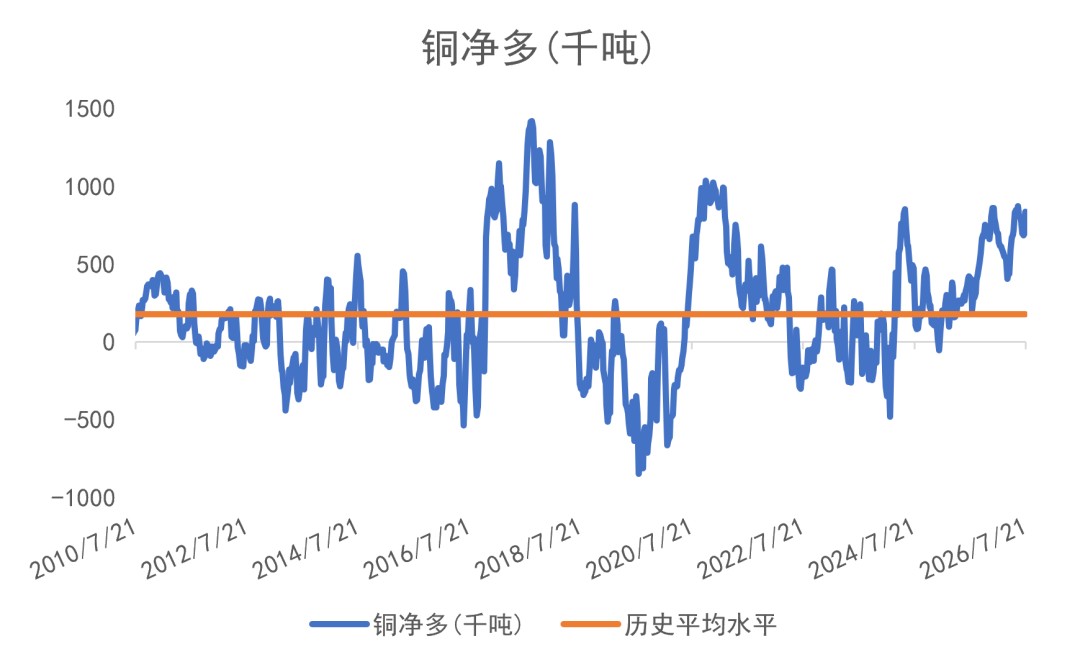
Data source: CFTC/LSEG Workspace
Even though the net long position of funds in U.S. futures gold contracts has contracted in 2025, the gold price has still risen by 64.4%, reflecting that physical demand far exceeds that of the futures market, dragging down the gold price through leverage. In the past, funds controlled metal prices through the futures market; for example, since the global spread of the pandemic in 2020, the net long position in U.S. precious metals has continuously declined, indicating that funds are intentionally preventing precious metals from rising. However, starting in the first quarter of this year, futures funds began to close long positions to take profits, yet gold prices remain high, reflecting that physical demand far exceeds the leverage of the futures market.
The CFTC weekly report on U.S. copper began in 2007. Since copper was in a bear market from 2008 to 2016, it is not surprising that U.S. futures copper has historically been mostly at net short levels. However, since 2020, due to the impact of the global pandemic on supply and mining operations, coupled with market expectations of strong demand for copper driven by AI and new technology developments, copper prices have risen, even reaching new historical highs In addition to gold having safe-haven properties, geopolitical tensions may drive up oil prices, and China's monopoly position in the supply of key materials such as rare earths, antimony, and tungsten is also expected to support its international prices (not domestic prices). The U.S. government not only invested in MP Materials but also signed a 10-year supply contract with them to purchase neodymium and praseodymium at a minimum price nearly double that of China (USD 110 per kilogram). Stock prices surged on this news. Recently, there have been reports that the U.S. defense sector wants to acquire cobalt metals overseas.
Subsequently, the U.S. government invested in Lithium America and Trilogy Metals, providing funding for Nova Minerals, which led to significant increases in the stock prices of these companies.
Additionally, major gold producer Agnico Eagle announced that it will establish a new subsidiary with USD 130 million to invest in strategic resource-related projects.
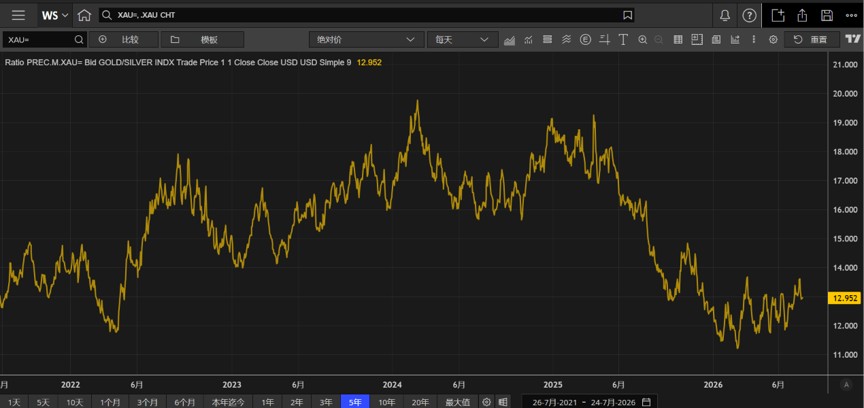
Li Gangfeng updated the important insights regarding short-term gold prices and their directional indicators for gold mining stocks. Last week, the ratio of gold prices in USD to North American gold mining stocks fell:
Data Source: LSEG Workspace
As of Friday (the 24th), the gold price/North American gold mining stock ratio was 12.952, down 4.6% from 13.579X on the 17th, with a cumulative increase of 2.8% this year. When market sentiment towards metals is optimistic, mining stocks outperform physical gold; conversely, when sentiment turns pessimistic, physical gold outperforms. In 2025, there was a cumulative decline of 34.1%, with North American gold mining stocks outperforming physical gold. In 2024, there was a cumulative increase of 16.5%. In 2023, there was a cumulative increase of 13.2% (2022: +6.4%). Historically, before 2008, the ratio of gold prices in USD to North American gold mining stock indices was only below 6 times.
In fact, since 2009/2010, the performance of mining stocks has consistently lagged behind the commodities themselves, and in recent years, even oil and natural gas production companies have shown similar trends. Li Gangfeng believes one reason for this is the growing emphasis on environmental, social responsibility, and corporate governance (ESG) in the investment community. For example, in 2021, BlackRock committed to the UK Parliament not to invest in coal and oil production companies, and they are certainly not the only fund company that has pledged to invest only in companies and industries that place greater importance on ESG.
Li Gangfeng believes that tracking the stock prices of overseas gold mining companies is a relatively reliable forward-looking tool; if gold prices continue to rise but gold mining stocks experience a sharp decline, caution is warranted.
Gold-Silver Ratio
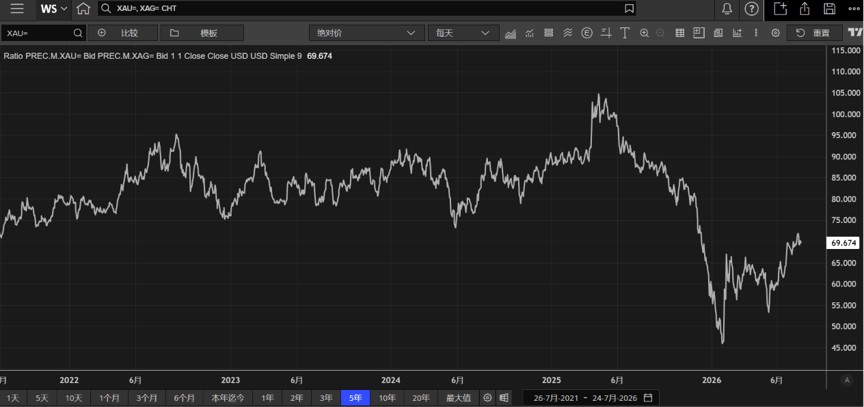
The gold-silver ratio is one of the indicators measuring market sentiment. Historically, the gold-silver ratio has operated at levels of approximately 16-125 times:
 Data Source: LSEG Workspace
Generally, the more panic in the market, the higher the gold-silver ratio will be. For example, in 2020, due to the global spread of COVID-19, the gold-silver ratio once broke through the historical high of 120 times.
Silver is expected to rise by 147% in 2025.
Last Friday, the gold-silver ratio index was 69.674, a decrease of 3.1% from the previous period, with a cumulative increase of 15.1% this year. It is expected to decrease by 33.4% cumulatively in 2025, and increase by 13.0% cumulatively in 2024. The cumulative increase in 2023 was 9.1%.
Li Gangfeng has long predicted that the gold-silver ratio could rise back to nearly 70 times or even higher levels.
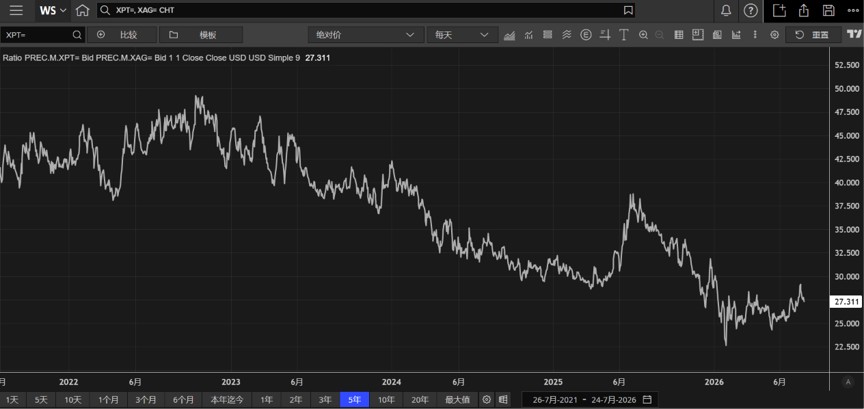
Platinum is expected to rise by 127% in 2025, but historically, one ounce of platinum can be exchanged for more than 60 ounces of silver, while recently one ounce of platinum can only be exchanged for 27.311 ounces of silver, which is at a historical low (having fallen 31% from the peak in June 2025; the lower the ratio, the cheaper platinum is relative to silver), reflecting that platinum is currently the cheapest in history relative to silver.
Data Source: LSEG Workspace
Market Estimates US Interest Rate Hike Probability Rises Again This Year
At the time of writing, the market believes that the probability of the Federal Reserve raising rates by 0.25% on July 29 has risen from 12.3% two weeks ago to 33.7% last Friday:
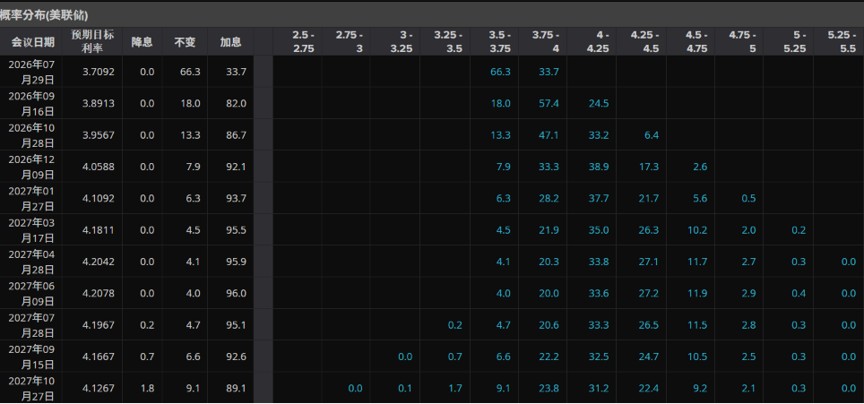
Image Source: LSEG Workspace
Currently, the market reassesses that the probability of a US interest rate hike this year has risen again compared to before. The probability of a rate hike in September has surged from 53.7% two weeks ago to 81.9% last Friday, and the probability for December has risen from 76% to 92.1%. Li Gangfeng has repeatedly emphasized that the futures market's deployment is usually of high reference value for predicting US short-term interest rates, but its accuracy over a longer period (six months or more) is lacking. Last week, the gold price in USD maintained above the $4,100 level for only about two days before falling below $4,100 again, and the technical trend does not need to be stated.
At this stage, each quick recovery of the gold price above the $4,000 mark has strengthened the confidence of the bullish market. However, if faced with interest rate hike pressure, it is necessary to closely monitor the daily closing price. If one day the gold price closes below $4,000, accompanied by increased trading volume, and the rebound strength in the following two to three days is weak, the technical outlook should turn cautious to guard against the risk of deep pullbacks caused by support turning into resistance.
In addition, international giant Newmont just announced its operational data for the second quarter of this year. Although revenue was slightly below the average expectations of sellers, earnings per share of $2.10 exceeded the market expectation of $1.98. Despite a significant drop in gold prices in the second quarter, Newmont still maintains strong cash flow As Li Gangfeng previously judged, the market is waiting for favorable news to cash out, and Newmont's stock price fell after announcing its earnings – even though Newmont's stock price decline may be reasonable (for example, if the market determines that gold prices have entered a bear market, expecting gold prices to fall below $2000), the cash flow and profits the company has at this moment are real. Looking back, the market invests in stocks to chase profits, but now funds are more chasing visions and engaging in collective trading. Currently, the market would rather have a potential profit of $100 billion expected to be realized in 10 years than the tangible $60 billion at this moment.
Although Li Gangfeng's analysis has always been based on fundamental analysis, we must also respect technical analysis – currently, gold and silver prices have fallen from their highs this year, and from a technical perspective, they have entered a bear market. It is well known that once precious metals enter a bear market, it usually takes years to transition back to a bull market. Once in a bear market, even if a peace agreement is reached between the U.S. and Iran, precious metal prices may continue to plummet. Fortunately, copper prices have only pulled back a little over 7% from this year's peak. From a comprehensive short, medium, and long-term perspective, it may be a more suitable investment strategy to shift from some precious metal assets to cash and copper-related (stocks). The market generally believes that copper mining projects are in a transitional phase, and for many years starting this year, demand will exceed mine supply, with demand growth mainly coming from the new energy and high-tech industries. Li Gangfeng believes that copper prices (uncertain if this year) will at least rise to $8-10 per pound.
In addition, the contract price for uranium, the raw material for nuclear power generation, has quietly approached $95, while the spot price remains stable around $85. Li Gangfeng believes that for investors with long-term holding patience, holding uranium investment trusts now has a higher chance of success than holding gold ETFs.
Li Gangfeng has always believed that the global economy is likely entering stagflation, hence optimistic about commodities and bearish on the bond market. Previously, the market paid little attention to U.S. debt issues due to strong economic growth, but with the economic slowdown in recent years, the debt issue has become a market focus, the U.S. dollar has weakened, and commodity prices have risen accordingly. However, from the job creation data in the U.S. in May, it is not difficult to conclude that U.S. economic growth has begun to accelerate. Although this job data has some "water," it still needs time to prove that the acceleration of U.S. economic growth is only temporary. Before clear evidence appears, commodity prices (especially gold) may continue to be under pressure.
In the column, Li Gangfeng wrote: "As a long-time expert in Western mining stocks, in addition to being optimistic about precious metal mining shares, Li Gangfeng has also been optimistic about the stocks of exploration companies for strategic and military metals since last year. The former relies on market sentiment for precious metals – even if currency devaluation and de-dollarization are all supported by fundamental factors, the dollar/currency does not only fall but can also rise; market sentiment is that last year there was talk of interest rate cuts, this year there is discussion about whether the rate cut will be narrowed, or even the idea of rate hikes lingering, and by the second half of this year, there may be a welcome return to rate cuts; in contrast, strategic metals have the backing and funding support of Western countries, and in the current global trend where politics outweighs everything, both sectors can play a role in the new phase of the 'Warring States era' that the world has entered." Since this time the entire metal sector is rising, Li Gangfeng believes that once a bear market for metals arrives, it is highly likely that all metals will enter a bear market together, rather than just precious metals entering a bear market while strategic metals remain in a bull market (in fact, recently strategic metal stocks have also been affected by the situation in the Middle East and have pulled back) From a fundamental perspective, even if the United States does raise interest rates, Li Gangfeng still sees no reason for strategic metals to fall into a bear market. Once strategic metals do not enter a bear market, other metals may not rise as much as before, but that does not mean they will enter a bear market.
Estimating when gold and silver prices will bottom out is as difficult as estimating when they will peak. For friends participating in the futures market, given the current uncertain environment, it may be wise to engage in operations that are bullish on the gold-silver ratio and platinum-silver ratio.
The main reasons for the recent decline in gold and silver prices are:
After accumulating substantial returns, the precious metals market indeed showed signs of overheating. In light of significant fundamental changes (oil prices may remain high for an extended period), the market chose to take profits, and widely used technical analysis accelerated the decline in gold and silver prices;
The market believes that inflation is heating up, and even in the case of stagflation, the U.S. Federal Reserve will only raise interest rates without considering voters' feelings or whether rate hikes can truly address the issues.
Looking back at history, the first official gold bull market rose from $35 per ounce in 1970 to $850 in 1980 (of course, the process was not a straight line but rather high and low, very volatile). During this period, the 1973 OPEC oil embargo against Western countries caused oil prices to rise from $3 to $12 per barrel, and the 1979 Middle East conflict doubled oil prices to $39.5 per barrel, along with two energy crises, reflecting how geopolitical factors pushed up oil prices, which in turn raised inflation, leading market funds to flow into gold as a safe haven. Indeed, it was the significant interest rate hikes by the U.S. in 1980 that suppressed inflation and gold prices, but it is important to note:
If you sold your gold in 1974, you would have missed out on the gold bull market that continued until the end of 1980;
At that time, U.S. government debt was about 30% of GDP, which naturally allowed for significant interest rate hikes, but now the ratio has risen to over 120%. If the U.S. were to raise interest rates significantly again, the gold bull market would not be extinguished, and U.S. debt would come under even greater pressure
