


KO: AI Rout; Is Buffett Bleeding Again?
The 'No.1 consumer stock in the universe' KO posted Q2 2026 results (through Jun 2026) pre-mkt on Jul 28, 2025 Beijing time, delivering another beat. The company also raised full-year guidance for a second time this year; highlights below: $Coca Cola.US
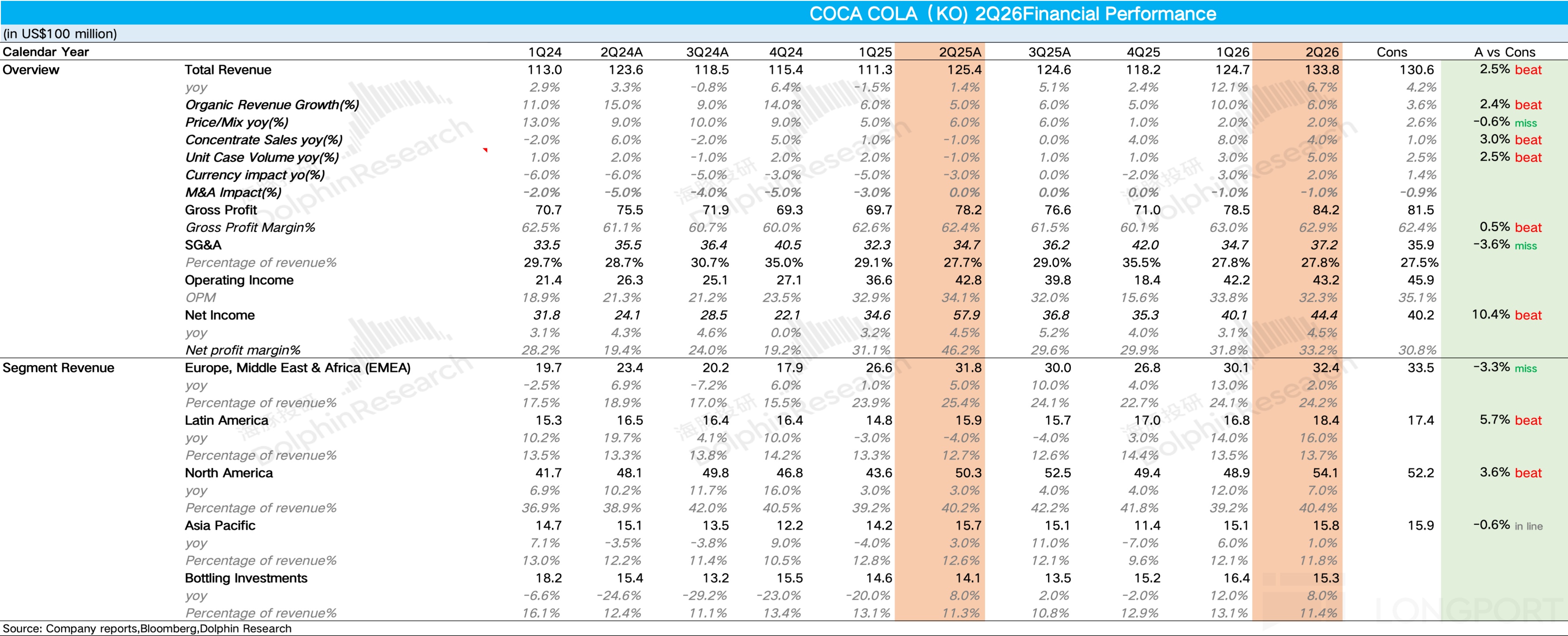
1) Volume/price rebalanced, volume back as the primary engine. In Q2, KO reported revenue of $13.4bn (+7% YoY). By driver, concentrate sales volume rose 4% YoY, the key upside surprise (vs. ~1% cons.). Despite concerns that Q1 calendar shifts and channel pre-buying would force bottlers to destock and suppress concentrate shipments in Q2, concentrate growth trailed unit case volume by only ~100bps.
Once again, this confirms a real acceleration in underlying sell-through. Price/mix rose 2% YoY, slightly below expectations.
2) World Cup tailwinds drove upside in North America and LatAm. As a global FIFA World Cup sponsor, the company ran broad, coordinated campaigns during the event. With the tournament hosted in North America and LatAm’s deep-rooted football culture, both regions captured outsized event dividends and beat at the terminal level.
3) Coke Zero Sugar accelerated QoQ. By category, Coke Zero Sugar grew 16% YoY, accelerating QoQ to a multi-year high, with growth across all regions. World Cup activation also helped juice, value-added dairy and plant-based beverages turn from -1% in Q1 to +2%. Sports drinks accelerated from 3% in Q1 to 5%, while the only decliner was RTD coffee (-2%), mostly due to Asia Pacific.
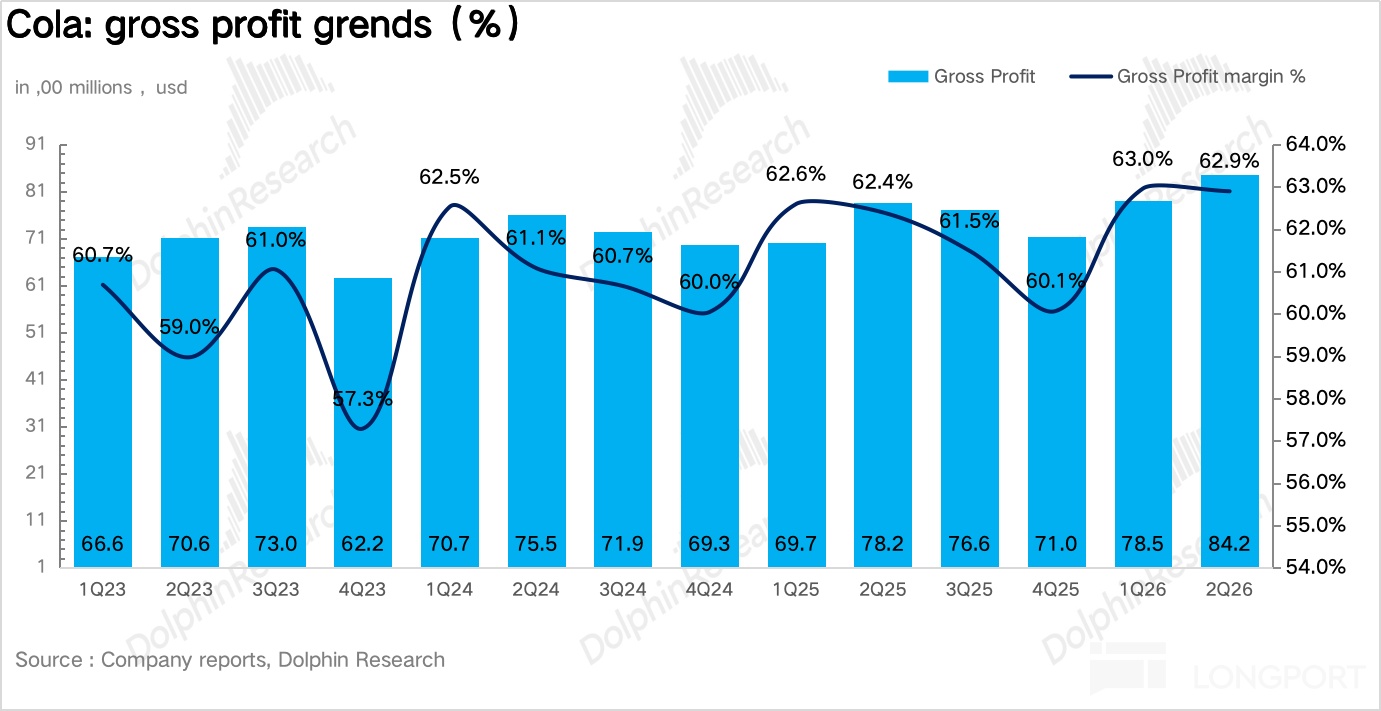
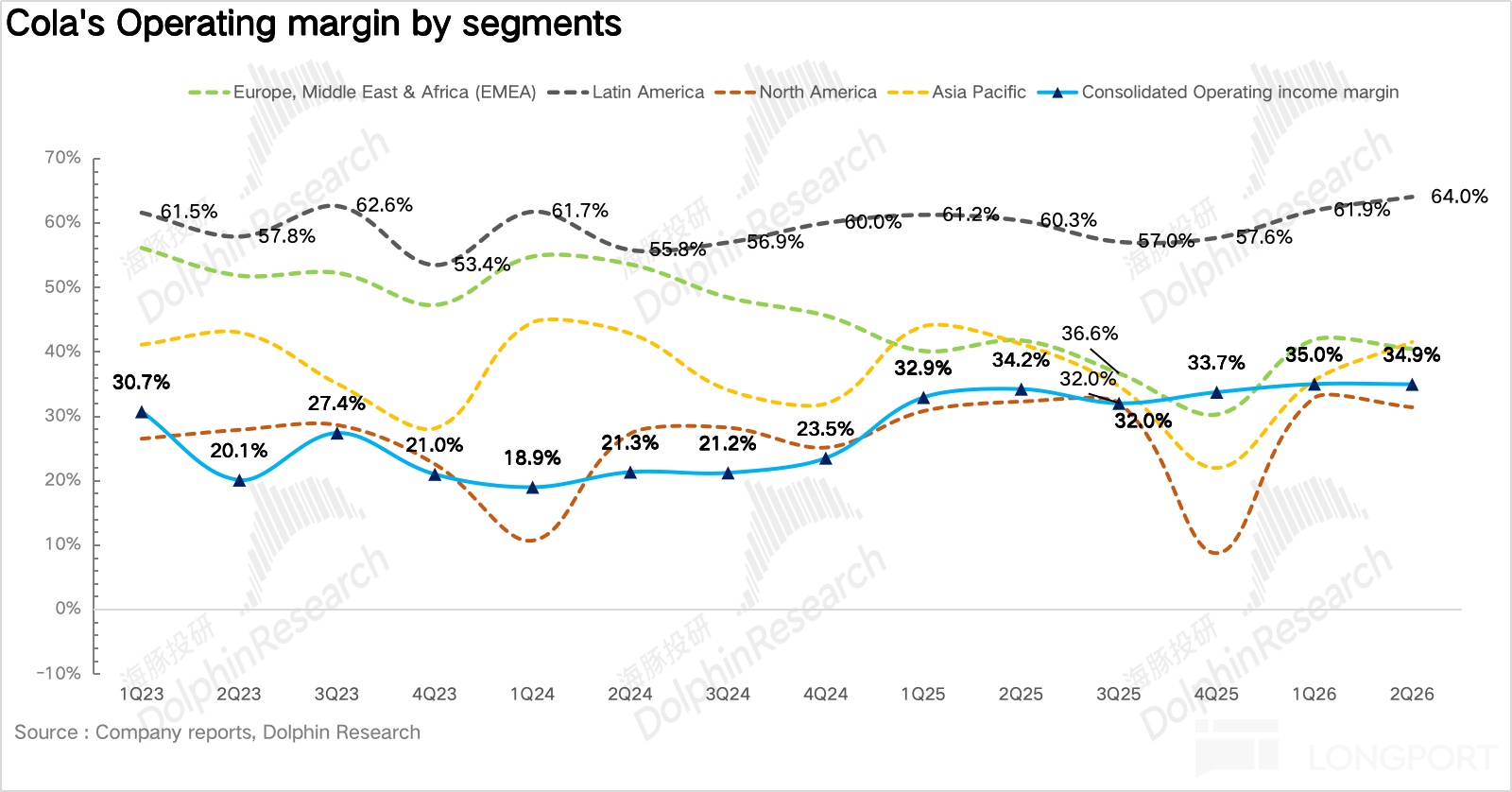
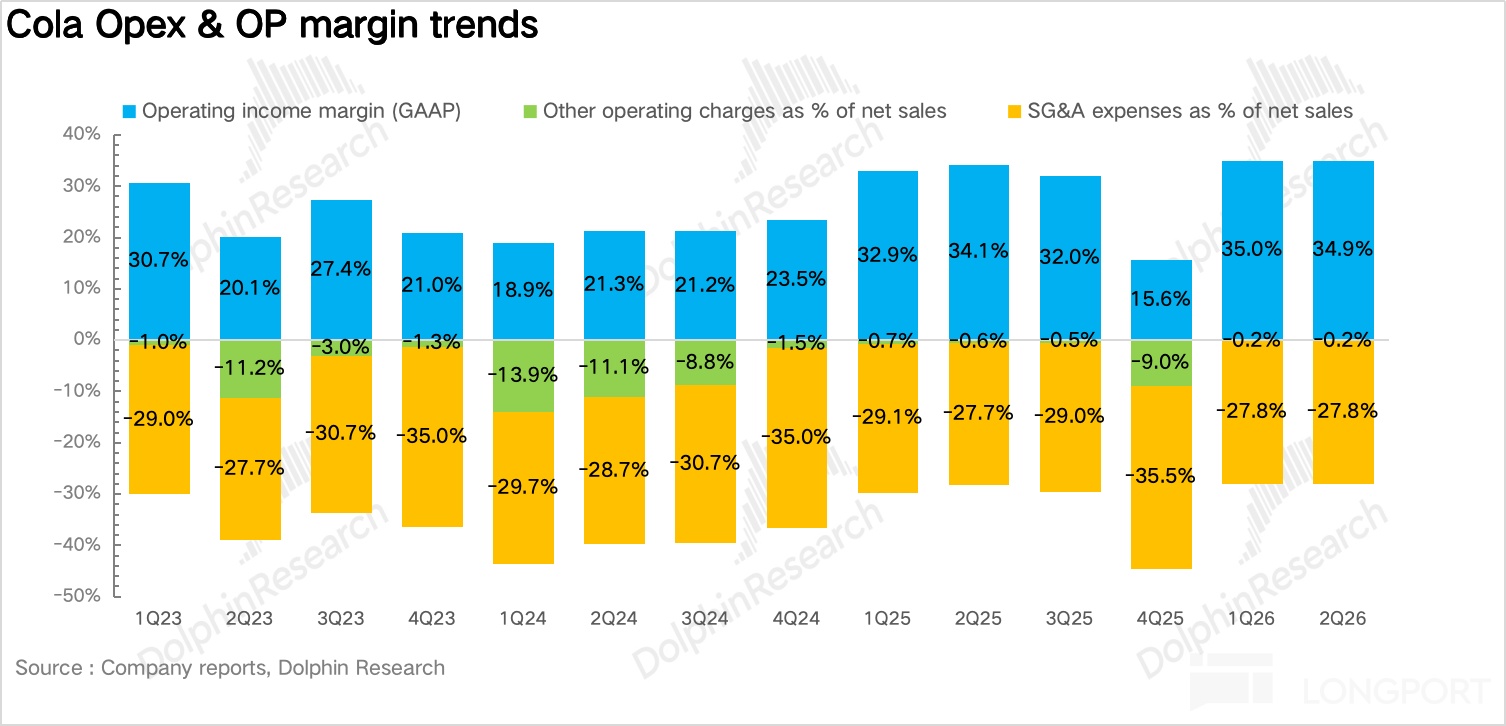
4) Mix upgrade expanded profitability. On GPM, continued scale-up of higher-margin, better-for-you offerings such as Zero Sugar, fairlife ultrafiltered milk, and premium sparkling water expanded GPM by 50bps YoY to 62.9%. On opex, with Q2 the execution period of World Cup activation, front-loaded marketing lifted S&M and G&A ratio by 12bps to 27.8%. Comparable OP margin ultimately rose 86bps to 35.6%.
5) Second in-year guidance raise: organic revenue growth lifted from 4%–5% to ~5%, comparable EPS growth from 8%–9% to 9%–10%.
6) Financial summary
Dolphin Research view:
Purely on results, 7% revenue growth and 11% EPS growth, plus an across-the-board guidance hike, is a standout print for a mature staples giant. Beyond the nice numbers, two signals in this report matter for whether KO’s current valuation holds.
The first is the Jul 16 cyberattack that forced fairlife (KO’s premium ultrafiltered milk line) to halt production in North America (most capacity now back online). Per Morgan Stanley’s checks, fairlife accounts for 10.6% of KO’s U.S. tracked-channel retail sales and is among the fastest growers (retail sales +13% over the last 13 weeks vs. +5.6% for the company overall).
Assuming 75% tracked-channel coverage, fairlife’s annualized revenue is approx. $3.5bn, or ~7% of company revenue. On P&L impact, because fairlife runs a finished-goods model (higher revenue per unit but lower unit margin, EBIT margin ~15%) rather than concentrates, a simple three-week production halt on a $3.5bn revenue base implies only ~90bps drag to Q3 profit, which we see as modest.
That said, management in late Jun flagged the next-decade innovation pillars as protein, hydration, fiber, healthy aging, and GLP-1 adjacencies. fairlife and Core Power sit at the core of this strategy, so a forced stop just as capacity ramps primarily dents sentiment rather than fundamentals.
On AI’s contribution mentioned in the release:
Management reiterated that KO’s digital and AI deployment is not about classic cost-out, but about radically sharpening decision granularity; cost efficiency is a by-product. Specifically, AI is redefining pricing, moving away from the blunt, inflation-era 'across-the-board, simultaneous hikes', and leveraging proprietary ZIP-code-level preference data plus vast bottler POS data to enable dynamic, localized price/mix and portfolio allocation.
This also addresses a core market puzzle: with low-income consumers still under pressure and value-seeking on the rise globally, KO has leaned into affordability via mini cans, entry multipacks and smaller SKUs to defend traffic and share, yet avoided a typical price war. It continues to harvest structural premium and preserve margin resilience.
Valuation-wise, on 9% profit growth guidance (net income ~$14.3bn), shares trade at ~26x, a touch above the 10-yr mid (~25x) — not cheap. But with CCBA divestiture expected to further lift mid-term margins, KO retains scarce defensive appeal in a macro-uncertain backdrop and remains a core defensive consumption asset with allocation value.
I. Investment framework
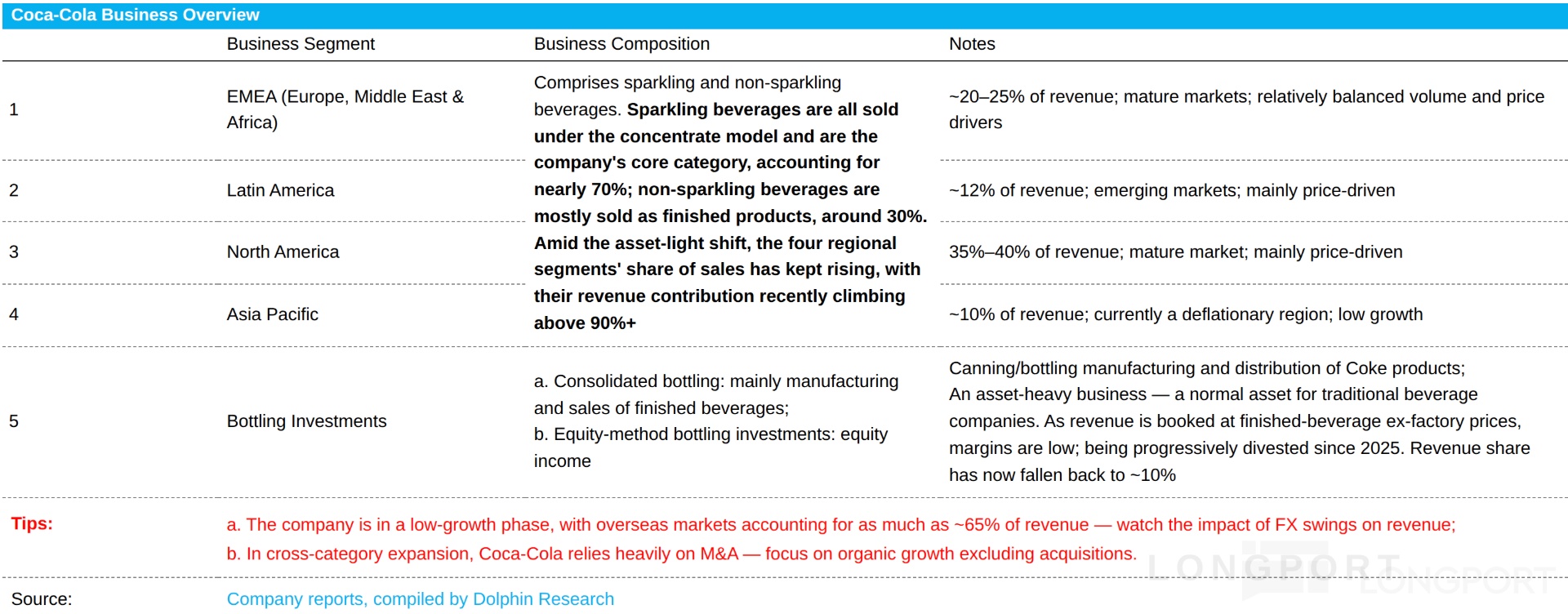
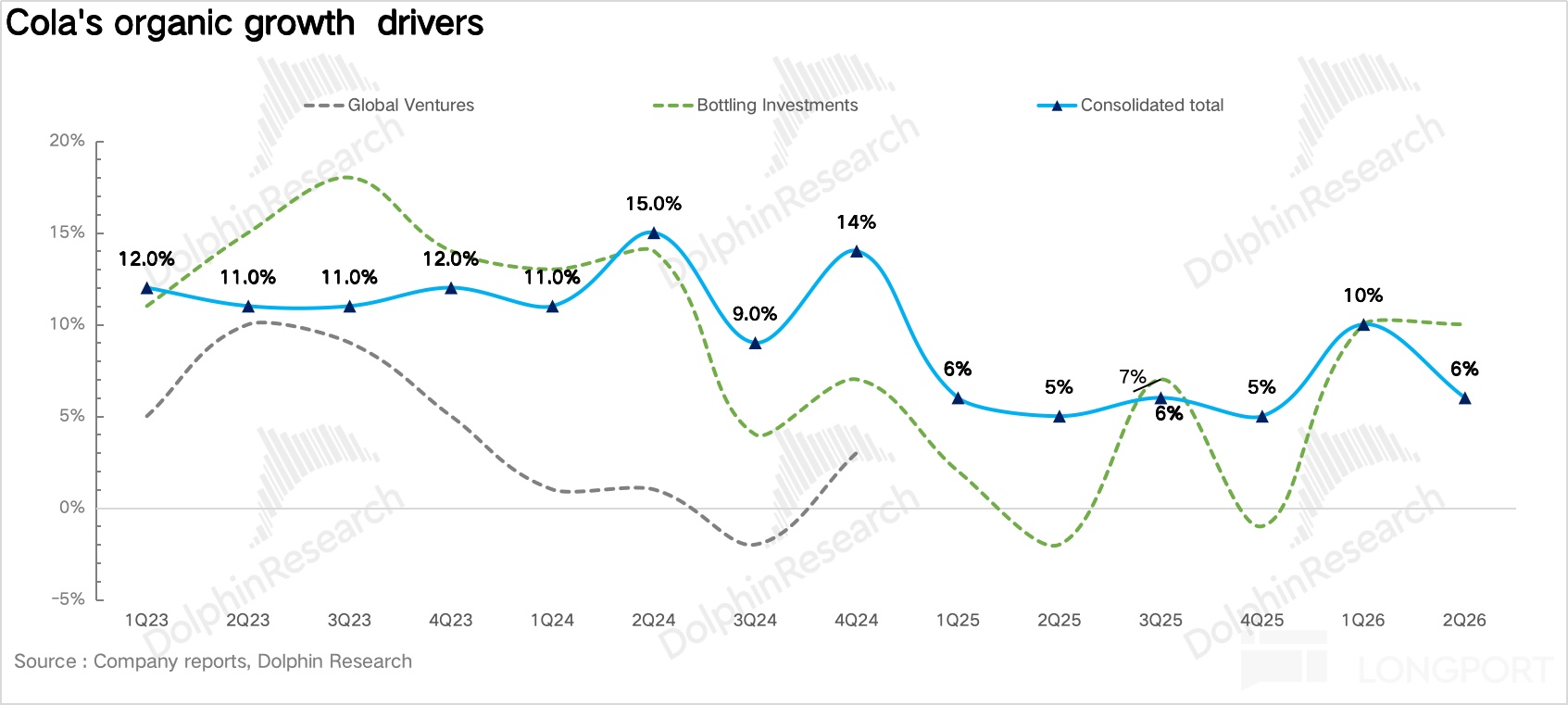
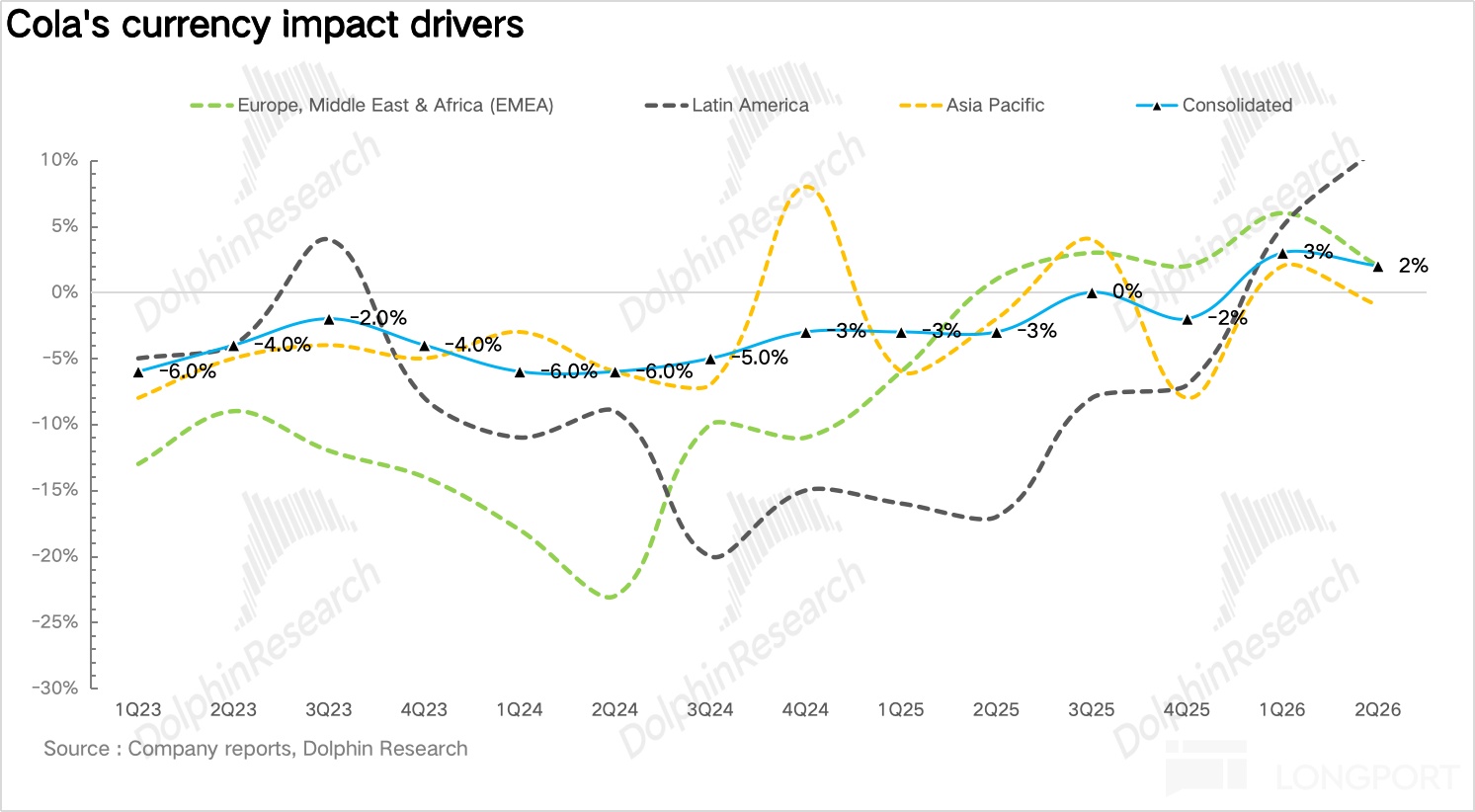
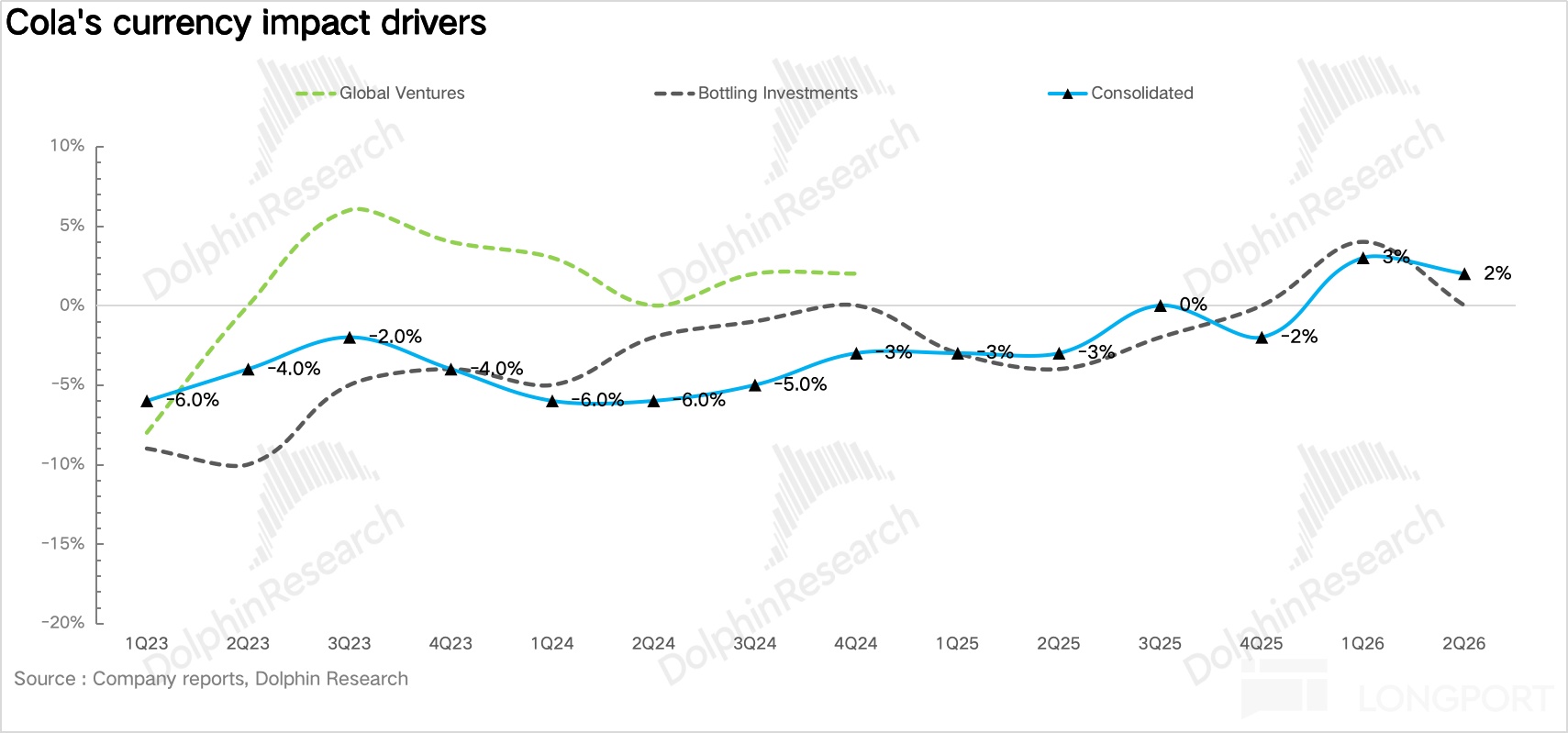
Per company disclosure, reported revenue growth is broken down across EMEA, Latin America, North America, Asia Pacific, and Bottling Investments. Each segment’s revenue growth further splits into organic growth, structural impacts (M&A), and FX.
(1) EMEA, LatAm, North America, and Asia Pac are geographic segments. They include both CSDs and NCBs; CSDs are largely concentrate-based and account for ~70%, while many NCBs are sold as finished goods (~30%).
(2) The Global Ventures unit was created in 2019 to acquire and scale promising brands globally. Since 2015, though, it has not reported separately; acquired brands such as Costa (coffee), Innocent (juice), and Dogadan (tea) are consolidated within their respective regional segments.
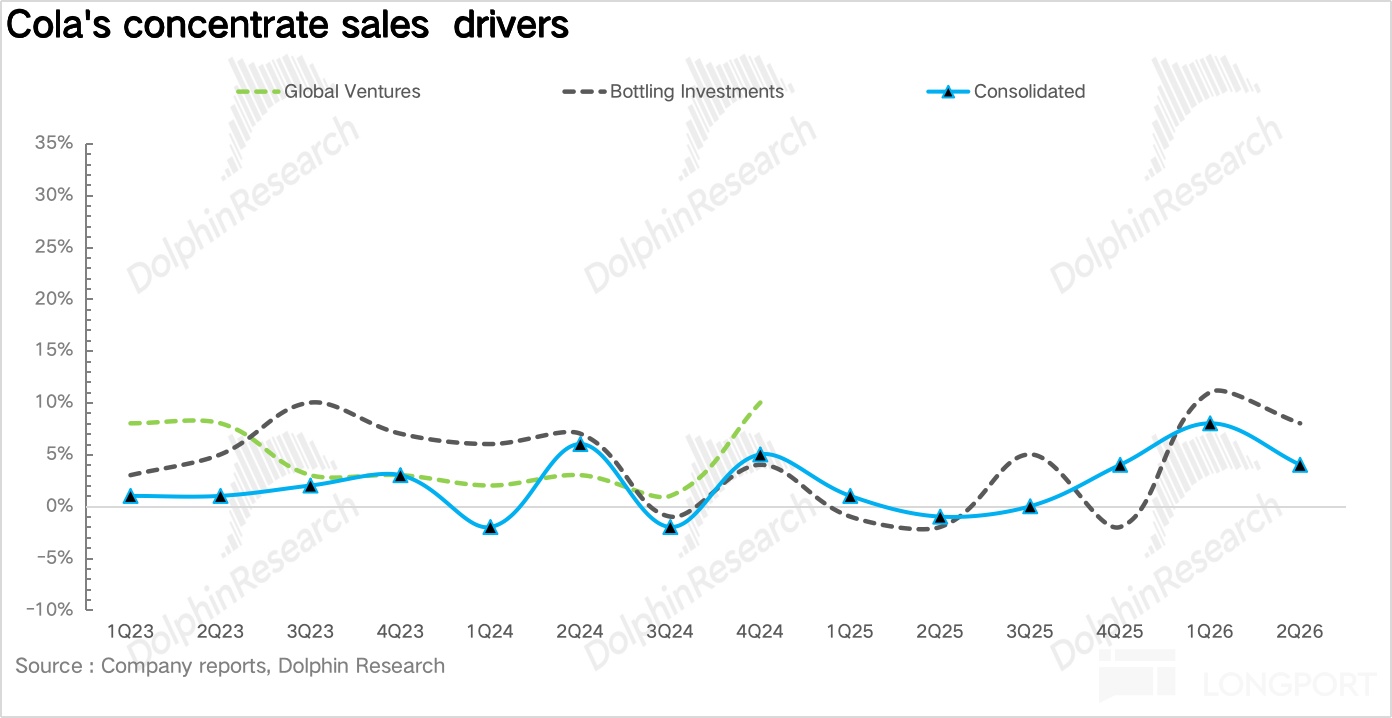
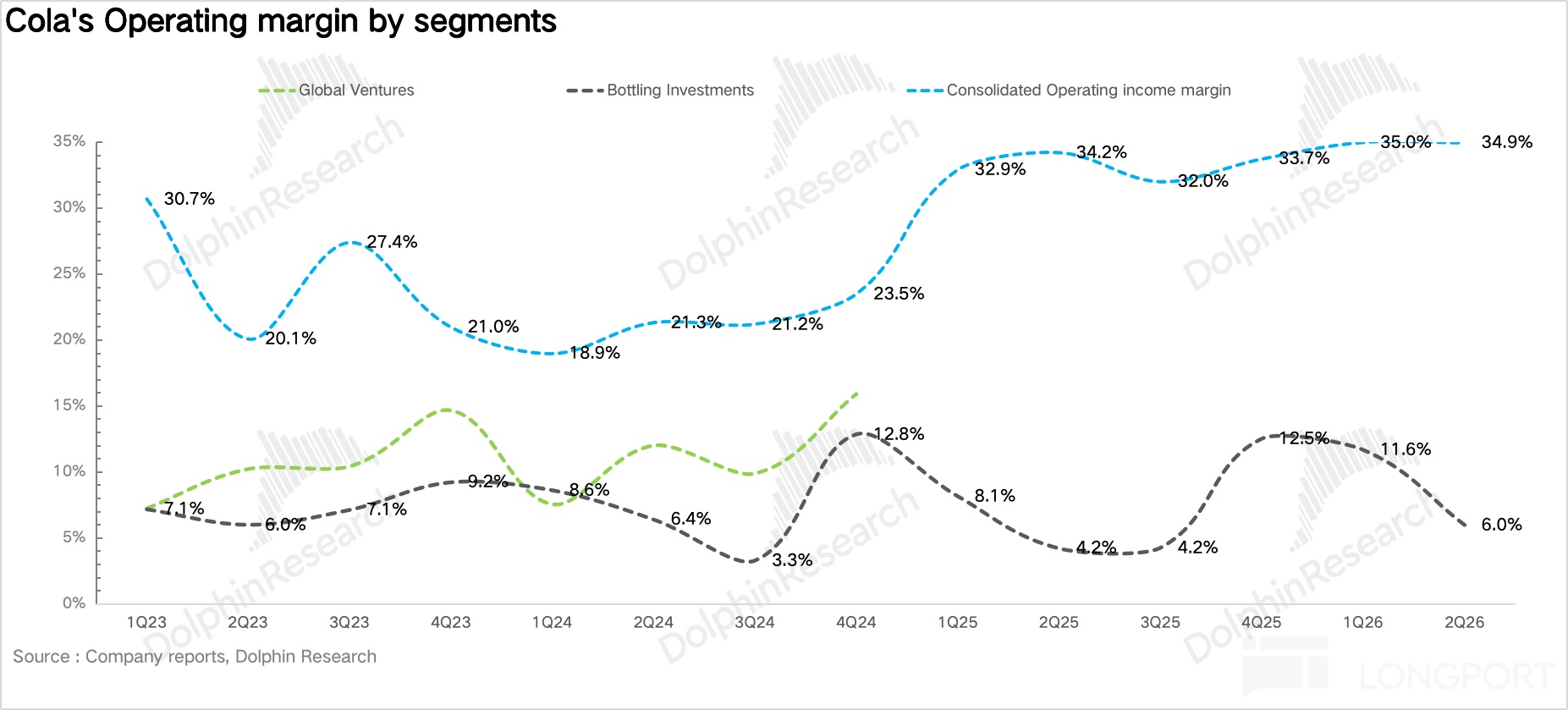
(3) Bottling Investments consists of KO-controlled bottlers worldwide, with most revenue from manufacturing and selling finished beverages. Given its asset intensity and lower profitability, KO has been divesting this segment since 2015.
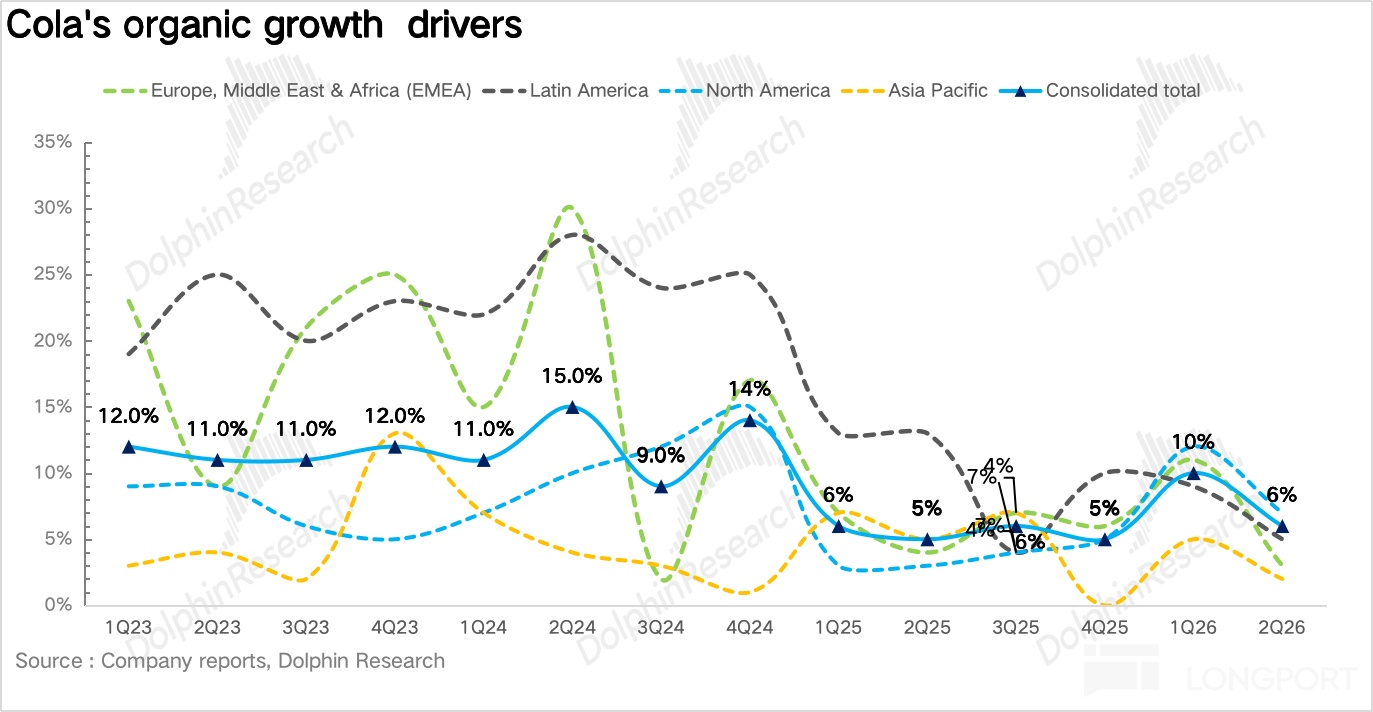
Below we focus on KO’s organic growth, decomposing into concentrate volume and price/mix drivers:
II. Broad-based beats vs. expectations
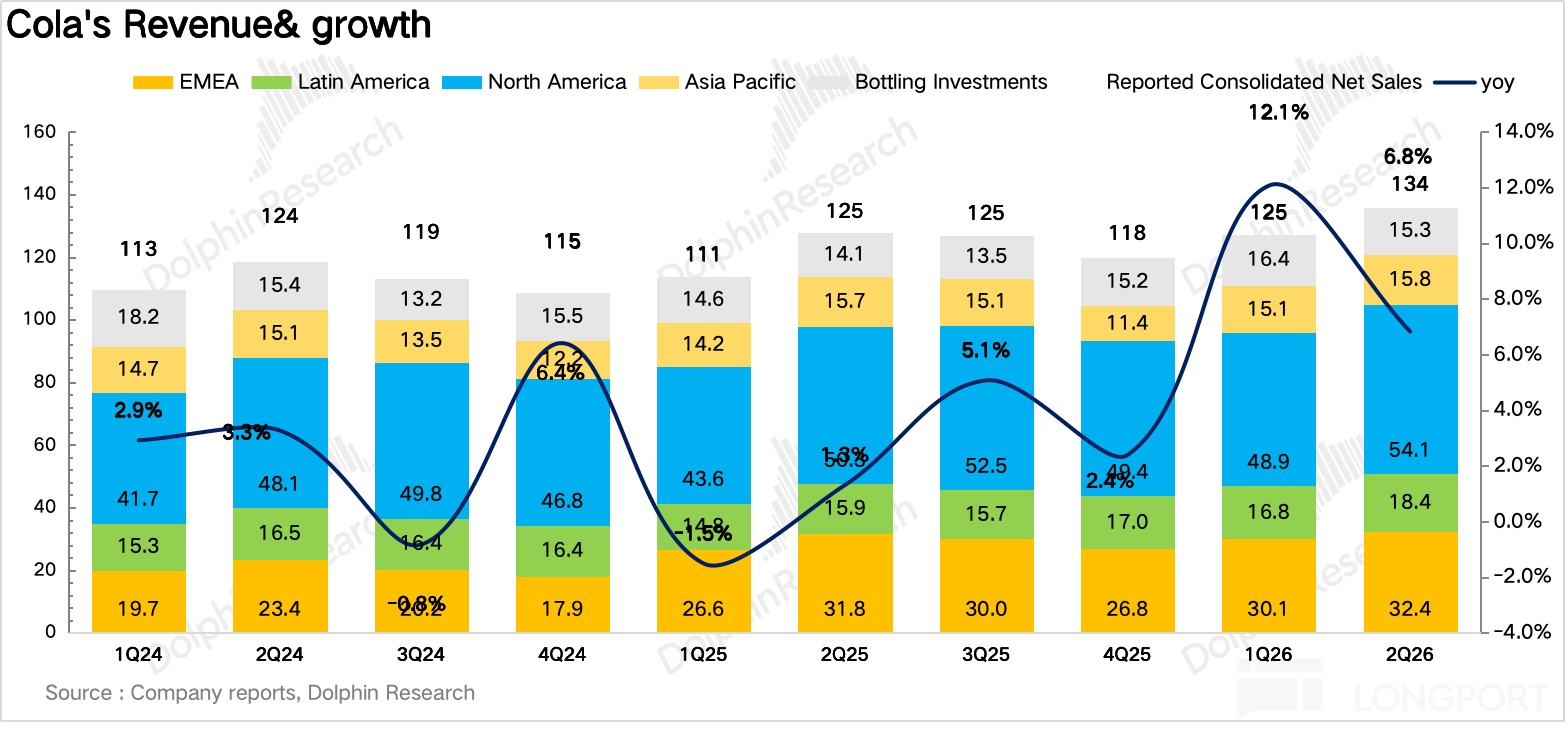
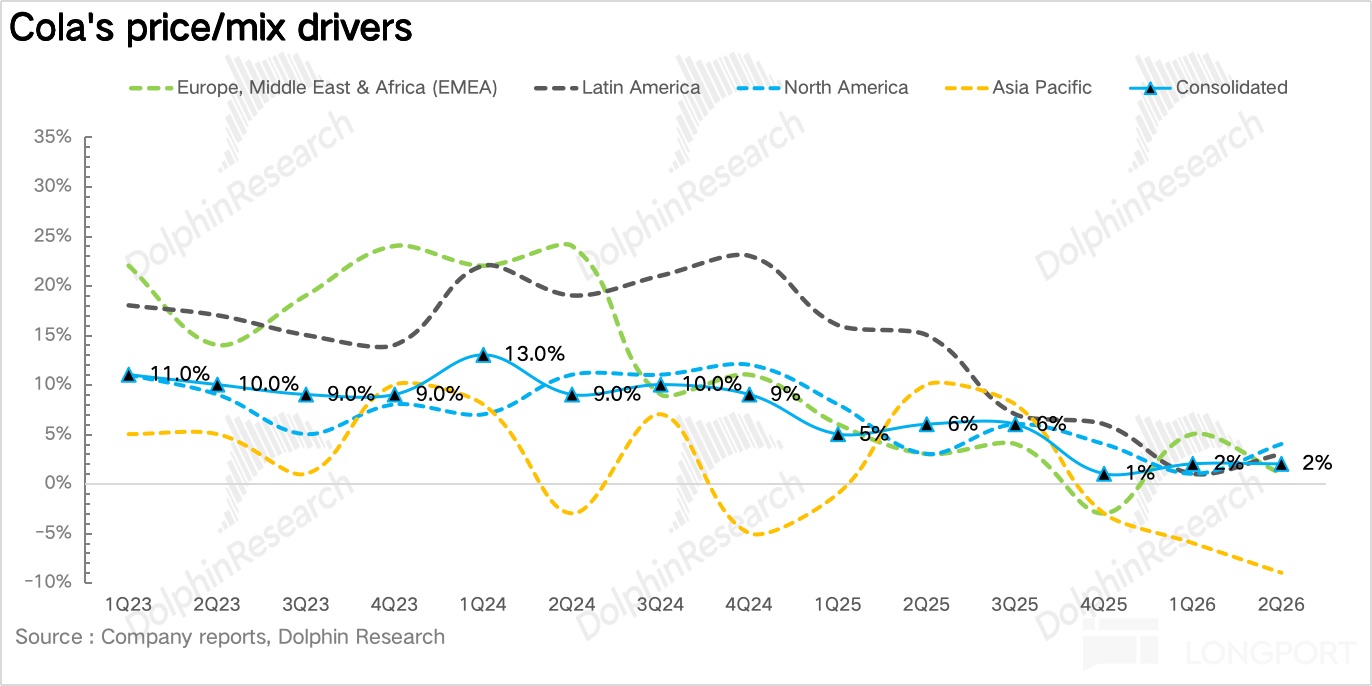
Q2 2026 reported revenue was $13.38bn (+7% YoY), with organic revenue +6%, well above cons. (3.6%). This quarter was clearly 'volume-led' vs. 'price-led': concentrates contributed +4ppt, price/mix +2ppt, the reverse of Q2 2025 when price was +6ppt and volume -1%. This aligns with management’s longer-term aim to move beyond the post-Covid price-led phase and return to a balanced 4%–6% algorithm, with volume and price/mix contributing roughly half each.
By region:
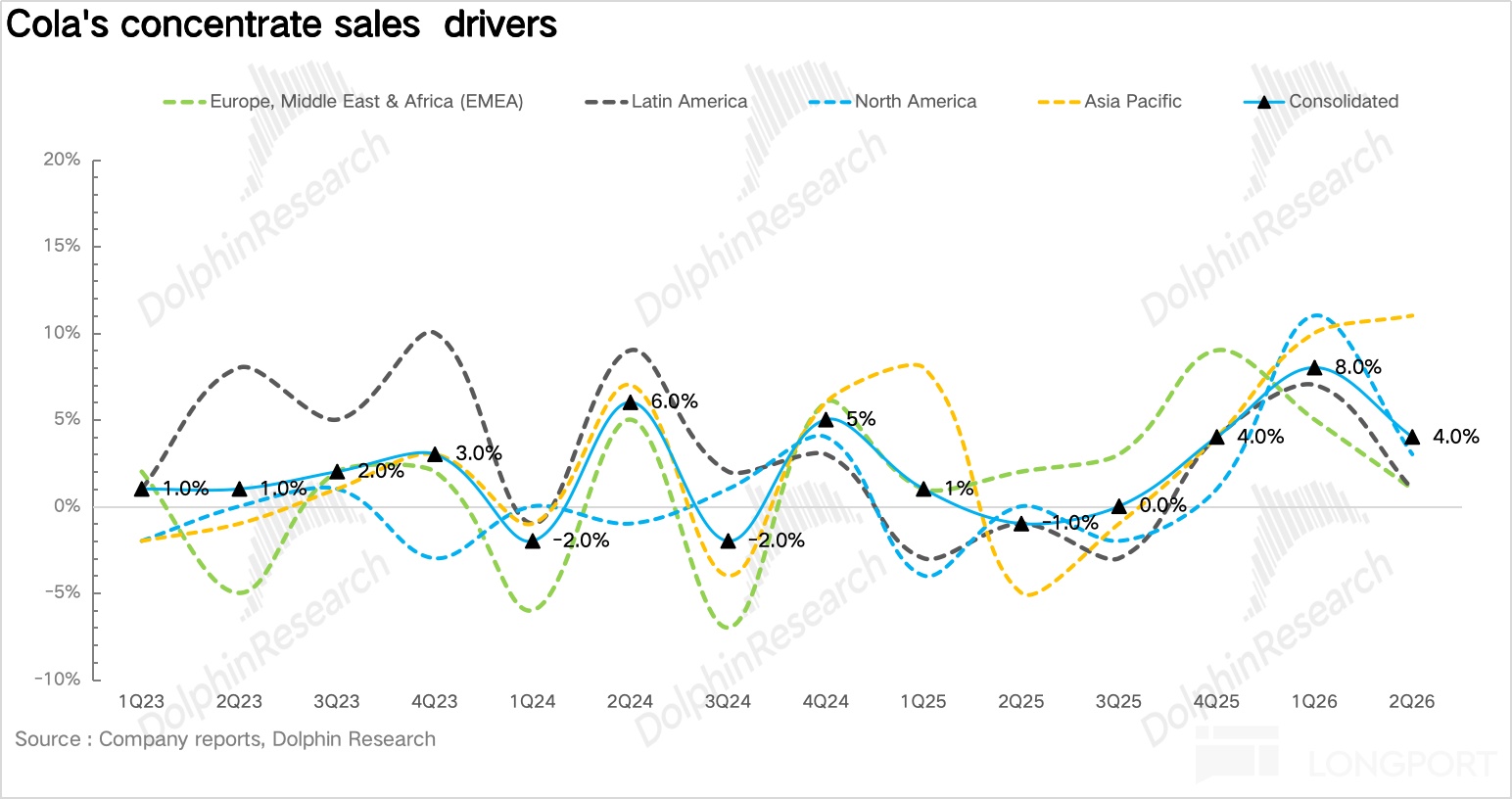
North America: Revenue $5.41bn (+7% YoY). The only region to deliver both volume and price/mix growth with concentrate shipments fully in sync with unit cases (concentrates +3%, unit cases +3%, price/mix +4%). Price/mix rebounded to +4% from +1% in Q1 2026 as Easter timing headwinds faded and prior packaging water mix headwinds eased. On volume, World Cup-themed collectible card promotions spurred high-frequency convenience purchases.
EMEA: Revenue $3.24bn (+2% YoY), organic +3%, the weakest region this quarter and the only segment with declining profits (World Cup marketing spend concentrated here). Intra-region divergence was notable. Europe led growth: early-summer weather in Nordics boosted HoReCa traffic and high-margin SKUs, and Coca-Cola Zero Zero (zero sugar, zero calories, zero caffeine) relaunched to capture late-evening, caffeine-avoidant adult demand, unlocking dinner/night occasions. The Middle East was weighed by geopolitical disruptions, pressuring sentiment and sell-through.
Latin America: Revenue $1.84bn (+16% YoY). As Northern LatAm (Mexico, Central America, Caribbean) entered hot season, and World Cup marketing lifted viewing occasions, immediate consumption for cold drinks and packaged water improved. Top bottler Arca Continental used digital tools to optimize routes and deploy connected coolers, widening distribution coverage, especially in informal retail.
On pricing, IEPS beverage tax continues to raise price sensitivity, shifting demand toward value SKUs and restraining premiumization. That capped price/mix at +3% this quarter vs. +15% in Q2 2025.
Asia Pacific: Revenue $1.58bn (+1% YoY). Unit cases rose 8% YoY, the best globally, while price/mix fell 9%, the weakest. Management is prioritizing volume-for-value in price-sensitive emerging markets by pushing affordable small packs to defend traffic in lower-tier channels, which mechanically pressures mix.
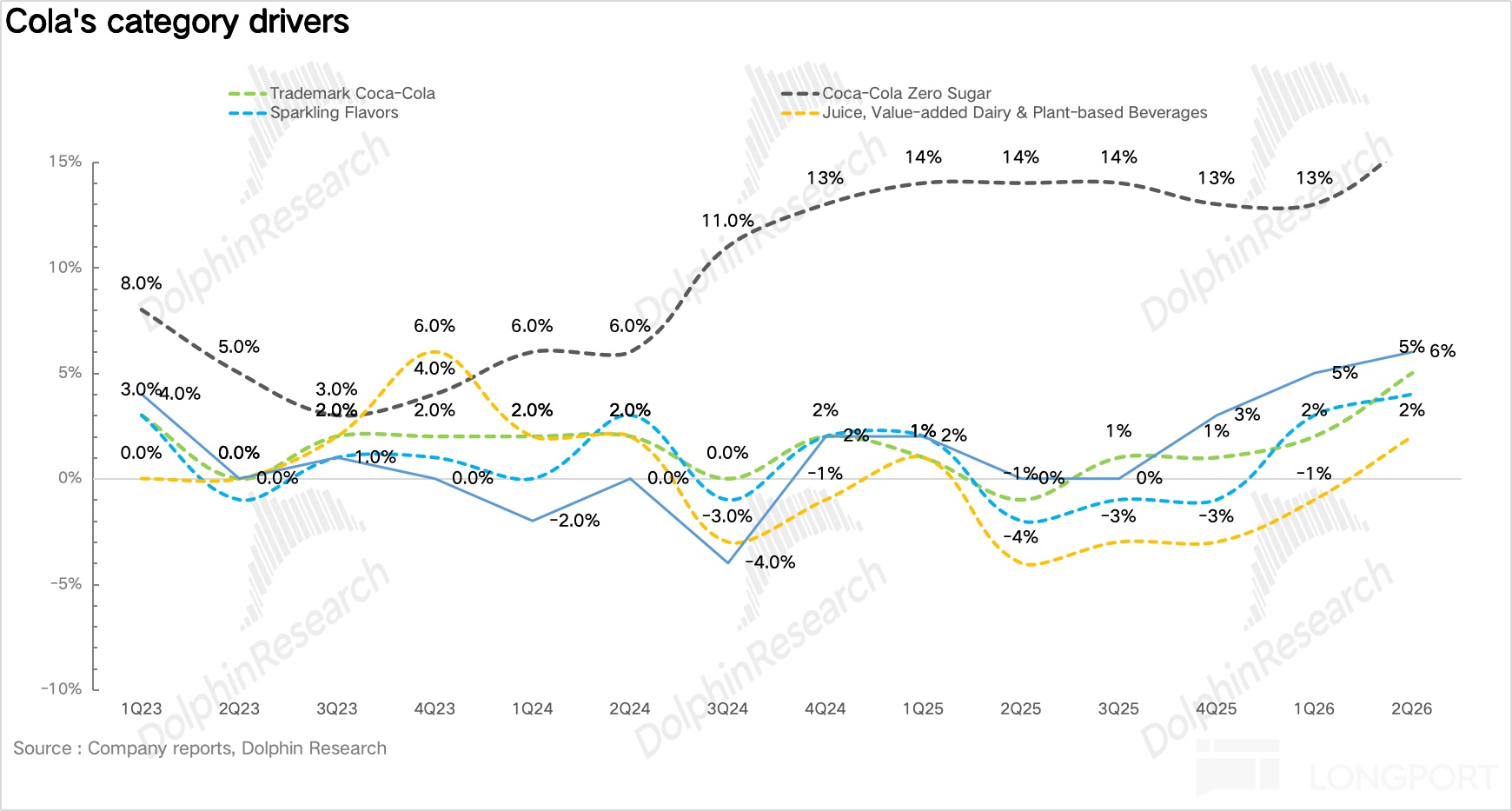
II. Zero Sugar at a new high; juice and value-added dairy turned positive
Volume: Q2 2026 concentrates +4% YoY; global unit cases +5% YoY, a 100bp gap (shipment timing), better than the prior guide of ~200bps lag. Health- and function-led categories remain the core engine.
CSDs +4%, broad acceleration. Coke Zero Sugar +16%, a new multi-year high (vs. +13% in Q1 2026), with growth across all regions, making it the most dependable engine. Cherry-flavor matrix (Diet Cherry Coke, Zero Sugar Cherry Float, Mr Pibb Cherry) continues to anchor flavor sub-segments, and World Cup limited-edition packs activated viewing and gathering occasions, offsetting the long-run pressure on sugared CSDs.
Juice, value-added dairy and plant-based moved from -1% in Q1 2026 to +2%, led by Asia Pac and North America. fairlife remains the strongest growth SKU in the portfolio, now ~5% of KO global sales and 10.6% of U.S. tracked retail; it has shifted from a health supplement drink to KO’s North America growth core, while plant-based saw muted traction amid fewer blockbuster launches.
Water +6% YoY (vs. +5% in Q1 2026), driven by Asia Pac, EMEA and LatAm. The split remains stark: value still water brands like Dasani and Ice Dew face intense price competition with weaker profitability, limiting price/mix upside; premium sparkling and functional waters such as smartwater and Topo Chico performed better via channel upgrades and flavor innovation, but Topo Chico’s core PET capacity constraints likely persist into Q3, capping North America mix.
Sports drinks +5% YoY, accelerating QoQ. Momentum from March Madness BODYARMOR campaigns carried into Q2, and summer outdoor, fitness and sports occasions clustered to bolster demand. The company also launched BODYARMOR FIT (carbonated, zero sugar, electrolytes, caffeine, with metabolic support) to extend further into functionality.
RTD tea +6% YoY (vs. +8% in Q1 2026), slightly slower QoQ. We infer share pressure from strong local tea brands in some mature markets. RTD coffee -2%, the only declining category this quarter.
Price/mix: up 2% overall. On the positive side, premium skus like Coke Zero Sugar, BODYARMOR, Powerade and smartwater keep driving mix; Coca-Cola 00’s launch in Europe unlocked high-margin night occasions, and World Cup packs lifted premium CSD formats. At the same time, KO is building layered price ladders using mini cans, small singles, and lightweight recyclable packaging to refine price bands. Entry SKUs defend traffic in lower-tier markets, while larger or specialty packs in mature markets lift value per case.
Net-net, future price upside should come from RGM-led structural mix, not broad-based price hikes — the core reason AI’s value skews to price/mix rather than cost.
III. Operating leverage lifted profitability
On GPM, ongoing mix shift toward higher-margin, health-oriented categories such as Zero Sugar, fairlife, and premium sparkling water expanded GPM by 50bps to 63%. Even as management acknowledged rising input costs, mix improvements more than offset cost pressure.
On opex, World Cup execution brought forward marketing, nudging S&M and G&A ratio up 12bps to 27.8%. Comparable OP margin rose 86bps to 35.6%.
<End of text>
Dolphin Research past work on KO:
Earnings season
Feb 12, 2025 earnings take: KO: Buffett was right all along; the 'guilty-pleasure soda' keeps winning
Apr 29, 2025 earnings take: KO: The tougher the tariffs, the pricier the 'guilty-pleasure soda'?
Jul 22, 2025 earnings take: Is the 'guilty-pleasure soda' still the safest harbor?
Feb 10, 2026 earnings take: KO: Betting on AI — playing the long game with 'guilty-pleasure soda'?
Deep dives
KO: Why is the 'guilty-pleasure soda' a favorite of the Oracle?
KO: Past its prime? Still delivering 'steady happiness'
Risk disclosure and disclaimer: Dolphin Research disclaimer and general disclosures
