


The scale of AI investment continues to expand, raising concerns as NVIDIA's credit default swaps hit the largest single-day increase in history
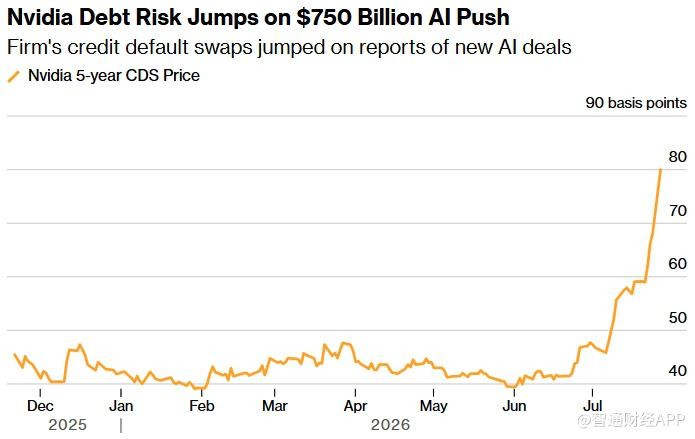
NVIDIA's discussions regarding a cooperation project for AI infrastructure exceeding $750 billion have raised investors' concerns about its financial commitments and the risk of debt default. On Monday, its five-year credit default swap (CDS) price saw the largest single-day increase in history, reflecting the market's rising demand for compensation for potential financial risks
According to Zhitong Finance APP, after the market reported that NVIDIA (NVDA.US) is negotiating an artificial intelligence (AI) infrastructure cooperation project with a total scale of over $750 billion, concerns among investors regarding its potential financial commitments have intensified. The company's credit default swap (CDS) prices recorded the largest single-day increase on record on Monday.
Data from ICE Data Services shows that the five-year credit default swap price for NVIDIA rose by about 0.14 percentage points on Monday, reaching approximately 0.82%, marking the largest intraday increase since the contract became actively traded in November last year. This indicates a significant rise in the cost that investors are paying to hedge against the risk of NVIDIA's debt default.
As of the time of publication, NVIDIA has not responded to the related news.
It has been reported that NVIDIA is in talks with OpenAI regarding a financing arrangement, planning to guarantee up to $250 billion for a U.S. data center project to help OpenAI lease computing resources. This would become one of NVIDIA's largest customer financing collaborations in its history.
Additionally, NVIDIA announced last Friday that it is advancing an AI infrastructure plan in collaboration with the parent company of South Korean chip manufacturer SK Hynix (SKHY.US), with a total scale exceeding $500 billion.
Analysts believe that as investments in AI infrastructure continue to expand, the market is beginning to focus on the potential additional financing and guarantee obligations that NVIDIA may undertake, which is also a significant reason for the sharp rise in the company's credit default swap prices. Although the rise in CDS does not mean the market expects the company to default, it reflects that investors are demanding higher risk compensation for its potential financial risks
