AI Trading Faces "Leverage Backlash": South Korea Becomes the World's First Stress Test
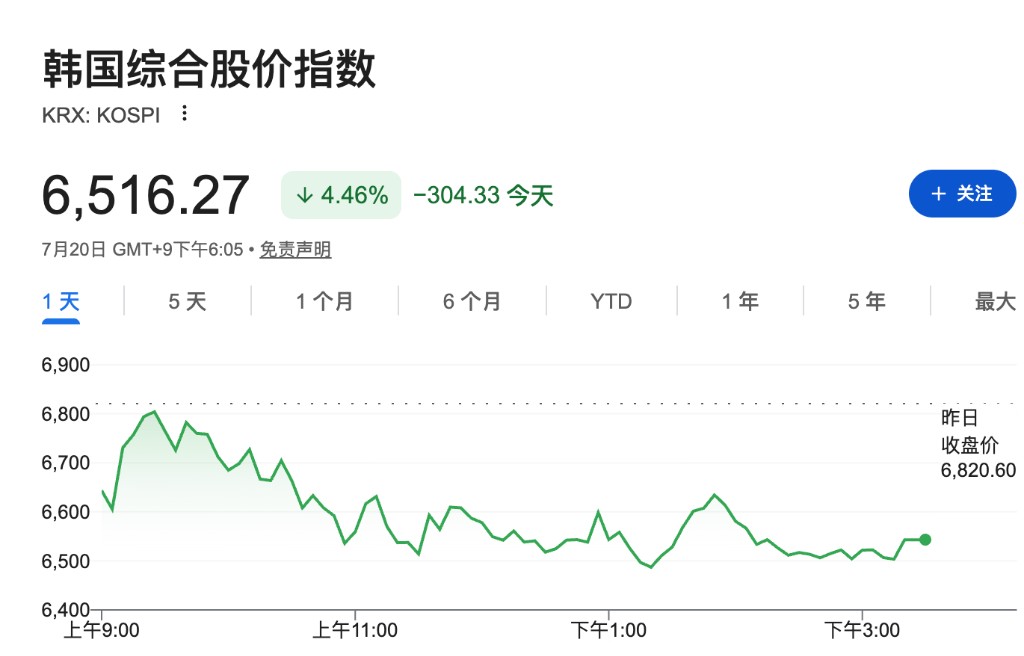
South Korea's KOSPI index plunged 4.5% on Monday, with key support levels falling one after another. Previously extreme crowded leveraged funds and option positions (the SK Hynix call/put ratio once reached as high as 27 times) are amplifying the decline in the opposite direction, while market maker hedging has triggered mechanical selling pressure. Goldman Sachs believes this adjustment is a liquidity-driven position reset rather than a reversal of AI logic, but market volatility risks remain significant until deleveraging is complete
The South Korean stock market is paying the price for the high leverage in global AI trading.
As the KOSPI rapidly corrects, the leveraged funds, option positions, and market maker hedging mechanisms that previously drove the rise in this round of AI rally are now amplifying the market's decline in the opposite direction. Goldman Sachs views this more as a liquidity-driven position reset rather than a reversal in AI investment logic, but the market still faces significant volatility risks before the mechanical selling pressure is fully released.
On Monday, the KOSPI fell another 4.5%, approaching the first important support area near the 6,250-point mark. The index has broken below the 100-day moving average but remains above the 200-day moving average. Meanwhile, the call/put option ratio for South Korea's AI leader, SK Hynix, once reached as high as 27 times, with extremely crowded long positions becoming a major amplifier of this downturn.
For global investors, the adjustment in the South Korean market is not just a regional event but a risk lesson on how crowded trades can backfire on the market. When rallies rely on leverage and derivatives, pullbacks are similarly magnified by these forces.
From Parabolic Rally to Technical Breakdown
Risk signals actually appeared long ago.
On June 23, market analysts pointed out that the KOSPI had evolved into a typical "parabolic asset." The steeper the upward slope, the stronger the reliance on new capital inflows, and historical experience shows that such rallies rarely cool down smoothly, often ending in violent adjustments.
Now, this judgment is being realized. The KOSPI has broken below the 100-day moving average, entering the critical zone between the 100-day and 200-day moving averages. Although the RSI has entered a deep oversold territory, historical experience suggests that bottoms formed by parabolic rallies often take time to digest, with oversold conditions typically lasting far longer than market expectations. The 200-day moving average, coinciding with the long-term uptrend line, remains the most important technical support at present.
Option Imbalance Triggers Chain Reaction, Mechanical Selling Pressure Continues to Release
Compared to technical patterns, the imbalance in option positions accumulated in the South Korean market deserves more attention.
During the rally, investors frantically bought call options, creating a rare pattern of "rising spot prices accompanied by rising implied volatility." This means that even as stock prices continued to hit new highs, the cost of option protection did not decrease but instead became increasingly expensive.
When implied volatility is pushed to extremely high levels, the cost of buying protective put options rises sharply. Many investors ultimately chose to abandon hedging, holding stocks with naked positions. When the market took a sharp downturn, these funds could not rely on options to buffer risk and had to sell spot holdings directly, further amplifying the decline.
Currently, the KOSPI's implied volatility still prices in daily fluctuations of nearly 6%. During the rise, volatility was pushed up by demand for call options; during the fall, it is being further driven up by panic-driven demand for puts. Regardless of whether the market rises or falls, the cost of option protection remains high, making spot selling the primary outlet for risk release.
Goldman Sachs' previous calculations showed that highly concentrated derivative trading in the South Korean market has made market maker rebalancing a significant force influencing stock prices. Models indicate that every 5% fluctuation in the underlying index triggers approximately $4.7 billion in market maker rebalancing transactions, equivalent to about 13% of the South Korean stock market's average daily trading volume.
For heavyweight stocks like SK Hynix and Samsung Electronics, this impact is even more pronounced. Goldman Sachs estimates that the scale of market maker rebalancing for both companies could exceed 20% of their respective average daily trading volumes. The mechanical capital flows that drove the rise will similarly push the market down in the opposite direction when the trend reverses.
JPMorgan Chase also previously pointed out that option positions in South Korea's core AI assets have reached extreme levels, with SK Hynix's call/put ratio once hitting 27 times. Such one-sided position structures continuously reinforced the rise during the uptrend, but once the direction reverses, they quickly become accelerators for deleveraging.
SK Hynix Becomes Microcosm of AI Trading, Goldman Sachs Still Views It as Position Reset
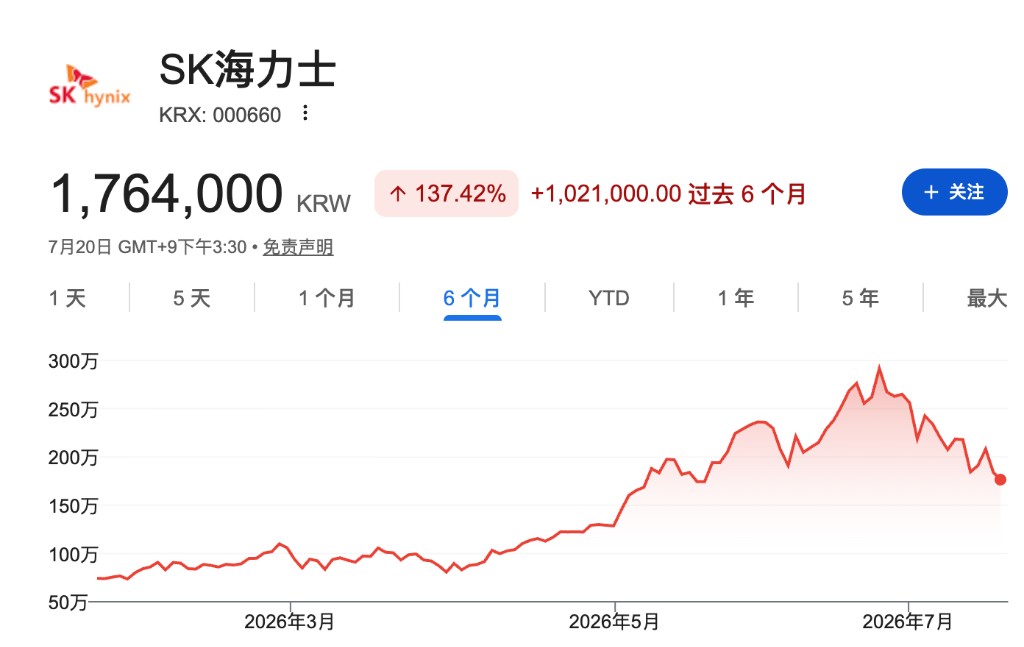
As the most representative underlying asset for Asian AI trading, SK Hynix has currently fallen to its lowest level since mid-May, although its stock price remains above the 100-day and 200-day moving averages, meaning its long-term technical structure has not been completely damaged.
Its RSI has dropped to the lowest level since late March, and after a similar oversold condition occurred previously, the stock price subsequently experienced a rapid rally. However, market participants warn that oversold conditions only mean a concentrated release of short-term selling pressure and do not necessarily indicate that the market has bottomed out.
The impact on retail investors is even more apparent. During the hottest period of the AI rally, large amounts of capital flooded into the 2x Long SK Hynix ETF. Now, this product has fallen back to its late April levels. For investors who bought at high levels less than a month ago, the fund would need to rise by approximately 250% to recover their losses, highlighting again the compounding erosion of leveraged ETFs amid severe volatility.
However, Goldman Sachs does not view this adjustment as a structural turning point in the AI investment cycle, but rather defines it as a liquidity-driven position reset. The bank believes that long-term fundamental logic, such as capital expenditure on data centers, has not changed, but short-term market pricing is more dominated by changes in leverage, liquidity, and derivative positions.
The South Korean market provides a representative case: when a market becomes the most concentrated leveraged expression of global AI trading, the reversal of the trend often does not unfold linearly. Instead, under the combined influence of leverage, options, and market maker hedging mechanisms, deleveraging is completed at a speed and magnitude far exceeding expectations. For global investors still holding crowded AI positions, this adjustment in the South Korean market may serve as a leading indicator for observing risk appetite in global AI trading.