


Sandisk Plunges Over 12% to Lead Decline, SK Hynix Drops 8%: US Memory Sector Faces Broad Sell-Off at Open
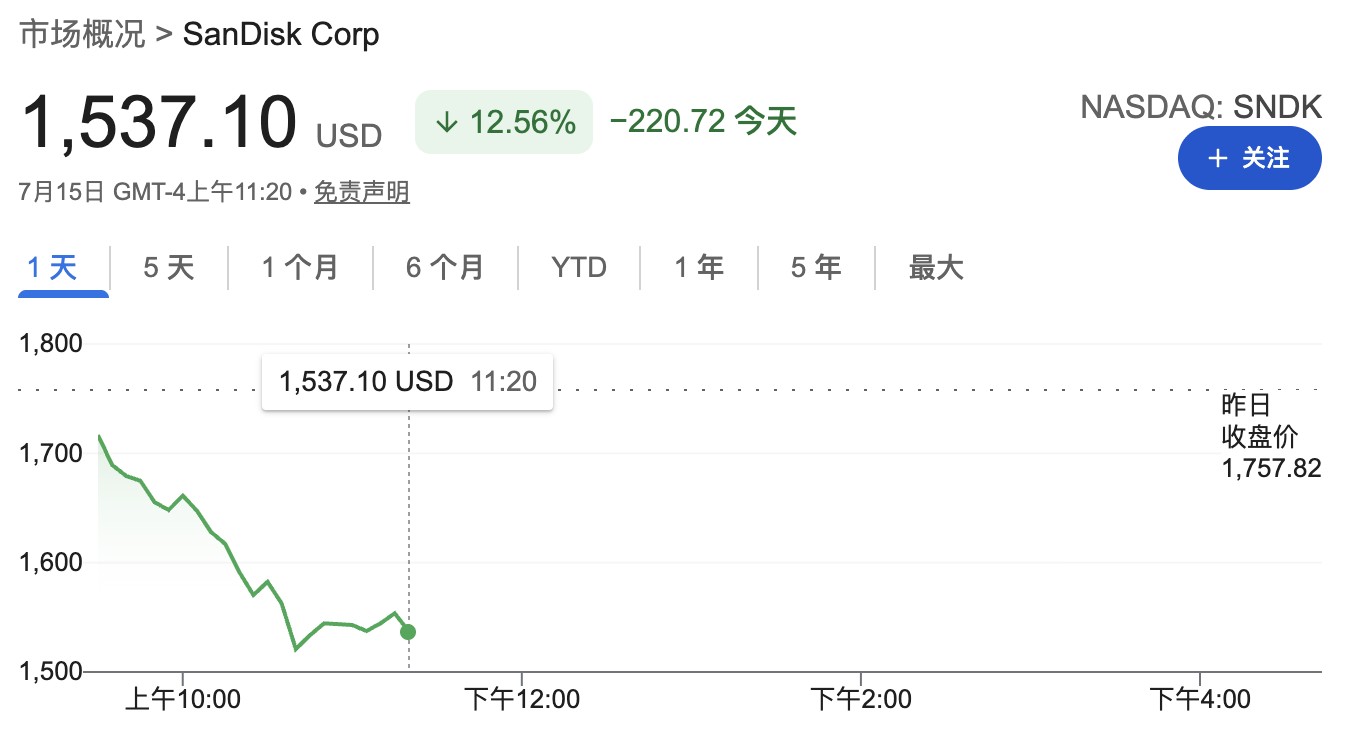
The US memory chip sector faced a broad sell-off at the open, covering segments such as DRAM, NAND, and HBM. Sandisk led the decline with a drop of over 12%, while SK Hynix fell sharply by 8%. Western Digital, Seagate, and Micron also saw significant declines. This indiscriminate downturn has drawn market attention, requiring further verification to determine whether it stems from short-term sentiment fluctuations or signals a shift in demand
The US memory chip sector faced a collective sell-off at the open of today's trading session. None of the six major stocks across various segments, including DRAM, NAND flash, HDDs, and HBM, rose, with declines ranging from 1.5% to 10.5%.
Among them, Sandisk led the broader decline with a 12.56% drop, followed closely by SK Hynix, which fell 8.16%, making them the two hardest-hit stocks in the memory sector for the day. Western Digital dropped 7.73%, Seagate Tech fell 7.25%, Micron Tech declined 5.91%, and Kioxia ADR slipped 4.5%.
From a market perspective, this sell-off featured an indiscriminate decline across all segments. Neither Seagate, the leader in mechanical hard drives, nor Sandisk and Western Digital, core suppliers of NAND flash, nor SK Hynix, the benchmark company in the HBM (High Bandwidth Memory) field, received capital support.
As one of the most cyclical sectors in the semiconductor industry, price trends in the memory sector have historically served as important leading indicators for assessing industry prosperity. Whether this broad-based decline is due to short-term sentiment fluctuations or signals deeper changes on the demand side remains to be verified by subsequent data.
Overview of Individual Stock Declines: Sandisk and SK Hynix Hit Hardest
In terms of the distribution of declines, there was a clear divergence within the sector.
Sandisk led with a 12.56% drop, far exceeding the sector average. As a core supplier in the NAND flash field, Sandisk's stock price volatility is often highly correlated with end-user demand in consumer electronics and trends in flash memory contract prices.
SK Hynix plunged 8.16%, second only to Sandisk. As a global leader in the HBM market, SK Hynix's stock performance is typically viewed as a barometer for market expectations regarding investment in AI computing infrastructure. Amid the broad-based decline on the day, SK Hynix's deep correction drew particular attention.
Western Digital and Seagate Tech fell 7.73% and 7.25%, respectively. Both are key players in traditional storage and mechanical hard drives, and their similar declines reflect synchronized pressure in this sub-sector.
Micron Tech dropped 5.91%. As a comprehensive storage giant covering both DRAM and NAND product lines, its decline, while mid-range within the sector, was still significant in absolute terms, highlighting the breadth of the sell-off.
Indiscriminate Decline Across All Segments: Breadth of the Sell-Off
Another notable feature of this decline was its comprehensive coverage.
Whether it was the high-end HBM product lines targeting AI data centers (SK Hynix), NAND flash tightly linked to consumer electronics prosperity (Sandisk, Western Digital, Kioxia), the relatively traditional mechanical hard drive business (Seagate), or diversified storage giants spanning multiple categories (Micron), none were spared.
This synchronized sell-off across sub-sectors and end markets implies that capital on the day was not pricing in risks specific to any particular niche but rather executing a broad risk-avoidance strategy for the entire memory sector.
In terms of absolute decline values, the gap between the highest drop (Sandisk -10.51%) and the lowest drop (Kioxia ADR -1.55%) was nearly 9 percentage points, indicating that even amid a broad downturn, significant differences in capital preference for individual stocks persisted.
Key Focus Areas Going Forward
This collective correction in the memory sector occurred at a delicate juncture. Previously, the memory industry experienced a demand upcycle driven by AI infrastructure investment, with continuous supply shortages in high-end product lines like HBM, leading to a significant expansion in sector valuations.
However, the intense volatility of a single trading day is insufficient in itself to judge a directional shift in the industry cycle.
Market participants will subsequently focus closely on the evolution of the following variables: the latest capacity utilization rates and inventory levels of major memory manufacturers, changes in capital expenditure guidance from downstream cloud service providers, and the pace of recovery in traditional consumer electronics and PC demand.
In the absence of further fundamental signals, the sector's sharp decline on this trading day largely reflects the release of short-term trading pressures. Whether it constitutes an early signal of a turning point in industry prosperity still requires confirmation from clearer data on both the supply and demand sides.
Risk Warning and Disclaimer
The market involves risks; investment should be approached with caution. This article does not constitute personal investment advice, nor does it take into account the specific investment objectives, financial status, or needs of individual users. Users should consider whether any opinions, views, or conclusions in this article align with their specific circumstances. Investment based on this content is at the user's own risk.
